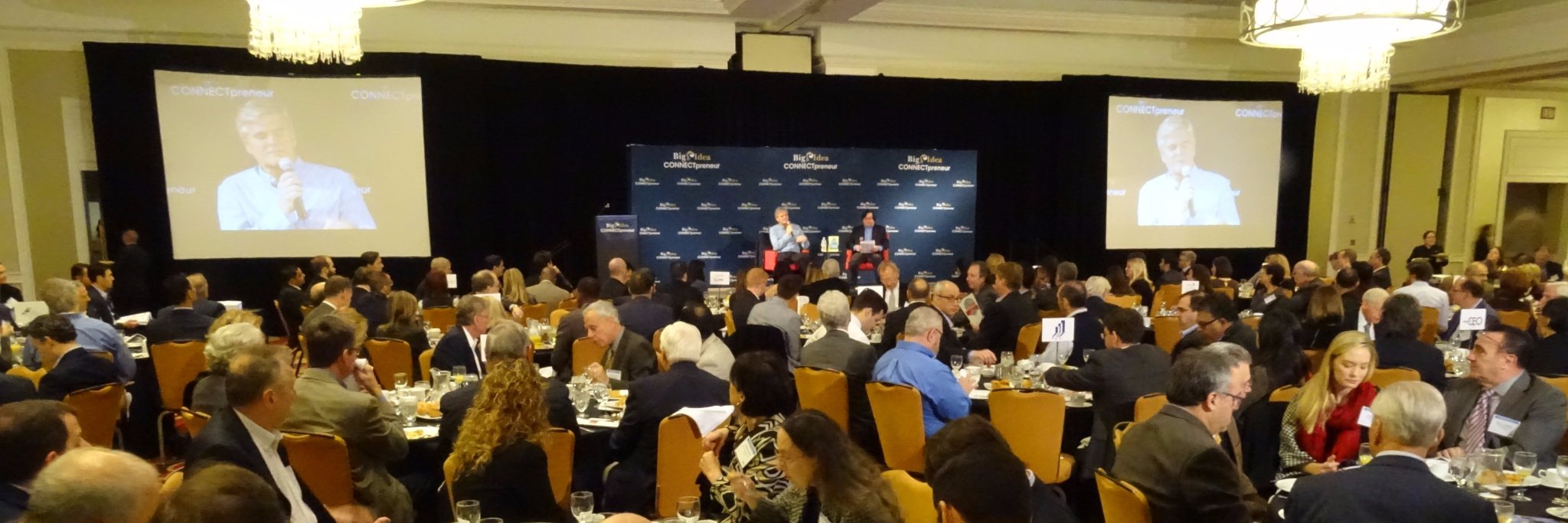
Thank you to everyone who came by our Annual Life Science Investor Reception during BIO week!
A special thank you to our volunteers, sponsors, & partners for making the evening possible.
We look forward to seeing you at future CONNECTpreneur & Opus8 events!
A big thank you to our incredible exhibitors and partners for supporting our Annual Life Science Investor Reception during BIO Week!
Last chance to register and join us!
https://t.co/XY3w5LijFW
Last call to join us at the Newport Beach Investor Conference on June 25!
If you're looking to connect with innovative companies, engage with fellow investors, & explore opportunities in some of today's fastest-growing sectors, this is your chance.
RSVP: https://t.co/7tzEb397zi
Tom Hanks shares the best advice he’s ever received
“Throw deep. If you’re gonna do it, do it”
“If you have the chance, do it. Don’t pause. If you’ve got an instinct, go at it”
Did you see "Claude Design"? TOTAL DISRUPTION… Canva and Figma are freaking out… As will ALL other verticals. The LLM companies will disrupt every specialized vertical use case in order to maximize their revenue, to build out their data centers and close their business case. Fireworks are just beginning!
Elon Musk just quantified the exact speed of human obsolescence.
For ten thousand years, one organ ran this planet. Every empire, every invention, every war traced back to the same three pounds of tissue sitting behind your eyes.
Go was the last fortress. A game so impossibly complex the world’s greatest players swore no machine would ever crack it.
Musk: “People thought defeating Go was either never or 20 years away.”
Then the silicon woke up.
Musk: “Now that same AlphaGo system can defeat the top 50 players simultaneously with 0% chance of them winning. And that’s one year later.”
Do not gloss over zero percent.
Fifty of the sharpest biological minds alive. Entire lifetimes of obsessive mastery.
Neutralized in twelve months by a system that does not know it is playing a game.
Now replace that board with financial markets. With the global economy. With the architecture of modern warfare.
Musk: “The degrees of freedom to which artificial intelligence is able to apply itself are really increasing by 10 orders of magnitude a year.”
Ten orders of magnitude is ten billion times. Every single year.
Human brains think in straight lines. We expect progress to walk.
It compounds by ten billion times every twelve months. We still think we have time.
A dog knows you are smarter than it. It cannot tell you by how much.
A chimp will never grasp calculus. Not because it is stupid. The gap itself is invisible from where it stands.
We are approaching that threshold. Once a system surpasses us, we lose the ruler. We will know something is ahead of us.
We will never be able to measure how far.
The monopoly on intelligence is over.
We did not build a tool.
We built what comes after us.
No generation before us stood here. No generation after ever will.
We are not the replaced. We are the witnesses.
The last minds who will ever see intelligence at eye level.
Derek Sivers said it right:
“Mastery is the best goal because the rich can’t buy it, the impatient can’t rush it, the privileged can’t inherit it, and nobody can steal it. You can only earn it through hard work. Mastery is the ultimate status.”
Larry Ellison:
“My standard advice to entrepreneurs is you can’t be successful as a small company doing the same thing everyone else is doing… If you’re an entrepreneur, you have to find errors in conventional wisdom.”
It took me 35 years to learn this: If you’re half-in, you’re actually all-out. Even 90% in gets you nowhere. There’s something magical in that last little bit. It's where you unlock new levels to the game. Simply because so few have the courage to do it.
If the economy grows 10x in a decade, opportunity is everywhere. But it's very unlikely that the opportunity is the same as whatever you were doing yesterday or even today.
Be nimble. Stay curious. Move fast.
Anthropic has a SINGLE growth marketer.
And he just mapped the 4 levels of AI marketing, most are still on level 1.
Level 1 is automating what you already do. Reports, copy, data pulls. Useful, but everyone has it.
Level 2 is using AI as a thinking partner where it's smarter than you. Tax questions, legal implications, second opinions on hard calls.
Level 3 is doing work that was below the ROI threshold before. Mining negative keywords across every ad group. Daily broken link checks across your full site. Competitor monitoring that runs forever.
Nobody did this work before because the manual cost was never worth it.
Level 4 is building custom tools only you would ever build. Your business has specific data, specific workflows, specific edge cases. No off-the-shelf product covers them.
Most of the AI marketing plugins floating around GitHub work in theory and break in practice because they're built for the median user.
The companies pulling ahead are building for themselves. Ramp is doing it with Glass. We're doing it with SingleBrain.
Level 1 is going to get eaten by software companies running cheap Chinese models like Qwen and Kimi.
The compounding happens at level 3 and 4, where the work is built for YOUR business and nobody else's.
Box and Dropbox were supposed to be killed by Google Drive and iCloud. They survived because they were obsessed with their customers. If you have passion and focus, you will outperform them. Every time.
.@elonmusk just crossed $800 billion — roughly 2.7% of the entire US GDP. The last person to hold that much of the American economy? John D. Rockefeller in 1913. It took a century for anyone to match him. Rockefeller had oil. Musk has the future.
AI will create more jobs than any other technology in history.
The doomers' fundamental error isn't just the lump of labor fallacy. It's deeper than that.
They assume a finite problem space.
This is the fundamental error of AI and job doomers. They look at the economy and see a fixed amount of work to be done, a pie that can only be sliced thinner as machines take bigger bites. They see humans a competitive resource for a finite amount of work and a finite amount of problems to solve that must be eliminated.
This is fundamentally, totally and completely wrong.
The pie isn't fixed. It never was. And the reason it isn't fixed is baked into the very nature of technology itself.
Technology is nothing but abstraction stacking. And abstraction stacking is infinite. Therefore the work is infinite.
The hammer didn't reduce the amount of work. It moved the work up the stack. And the new work was more complex, more varied, and more interesting than the old work.
Complexity breeds more complexity and more variety.
Once you have houses instead of mud huts, you have a cascade of new problems that didn't exist before. Plumbing. Wiring. Insulation. Roofing materials that don't rot. Drainage systems so the foundation doesn't flood. Fire codes so your neighbor's bad wiring doesn't burn down the whole block.
Each of those problems becomes a job. A plumber. An electrician. An insulator. A roofer. A civil engineer. A building inspector. None of those jobs existed when we lived in mud huts.
They exist because we solved the mud hut problem.
Think of all of human technological development as a stack of abstraction layers, each one built on top of the ones below it.
At the bottom: raw survival. Finding food. Building shelter. Making fire. These are the base-layer problems.
Each major technology wave solved a base-layer problem and in doing so created an entirely new layer of problems above it:
Agriculture solved "how do we reliably eat?" — and created problems of land ownership, irrigation, crop rotation, storage, trade, taxation, and governance.
Writing solved "how do we remember things across generations?" — and created problems of literacy, education, record-keeping, law, bureaucracy, and literature.
The printing press solved "how do we spread knowledge at scale?" — and created problems of intellectual property, censorship, journalism, publishing, public opinion, and democratic discourse.
The steam engine solved "how do we generate mechanical power without muscles?" — and created problems of factory design, worker safety, urban planning, railroad engineering, coal mining, labor relations, and environmental pollution.
Electricity solved "how do we deliver energy anywhere?" — and created problems of grid design, power generation, appliance manufacturing, electrical safety codes, utility regulation, and an entire consumer electronics industry.
The Internet solved "how do we connect all human knowledge?" — and created problems of cybersecurity, digital privacy, online commerce, content moderation, network infrastructure, cloud computing, social media dynamics, and an entire digital economy that employs tens of millions.
Notice the pattern?
Each solution didn't just solve a problem.
It created an entirely new problem space that was larger, more complex, and more varied than the one it replaced.
The stack grows. It never shrinks.
It's turtles all the way down and all the way up.
Ken Griffin on the single factor he looks for when hiring at Citadel:
"show me an athlete who did well academically."
"an athlete because they know what it takes to win and they've had to experience loss."
talent is everywhere. what's rare is someone who knows how to lose, recover, and still perform at a high level.
same thing separates profitable traders from everyone else.
Every technology that seemed too expensive for the masses eventually became too cheap to notice. Electricity. Telephony. Computing. Internet. AI is next. The pattern never breaks.