1/ Announcing Ethereum Institutional
An independent non-profit dedicated to accelerating the institutional adoption of Ethereum, its L2s, applications and overall ecosystem.
1/ Today, the Global Policy Strategy (GPS) team is publishing Ethereum Basics for Governments and Institutions, a non-technical primer to equip the leaders making policy and deployment decisions with an understanding of how Ethereum works, how it's governed, and how it compares with perceived alternatives.
We sat down for the first time with @ethereumJoseph, Founder and CEO of Consensys and Co-Founder of Ethereum, and @KeoneHD, Co-Founder and GM of Monad Foundation.
A conversation about where the future of money is headed, AI, and the new @metamask Money Account.
Timestamps:
0:00 Intro
1:46 What Joe thought the internet would do to money
7:00 Why a 16-year-old skips the bank entirely
12:52 Has crypto only helped people already doing fine?
15:47 How AI changed the way they build
19:47 Is traditional finance moving onto crypto, or is crypto redefining it?
22:47 What do TradFi institutions actually want?
26:51 What is the MetaMask Money Account?
29:43 Who is it for?
30:14 What does it take at the chain level?
31:48 Why did MetaMask chose Monad?
33:37 When will stablecoins go mainstream?
38:09 AI agents that move money on their own
43:35 The story that says it all
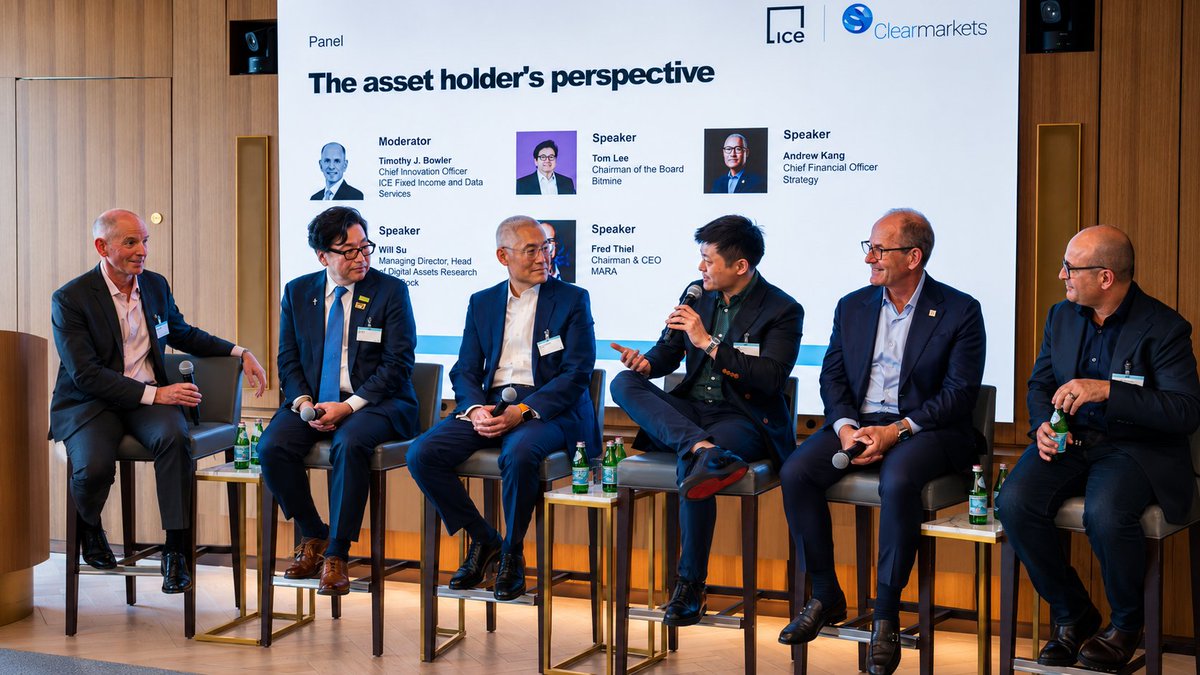
Last week at the Institutional Digital Asset Financing Summit at the @NYSE, hosted by @ICE_Markets and Clearmarkets, our CEO @joechalom joined:
- Tom Lee (@fundstrat / Chairman @BitMNR)
- Will Su (Head of Digital Assets Research @BlackRock)
- Andrew Kang (CFO @Strategy)
- Fred Thiel (@fgthiel / Chairman & CEO @MARA)
The throughline: a treasury should work in every part of the cycle. Consolidation periods are exactly when a productive balance sheet proves its value. Nearly all of our ETH is staked and generating yield, so our holdings keep compounding while the market waits.
That is the power of ETH as a productive reserve asset, not a static one.
It’s time for you to Predict the Pitch.
Up to $75,000 in mUSD is at stake. 🦊
Take positions on the tournament’s biggest markets, powered by @Polymarket - the top 20 traders by ROI will win.
Wallets are becoming money apps and every extra step in the user onboarding process is a potential drop off point for users.
In most wallets, buying crypto still means leaving the app: a pop-up, a third-party redirect, a repeated KYC check, fees you cannot see clearly.
@MetaMask's new deposit feature, powered by Transak, consolidates several touch points into one seamless onboarding process.
The deposit flow is embedded directly in the wallet, with transparent pricing and support for ACH, SEPA, cards, Apple Pay, and Google Pay. Compliance and licensing run underneath across 60+ countries, certified to SOC 2 Type II and ISO 27001.
Need an onboarding solution that can integrate natively with your app? Talk to us -> https://t.co/YCc66Z101X
*Not available to users in the UK.
Beautifully crafted piece on "Why Ethereum?" Very powerful. Some quotes:
“The original vision of consortium blockchains – the idea that you have 5 banks or major companies that come together and create their own chain – has been mostly a failure,” Vitalik Buterin explains . “It ends up inheriting most of the disadvantages of centralization and most of the disadvantages of decentralization at the same time.” The problem, as he describes it, is that the first few banks feel like equal founders, but bank number twenty is just joining something its competitors already control. You take on all the engineering cost of a distributed system and get none of the benefits of openness, composability, and credible neutrality that made blockchains worthwhile in the first place.
The single-most important blockchain property is sovereignty (Note: Another way to express "sovereignty" is: credible neutrality + censorship resistance + privacy + security). What made Bitcoin revolutionary was that it was the world’s first sovereign computer platform. Before Bitcoin, all computer platforms belonged to a person, a company, or a government, and they had to obey the will of their owners and the rules of the jurisdiction where they resided. But a sovereign only obeys its own rules, and no single entity could impose rules on Bitcoin. (Note: On Ethereum, builders and users also have far more personal sovereignty than possible on any other large public platform in the world.)
Much of Ethereum’s lead in sovereignty and credible neutrality comes from path dependence that no other blockchain can replicate. Ethereum launched with proof-of-work in 2015 and ran on it for seven years before transitioning to proof-of-stake in 2022. During that period, ownership of the network was distributed through an open 2014 crowdsale and GPU mining that was deliberately kept accessible to consumer hardware. The result was widespread token distribution with no single entity controlling a meaningful fraction of the network (an essential factor in the sovereignty of a proof-of-stake network).
According to Token Terminal’s Ethereum Q1 2026 Report, Ethereum holds 79% of active DeFi loans across the top five chains, 62% of stablecoins, 73% of tokenized funds, and 84% of tokenized commodities.
Erik Voorhees, the founder of https://t.co/q4WHRFuPw2 (the privacy-first AI inference platform with 3+ million users and tens of millions of dollars in ARR), articulated a similar rationale a few days ago "It wasn't even a question for us," Erik replies when asked why he built Venice on Coinbase's Ethereum L2 Base, "The Ethereum ecosystem is the far more authentic, resilient, and robust ecosystem of all smart contract platforms."
NEW: Five former Ethereum Foundation researchers have launched @ethlabs_org, an independent nonprofit focused on preparing $ETH for institutional adoption at scale.
Backed by @BitMNR, @Sharplink and Ethereum co-founder @ethereumJoseph.
Announcing Ethlabs: a non-profit R&D lab for Ethereum and ETH
Our mission is to make Ethereum the settlement layer of the global economy.
The internet became global because shared protocols created a common language between networks. Private systems remained useful, but bounded. Finance is approaching a similar moment. As value, assets, and markets become digital, the world needs shared settlement infrastructure.
Ethereum is uniquely positioned to become that shared base layer, the neutral foundation on which users, institutions, and agents can transact without intermediation.
What we believe:
• We believe credible neutrality matters. Ten years of uptime and the lowest counterparty risk. Ground that cannot be pulled away by any one country, institution, company, or person.
• We believe ETH matters. The most valuable, programmable store of value. A decade of broad distribution, deep liquidity in onchain markets, and maximally trustless asset on Ethereum.
• We believe DeFi matters. Markets, liquidity, credit, exchange, and coordination, open to anyone.
• We believe adoption matters. Principles do not change the world until people benefit from them.
We sit between two worlds: real usage from the builders at the frontier, and the protocol that has to support it. We work with users, applications, wallets, L2s, infrastructure teams, institutions, ETH holders, core devs and researchers, then turn what they actually need into protocol work, shared standards, infrastructure, and shipped products.
Ethlabs is independent but Ethereum is a shared project. We are one node in a much larger network of stewards. This is the multi-node future.
We have spent the better part of the past decade contributing to Ethereum core research and development.
We are opinionated and transparent. We move with urgency, learn in public, and course-correct when we’re wrong.
We are building a lean, talent-dense team for people who want to do the most important work of their careers: [email protected]