Today, we're announcing $30M in new funding to build the AI OS for Research.
2.5M researchers start their work with Consensus every month. Their work is the foundation that all progress is built upon.
We could tell you our story. We'd rather they did👇
Finding an under-researched area you can start a study in has always been time-consuming. But not anymore.
The new Research Gaps Matrix feature in Consensus turns one question into a coverage map to show you where research is missing.
This makes it much easier to:
🔍 Find a under-researched niche you can start a study in
❗️ Identify gaps in your library of research that you should fill
📄 Find a cross section of population/method (or anything custom) to run a targeted follow up search
Here's an example. If you went to a collection in your library and searched: "Show me a research gaps matrix comparing population to study method in this collection so I can see what I am missing"
Consensus will create a table showing you different populations, different study types, and how many papers you have that cover each different area. If there are any missing, you can instantly run a targeted search for them.
Read the full announcement and try it for free in Consensus today: https://t.co/NWwkjXcWLL
This is big and exciting!
I’ve been using @consensusapp as my main research tool for ~5 years, and today they announced a partnership with AAAs.
They continue to improve their product constantly, which is a reason I’ve been a fan from the start.
AAAS joins a growing list of publisher partners, and the reason is simple: we send readers back to the source.
Every result routes to the paper with full attribution. Since AAAS content went live in August, click-throughs per search appearance have more than doubled.
https://t.co/f0HRUtWfCM
Today we're announcing our partnership with @aaas to bring the full text of the @ScienceMagazine journals to Consensus.
We can now index, search, and cite from the full-text of every article in the Science family, so the next breakthrough is visible to researchers on day one.
Research doesn’t always start in a search engine anymore.
That’s why we’re bringing Consensus to the AI tools people already use.
Consensus is available in:
→ ChatGPT
→ Claude
→ Microsoft 365 Copilot
The assistant you use may change. Your standard for evidence shouldn’t.
Read more: https://t.co/2zdvX9Jm1e
📚 New in Consensus: Collection Sharing
Working on a group project? Now your whole group can search, save, and organize papers in one shared Collection.
Add papers as you find them, ask questions across what your group has collected, and keep everything in one place.
Less duplicate searching. Fewer lost links. Better group research.
Find the right papers, faster this school year.
Pulling up 200 results takes a second. Figuring out which ones actually answer your question takes hours.
That's what we're covering live on Tues, Sept 1 at 12PM ET. These 45 minutes are guaranteed to save you hours this school year.
Save your spot: https://t.co/0qXn6wUefP
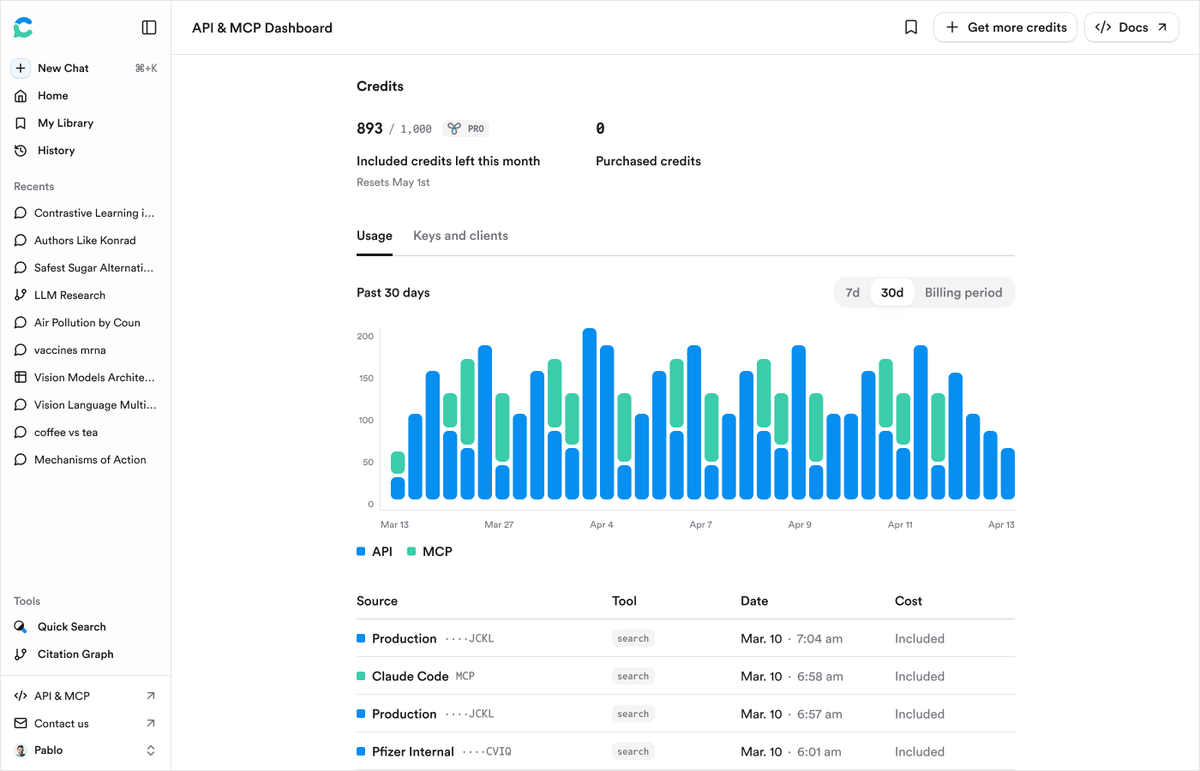
The Consensus API & MCP are live 🎉
After a few months in closed beta with pharma teams, AI bio startups, and materials science groups, anyone can sign up and start building today.
The academic search that powers Consensus, is now callable from your own systems.
The risk of an AI tool hallucinating a citation is small.
The cost of it happening in your literature review is not.
So researchers check. They should — reading the source is part of the job.
What's broken is everything around it: leaving the answer, tracking down the PDF, scanning for the passage that supposedly backs the claim.
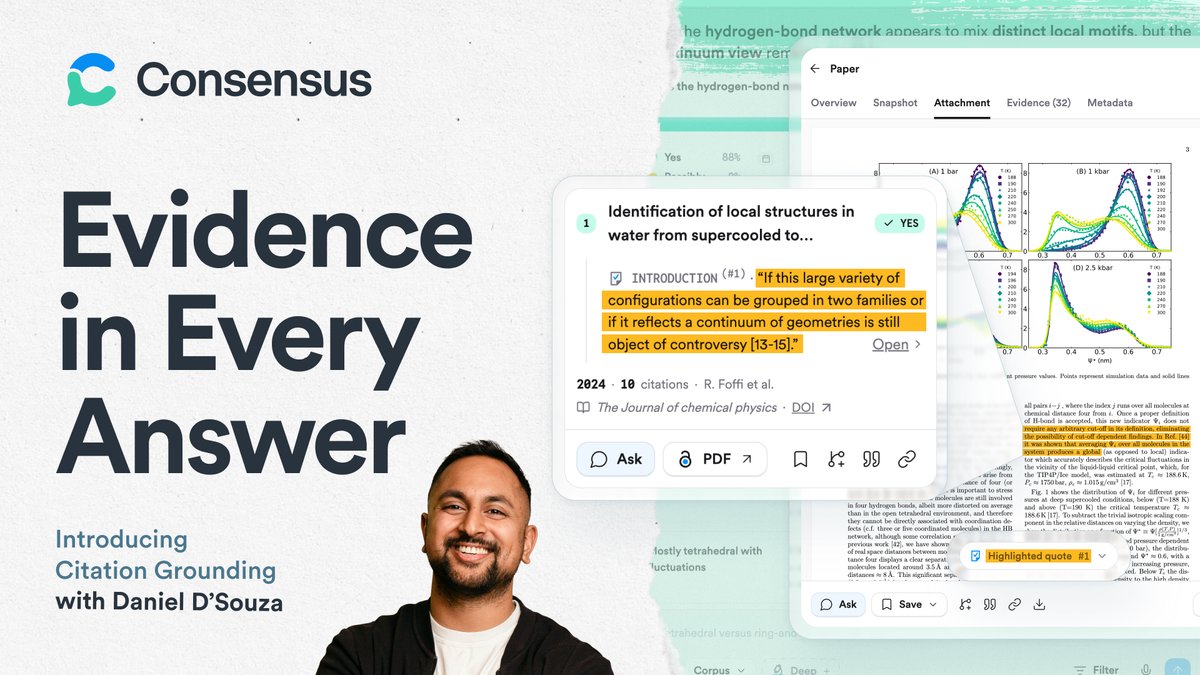
On Tuesday, August 25th, we're launching Citation Grounding, our set of features that show you the evidence in every answer.
👉 Hover a citation in Consensus and you'll see the quote it came from.
💻 Click the quote and we'll open the paper to the exact place it lives, in its original context.
🔎 Open the Evidence tab and you'll see every quote pulled from that paper for your search.
Daniel 'Tuba' D'Souza, our Head of Growth, will cover how it works, why we built it, how our full-text partnerships make grounding possible, and live research workflows you can use the same day.
Save your seat and see it live → https://t.co/7GPjttivyy
Consensus aims to be where you discover, understand, and act on research. But our features are only as powerful as the content behind them.
This is our 6th full-text publisher partnership in the last few months, with more on the way.
Read here: https://t.co/jVlrUFj1CY
We are excited to announce our partnership with @degruyter_brill, one of the world's leading publishers in the humanities and social sciences.
Consensus can now index and utilize the full text of their paywalled journals. More precise results, AI responses cited from full text.
15 things you probably don't know about American crows 🐦⬛, straight from Dr. Anne B. Clark, a professor emerita of behavioral ecology at @binghamtonu who has spent almost 30 years studying the same population of them.
Swipe through for the facts 👉 Read the full story for the parts that will really get you, including one crow that learned to recognize a specific car in a parking lot full of identical ones 👀
When Dr. Barbara Han reaches a question no one has studied directly, she uses Consensus to find the closest related research and identify the connections her lab needs to make. 🔎
That often means entering an unfamiliar field, learning its terminology, and tracing a path through adjacent bodies of literature.
Consensus helps her get oriented quickly, surface vetted papers, and trace each answer back to the source. 📚
As she puts it, it helps her get past “that impenetrable wall of new disciplinary jargon” and reach the crux of what she needs to know.
When Dr. Barbara Han reaches a question no one has studied directly, she uses Consensus to find the closest related research and identify the connections her lab needs to make. 🔎
That often means entering an unfamiliar field, learning its terminology, and tracing a path through adjacent bodies of literature.
Consensus helps her get oriented quickly, surface vetted papers, and trace each answer back to the source. 📚
As she puts it, it helps her get past “that impenetrable wall of new disciplinary jargon” and reach the crux of what she needs to know.