então, aparentemente se você conectar todas as suas contas bancárias e cruzar os dados, dá pra detectar um monte de coisa que passa despercebido no dia a dia
construí um negócio que faz isso e os resultados são meio assustadores
tipo, a netflix aumentou o preço 3x em 2 anos e você nem percebeu. +116%
e tem gente gastando mais no ifood do que de aluguel
We are overstimulated and we don't even notice. Netflix while eating. Reels in the bathroom. Music while cooking. Podcasts on walks. We consume by default, not by intention. You keep filling every gap, then wonder why you feel foggy and unmotivated. Boredom and silence are the real growth drivers. They give you space to think and create. That's when solutions show up for problems that have been stuck for months. Leave some room.
When are tech folk going to get that people like wasting time, it's life. They don't optimize for efficiency, they try to get by, they watch dumb stuff, they enjoy shopping. Inefficiency is another work for living and life.
Your m mean and median job isn't a software engineer in Menlo Park, it's Ashley in accounts in a not for profit in Columbus, it's Jesse , the office manager for a tool rental business in Tallahassee, they are more likely to use a Fax machine than Slack.
They quite like meetings because they like chatting, they'll use AI to make a better invite to their baby shower, not agentify their job.
These people, nor their bosses boss, aren't in a rush to build software as a side hustle, they are keen to use AI to check if their vet is overcharging them. They'd like AI to check spelling on the email to the school governor.
They don't want agentic commerce, they want AI to be in the background and make living a little less stressful
The token cost to build a production feature is now lower than the meeting cost to discuss building that feature.
Let me rephrase.
It is literally cheaper to build the thing and see if it works than to have a 30 minute planning meeting about whether you should build it.
It’s wild when you think about it.
This completely inverts how you should run a software organization. The planning layer becomes the bottleneck because the building layer is essentially free. The cost of code has dropped to essentially 0.
The rational response is to eliminate planning for anything that can be tested empirically. Don’t debate whether a feature will work.
Just build it in 2 hours, measure it with a group of customers, and then decide to kill or keep it.
I saw a startup operating this way and their build velocity is up 20x. Decision quality is up because every decision is informed by a real prototype, not a slide deck and an expensive meeting.
We went from “move fast and break things” to “move fast and build everything.”
The planning industrial complex is dead.
Thank god.
If I look at the last 15 years of knowing people in startups, and then seeing who became successful and who didn't, I'm starting to see some general patterns
The people I know who became successful (and very rich) regularly asked for help and feedback, and then applied that feedback very quickly (think minutes) and shipped fast while maintaining their own vision
The people who didn't become successful are the ones who worked on stuff for months/years without asking for help or feedback, or when they did took weeks/months to apply it
So I think the feedback -> implement loop and speed of it is possibly very important
universities are about to realize that they had been selling the wrong product for the 150 years. they thought they sold knowledge, then information became free. they pivoted to selling credentials but now credentials are just proxies. in the post-ai era the universities who survive will realize they were always selling 3 things: network, status signaling, and a 4 years of protected time to become an adult.
TAP AFFILIATE NETWORK IS OFFICIALLY LIVE
I've been running TAP privately for the last few weeks with a small group of affiliates and the results have been insane
- 100% upfront + 50% MRR commissions
- 24-hour payout
- Marketing frameworks
- Automation software
RT + Comment "TAP" and I'll DM you the link to join
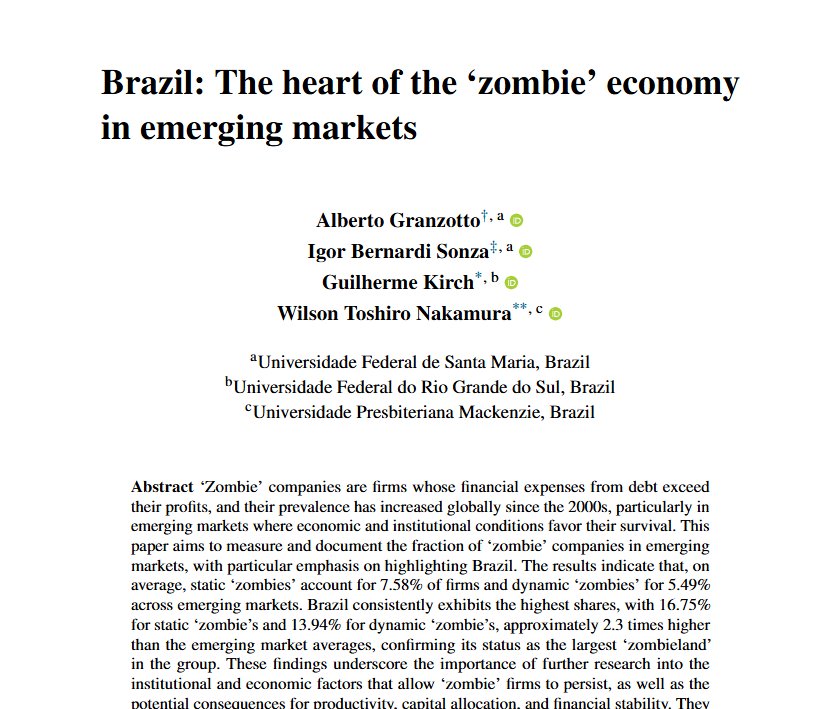
When we look at the Brazilian economy and wonder why growth has been so low for so long, an uncomfortable part of the answer lies in the private sect itself. Brazil is a notorious breeding ground for zombie companies. These are firms that cannot generate enough profit even to pay the interest on their own debt, but remain in existence because the financial system allows for the constant rollover of this liability. They do not innovate, they do not grow, they do not increase productivity.
According to an article by Granzotto et al. (2025) in the Brazilian Review of Finance, which compares companies in various emerging markets, on average 7.6% of firms are "static zombies" (firms with EBITDA/Financial Expenses < 1) and 5.5% are "dynamic zombies" (EBITDA/Financial Expenses >/= 1) in these markets.
In the Brazilian case, 16.75% of companies are classified as static zombies and 13.94% as dynamic zombies! In other words, more than double the average for emerging markets. The authors themselves bluntly state that Brazil is the "heart of the zombie economy" among emerging markets, about 2.3 times above the international standard.
To clarify what this means: we are talking about companies that cannot generate enough profit to cover their financial costs, meaning that investors will have to wait longer to recover their principal, and that workers will be employed in firms without the capacity to invest in new technologies and processes that could improve their human capital and productivity.
The article shows that this mass of zombie companies distorts capital allocation, reduces aggregate productivity, and weakens investment dynamics. Credit, labor, and resources are trapped in financially fragile firms, while more productive companies face a hostile financing environment. And this, of course, has a cost in terms of potential economic growth.
As long as the Brazilian government does not address the problem of reforming the business environment and its capital markets, these types of inefficiencies will continue to persist and condemn workers and investors to remain trapped in firms that should be defunct.
SOURCE: https://t.co/a8MPL6y7xz
#Economía #econtwitter #Economics #Finance #Brazil
I’m a firm believer that if you feel stuck or depressed in life it’s because your soul is asking you to make a change or do something radically different and you’re not listening.
Today I say goodbye to my 30s. It was a wild decade:
-Launched my first supplement company (Holy Land Health) in 2015 and went from $1MM rev that year to $23MM the second year.
-Had to meet with 9 district attorneys in Oakland after they sent me a letter about that company (it worked out alright).
-Launched an agency (Red Ox Consulting) that did $10MM+ in revenue in a single year. Hated that business.
-Made $1MM+ in freelancing income for 4 straight years (while running businesses). Did it by charging $50k per sales letter for clients.
-Wrote hundreds of sales letters that generated billions of dollars.
-Saw the emergence of AI occur, embraced it, and accepted that the days of charging $50k a sales letter were over.
-Founded a call center (Turtle Peak) and sold it for 7 figures.
-Founded a SaaS and sold it for 6 figures (FreeAdCopy).
-Founded Copy Accelerator (CA Pro these days), through which I've helped 500+ DTC brands who collectively have generated $10BN+ in revenue since working with them.
-Bought out my original co-founder of CA Pro for 7 figures.
-Became a guru and built a personal brand.
-Realized I didn't want to be a guru and stopped doing it.
-Made millions of dollars selling courses and info, including RMBC which is considered one of the best copywriting courses of all time, and more recently RMBC II.
-Did live events that generated millions of dollars in a single 3-day period.
-Stopped doing those events because I didn't like pitching/selling from stage.
-Flew private 50+ times.
-Bought a Bentley.
-Became an "investor" with 7 figures put into movies, an agriculture startup, tech startups, multi-family real estate, food startups, etc.
-Saw most of that money disappear as those companies/projects went bust and multi-family got crunched due to high interest rates.
-Became super illiquid
-Realized being an "investor" sounds sexy until you need cash and all your money is locked up in things
-At one point I sold a Rolex to help cover mortgages (at the height of my liquidity crunch).
-Recovered from that, but stopped spending like a celebrity. Most of the time I fly Comfort+ but rarely splurge for first class. Also stopped putting any personal expenses on credit cards. Went from monthly credit card payments of $200K+ to payments of like $10k or so on average.
-Had my first daughter in 2018.
-Almost got divorced in 2022. We separated and were in arbitration.
-Stopped drinking alcohol (along with my wife - and yes our drinking was related to us almost divorcing).
-We saved our marriage.
-Had our second daughter in April.
-Marriage is in the strongest place ever.
-Met an endless list of celebrities, billionaires, etc.
-Saw my best friend since childhood get diagnosed with cancer in his mid 30s and die right before his 38th birthday.
-Saw another best friend since childhood also get diagnosed with Stage IV cancer at age 38. Spent weeks at the hospital in LA supporting him last summer during/after emergency surgery to remove multiple infected organs. He's doing okay right now thank God. I try to visit him at least once every 3 months.
- Did $10MM+ in real estate transactions - these ones have mostly worked out pretty well.
-Got in great shape thanks to my friend Glenn Dawson and ResetU.
-Survived attacks from enemies trying to destroy my business.
-Finally stopped bouncing around to things and got hyperfocused on the telemedicine business I run, which did $20MM in our first year and is doubling that in our second year.
—
Honestly there's so much more I could put. It was a very busy decade…
But ultimately, the biggest transformation as I come out of it is a feeling of maturation and focus.
I'm thankful for the experiences I had. The good and the bad. The wins and the dumb mistakes. All of it...
But as I turn 40, the most beautiful thing is how much simpler my life feels.
Family:
They come first. I love being a dad. I coach my oldest daughter's softball games. I'm up early in the morning with our 6-month-old. I don't go out and party. When I'm not working or working out, I'm with my family. If it's not work time and I'm not with my kids, it's because I'm out on a date with my wife.
Business:
I say no to every new business opportunity that comes my way. I say no to pretty much any speaking invite or opportunity. I don't launch new info products or courses (with the exception of RMBC II). I don't have any interest in investing in random businesses. I'm good with CA Pro and telemedicine and that's it.
Finances:
I spend less. Money goes out of my account every month and into an index fund. Every now and then I'll buy some individual stocks. I don't do speculative stuff. I don't spend money on PJs or ultra-luxury cars. I still like nice things, but I buy them rarely, and there's never a compulsive need for "more." We have a nice house and even if I had a billion dollars, we probably wouldn't move. The house is great and the neighborhood is full of families and kids that my daughters can play with. Who cares about a house that's bigger.
Health:
I work out every single day. I eat pretty healthily. I'm as mentally and physically strong as I've ever been.
Spirituality:
I meditate regularly and I give thanks to God for everything I have.
—
And that's the tweet. Long. Maybe self-indulgent. Maybe contains lessons. I don't know…
But I'll only turn 40 once and there's something about big milestone events that can leave a man feeling reflective.
A lot of you guys have been asking about my brother "Josh" and how he did 25k in his first month doing organic, So I thought I would drop the full case study on how he did.
reply 'Josh' and Retweet and it'll be sent straight to your dms