What happens after harvest?
Harvesting crops is only half the job. Without effective storage, valuable food can be lost before reaching consumers.
Granaria helps transform agricultural storage into connected, data-driven infrastructure.
Discover: https://t.co/M4hqxefUAM
@mbompard Pour la victoire en 2027,il faudra s'assurer que tous les jeunes et moins jeunes de tous les quartiers délaissés de France aient leur carte d'électeur et aillent voter. Pour cela il faudra organiser des navettes de bus de leur lieu de résidence aux différents centres de vote.
@ALeaument@LulaOficial Pour la victoire en 2027,il faudra s'assurer que tous les jeunes et moins jeunes de tous les quartiers délaissés de France aient leur carte d'électeur et aillent voter. Pour cela il faudra organiser des navettes de bus de leur lieu de résidence aux différents centres de vote.
@BallyBagayoko Pour la victoire en 2027,il faudra s'assurer que tous les jeunes et moins jeunes de tous les quartiers délaissés de France aient leur carte d'électeur et aillent voter.
Pour cela il faudra organiser des navettes de bus de leur lieu de résidence aux différents centres de vote.
Everyone needs to know what actually happened in Serbia.
Instead of students just protest against their government, the students organized themselves into a student list and ran in elections against their government—and they have just won.
Dear Serbia, congratulations on your victory; you have just opened a new door in protesting. This is history
Africa, Burkina Faso, will introduce the Haitian Revolution into its school curriculum for the 2026-2027 school year, as part of efforts to teach more about colonialism and the fight for freedom.
Students will learn how enslaved Haitians fought slavery and French colonial rule, how Haiti won independence in 1804, and the key decisions, strategies and actions of revolutionary leaders. They will also study the successes, challenges and mistakes during and after the struggle.
The full revision of textbooks is still pending, as the updating of materials is ongoing.
This is good news for both countries. Haiti’s revolution is one of the most important events in world history, but it is often overlooked in schools. Teaching it in Burkina Faso will help a new generation understand what Haitians accomplished and how it changed history.
The connection is also historic. Many Haitians know Burkina Faso’s leader Thomas Sankara for his anti-imperialist views and fight against inequality. Now young people in Burkina Faso will learn about Haiti’s leaders like Toussaint Louverture and Jean-Jacques Dessalines.
This creates a chance for both countries to learn from each other. Haitians can continue learning about African leaders, while Burkinabè students can better understand Haiti’s contribution to freedom.
By including the Haitian Revolution, Burkina Faso is showing that Haiti’s history deserves recognition. It can also build mutual respect and strengthen ties between future Haitian and Burkinabè leaders.
The real impact will depend on how it is taught and whether students get an accurate account, including achievements, decisions, mistakes and consequences.
Haiti and Burkina Faso have different histories but share struggles over freedom, sovereignty and foreign domination. Helping young people understand each other’s history today could lay the foundation for stronger relations in the future.
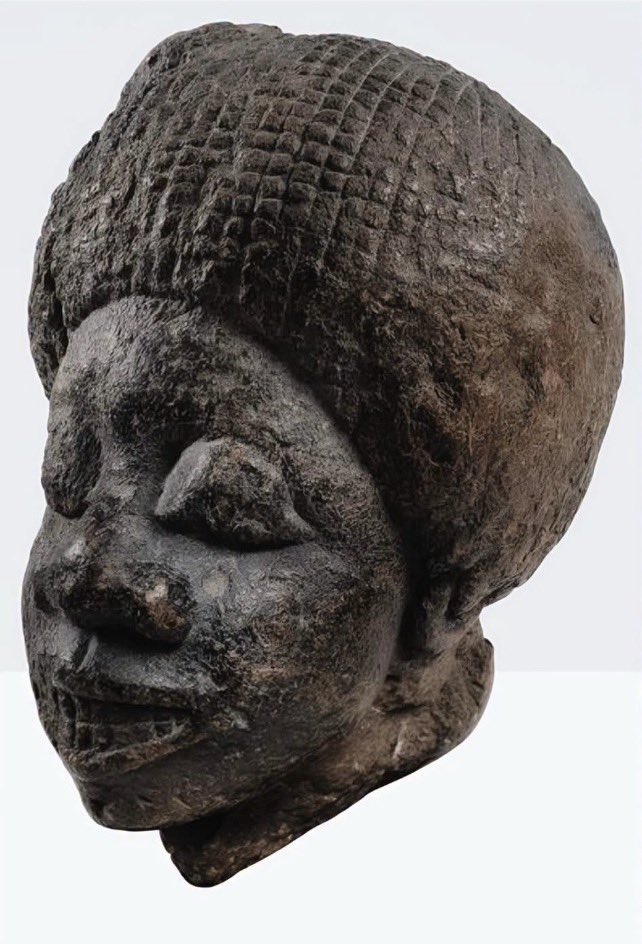
The same sculptures the colonizers condemned and called evil were what served as pictures for our ancestors that tell our history. We need to wake up to that reality. This is a Medieval Sierra Leone sculpture with Afro-textured hair, 7th- 8th century CE, and a photograph of Sierra Leonean women today.
The lie about Africa was not a small lie carelessly told.
It was a structural lie, deliberately constructed, institutionally maintained, academically defended.
It required the renaming of things. Egypt became, in the Western imagination, not quite African. The pyramids became a "mystery," because the alternative was crediting Africans with their construction, which the framework could not accept.
It required the discrediting of Arab and African scholarship about African history.
It required the dismissal of oral traditions as legend rather than history.
It required deciding that writing on paper counted as "civilization" and other forms of knowledge transmission did not.
It required, essentially, redesigning the criteria for what counted as "civilization" so that the places being colonized would fail the test.
The test was not neutral.
The test was written to produce a specific result.
And that result was: "Africa has no history worth the name."
Therefore what colonialism destroyed was not civilization. Therefore what colonialism did was not destruction.
This is not an accusation of individual ignorance.
This is a description of institutional architecture, built over centuries, maintained by people who understood exactly what it was for.
This is what Western hypocrisy, misinformation, and propaganda look like in history via Hollywood, where they try to whitewash history for their benefit.
"Much of black people's ancient history was not destroyed but covered up because it was needed to educate Europe into the ways of civilization: and whites treasured it and kept it in museums and private collections"
🇲🇽 À seulement 16 ans, cette adolescente invente un extincteur capable d’éteindre le feu grâce aux ondes sonores ! Karime Hernández Venegas vient de remporter la médaille d’or au Salon international de la science et de l’invention 2026 grâce à une invention qui pourrait révolutionner la lutte contre les incendies ! 🔥 (El Heraldo De Mexico)
📸 Karime vortex
This is a sleeper carriage on China's 350 km/h Fuxing high-speed train!
Lie down, rest up, and race across the country at bullet-train speed!
This is what happens when your country invests in technologies instead of funding wars!
@Chinaretold