3C is Nigeria’s first AI Consumer Rights Guide, to help you know your rights and guide you on what steps to take when facing consumer issues. And it is FREE!
✔ Understand your rights
✔ Know what steps to take
You can try it here: https://t.co/DKsLMZtZ9t
Or scan the QR code
Under the Electricity Act 2023, 15 states have now taken full control of their electricity markets.
This means:
>You no longer report complaints to NERC
>You now report complaints to your state electricity regulator (SER)
>Your state electricity regulator (SER) is now your primary point of contact for complaints such as disputed bills, metering delays, poor customer service from DisCos, etc.
Report complaints directly to your SER if you live in:
Enugu
Ekiti
Ondo
Imo
Oyo
Edo
Kogi
Lagos
Ogun
Niger
Plateau
Abia
Nasarawa
Bayelsa
Save this post and share it with someone in these states.
#NERC #ElectricityAct2023 #StateElectricityMarkets #EnergyReform #NESI #PowerSector #Nigeria #ElectricityData #SERs #EnergyTransition
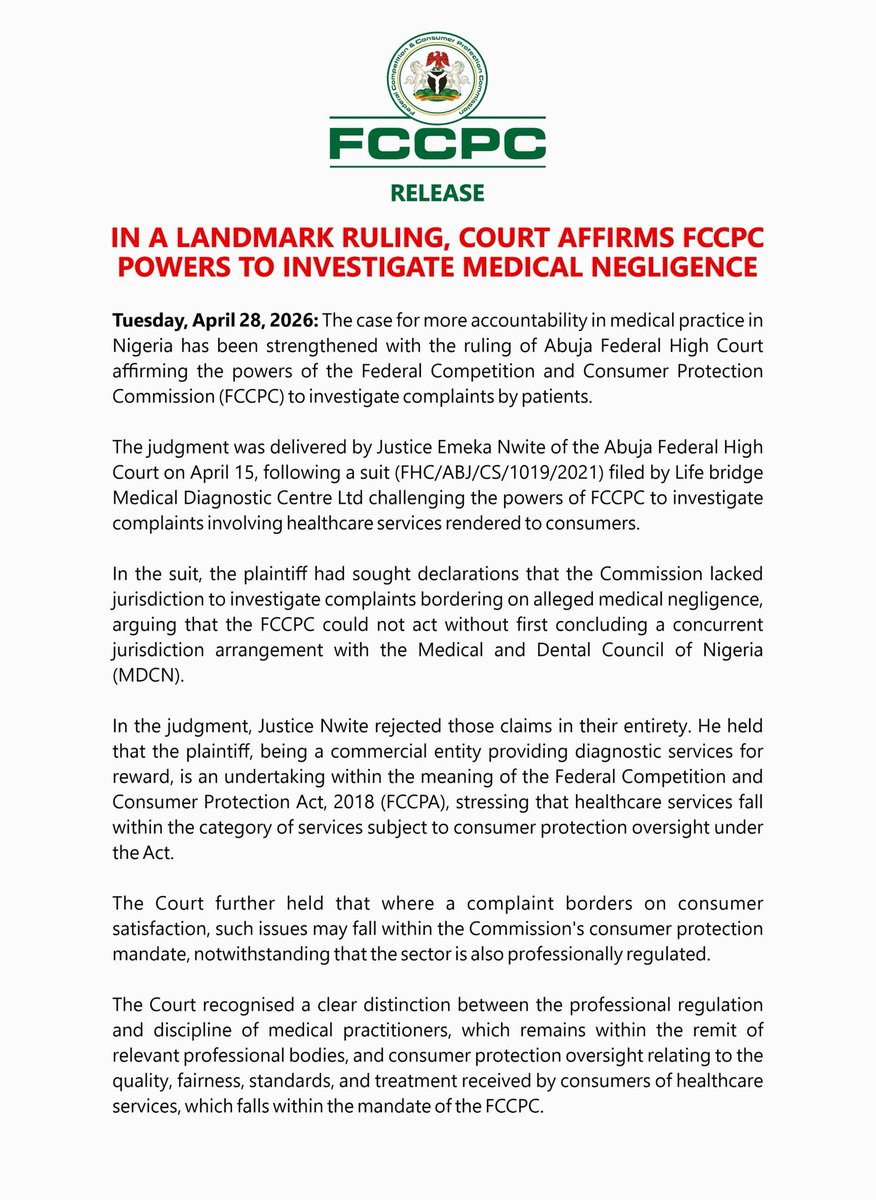
Banks answerable to FCCPC, court rules
* Dismisses UBA’s suit, fined N2m
* It’s a big victory for bank customers, says Tunji Bello
Advocacy for consumer rights in the banking sector recorded a major boost today with a judgement by a Federal High Court in Abuja dismissing, in its entirety, a suit by UBA Plc seeking to contest the jurisdiction of the Federal Competition and Consumer Protection Commission (FCCPC).
In its ruling, presiding Justice James Omotosho affirmed the Commission’s statutory authority to investigate consumer complaints involving banks and other financial institutions.
In the suit, FHC/ABJ/CS/1972/2025, United Bank of Africa Plc sought to determine whether in light of Section 251 (1) (d) of the 1999 Constitution of the Federal Republic of Nigeria (as amended 2023) and Section 65(1)(a) of the Banks and Other Financial Institutions Act (BOFIA) 2020, the FCCPC could validly exercise jurisdiction over a commercial bank duly licensed by the Central Bank of Nigeria (CBN) and over any of its functions, acts, financial products, or financial services.
In his judgement, Justice Omotosho considered Sections 251 (1) (d) of the Constitution and 65(1)(a) of BOFIA, which the plaintiff had relied upon to challenge the Commission’s jurisdiction, and upheld the authority of the FCCPC in competition and consumer protection matters in the financial sector.
Consequently, UBA plc was fined N2m for “bringing a frivolous and unmeritorious case against the defendant”.
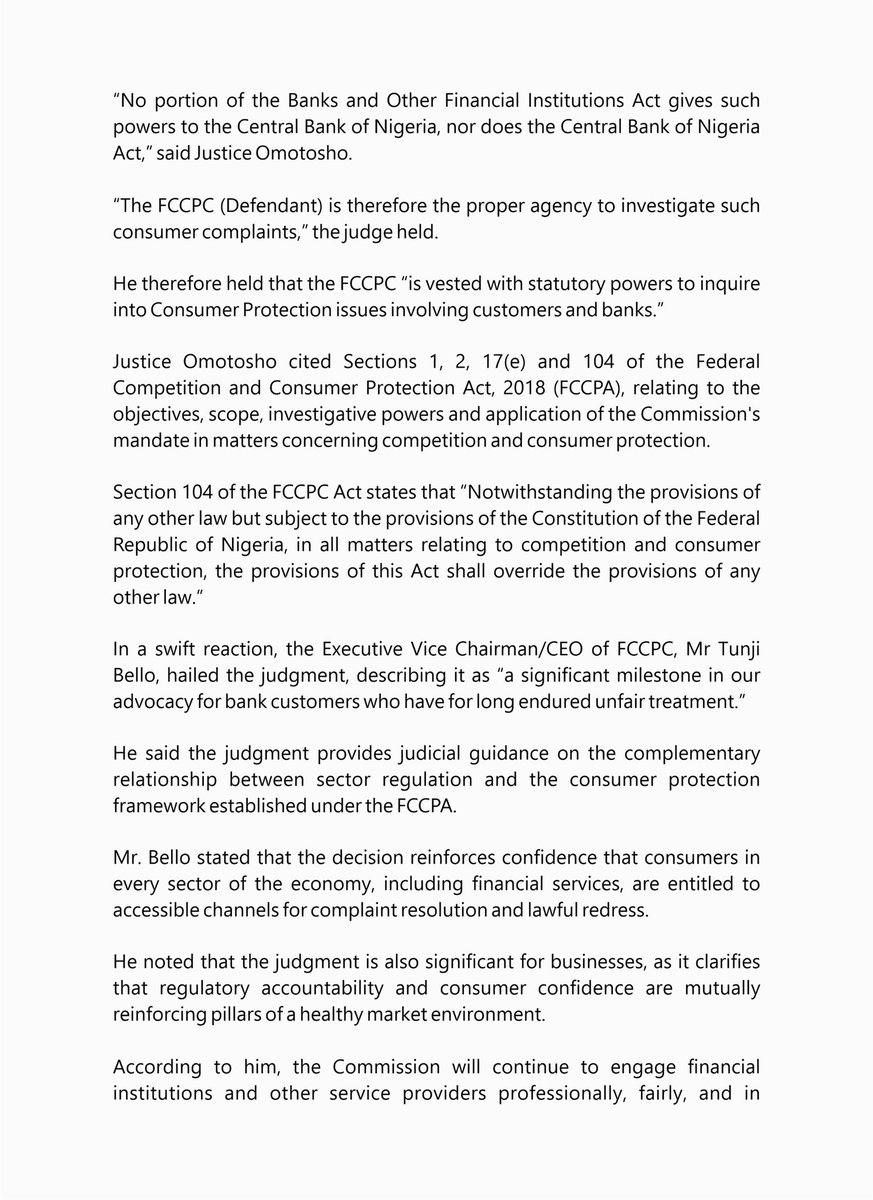
With respect to receiving and investigating Consumer complaints, the Court stressed that there is no other agency in Nigeria saddled with this responsibility except the FCCPC.
“No portion of the Banks and Other Financial Institutions Act gives such powers to the Central Bank of Nigeria, nor does the Central Bank of Nigeria Act,” said Justice Omotosho.
“The FCCPC (Defendant) is therefore the proper agency to investigate such consumer complaints,” the judge held.
He therefore held that the FCCPC “is vested with statutory powers to inquire into Consumer Protection issues involving customers and banks.”
Justice Omotosho cited Sections 1, 2, 17(e) and 104 of the Federal Competition and Consumer Protection Act, 2018 (FCCPA), relating to the objectives, scope, investigative powers and application of the Commission’s mandate in matters concerning competition and consumer protection.
Section 104 of the FCCPC Act states that “Notwithstanding the provisions of any other law but subject to the provisions of the Constitution of the Federal Republic of Nigeria, in all matters relating to competition and consumer protection, the provisions of this Act shall override the provisions of any other law.”
In a swift reaction, the Executive Vice Chairman/CEO of FCCPC, Mr Tunji Bello, hailed the judgment, describing it as “a significant milestone in our advocacy for bank customers who have for long endured unfair treatment.”
He said the judgment provides judicial guidance on the complementary relationship between sector regulation and the consumer protection framework established under the FCCPA.
Mr. Bello stated that the decision reinforces confidence that consumers in every sector of the economy, including financial services, are entitled to accessible channels for complaint resolution and lawful redress.
He noted that the judgment is also significant for businesses, as it clarifies that regulatory accountability and consumer confidence are mutually reinforcing pillars of a healthy market environment.
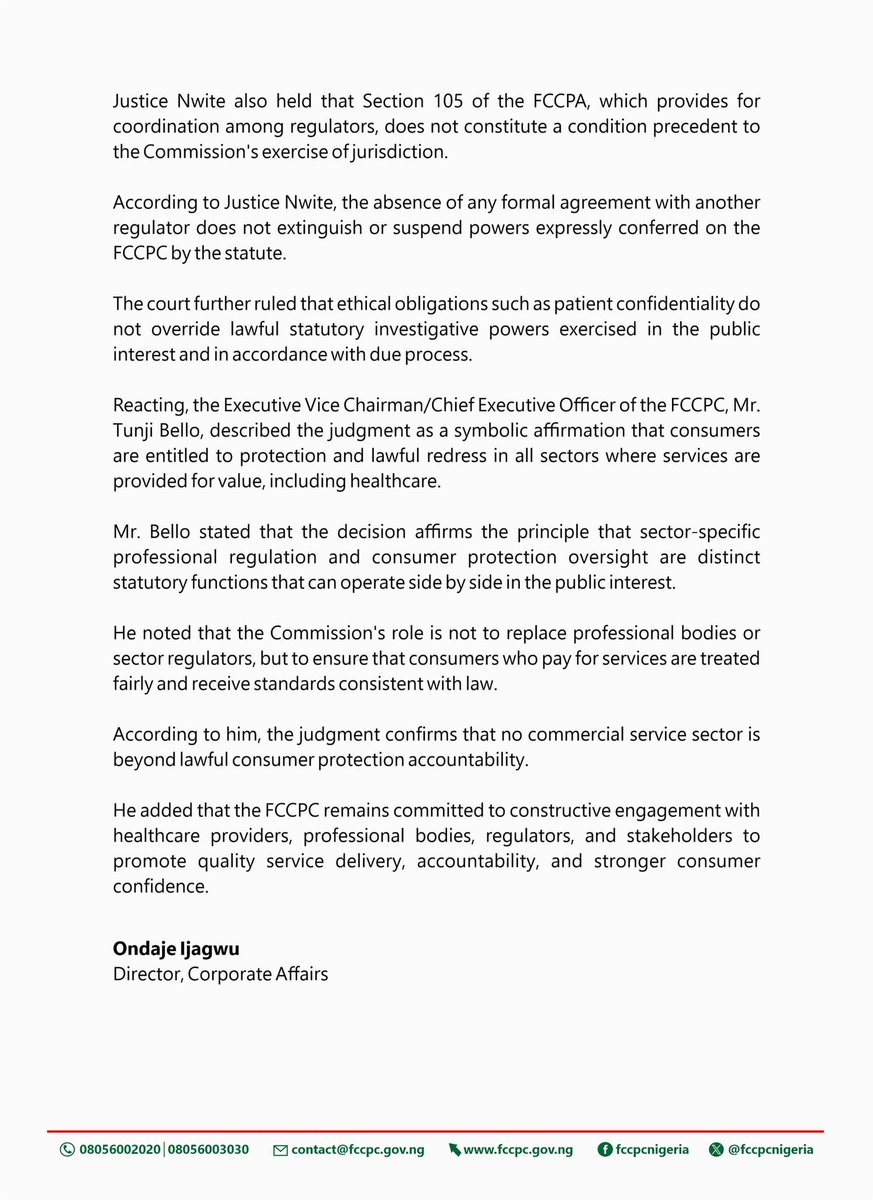
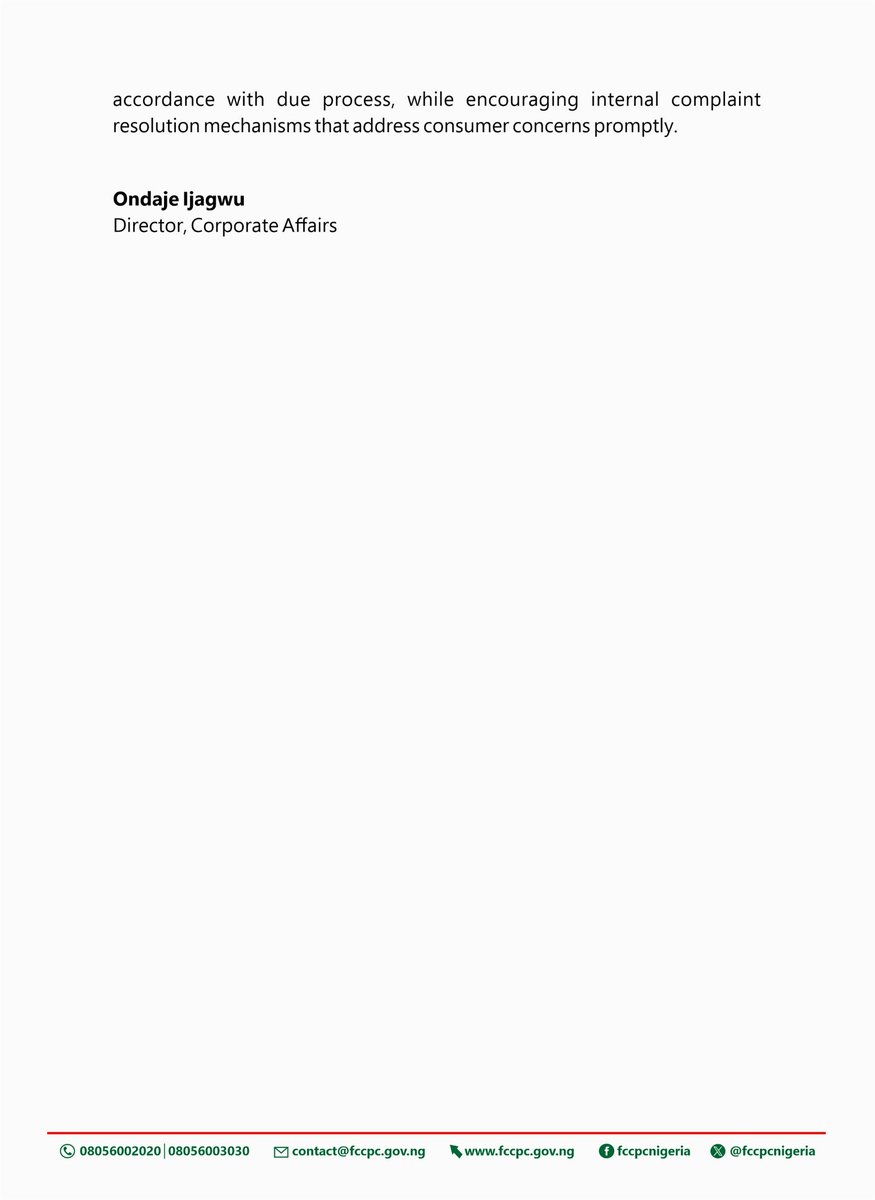
According to him, the Commission will continue to engage financial institutions and other service providers professionally, fairly, and in accordance with due process, while encouraging internal complaint resolution mechanisms that address consumer concerns promptly.
Ondaje Ijagwu
Director, Corporate Affairs
@NigeriaGov@NGRSenate@HouseNGR
Consumer Complaint Resolution Report
Mrs. Esther Olasantan, a businesswoman from Isolo Community, Lagos State, purchased a carton of fish on January 30, 2026. Unfortunately, the fish became spoilt after purchase.
Upon reporting the issue to the cold room management, she was informed that neither a refund nor a replacement would be provided for the damaged goods.
Subsequently, she was referred to the Lagos State Consumer Protection Agency (LASCOPA), Ikeja Office for intervention.
The General Manager of LASCOPA, Mr. Afolabi Solebo Esq., invited the cold room management for a mediation meeting.
Following deliberations and resolution of the matter, the cold room management agreed to refund the sum of ₦180,000, being the cost of the fish, and an additional ₦20,000 as compensation to Mrs. Olasantan.
This intervention ensured fair redress and reinforced consumer protection rights.
@jidesanwoolu@drobafemihamzat@gbenga_omo@gboyegaakosile@LanreBajulaiye@BarrBimbola@Mr_JAGs@Riddwane
#AGreaterLagosRising
#LASG
An eye exam isn’t just about reading letters on a chart. It’s about understanding how your eyes work together, detecting silent conditions, and catching early signs of problems you may not even feel yet.
My latest article explores why consumer protection is not anti-business, and how poor governance of consumer risk is the real threat to long-term enterprise value.
Read here:
#CorporateGovernance#ConsumerProtection#BusinessRisk
https://t.co/hVfz9ECWAo
Before you click “buy”, check the seller’s full business name and contact details.
No address, no phone, no accountability.
FCCPC: promoting choice, ensuring fairness
People say they want privacy until they meet someone who actually has it.
Not the performative “private” where you still post soft launches, vague captions, story replies, little curated hints so everyone can keep tracking the plot. I mean real privacy. The kind where your life doesn’t come with commentary. Where your phone isn’t a public window. Where your wins, your losses, your relationships, your breakdowns don’t get uploaded as evidence.
people get weird.
You can see the moment their brain hits the wall. They ask a normal question, “so what have you been up to,” and you give them a normal answer that is also a closed door. “Work’s been busy.” “Just been chilling.” “Nothing crazy.” You smile. You move on. And something in them doesn’t relax. Because they weren’t asking for facts. They were asking for access.
A lot of people are not used to not having access.
We live in a time where everyone is constantly narrating themselves. Posting their meals, their heartbreak, their therapy language, their gym progress, their new person, their new home, their new era. Even if they say “I’m private,” they still leak. They drop breadcrumbs on purpose because being fully unseen feels like death to them.
So when you don’t leak, they start filling the silence with stories.
They assume you’re hiding something. They assume you’re lying. They assume you think you’re better than them. They assume you’re judging them. They assume you’re mysterious in a calculated way, like you’re playing chess while they’re making small talk.
Sometimes they even get offended, which is hilarious.
Like your privacy is an insult. Like you owe them transparency to prove you’re “real.” Like you owe the room a plotline so they can orient themselves. And if you don’t give it, they start poking. Testing. Fishing.
“So are you seeing anyone?”
“What happened with that job?”
“Why don’t you post more?”
“Where were you last weekend?”
“Who were you with?”
They try to catch you. Not because they care. Because they’re unsettled by not being able to map you.
This is the part no one says out loud: a lot of people use information as control.
Not evil control. Everyday control. Social control. The kind where if I know what you’re doing, I know where I stand. If I know your relationship status, I know how to treat you. If I know your problems, I know what role to play in your life. If I know your weaknesses, I know how to win an argument later. If I know your plans, I know if you’re leaving me behind.
So when you’re truly private, you remove a tool they rely on.
u become unpredictable in a way that scares them, because they can’t pre-empt you. They can’t manage you. They can’t keep a running tally of your life and compare it to theirs. They can’t decide if they should envy you, pity you, compete with you, flirt with you, ignore you. They have to relate to you in real time, on what you actually say and do, not on the story they’ve been consuming from your feed.
that is rare now. It’s also intimate in a way people don’t expect.
Because if you don’t broadcast, then the only way to know you is to know you.
To ask. To listen. To spend time. To earn the details. To be trusted.
Most people don’t have the patience for that. They want the summary. The highlights. The quick scroll that tells them what category you’re in.
So they get odd. They start guessing.
They’ll call you “mysterious” like it’s either a compliment or a warning. They’ll joke that you’re “secretive” when what they mean is “I can’t track you.” They’ll project motives onto you. They’ll decide you’re arrogant. Or traumatized. Or sneaky. Or having an amazing life and hiding it. Or having a miserable life and hiding it. They’ll pick a narrative and treat it like fact because uncertainty makes them itch.
And sometimes - this is the sharp one - they’ll try to provoke you into revealing yourself.
They’ll say something slightly disrespectful just to see if you react.
RELEASE - Digital Lending: FCCPC Sets January 5 Deadline for Compliance
Thursday, November 13, 2025: The Federal Competition and Consumer Protection Commission (FCCPC) has set Monday, 5 January 2026, as the deadline for full compliance with the Digital, Electronic, Online and Non-Traditional Consumer Lending Regulations, 2025.
The Regulations came into effect on 21 July 2025 under the Federal Competition and Consumer Protection Act (FCCPA) 2018. It aims to promote fairness, transparency, and accountability across Nigeria’s growing digital lending market.
To support operators in meeting the required standards, the Commission has issued an additional instrument, the Guidelines on the Digital, Electronic, Online and Non-Traditional Consumer Lending Regulations, 2025, made under Sections 17 and 163 of the FCCPA. This document provides practical direction for lenders and intermediaries, explains the documentation required, and introduces updated Forms 1 and 3 based on feedback received from stakeholders.
Applicants with pending submissions may provide any additional information required under the new Guidelines without waiting for a formal request. The Commission will continue to process applications promptly and maintain a transparent review process.
The Executive Vice Chairman of the FCCPC, Mr. Tunji Bello, stressed the importance of meeting this timeline. He explained that “full compliance is not only a legal requirement but an important step in protecting consumers and ensuring that the sector continues to grow in a fair and responsible manner. Operators have had ample time to adjust to the Regulations and the additional guidance now provided. We expect all obligations to be met before the deadline.”
All affected operators, including lending platforms, service partners, and intermediaries, are expected to complete their compliance obligations by 5 January 2026. Enforcement will begin immediately after the deadline. Measures may include restricting non-compliant entities from operating, directing partners or platforms to cease dealing with them, and applying other sanctions permitted under the law.
Copies of the Guidelines, Forms, and Frequently Asked Questions (FAQs) are available on the Commission’s website at https://t.co/OhXnpqj6ij, including through enquiries at FCCPC offices nationwide, or via other official channels provided on the website.
The FCCPC is committed to promoting responsible digital lending practices that protect consumers and support confidence in the financial technology sector.
Ondaje Ijagwu
Director, Corporate Affairs