🚨 [AI POLICY] The @UN published "Governing AI for Humanity," and it's a MUST-READ for everyone in AI. Quotes:
"Left ungoverned, however, AI’s opportunities may not manifest or be distributed equitably. Widening digital divides could limit the benefts of AI to a handful of States, companies and individuals. Missed uses – failing to take advantage of and share AI-related benefts because of lack of trust or missing enablers such as capacity gaps and ineffective governance – could limit the opportunity envelope."
-
"There is no shortage of documents and dialogues focused on AI governance. Hundreds of guides, frameworks and principles have been adopted by governments, companies and consortiums, and regional and international organizations. Yet, none of them can be truly global in reach and comprehensive in coverage. This leads to problems of representation, coordination and implementation."
-
"Our recommendations advance a holistic vision for a globally networked, agile and fexible approach to governing AI for humanity, encompassing common understanding, common ground and common benefts. Only such an inclusive and comprehensive approach to AI governance can address the multifaceted and evolving challenges and opportunities AI presents on a global scale, promoting international stability and equitable development."
-
"We remain optimistic about the future with AI and its positive potential. That optimism depends, however, on realism about the risks and the inadequacy of structures and incentives currently in place. The technology is too important, and the stakes are too high, to rely only on market forces and a fragmented patchwork of national and multilateral action."
👉Read the full document below.
🔥 To stay up to date with the latest developments in AI policy, compliance & regulation, join 35,000+ people who subscribe to my newsletter (link below).
Very happy to see that our article (originally published online in 2022) has now been placed in an issue of New Media & Society – co-authored with Veronika Kalmus and Rita Figueiras @Mkv_Sodertorn
https://t.co/FYrKS1SjsT
📚 [AI BOOK CLUB] "The Equality Machine: Harnessing Digital Technology for a Brighter, More Inclusive Future," by @OrlyLobel, is a must-read for everyone interested in AI, and it's our 🎉 9th selected book:
📖 About the book:
"Much has been written about the challenges tech presents to equality and democracy. But we can either criticize big data and automation or steer it to do better. Lobel makes a compelling argument that while we cannot stop technological development, we can direct its course according to our most fundamental values.
With provocative insights in every chapter, Lobel masterfully shows that digital technology frequently has a comparative advantage over humans in detecting discrimination, correcting historical exclusions, subverting long-standing stereotypes, and addressing the world’s thorniest problems: climate, poverty, injustice, literacy, accessibility, speech, health, and safety.
Lobel's vivid examples—from labor markets to dating markets—provide powerful evidence for how we can harness technology for good. The book’s incisive analysis and elegant storytelling will change the debate about technology and restore human agency over our values."
📖 Why read:
This is a great read to understand the potential positive applications of AI-powered technology and to reflect on counter-arguments and different perspectives in the context of the core debates involving AI policy, regulation & governance.
📖 Go beyond:
I recommend you also watch my conversation with Orly Lobel "AI for Good: Rethinking Risks, Privacy & Regulation" (available on my YouTube Channel), and her TEDx Talk "How we can use AI for good" (links below).
📖 Join the AI Book Club
Our AI Book Club already has 1,200+ members. Join it at the AI, Tech & Privacy Academy's website and NEVER MISS our book recommendations (link below).
Happy reading!
🚨 [AI REGULATION] @UNESCO published its "Consultation Paper on AI Regulation - Emerging Approaches Across the World," and it's a MUST-READ for everyone in AI governance. Important information:
➵ Among other topics, the consultation paper describes 9 regulatory approaches (with examples from around the world) that are extremely interesting to anyone working or studying AI governance & regulation:
"1️⃣ Principles-Based Approach: Offer stakeholders a set of fundamental propositions (principles) that provide guidance for developing and using AI systems through ethical, responsible, human-centric, and human-rights-abiding processes.
2️⃣ Standards-Based Approach: Delegate (totally or partially) the state’s
regulatory powers to organizations that produce technical standards that
will guide the interpretation and implementation of mandatory rules.
3️⃣ Agile and Experimentalist Approach: Generate flexible regulatory schemes, such as regulatory sandboxes and other testbeds, that allow organizations to test new business models, methods, infrastructure, and tools under more flexible regulatory conditions and with the oversight and accompaniment of public authorities.
4️⃣ Facilitating and Enabling Approach: Facilitate and enable an environment that encourages all stakeholders involved in the AI lifecycle to develop and use responsible, ethical, and human rights-compliant AI systems.
5️⃣ Adapting Existing Laws Approach: Amend sector-specific rules (e.g., health, finance, education, justice) and transversal rules (e.g., criminal codes, public procurement, data protection laws, labor laws) to make incremental improvements to the existing regulatory framework.
6️⃣ Access to Information and Transparency Mandates Approach: Require the
deployment of transparency instruments that enable the public to access basic information about AI systems.
7️⃣ Risk-Based Approach: Establish obligations and requirements in accordance with an assessment of the risks associated with the deployment and use of certain AI tools in specific contexts.
8️⃣ Rights-Based Approach: Establish obligations or requirements to protect individuals' rights and freedoms.
9️⃣ Liability Approach: Assign responsibility and sanctions to problematic
uses of AI systems."
➵ It's important to notice that the regulatory approaches described above are not mutually exclusive, and AI laws around the world will often combine two or more approaches.
➵ The paper will be available for open public consultation in English until 19 September 2024.
➵ Link to download the document below.
🔥 To stay up to date with the latest developments in AI policy, compliance & regulation, join 32,600 people who subscribe to my weekly newsletter (link below).
Congratulations to our faculty member, Tyler Williams (@Pravasi101) for the publication of his book "If All The World Were Paper."
https://t.co/HsBHhZ81Wd
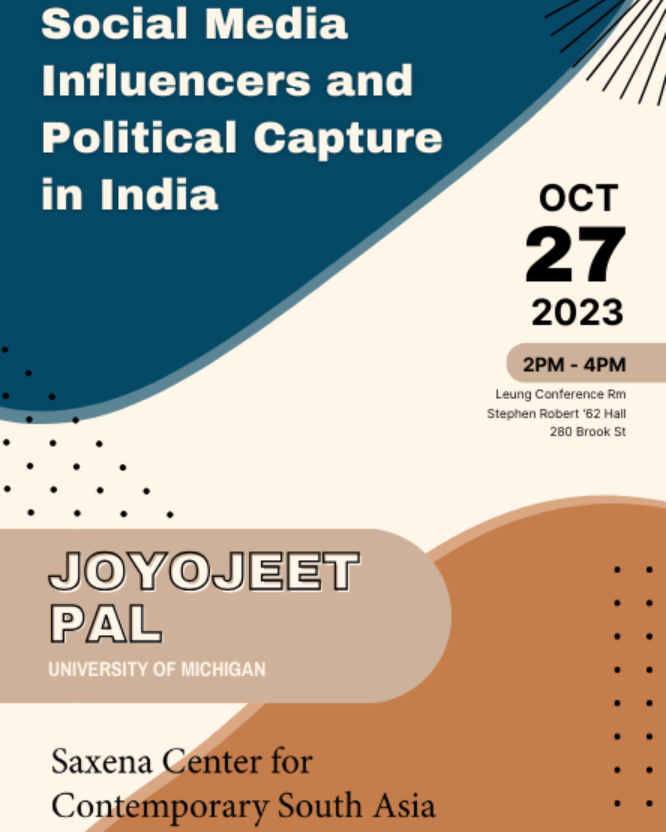
I will be speaking at @southasiabrown tomorrow on the role of Twitter and YouTube influencers in political speech and address their role in polarization, and in pushing political content.
Talk is free to attend.
https://t.co/gtyQmiz9Ht
My new research finds that while #media can increase #public awareness of #climate change, we need to see it as a personal risk to act. Despite low media coverage, citizens in poor & developing countries see it as greater risk & more willing to #protest
https://t.co/UQAWuC98r0
📢Our Special issue “Reconceptualizing public sphere(s) in the digital age? On the role and future of public sphere theory” ed. by me and @mss7676 is out in @icahdq's and @OxfordJournals' #CommunicationTheory! https://t.co/LnTkwXYbXt 🧵 1/19
The archive of Indian political messaging is the work of several people, incl two students who led the work on politicians & influencers - @anmolpanda_ & @AryaArshia
This is housed in the SOMAR social media archiving project led by @libbyh
https://t.co/bcQIAFiRNP
Yesterday, I wrote a heartfelt op-ed for @htTweets about the grim conditions in India's archives
Not only are records decaying away, what little survives in India's archives is subject to the most absurd rules
So imagine my reaction when I received this forward on WhatsApp..
#OpenAccess
Tellings and Texts: Music, Literature and Performance in North India
eds. Katherine Butler Schofield, Francesca Orsini
Open Book Publishers 2015
https://t.co/S0Yt2GXmXJ
Direct Access Link (PDF)
https://t.co/flXohRQmgf
Today in my mail! Feels good to have it in hands and to browse through the chapters of our amazing contributors. IAMCR members can get a special 35% discount on this and other titles of the Global Transformation Series!
https://t.co/lNVWwJrvq7
@HananBadr@sfuCMNS
Historians of empire: I’m looking for research on the importance of paperwork to colonial rule & administration, e.g. the British in India. Any suggestions?
#PhDcourse# Wanna conversate with leading scholars on tech and poli movements? Join us on the international PhD course "MOVEMENTS AND CONTENTION IN THE DIGITAL AGE" @koebenhavns_uni 8-10 May, 2023. w/ @ComDem_ECREA@cdcspenn, funded by @DFF_raad
https://t.co/H8JPHwK3JA
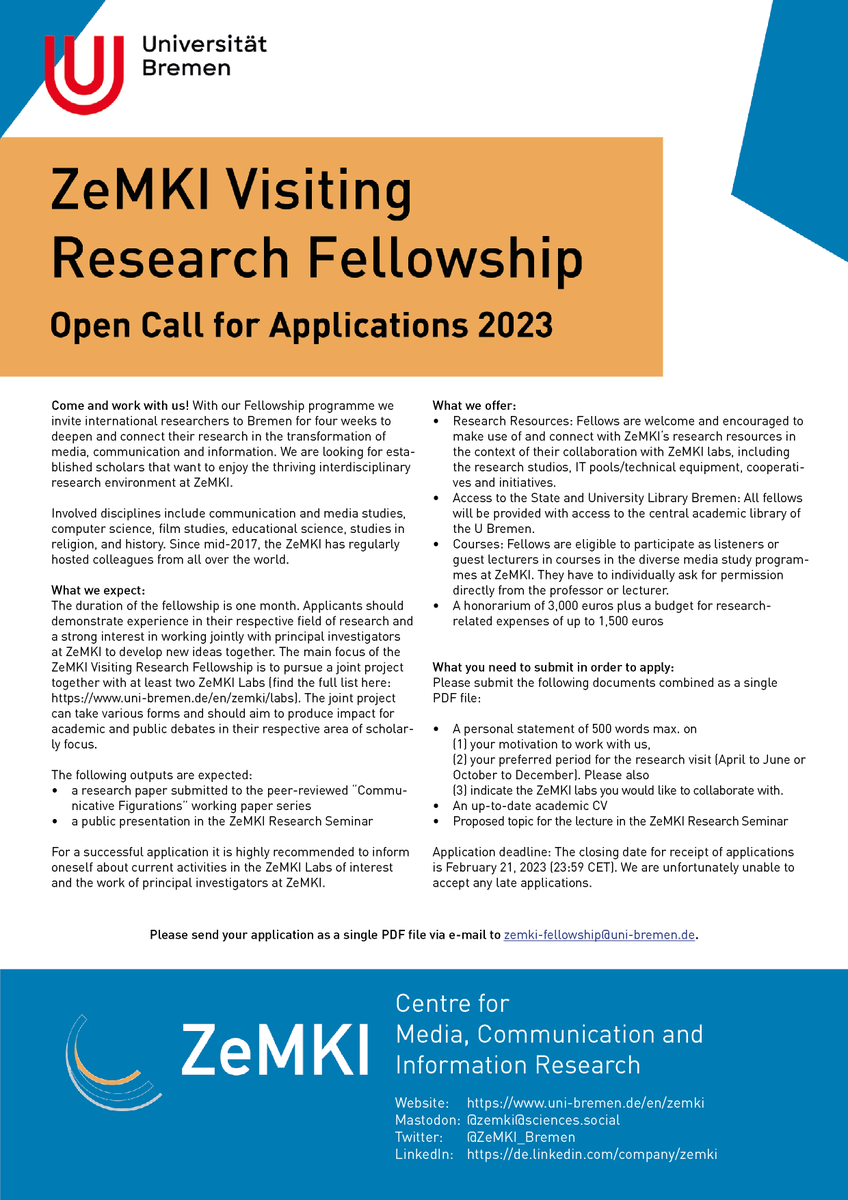
Come and work with us! Open Call for Applications for the ZeMKI Visiting Research Fellowship: 4 weeks of (paid) research in the beautiful city of @Bremen_de at @UniBremen. Please send us your application by February 21, 2023: https://t.co/qwEkSBm3Yc
Submissions for #AoIR2023 Revolutions are now being accepted!
Details on submission types: https://t.co/KiIXrFHMQk
Details on the conference theme: https://t.co/8iYgXBLAr4
Location: Philadelphia, PA, USA
Date: 18-21 October 2023
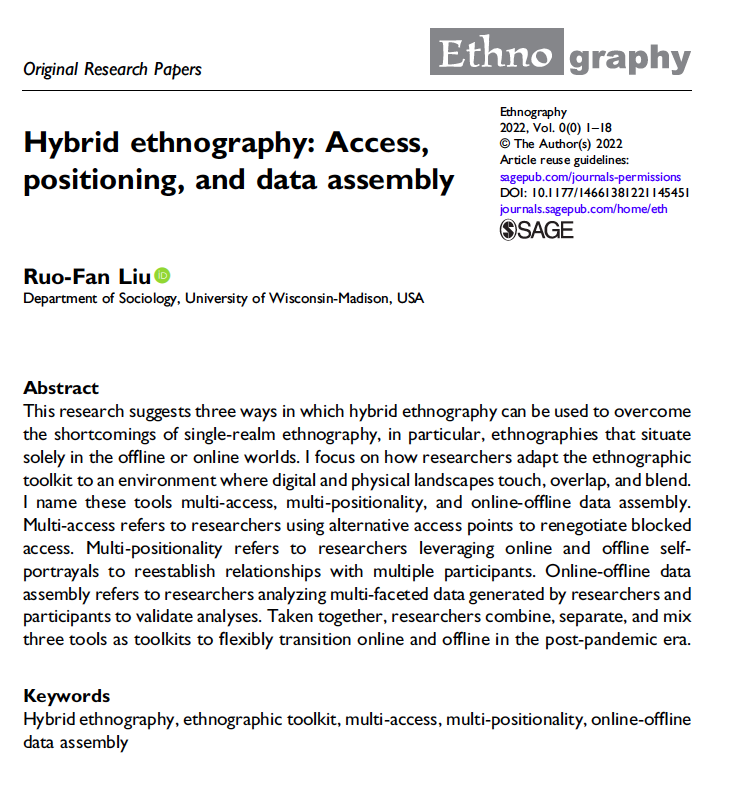
My second solo-authored article, "Hybrid Ethnography," is out in @ethnography#ethnography. I explore how ethnographers adapt existing tools to navigate the post-covid era when digital and physical landscapes constantly overlap and blend.
https://t.co/1tpONTatD4
Drawing upon a range of theoretical perspectives, including cultural studies, postcolonial theory, critical race studies, political economy and sociology, this volume examines journalism as a democratic necessity that often fails to live up to its promise.
https://t.co/yZxWLZZtXa


![LuizaJarovsky's tweet photo. 🚨 [AI POLICY] The @UN published "Governing AI for Humanity," and it's a MUST-READ for everyone in AI. Quotes:
"Left ungoverned, however, AI’s opportunities may not manifest or be distributed equitably. Widening digital divides could limit the benefts of AI to a handful of States, companies and individuals. Missed uses – failing to take advantage of and share AI-related benefts because of lack of trust or missing enablers such as capacity gaps and ineffective governance – could limit the opportunity envelope."
-
"There is no shortage of documents and dialogues focused on AI governance. Hundreds of guides, frameworks and principles have been adopted by governments, companies and consortiums, and regional and international organizations. Yet, none of them can be truly global in reach and comprehensive in coverage. This leads to problems of representation, coordination and implementation."
-
"Our recommendations advance a holistic vision for a globally networked, agile and fexible approach to governing AI for humanity, encompassing common understanding, common ground and common benefts. Only such an inclusive and comprehensive approach to AI governance can address the multifaceted and evolving challenges and opportunities AI presents on a global scale, promoting international stability and equitable development."
-
"We remain optimistic about the future with AI and its positive potential. That optimism depends, however, on realism about the risks and the inadequacy of structures and incentives currently in place. The technology is too important, and the stakes are too high, to rely only on market forces and a fragmented patchwork of national and multilateral action."
👉Read the full document below.
🔥 To stay up to date with the latest developments in AI policy, compliance & regulation, join 35,000+ people who subscribe to my newsletter (link below).](https://pbs.twimg.com/media/GX2kwcHXIAANc6S.jpg)
![LuizaJarovsky's tweet photo. 📚 [AI BOOK CLUB] "The Equality Machine: Harnessing Digital Technology for a Brighter, More Inclusive Future," by @OrlyLobel, is a must-read for everyone interested in AI, and it's our 🎉 9th selected book:
📖 About the book:
"Much has been written about the challenges tech presents to equality and democracy. But we can either criticize big data and automation or steer it to do better. Lobel makes a compelling argument that while we cannot stop technological development, we can direct its course according to our most fundamental values.
With provocative insights in every chapter, Lobel masterfully shows that digital technology frequently has a comparative advantage over humans in detecting discrimination, correcting historical exclusions, subverting long-standing stereotypes, and addressing the world’s thorniest problems: climate, poverty, injustice, literacy, accessibility, speech, health, and safety.
Lobel's vivid examples—from labor markets to dating markets—provide powerful evidence for how we can harness technology for good. The book’s incisive analysis and elegant storytelling will change the debate about technology and restore human agency over our values."
📖 Why read:
This is a great read to understand the potential positive applications of AI-powered technology and to reflect on counter-arguments and different perspectives in the context of the core debates involving AI policy, regulation & governance.
📖 Go beyond:
I recommend you also watch my conversation with Orly Lobel "AI for Good: Rethinking Risks, Privacy & Regulation" (available on my YouTube Channel), and her TEDx Talk "How we can use AI for good" (links below).
📖 Join the AI Book Club
Our AI Book Club already has 1,200+ members. Join it at the AI, Tech & Privacy Academy's website and NEVER MISS our book recommendations (link below).
Happy reading!](https://pbs.twimg.com/media/GWOoNTeXgAABqk1.jpg)
![LuizaJarovsky's tweet photo. 🚨 [AI REGULATION] @UNESCO published its "Consultation Paper on AI Regulation - Emerging Approaches Across the World," and it's a MUST-READ for everyone in AI governance. Important information:
➵ Among other topics, the consultation paper describes 9 regulatory approaches (with examples from around the world) that are extremely interesting to anyone working or studying AI governance & regulation:
"1️⃣ Principles-Based Approach: Offer stakeholders a set of fundamental propositions (principles) that provide guidance for developing and using AI systems through ethical, responsible, human-centric, and human-rights-abiding processes.
2️⃣ Standards-Based Approach: Delegate (totally or partially) the state’s
regulatory powers to organizations that produce technical standards that
will guide the interpretation and implementation of mandatory rules.
3️⃣ Agile and Experimentalist Approach: Generate flexible regulatory schemes, such as regulatory sandboxes and other testbeds, that allow organizations to test new business models, methods, infrastructure, and tools under more flexible regulatory conditions and with the oversight and accompaniment of public authorities.
4️⃣ Facilitating and Enabling Approach: Facilitate and enable an environment that encourages all stakeholders involved in the AI lifecycle to develop and use responsible, ethical, and human rights-compliant AI systems.
5️⃣ Adapting Existing Laws Approach: Amend sector-specific rules (e.g., health, finance, education, justice) and transversal rules (e.g., criminal codes, public procurement, data protection laws, labor laws) to make incremental improvements to the existing regulatory framework.
6️⃣ Access to Information and Transparency Mandates Approach: Require the
deployment of transparency instruments that enable the public to access basic information about AI systems.
7️⃣ Risk-Based Approach: Establish obligations and requirements in accordance with an assessment of the risks associated with the deployment and use of certain AI tools in specific contexts.
8️⃣ Rights-Based Approach: Establish obligations or requirements to protect individuals' rights and freedoms.
9️⃣ Liability Approach: Assign responsibility and sanctions to problematic
uses of AI systems."
➵ It's important to notice that the regulatory approaches described above are not mutually exclusive, and AI laws around the world will often combine two or more approaches.
➵ The paper will be available for open public consultation in English until 19 September 2024.
➵ Link to download the document below.
🔥 To stay up to date with the latest developments in AI policy, compliance & regulation, join 32,600 people who subscribe to my weekly newsletter (link below).](https://pbs.twimg.com/media/GV02Nc_XsAA4LwQ.jpg)