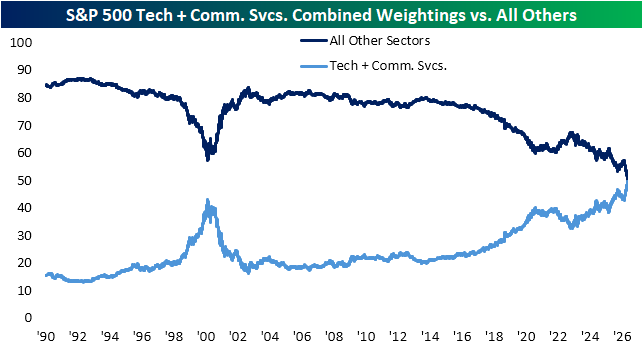
Technology and Communication Services, rounded up, now make up half of the S&P 500, while the other nine sectors make up the other half.
Crazy chart from today's Chart of the Day:
Last ten years.
Gold’s largest drawdown? 23%
vs.
Bitcoin -82%, -58%, -65%, -75%, and now near -50% yet again.
A store of wealth holds its value. It doesn’t lose half its value or more every few years.
Diesel is the pinch point. Hormuz is only part of the story. And equity markets may be missing the bigger repricing ahead.
In the latest EA Forum podcast, @ea_amrita and @CommodMkt unpack one of the biggest market dislocations in energy and commodities right now.
Key takeaways:
- The market is still conflating a deficit with a shortage and until that shifts, prices may not fully reflect the underlying reality.
- Even if the Strait of Hormuz reopened tomorrow, long-dated oil still needs to reprice on the structural set-up.
- Jeff argues this could be the biggest repricing opportunity across the commodity complex.
- Meanwhile, equity markets are in “la la land”, having repriced the energy halo lower while overlooking the broader hard asset story.
- Diesel remains the critical pinch point, with implications that feed through the entire system.
Watch the full episode now: https://t.co/fi9ii0WEwR
Recorded on 8 May, this episode features Energy Aspects Founder and Director of Market Intelligence Dr Amrita Sen and Jeff Currie, Co-Chair at Abaxx Exchange, Co-Founder of 1947 Oil & Gas Plc and Non-executive Director at Energy Aspects.
EA Forum brings together leading voices in global commodities and macroeconomics, offering unique perspectives and in-depth analysis from both EA and external experts.
#EnergyAspects #EAForum #EnergyMarkets
Looking forward to Toronto - special thanks to the Portfolio Management Association of Canada for inviting us to speak at their events:
Inquiries [email protected]
Bitcoin over the last 240 days
October 6th to June 3rd: -48%
*During one of the greatest runs for risk assets we have ever seen. What is driving this price action?
Since 2021
Bitcoin
59k to 59k
Gold
1750 to 2500
*Last ten years - Gold’s largest drawdown? 21% vs. Bitcoin -82%, -58%, -65%, -75%.
*A store of wealth holds its value. It doesn’t lose half its value or more every few years.
Seriously, why even buy an IPO after venture capital has picked over the equity for a decade??? Just buy the post-lockup dump-athon.
h/t Truist's Keith Lerner
cc @jimcramer@andrewrsorkin@BeckyQuick@SullyCNBC
The Great Bull Market Run since the 1990s
Since October:
$IBIT Bitcoin -47%
vs.
$SOXX Semis +110%
$OIH Oil Svs +65%
$SLV Silver +53%
$WQTM Quantum Computing +38%
$QQQ Big Tech +23%
$GLD Gold +15%
*Crypto has wiped out nearly $2T of wealth, per Grok.
Since 2021
Bitcoin
59k to 59k
Gold
1750 to 2500
*Last ten years - Gold’s largest drawdown? 21% vs. Bitcoin -82%, -58%, -65%, -75%.
*A store of wealth holds its value. It doesn’t lose half its value or more every few years.
*SPACEX TARGETS SALE OF 555.6M SHRS AT $135 EACH IN IPO: REUTERS
At a ~$1.8T valuation, the implied fully diluted share price aligns around that $135 range for the offering tranche.
The Dark Side of Passive Investing -- At near 6% of GDP, inflation-adjusted, the SpaceX IPO valuation is 847× more expensive than the Microsoft IPO (1986), 653x the Tesla IPO (2010), and 14x more expensive than the Facebook IPO (2012).
https://t.co/HEmmJRJ8ct
Let's see: $80 billion for GOOGL, probably $100 billion for Anthropic, $100 billion for OpenAI (maybe more) and $100 billion for SpaceX and $100 billion for Amazon? does this market have $500 billion in spare change. What has to be sold to raise it???
Best estimate - across all crypto coins - Bitcoin, total estimate of wealth lost from October 2025 to now?
Grok says: $2T
**Net loss: $4.35T (midpoint peak) – $2.4T (current) ≈ $1.95T, routinely rounded to $2T .
*Special thanks to the Bloomberg terminal.
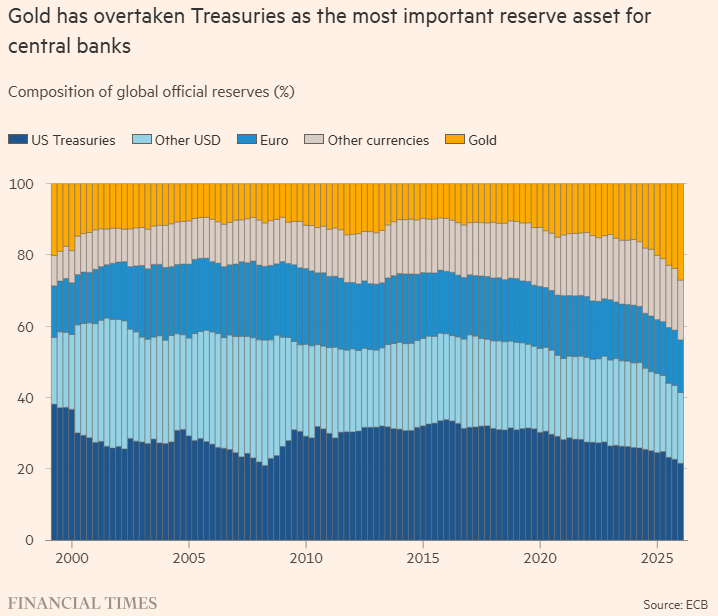
🌎 Gold has just overtaken US Treasuries as the main reserve asset held by central banks according to the ECB - FT 🚨
📈 This is a very important signal as it is above all a story about trust, sovereignty, and the reshaping of the global monetary system. For decades, US Treasuries were the reserve asset by default as being backed by the dollar, the central currency of global trade and finance. However, a shift seems to be underway. The share of Treasuries has been gradually declining while the share of gold has risen sharply, especially in recent years.
⚠️ Let's be clear, this shift does not mean that the dollar is disappearing or that the United States is suddenly losing its central role. The dollar remains outrageously dominant in international trade, financial markets, and global funding but it does show that central banks want to reduce their dependence on a single asset, a single currency, and a single financial system.
➡️ The key difference is that a Treasury is debt while gold is nobody’s liability. Therefore, in a world marked by geopolitical tensions, financial sanctions, US deficits, and the fragmentation of economic blocs, this neutrality is becoming extremely attractive again.
Gold is regaining a role many thought belonged to the past, that of a pillar of the international monetary system.
*FT link: https://t.co/E6YdndFUSe
The S&P 500 has surged 20% since the end of March, but the rally has been insanely narrow, with just 10 stocks accounting for 68% ish of the entire advance. As a result (passive Indexing), every new dollar flowing into the S&P 500 today is being allocated in a highly concentrated way: 20 cents to semiconductors (most expensive ever), 35 cents to the Mag 7 (near-record), and 39 cents to the top 10 stocks (also a record). Highly concentrated risk - S&P 500's performance has become heavily dependent on a handful of mega-cap names.
This is the moment. As a former Lehman trader I feel it’s the time speak up. We all have that responsibility, enough hubris. We must STOP this. Your 401k is on the line. I know deep down @elonmusk@chamath and @DavidSacks agree — at a $2T valuation, passive investors (the S&P 500, the Nasdaq) deserve better.