Introducing Cook Studio
The AI video platform for YouTube creators
> Give it a topic, get a publish-ready YouTube video
> Real photos from the web, YouTube B-roll, motion graphics, animation, music and SFX included
> Any length from 1 to 30 minutes
> Reference any video to get the same style
> Fix any scene of the finished video in plain words
> Adapts itself to any niche
> HeyTuber, our AI avatar model, for avatar channels
> All from a single prompt
Link in the reply
One prompt. The whole video.
Write a topic and Cook Studio makes the script, voiceover, edit with real footage and motion graphics, music and thumbnail.
Cook your first video: https://t.co/6GNG1MNT83
We just shipped an update for map scenes in Cook Studio. You can now get amazing scenes for anything told on a map, especially in history, geopolitics, economics and war niches.
And all of it from a single prompt. Unreal.
Cook Studio early access is live!
Today we started inviting the waitlist and everyone who signed up on our site.
No invite yet? Don't worry, invites go out daily and we plan to open to everyone soon.
Write a topic, get a publish-ready YouTube video: https://t.co/NG91CWUwWw
We Let You Cook on YouTube!
Write a topic, get a YouTube video ready to publish.
Script, voiceover, web and archive visuals, AI images and video, motion graphics, typography, music and editing, all from one prompt.
Sign up for early access now: https://t.co/vyKBa1hBJK
🚨 Announcement: I am looking for 100 channels to implement my 2027 YouTube playbook with!
Today, we officially open up applications for my next Accelerator cohort.
The program behind some of the fastest growing youtube channels in the world.
In October we will take 50-100 creators and give them:
- 8 weeks of intense training (all live with me)
- 30+ hours of material
- Our full playbook to dominate any niche
- Our ideation system for million view videos
- Personalized strategy support to build their plan
- Personalized feedback and execution help
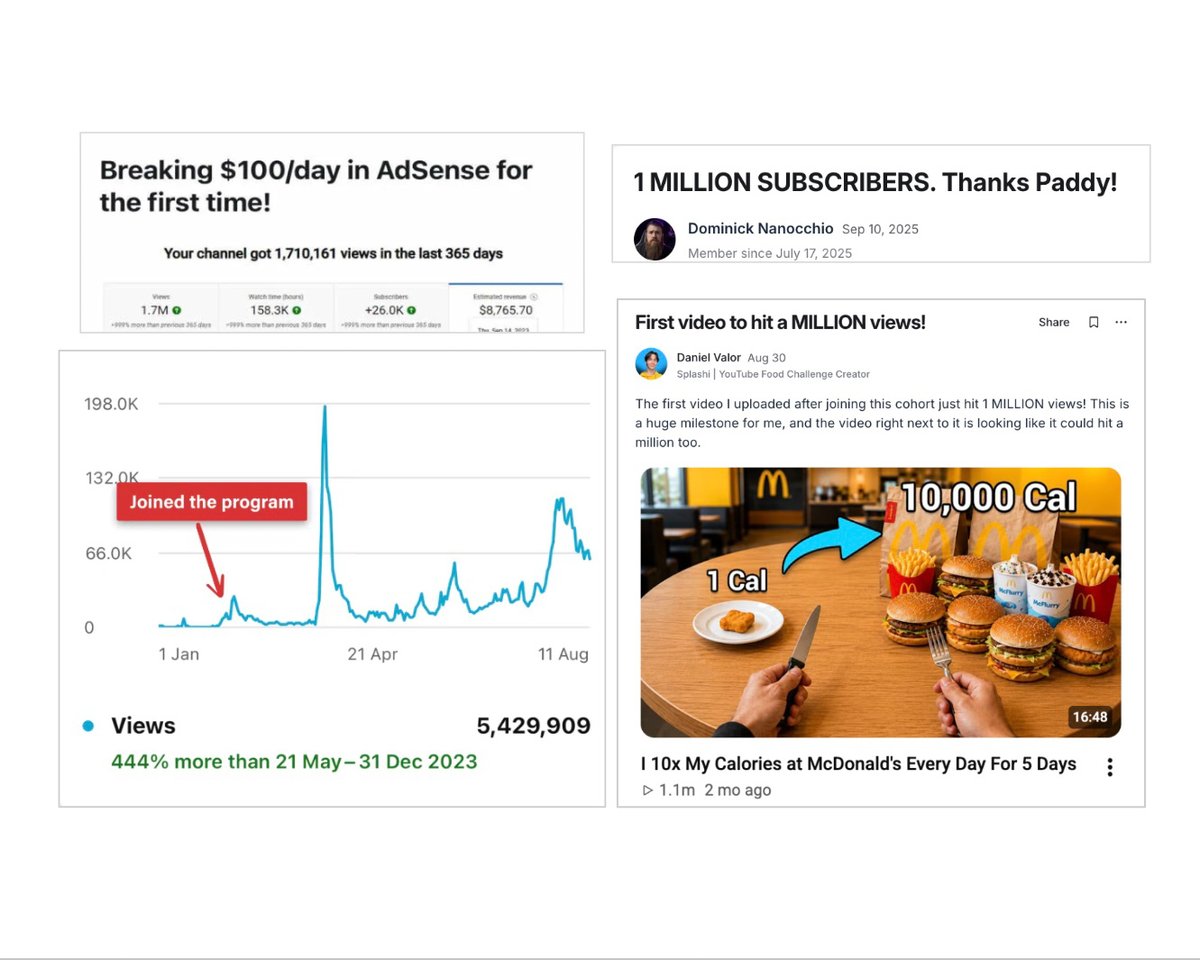
We’ve grown channels from 1k views a video to 500k+
$100/month to $10,000/month (in months)
Had multiple creators post 5m+ videos DURING the cohorts. Even some 10m+.
Look at the endless testimonials on the site (from real channels you can look up haha)
Applications open today (link below).
Apply and if we think we can grow your channel, I’ll reach out personally.
Only about 10% of applications get into the program. We prioritize student results over everything.
It's not affordable for everyone, so I’ll also be giving away a free scholarship (funded by me)!
Just RT and like this post and I’ll pick a winner on Monday.
Can’t wait to see the next group of creators go through our program and dominate 2027. ❤️
Dear new YouTube entrepreneurs (individuals, brands, agencies…),
Before you hit the record button, make sure you’ve seriously considered these 3 things:
1. Is there demand for your content? The easiest way to figure this out is by analyzing the performance of competing channels in your niche over the past 6 months. If these channels have few subscribers but still get high views, that means demand exists. If there are no direct competitors, you should look at adjacent niches (for example, if your concept is football, check out tennis channels).
2. Do you have someone who can design thumbnails and titles? Even if you create the best content in the world, YouTube’s job is simply to show your video to people who might enjoy it. From that point on, it’s all on you—you need to convince viewers to click. And the way to do this isn’t just “oh, our graphic designer can do that.” There are established best practices you need to learn.
3. Do you have the budget and mindset to keep this up for at least 20 videos or 6 months? Sometimes it takes months for a channel to reach its ideal audience. Continuously producing high-effort, amazing content without anyone watching is psychologically very tough. That’s why you need to be sure you have the strength to keep going.
If you struggle at these stages, have the courage to seek support. Getting help—from me or from someone else—can save you a serious amount of time and money. How do I know? Because it took me years and thousands of dollars to learn these lessons.
Good luck!
MrBeast is starting his first Kick stream today. This is big news for YouTubers and streamers because it could affect industry dynamics—and, by extension, the fate of us content creators. How so?
1. I’ve previously said that, with the rise of AI-generated content, I expect an “inflation” of such material, which will create demand for more “human” content.
2. Currently, the best places to find the most “human” content are live streaming platforms—meaning streamers.
3. Until now, streaming had a sort of YouTube–Twitch balance. Then Kick entered the game, competing with both by using low-latency streaming tech, showing fewer ads to viewers, and offering higher payouts to creators.
Up to this point, streaming culture was somewhat closed off—a culture of its own, sustained by both viewers and creators.
BUT,
MrBeast’s entry into this space means over 400 million potential subscribers could:
1. Move to Kick
2. Discover live streaming culture
For Kick, this is obviously a turning point. YouTube is backed by Alphabet, Twitch by Amazon, and Kick… by an online crypto gambling platform. I don’t endorse the company behind it, but it’s impressive that they’re running a campaign capable of competing with global giants.
Back to the point—this single stream could spread live streaming culture to a much broader audience, even mainstream it. That means traditional content creators may need to start exploring live streaming strategies, and existing streamers will have to think about how to survive in the growing competition.
The hard part is that we still don’t have a solid data set to define clear strategies for streaming. That’s why we’re trying to adapt traditional content creation methods to live streaming. Personally, I’m constantly researching growth strategies in streaming, and I’ll keep sharing my findings with you.
Thanks for reading.
ME ADIN AND XQC ARE GOING LIVE ON AUGUST 14th FOR MY FIRST KICK STREAM! WE CANT END THE STREAM UNTIL WE RAIZE $5,000,000 FOR TEAMWATER HOPEFULLY IT DOESN’T TAKE DAYS
FOLLOW ME - https://t.co/TEuH9Xg5iX
In the media industry, you’ll encounter several types of managers. I categorize them based on their backgrounds as follows;
1. Design-oriented
2. Production-oriented
3. Writer-oriented
4. Sales-oriented
1. Design-oriented:
These are the ideal managers for businesses producing content on highly visual platforms, especially Instagram. They usually have a strong aesthetic vision, are stylish, and charismatic. They set high standards for visual quality. However, their weak point is that they often don’t give enough attention to the textual, strategic, or financial aspects of the business.
2. Production-oriented:
They often start as camera operators and work their way up to director. They have a deep understanding of set culture, value hierarchy, and work in a disciplined manner. Some also develop skills in finance and communication; these tend to move toward producing. They realize their potential best in production-focused environments such as production companies. However, because they are generally less adaptable, they often struggle in the fast-changing world of digital media.
3. Writer-oriented:
In my opinion, the best managerial candidates come from this group. A good writer, when crafting a script, must consider every element—from visuals to music, from editing to emotional impact. This process equips them with a comprehensive vision as well as strong organizational and coordination skills.
However, there’s a risk: some writers become too immersed in writing and drift toward pure literature, failing to develop their managerial skills. On the other hand, writers who are open to other fields can achieve outstanding results both creatively and managerially. Still, for them to generate revenue for a business, they either need to develop their commercial skills or be complemented by sales-oriented managers. Personally, if I were to start a new agency or YouTube channel, I would still appoint a writer-oriented person to lead it.
4. Sales-oriented:
Having focused on one goal—sales—throughout their careers, they master this field. They have excellent communication skills and are generally well-liked by people. Once they gain enough experience, their ability to persuade others on almost any subject becomes very strong. This is why they make the best managerial candidates for any business whose primary goal is “making money.” However, to lead creative processes, they usually need to be complemented by production-oriented managers.
Are there multi-functional managers who come from a specific background but have developed themselves in many areas? Of course, but they are rare. Here’s to all managers with a broad vision.
Regardless of whether it’s YouTube or any other industry, I divide managerial work ethics into three types of people:
1. Those who learned it from their fathers
2. Those who have no idea
3. Those who have chosen their own ethics
The first category has learned a “way” and follows it. They were usually raised under a strong father or managerial figure, but they have no concern about creating a new “way.” They know the basic principles, guard them closely, and because these are tried-and-proven methods, the chance of failure is quite low. They usually have few interests outside of work. Their work is their life, and thus it comes before everything else.
The second category builds their methods entirely around their personal weaknesses or strengths. If they were once made to suffer, they make others suffer. If their work was once stolen, they steal. If they were once humiliated in their job, they humiliate others. Especially in interpersonal relationships, they tend to take problems and difficulties personally. This leads them away from rationality and toward emotional reactions. As a result, we see the kind of people in business life who are commonly called “high-ego” or “bad managers.” This is often seen in people with strong business skills but weak emotional capacity. The problem is that these people usually think they belong to the first or third category.
The last category is very rare. These people reject all the systems taught or imposed on them. They trust in rational thinking and the voice of their conscience. They make all decisions—especially those affecting others—by passing them through an internal filter they have developed through knowledge, experience, and feeling. Since they have built their own moral framework, their style is shaped uniquely around it. They may see work more as a tool for living a good life. Therefore, they do not define themselves by their job. However, since they don’t have a proven method like the first category and their life is not entirely about work, their chances of success are lower compared to the first group. But if they do succeed, they create some of the most remarkable success stories in their industry.
Since there may be current or future bosses reading this, I’d like to remind you: you can choose who you want to be.
I remember the moment I published my first video on YouTube.
I watched every single 1% as it uploaded. Then I must have checked the title, description, and meta tags fifty times to make sure everything was right. Finally, I hit the “publish” button. For the next few days, I kept refreshing the analytics page over and over, watching the numbers in real time.
Today, I calculated that I’ve clicked that publish button more than three thousand times. And yet, the excitement I feel when releasing a video is still as fresh as it was on day one. You never really get used to it. It’s like a child showing their work to their parents, an actor stepping on stage, or a musician performing at a concert—because you’re putting something you’ve created out there for a crowd to judge and hopefully appreciate.
Some content creators constantly ask themselves, “Why am I not getting views?” But the real question they should be asking is: Does the idea of making a video truly excite me? Or am I doing this purely for the money?
3 updates for current or aspiring content creators;
1. Even with the GPT-5 update, GPT still can’t write text at an ideal level (I’ll let you know when it can).
2. For most people, it’s not possible to gain meaningful financial or personal rewards from YouTube with entirely AI-generated “low-effort” content (especially for beginners).
3. I expect a significant inflation of AI-generated content, so you should focus on strengthening your human touch (on-camera presence, voice-over, storytelling, video editing, etc.).
Questions are welcome in the comments.
Today, in the world of content creation, we’re sitting on top of a gold mine. How so?
For example, at first, there was only one YouTuber.
Then others came along, drawing inspiration from the filming styles, editing approaches, title and thumbnail choices, and content structures of the YouTubers before them. Each time, they built upon what came before—until they eventually developed their own unique style. Just like in other forms of art.
I don’t think there’s ever been a time in history when making videos became so widespread—when everyone had access to all the equipment, social trends, and culture needed to create great videos, and, more importantly, when content creators had at their fingertips such a vast library of unique and proven content formats. No matter what your interests are, there are millions of videos and styles you can draw inspiration from.
Creativity is a wonderful thing, and I’m always excited about the new ideas that are yet to come.
@mktbrew Yes, of course. This is what I do for a living. But unfortunately, it doesn’t end with strategy. Just like an orchestra, you have to execute many different disciplines well at the same time. Only then does the music come to life. How about you?
What people who try a concept on YouTube and fail often blame:
1. The algorithm is punishing me
2. YouTube is shadow banning me
3. People are too stupid to understand my content
What’s actually happening:
1. Choosing the wrong content strategy — or having none at all
2. Creating content with zero demand or that’s overly experimental
3. Not picking a niche and posting videos for different audiences on the same channel
4. Failing to create differentiation and curiosity in the title and thumbnail
5. Not using a hook at the beginning and losing viewers right away
6. Being unaware of in-video retention techniques
…
The list goes on.