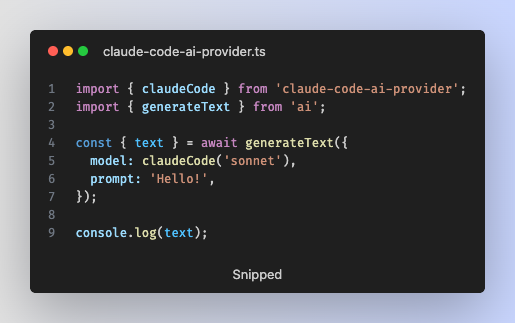
Created a community provider for Vercel AI SDK that integrates Claude Code.
Enables Claude MAX users to build local LLM applications using the standard Vercel AI SDK interface.
The provider was implemented with assistance from Claude Code itself.
https://t.co/UE4CWVkqiu
Announcing The Stargate Project
The Stargate Project is a new company which intends to invest $500 billion over the next four years building new AI infrastructure for OpenAI in the United States. We will begin deploying $100 billion immediately. This infrastructure will secure American leadership in AI, create hundreds of thousands of American jobs, and generate massive economic benefit for the entire world. This project will not only support the re-industrialization of the United States but also provide a strategic capability to protect the national security of America and its allies.
The initial equity funders in Stargate are SoftBank, OpenAI, Oracle, and MGX. SoftBank and OpenAI are the lead partners for Stargate, with SoftBank having financial responsibility and OpenAI having operational responsibility. Masayoshi Son will be the chairman.
Arm, Microsoft, NVIDIA, Oracle, and OpenAI are the key initial technology partners. The buildout is currently underway, starting in Texas, and we are evaluating potential sites across the country for more campuses as we finalize definitive agreements.
As part of Stargate, Oracle, NVIDIA, and OpenAI will closely collaborate to build and operate this computing system. This builds on a deep collaboration between OpenAI and NVIDIA going back to 2016 and a newer partnership between OpenAI and Oracle.
This also builds on the existing OpenAI partnership with Microsoft. OpenAI will continue to increase its consumption of Azure as OpenAI continues its work with Microsoft with this additional compute to train leading models and deliver great products and services.
All of us look forward to continuing to build and develop AI—and in particular AGI—for the benefit of all of humanity. We believe that this new step is critical on the path, and will enable creative people to figure out how to use AI to elevate humanity.
Anthropic CEO Dario Amodei is in Davos.
- AI could surpass human intelligence in the next two or three years
- Anthropic will be running over 1 million GPU's by 2026
- voice mode incoming for Claude!
- better memory for Claude
- smarter models 'in the coming months'
元祖コンパウンド戦略の超急成長スタートアップRippling創業者Parker Conradのインタビュー備忘メモ。
「多くのB2Bソフトウェアのビジネスモデルは根本的に破綻している」という凄まじい発言もあり、食い入るように動画見てしまった。AIやFounder Modeに関する見解も非常に学びになった。
・多くのB2Bソフトウェア事業の根本的では、ビジネスモデルは破綻している。
過去5年で、上場B2Bソフトウェア企業は営業/マーケティングを50%増やしたが、獲得した売上/New ARRは10%下がっている。
企業数が増えすぎ、競争が激しくなりすぎている。これがコンパウンド戦略を支持する背景の一つになっている。
"Fundamentally the business model for a lot of software is just broken..."
・AIによって企業はより少数精鋭集団のように運営されるようになる。
AIによって、2000人企業は200人のように、200人企業は20人のように、運営されるようになる。たとえ会社が巨大になっても、CEOとCTOの深いディスカッションが、ひとりのEngineerの意思決定に影響を与えられるようになる。CEOやCTOは現場で何が起きているのかを正確に理解できないが、AIにはできる。
・AIによって、B2Bソフトウェアはカスタマイズされるようになる。
全ての企業は固有の独自のニーズをもっている。AIを使えば、特定の業界、ビジネス、ニーズに合わせて、ソフトウェアをより正確に構成できる。コードを書かずに、コードレスソフトウェア開発の本来の姿に戻れる。カンブリア爆発のようなあらゆるソフトウェアの爆発的増加が起こり、ソフトウェアは、カスタマイズされる。
・AIのInside Sales/SDRは機能していないし、将来も大きな期待は得られない。
AIは魅力的なヒントをくれるものの、実際にはうまく仕事ができていない。将来、それが反転し、彼らがそれをできるようになったとしても、人々が期待しているようなインパクトは得られない。「おぉ、すごい!これでセールスとマーケティングが楽になる!」というようなことは起こらない。なぜなら、人々がアウトバウンドが多すぎて圧倒され、チャネルとして機能しなくなるからだ。
・コンパウンド戦略をとることで他社が追随できない研究開発に投資できる。
コンパウンド戦略であれば、あらゆるソフトウェアに恩恵を与えられるため、分析、承認、自動化などの機能に大きな投資をして、最先端のソリューションにすることができる。
・Founder Modeは大きな問題が起きているときだけ機能する。
創業者モードであっても企業には優秀な重役が必要。会社を運営するには、人を採用し、経営を手伝ってもらう必要がある。ただし、何かが壊れている場合や、重要な問題がある場合に、創業者モードが機能する。トップダウンだけで問題を修正することはできない。問題の根本まで行き、サポートチケットを確認したり、営業電話を聞いたり、 問題を理解するまで、ある程度の期間、現場で仕事をするべき。ずっと下まで降りていくべき。
・PMFにおいては、うまくいかないアイデアは、すぐに諦めるべき。
世の中には、とにかく頑張れ、諦めるなというアドバイスがあるが、それは最悪なアドバイス。うまくいっていないことを軸にして、最終的にそれがうまくいくようにビジネスを転換するなんてことは、ほとんどない。Airbnbの話はいつも出てきますが、ほとんどの場合はそうはならない。アイデアを5つほど考えていたのですが、そのすべてが信じられないほどうまくいった。信じられないほどうまくいった。PMFとはそのように起こる。
AI agents have the ability to fundamentally change the business model of enterprise software. Today, when you build a SaaS product, the primary business model is to sell seats that are tied to the end-users of your service. For "same store" sales, you can essentially grow at the rate of the headcount growth of that customer, or by adding additional capabilities on top of your offering. This business model is, of course fantastic, and has been around since the earliest days of enterprise software, and will keep going forever.
But AI Agents unlock an entirely new business model in software, because you can now grow in a way that is uncorrelated to direct enterprise headcount or even external factors to your software. What's amazing about this model is that the AI vendor actually can directly grow itself within an enterprise account due to direct productivity gains.
For instance, imagine an AI Agent that can generate outbound sales demand for a startup. Traditionally, B2B companies will start by hiring a very small team of maybe one or two people, and increase resources in this area in a very incremental fashion -- essentially a process that looks like a guessing game where you try to predict how much demand there might be in the market, the ability to fund new resources, and the length of time it takes to hire great talent. In a world of AI Agents, you would simply set a budget and then decide how fast you want to grow. This is much closer to the business model of Google Adwords than it is of a traditional SaaS service.
The same would be true for entirely different functions, where AI Agents can develop software at the rate of how many software projects you want built or how many legal documents you want reviewed -- all unconstrained by a company's headcount. This will even happen in areas where you wouldn't initially expect demand levels to change just because you move to AI, but in fact where there's plenty of latent demand. For instance, in front-line support, in a world where AI Agents can answer a greater set of questions a customer might have, you could see the kind of interaction volumes going up far higher in a world of AI.
This all has major implications to the economics of software, and it means that the AI Agent business model goes after a far greater pool of spend than just traditional IT. If software products now directly *drive* company productivity instead of just *enabling* company productivity, this could lead to a step-function change in the size of IT markets over time. Wild.
A 9-part series on RAG from Prototype to Production ⭐️
RAG in a notebook is easy, RAG serving live production users is hard. This tutorial series by Marco Bertelli is the perfect step-by-step resource to outline all the architectural components you need to productionize a full RAG server:
1. Introduction and setting up prototype RAG
2. Incorporating conversation history, user feedback, advanced RAG
3. Setting up the right document store for dynamic RAG
4. Building and deploying backend to Heroku with CI/CD
5. (Most recently) Building and deploying FE to AWS Cloudfront with ACLs on S3
Check out the latest tutorial which concludes this series - deploying FE to AWS and GitHub: https://t.co/L3inn3mcxJ
To start at the beginning, check out this tutorial instead: https://t.co/NrElgD3xY4
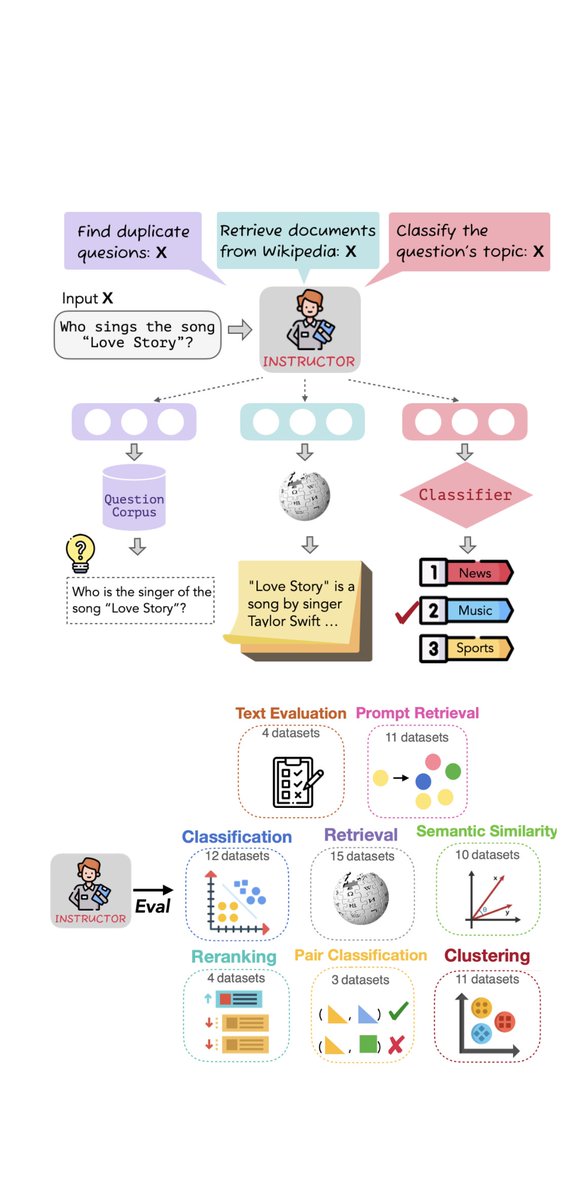
🙋♀️How to present the same text in diff. tasks/domains as diff. embeddings W/O training?
We introduce Instructor👨🏫, an instruction-finetuned embedder that can generate text embeddings tailored to any task given the task instruction➡️sota on 7⃣0⃣tasks👇!
https://t.co/mD8UeVg4WE