@TheSnoozeDoctor Mediocre middle management continues to thwart attempts to deliver the highest standards of clinical care. How can one fly like an eagle when one is surrounded by turkeys?
@mancunianmedic@sophia_edw28123 Even with low risk, elective work when things don’t go to plan in the private sector the NHS is relied upon to pull the chestnuts out of the fire. The private sector in the UK isn’t truly independent; it’s an unhealthy, symbiotic relationship.
@MitchellGlenn Asgiriya is unique in being the only school cricket ground in the world that has also been an international test cricket venue. It is owned and maintained by Trinity College, Kandy, a private school for boys established in 1872.
@mancunianmedic@CrazyVibes_1 ….and we were paid one third of the hourly rate (UMTs, later ADHs) for the extra hours worked! Ours was not to reason why- perhaps it was loyalty to the teams and institutions that helped us sustain the pace.
I want to explain to constituents why I’m supporting resident doctors who are taking strike action.
I know strikes are unpopular with many people. I understand that. When doctors strike, it can feel worrying or frustrating, especially when it affects patients and their families. No one takes that lightly, least of all doctors themselves.
But if we care about the NHS and want it to survive and improve in the long term, we have to understand why this is happening.
Resident doctors are fully qualified doctors. They do much of the day-to-day work in our hospitals. They diagnose illness, treat patients, work nights and weekends, and keep services running. From the moment they enter medical school to becoming fully qualified specialists, they train for around 10 to 15 years.
Most leave university with £70,000 to £100,000 or more in student loan debt. That debt builds interest and, for many, follows them for much of their working lives. We are asking people to take on enormous personal financial risk in order to serve the public in one of the most demanding professions there is. That should give us pause.
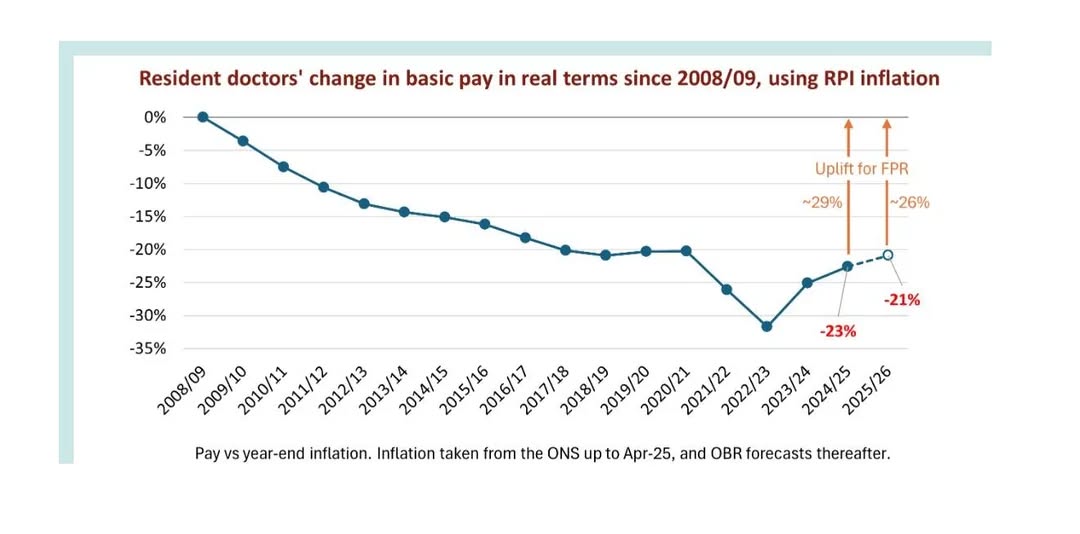
For the past 15 years or so, resident doctors’ pay has fallen sharply in real terms (see the attached graph), while workloads and pressures have increased. This is not disputed. Many are exhausted, burnt out, and struggling with housing and childcare costs. Unsurprisingly, growing numbers are leaving hospital medicine, moving abroad, or leaving the profession altogether.
That is not just a problem for doctors. It is a problem for patients.
When doctors are overstretched and exhausted, risks increase. When doctors leave the NHS, waiting times lengthen. When staff turnover is high, continuity of care breaks down and trust suffers. And when training becomes unattractive, we end up with fewer experienced doctors in the years ahead.
In other words, doctors’ working conditions shape patients’ care.
Doctors do not strike lightly. They would far rather be caring for patients. But many feel this is the only remaining way to protect the future of the NHS and prevent it being hollowed out by burnout and staff shortages.
Supporting resident doctors is not about taking sides. It is about recognising that a safe, publicly run health service depends on valuing the people who keep it going. That means doctors, nurses, cleaners, porters, anaesthetists, and administrative staff alike.
But this dispute also reflects something bigger.
Since the 2008 financial crash, many working people have seen real-terms pay cuts while public services were brutally underfunded or completely cut. The public paid the price for a crisis they did not cause, while the rewards at the top recovered far more quickly. It is not unreasonable for people to question whether that settlement is fair or sustainable.
Rather than seeing this strike as an inconvenience, we might see it as something to reflect on. When working people organise to demand fair treatment, it forces politics to confront how our economy works and who it works for.
Because right now, workers, small businesses, sole traders and many others are not getting their fair share of the nation’s considerable wealth, while large corporations, banks and those who already hold assets take far more than their share. That is not the politics of envy. It is simply a statement of reality. And crucially, it is not inevitable. It is the result of political choices, and different choices are possible. This ultimately is what 'change' should mean when it's promised by a Labour government.
Thus, backing resident doctors is about protecting the NHS for the long term. It is also a reminder that if we want a fairer and healthier society, we need an economy that properly values the people who hold it together.
And that's, you.
From the art of reading minds to a robot that can do your chores, these are the most-watched TED Talks of this year — did any of your favorites make the list?
Watch them all here: https://t.co/4e1mbW4ldX
You did it!
Thank you to the wonderful #OUfamily for raising over £193,000 for the Open Futures Fund – thanks to you, more students can begin their OU journey and unlock their potential!
Branden Baptiste, the first person in the world to receive base editing for sickle cell disease, reflects on how his life has changed since he received the new form of gene therapy (via @BostonChildrens) https://t.co/4j9Q7MHC3N
@sharrond62@Iwanrunner Impressed by your dispassionate analysis of some thorny issues affecting Olympic sports & sports in general at the Times event yesterday. Excellent panel ably moderated by Matthew S.
Wonderful memories & Olympic highlights + a glimpse into the psyche of elite athletes.Thank you
@mancunianmedic Today is a gift; that’s probably why we call it the ‘present’. Yesterday is history, tomorrow is a mystery.
It is an aggregation of ‘todays’ that we call a life. Make the most of today. Ask yourself how you could best use the next hour; today is a microcosm of our lives.
Daddy, throw me in the air
Daddy, let’s go for a bike ride
Daddy, let’s go get ice cream
Daddy, let’s play catch
Daddy, can you help me learn this?
Daddy, can you tuck me in?
Daddy, let’s read books together
Daddy, let’s dance
Daddy, come and wrestle me
Daddy, play “daddy monster”
The answer is always yes
In medicine, new drugs / technology / new ways of working enter clinical practice when:
1) they are shown to have better clinical outcomes to existing practice
2) they are cheaper ( with similar or better outcomes )
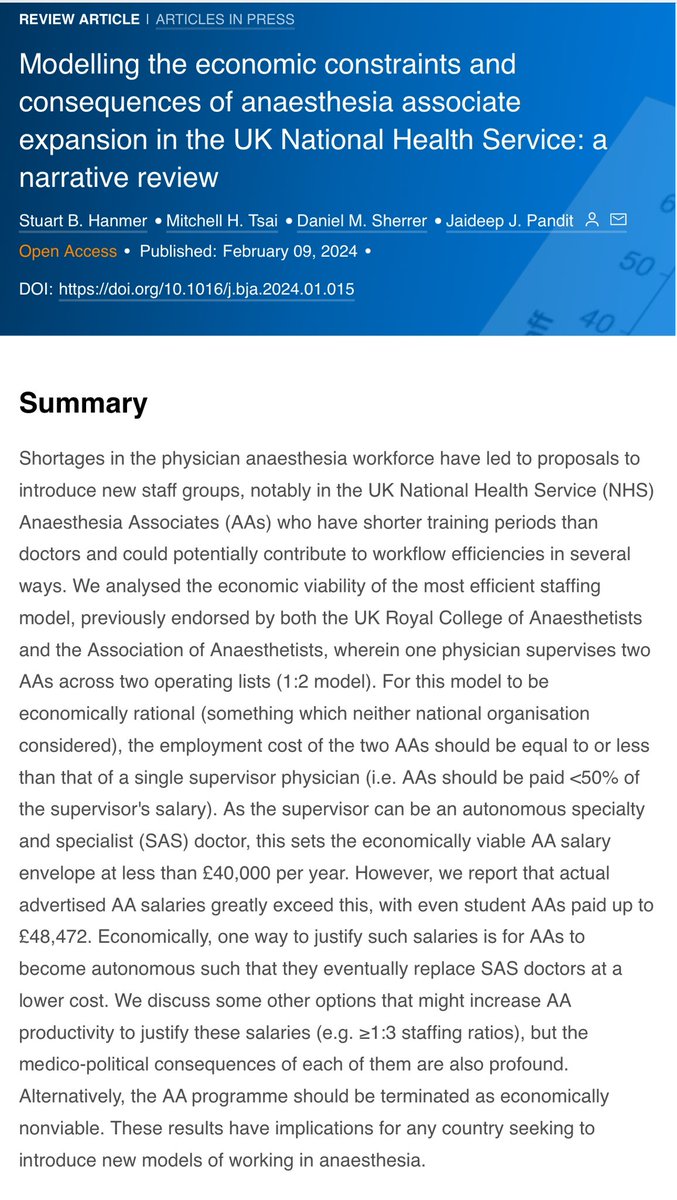
Anaesthetic associates are not doctors / anaesthetists and represent a risk to pts. New research suggests that they are more expensive than usual care: https://t.co/XRsEYJv9lQ
Why are we funding more expensive anaesthesia practices that provide worse quality of care than simply employing an anaesthetist doctor?
The experiment has failed- expanding these roles is simply burning money for inferior clinical services that place patients at risk.
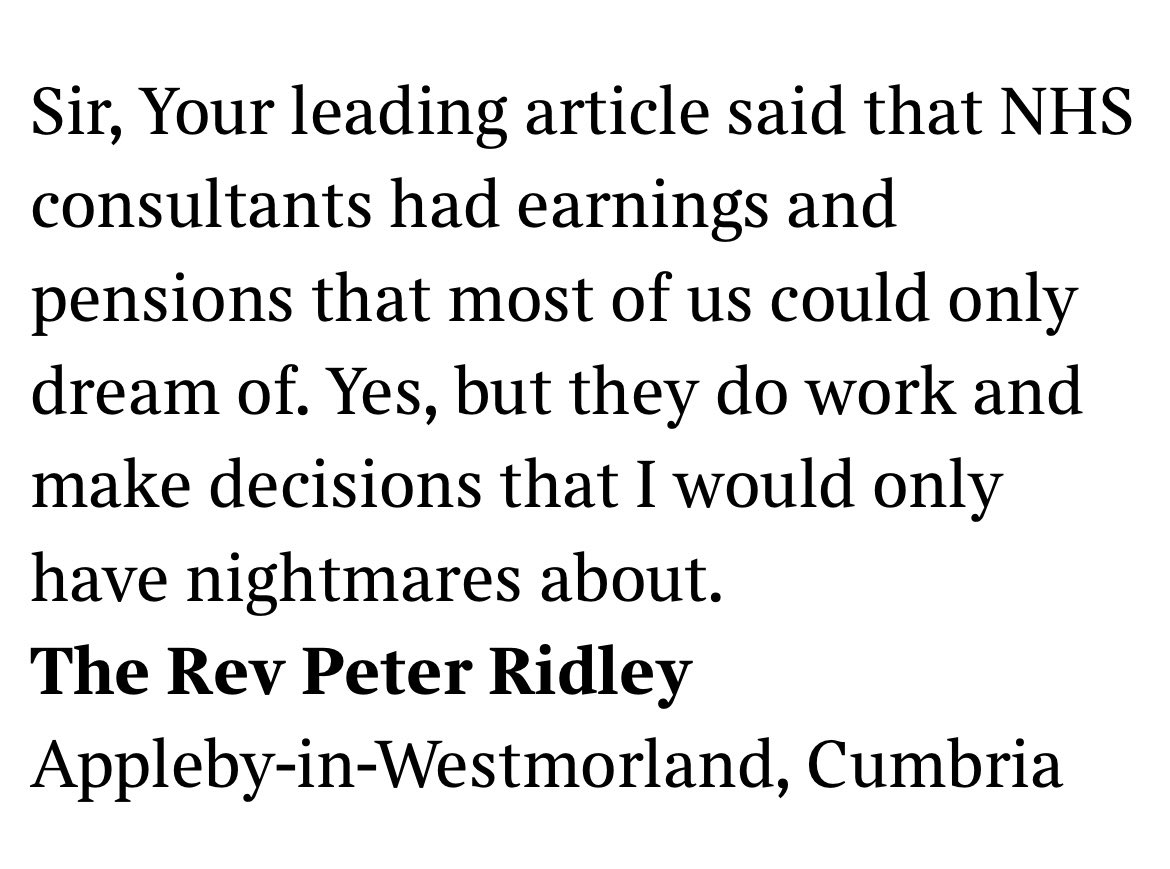
So much smearing & belittling of consultants in the press, but this, from today’s @thetimes letters page, could not have put it more beautifully.
Pls RT if you agree.
#NHS 💙