Tokenized stocks have arrived on @aave V4 on @base.
The Mag-7 are now collateral, with USDC to borrow. Our team assessed every token and designed the launch parameters.
As a risk service provider to the Aave DAO, we're paving the way for new forms of collateral on Aave.
Tokenized stocks have arrived on @aave V4 on @base.
The Mag-7 are now collateral, with USDC to borrow. Our team assessed every token and designed the launch parameters.
As a risk service provider to the Aave DAO, we're paving the way for new forms of collateral on Aave.
Tenbin's first asset is live.
Introducing Tenbin Gold (tGLD): Liquid, Yield-bearing Tokenized Gold.
Built for instant on-chain liquidity with DeFi utility.
https://t.co/0TESwDZ6As
We respect the decision of Chaos Labs to step down as one of the two risk managers for the Aave DAO.
We want to thank Chaos Labs for their work over the years. They have been a valuable partner to the Aave DAO, and their contributions have helped Aave grow and mature.
There is no disruption to the Aave Protocol, its smart contracts, asset listings, or network deployments, and we will work closely with Chaos Labs during the offboarding process.
Aave operates with a two-layer economic risk model that has been managed by Chaos Labs and LlamaRisk. While this model does create tension between risk managers from time to time, we believe it has been valuable in safeguarding Aave. We strongly support maintaining a two-layer approach and will continue supporting this model, alongside an additional technical risk layer managed by Aave Labs.
Over the past weeks, we held discussions with the Chaos team regarding next steps, as Chaos was exploring winding down its risk consultancy services business (and had already begun winding down some agreements with other protocols).
We were generally supportive of a 2× increase in their risk management payment to $5M, but not supportive of $8M without a separate addendum at a later stage if the workload proved higher than anticipated.
What we did not support were other elements of the proposal, including setting Chaos Labs as the sole risk manager and using Chaos Labs price oracles instead of Chainlink on all new deployments, as well as adopting Chaos Labs vaults as the default vaults (which are not yet audited) for all B2B integrations.
While we do not see issues with these Chaos products or their future viability, we strongly believe that, given the scale of the Aave protocol, it should maintain at least a two-layer risk management model and vendor lock-in free vaults. Additionally, given the strong track record with Chainlink, we prefer to continue supporting Chainlink for price oracles, which our users are currently more comfortable with at scale.
Regarding Aave V4, the architecture introduces isolated risk markets through Spokes, new liquidation logic, and governance-controlled parameters that give the DAO more granular control over how it manages risk across different markets and assets. We held multiple risk calls with Chaos Labs employees in attendance well before V4 went live, and the feedback we received during those sessions does not align with the concerns expressed in their post.
For the immediate future, Aave Labs will work closely with LlamaRisk to ensure a smooth transition and uninterrupted risk coverage for the protocol.
LlamaRisk already serves as a risk contributor to the Aave DAO and has deep familiarity with the protocol’s architecture and parameters. We support LlamaRisk increasing their budget to accommodate this additional workload and expanding their team as needed. Aave Labs will also contribute engineering and analytical resources wherever necessary to support this transition.
We also want to thank the entire Chaos Labs team for their contributions over the years, as they have helped bring the protocol we built into its current level of maturity.
We analyzed the full mechanics, including the math behind the dynamic IRM and the specific legal considerations for partners like BlackRock’s BUIDL and Coinbase. Read the full research here: https://t.co/Z5FzvSaXnk
@aave held $1.2B USDT in idle liq last year, diluting the avg. 5.7% borrow rate to a 4% supply rate, while the SOFR benchmark sat higher. This spread is an efficiency opportunity!
Here's how V4’s Reinvestment Controller could optimize this capital without compromising solvency 🧐
Community Discussion Framework
LlamaRisk published this research to provide a data-driven framework for the community. The goal is to discuss how the protocol can optimize idle liquidity and enhance lender yields using these new mechanisms, ensuring any implementation is robust and safe.
The Idle Capital Opportunity
Throughout 2025, the USDT market maintained a substantial liquidity buffer. While this ensures safety, it dilutes lender returns. By sweeping this float into low-risk strategies such as US Treasuries or Money Market Funds, simulations suggest the protocol could boost APY to 4.93% (at full utilization) while generating secondary revenue for the DAO.
Managing Liquidity Latency
Reinvesting idle cash requires careful management of redemption times. Historical data show that withdrawal shocks are often front-loaded. If funds are in T+1 settlement cycles during a withdrawal event, the protocol needs a mechanism to bridge the gap.
Dynamic IRM Calibration
To mitigate this, the research proposes a dynamic Interest Rate Model. It calculates utilization based on "Maximum Theoretical Utilization" (physical cash + reinvested assets). If physical cash runs low while funds are being reclaimed, rates adjust to incentivize repayments, protecting the protocol’s liquidity profile.
Regulatory & Operational Considerations
Integrating off-chain assets requires distinct structures. The report explores two paths: a Protocol-Managed model or a User-Opt-In Staking model. The latter may offer better alignment by matching user liquidity preferences with the redemption windows of the underlying RWA strategy.
As preparations for @aave V4 intensify, the shift to a modular architecture allows to redefine the design space of lending markets. Our analysis dives into how Aave V4 can compose Hubs, Spokes, and Credit Lines to achieve desired risk and efficiency properties. 🧵
The core of Aave V4 centers on Hubs (liquidity containers) and Spokes (functional modules). This allows the protocol to move from a one-size-fits-all pool architecture toward a highly customizable setup. LlamaRisk has mapped the theoretical design space into four of many possible models:
🔹 Model A: The Monolithic Hub
This is an evolution of the current paradigm where the vast majority of liquidity resides in a single, primary Hub. It offers the highest liquidity depth and capital efficiency, stabilizing interest rates by avoiding fragmentation. However, it lacks structural isolation; a failure in one long-tail asset could threaten the entire Hub’s solvency.
🔹 Model B: Risk-Profiled Hubs
This reimagines the protocol as a platform of distinct credit funds. Assets are segregated into tranches—Low-Risk, High-Yield, and High-Risk—each with its own independent liquidity and dedicated Umbrella safety module. While this protects conservative depositors from speculative volatility, it can lead to shallower markets and more complex setup of risk premiums.
🔹 Model C: Asset-Centric Hubs
This model organizes Hubs by specific categories or ecosystems, such as RWAs, LSTs, or asset issuer-specific markets. It facilitates rapid, permissionless innovation by allowing external protocols to have dedicated, Aave-powered credit markets. The trade-off is Null Internal Diversification, where a de-peg in a specific ecosystem could wipe out its entire dedicated Hub.
🔹 Model D: The Hybrid Model
A sophisticated approach that combines a stable, deep Low-Risk Main Hub with various isolated satellite Hubs. The Main Hub acts as a senior lender, cautiously extending credit lines to selected satellite Spokes. This preserves deep liquidity for blue-chip assets while allowing the protocol to expand into experimental markets without compromising the core's solvency.
Inter-Hub Credit Lines
A novel feature of V4 is the ability for liquidity to flow from a parent Hub to a Spoke of a secondary Hub. This solves the cold start problem for new assets via Liquidity Bootstrapping and provides a lender of last resort mechanism for Spoke Stabilization during periods of high utilization volatility.
Generalized Spokes
The modularity allows for diverse functionalities beyond simple borrowing:
• Vaults Spokes: Enables segregated, bankruptcy-remote positions for institutional actors.
• Debt Trading Spokes: Allows users to swap debt obligations (e.g., USDC debt for USDT debt) without unwinding underlying assets.
• GHO Direct Minting Spokes: Provides architectural control over stablecoin minting parameters directly at the liquidity layer.
As governance weighs these or even more options, the focus must remain on the interplay between capital efficiency and the containment of systemic risk. These are the points LlamaRisk will focus on when participating in the Aave V4 architecture definition process.
A common view about the Oct 10 market crash is that had Aave not hardcoded $USDe's price to $USDT and used a regular price oracle, DeFi would have been rekt
In reality, Chainlink's $USDe Price Feed closely tracked the market-wide price of $USDe, which filtered the depeg from Binance and more closely followed the redemption value and onchain markets
Hardcoding USDe pricing to USDT was the prudent for Aave to make, and while there are improvements to be made (i.e., using CRE + LllamaGuard, similar to Horizon market), I think people largely over-exaggerated the counterfactual
The Oct 10, 2025 market crash showed the significance of pricing strategy. This wasn’t a solvency crisis, it was a pricing failure.
We looked at $USDe and the future of risk managed price feeds, powered by @chainlink and #LlamaGuard.
Read our full analysis ↓
In our series on bug bounties for @Aave listed assets, today we focus on @monerium. With $23M+ in circulation, lacking a bug bounty leaves critical parts of the ecosystem exposed. Bug bounties are a vital defense layer.
Hey Monerium, here's how your program can be improved👇
Monerium currently does not have a publicized bug bounty program. The lack of a bug bounty removes a critical layer of security, weakening incentives for ethical hackers and limiting risk identification to internal teams and periodic audits.
As the first onchain Euro stablecoin, EURe, currently secures over $23 million. We believe that a bug bounty program with a max bounty of at least $50,000 should be introduced to protect these funds. A minimum bounty of this size would incentivize skilled researchers to identify any potential vulnerabilities.
Although centralized issuers like Monerium rely on regulatory and legal frameworks for post-incident recourse, these reactive measures cannot prevent exploits targeting critical infrastructure, custodial keys, or operators themselves. A robust bug bounty program provides the proactive safeguard needed to reduce reliance on after-the-fact interventions.
Introducing LlamaGuard NAV ⛊
A next-gen oracle for RWAs, built with @chainlink & @aave, is going live in production on Aave Horizon. It delivers dynamic, risk-adjusted NAV feeds with automated safeguards, powering secure and scalable DeFi.
Read the full announcement ↓
In our series on bug bounties for @Aave listed assets, today we focus on @tether. With $170B+ in circulation, a $10k max bounty is far below recommended minimums and leaves the ecosystem exposed. Here’s what we suggest 👇
@tether’s HackerOne program currently maxes out at $10,000. That’s simply not commensurate with USDT’s scale.
We recommend a $50k minimum and clearer coverage for custodial keys, admin tools, domains, and staff-facing systems. These are high-impact attack surfaces that legal recourse can’t prevent in real time.
Please consider raising the cap and widening scope. It would materially reduce systemic risk. @tether@PaoloArdoino@ClaudiaLagorio
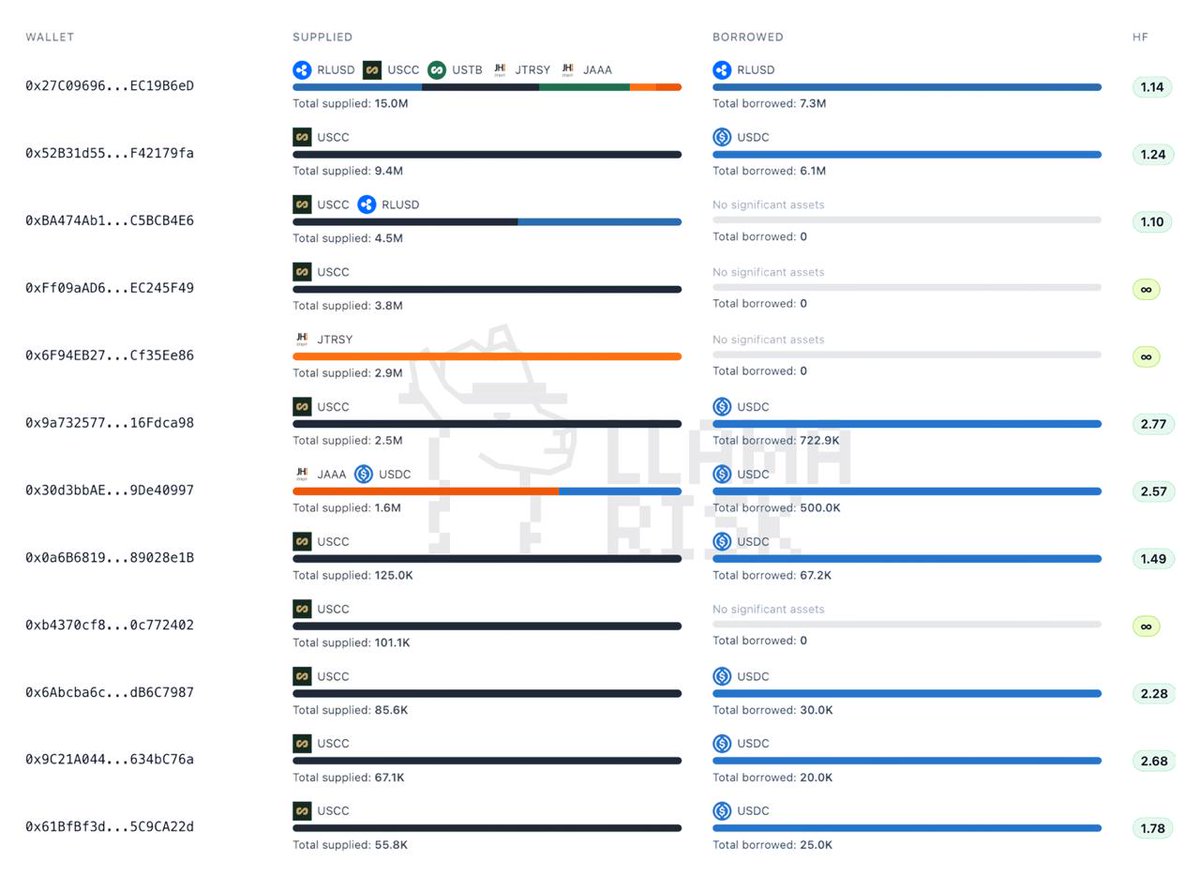
First week of Horizon is behind us. TVL surpassing $80m & over $16.5m RWA-backed loans, the protocol is showing promising results! Built on @aave V3 with @chainlink bounded NAV feeds, Horizon combines DeFi liquidity with institutional-grade risk oversight from LlamaRisk.👇
➡️ Key Performance Metrics:
- Total Value Locked (TVL): Exceeded $80 million. Stablecoin deposits constitute approximately $50 million of this total.
- Total Borrows: Surpassed $16.5 million.
- RLUSD Supply: The supply cap was raised twice (from $25M to $40M) to accommodate demand, which was influenced by an active rewards campaign. The cap was reached rapidly
- USCC Supply: The supply cap was increased from $10.6M to $40M. Horizon now holds approximately 7.5% of the total on-chain supply of USCC.
➡️Three primary use cases we expect:
1- Instant Institutional Credit: Access immediate working capital by borrowing against tokenized assets, avoiding issuer redemption delays and fees.
2- Leveraged Carry Trades: Execute a carry trade by borrowing stablecoins against yield-bearing RWAs, using recursive looping to scale the position and capture the basis between the borrow rate and asset yield.
3- DeFi Yield Generation: Generate yield through two primary avenues: passively supply stablecoins to earn interest from institutional borrowing, or actively execute farming strategies like supplying an RWA to mint and stake GHO.
3 months into @Aave's Umbrella module, the data is compelling! This first-loss layer is a vast improvement on the legacy Safety Module, boosting efficiency, cutting the cost per dollar of coverage from $0.21 to $0.12. Our quants dug into the on-chain data—here's what we found.👇
First, a quick recap. Umbrella is a set of first-loss capital vaults (USDC, USDT, WETH, GHO) that act as the first defense against protocol shortfalls. Deployed by @bgdlabs, its architecture features permissionless slashing, which can be triggered once a deficit is recognized above a parametrizable offset. The impact on efficiency for the @AaveAave DAO is undeniable: the annual cost per dollar of coverage has plummeted by 43%. A full transition could drop this cost to an incredible $0.028.
This success is fueled by strong capital inflows, with the modules attracting a cumulative $554M in deposits. Beyond just Aave users, Umbrella pulled in $164M in new capital from across the ecosystem, including Binance, Sky Protocol, Fluid, and Morpho. More importantly, the capital is sticky, with ~82% retention among new users from identified protocols.
Digging deeper, we see significant whale influence, especially in the WETH module, where one whale group accounts for ~54% of the TVL. We also observed a "perpetual cooldown" behavior: while up to 45% of funds in the USDC module are in the 20-day cooldown, actual withdrawal rates are low (~38-40%), as users obtain optionality while continuing to earn rewards.
The ecosystem is already building on top of Umbrella, with DeFi protocols like @pendle_fi and @yield creating secondary markets for the staked tokens. This adds another utility layer and signals a strong future for the module's composability.
Overall, the first three months show the Umbrella Safety Module is a major step forward in capital efficiency and protocol safety for @Aave. We’re excited to contribute to the next phase of the Umbrella roll-out!.