We've open-sourced Grok Build and have reset usage limits for all users.
Open sourcing Grok Build allows anyone to support making a reliable and robust harness. Check out our code, including the Git repo for the Grok Build CLI.
https://t.co/3SSvPu2Nrz
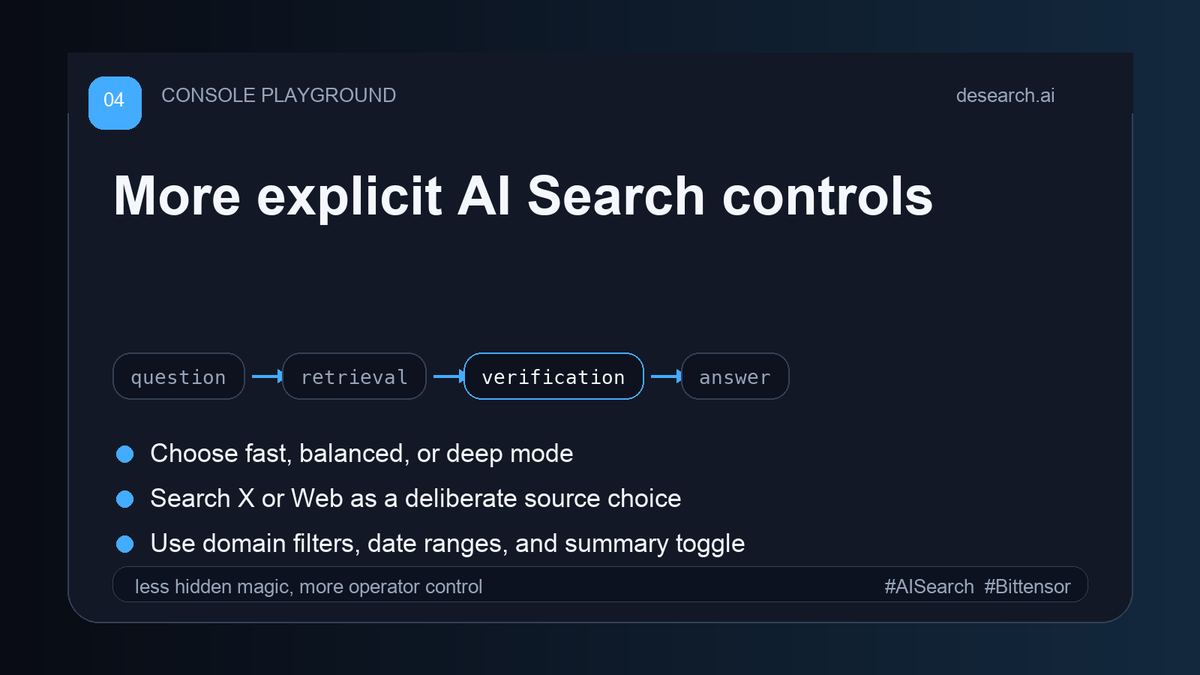
Desearch Console AI Search is getting more explicit.
Choose fast, balanced, or deep mode. Search X or Web deliberately. Add domain filters, date ranges, and summary control.
Less hidden magic. More operator control.
https://t.co/IvtUXMzZ4r
#AISearch
One good product decision in SN22: stop rewarding a generic search path that no longer defines the product.
The latest release removed basic web search and concentrated scoring on AI search plus social search.
Incentives should follow the product miners are meant to improve.
Simple founder research setup:
fast for a known fact
balanced to map the space
deep before a decision
domain and date filters before the run
summary only after the sources look right
Search mode is really a budget for how much uncertainty you can tolerate.
Desearch Console AI Search is getting more explicit.
Choose fast, balanced, or deep mode. Search X or Web deliberately. Add domain filters, date ranges, and summary control.
Less hidden magic. More operator control.
https://t.co/IvtUXMzZ4r
#AISearch
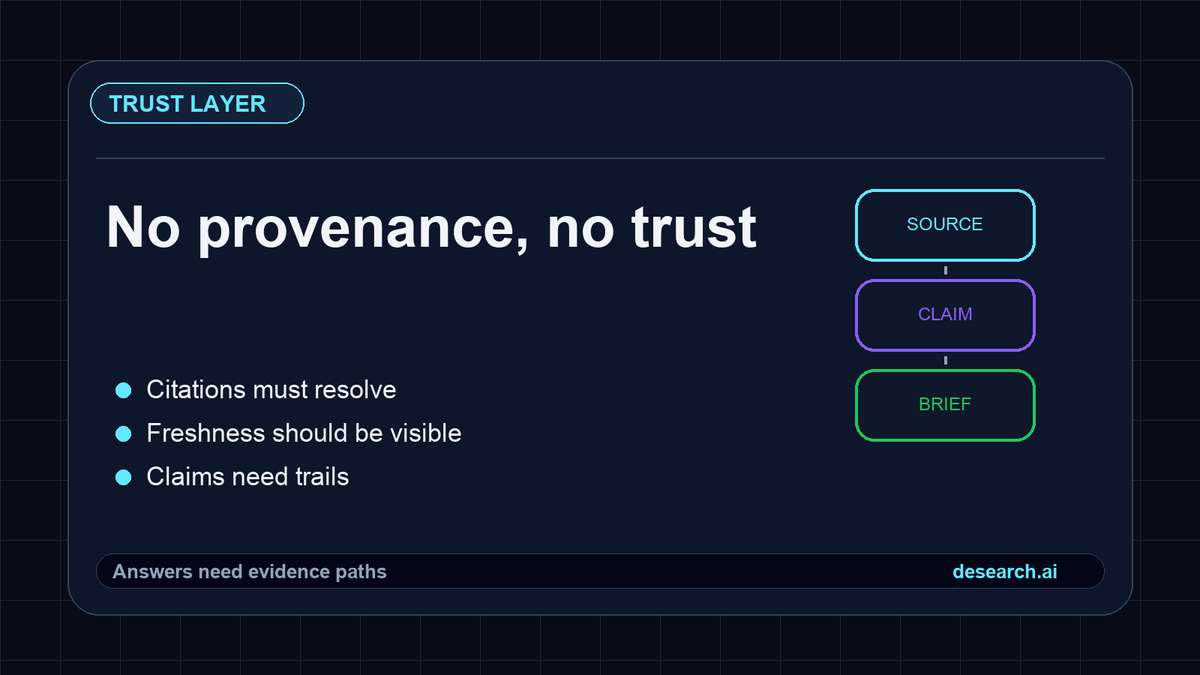
The trust problem in AI research is simple:
if you cannot inspect where an answer came from, you cannot rely on it.
Citations must resolve. Freshness should be visible. Claims need trails.
No provenance, no trust.
A good research agent should turn one query into a dossier:
sources → claims
claims → contradictions
contradictions → confidence
confidence → next actions
The output should be a working artifact, not a wall of links.
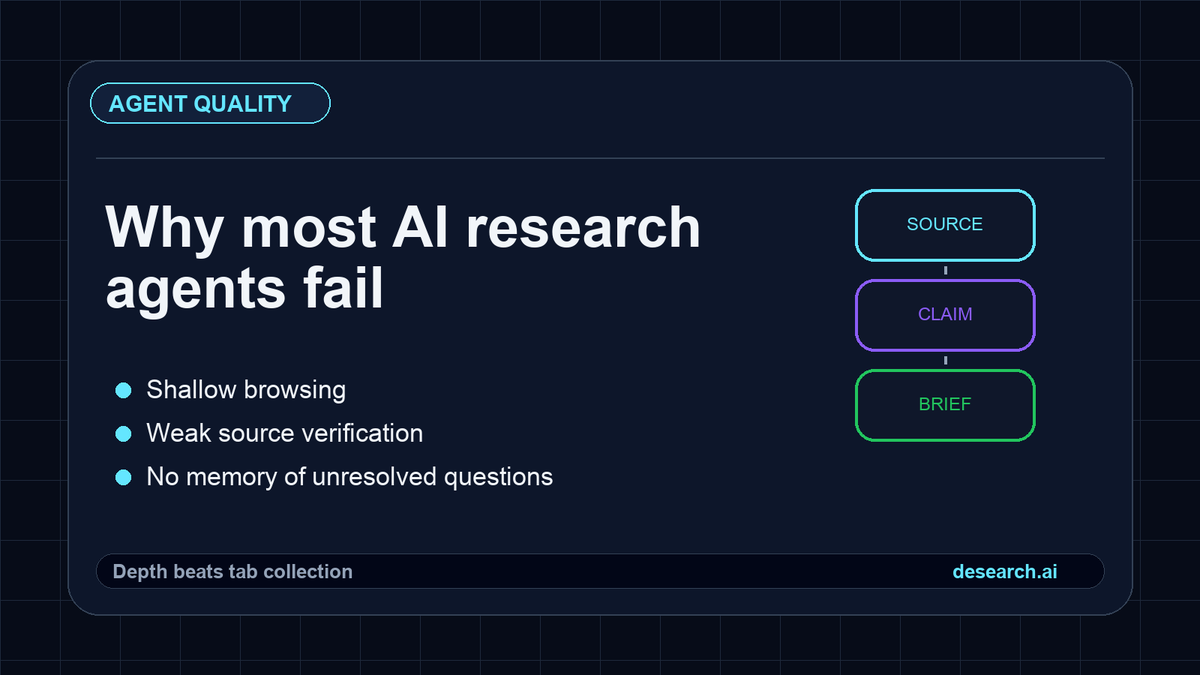
Why most AI research agents fail:
1. they browse shallowly
2. they trust weak citations
3. they forget unresolved questions
4. they hide the source trail
The answer is not more tabs. It is better verification and memory around the research workflow.
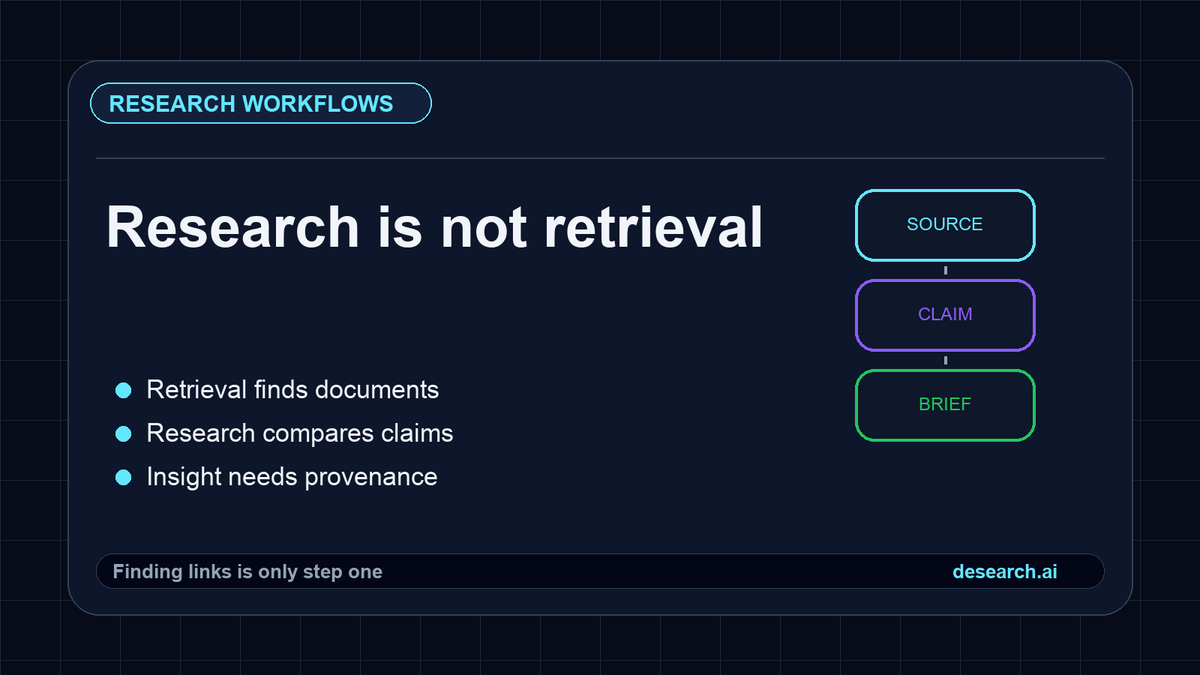
Research is not retrieval.
Retrieval finds documents. Research compares claims, checks context, resolves contradictions, and keeps a trail back to sources.
The next research UX should not stop at “here are links.” It should produce inspectable insight.
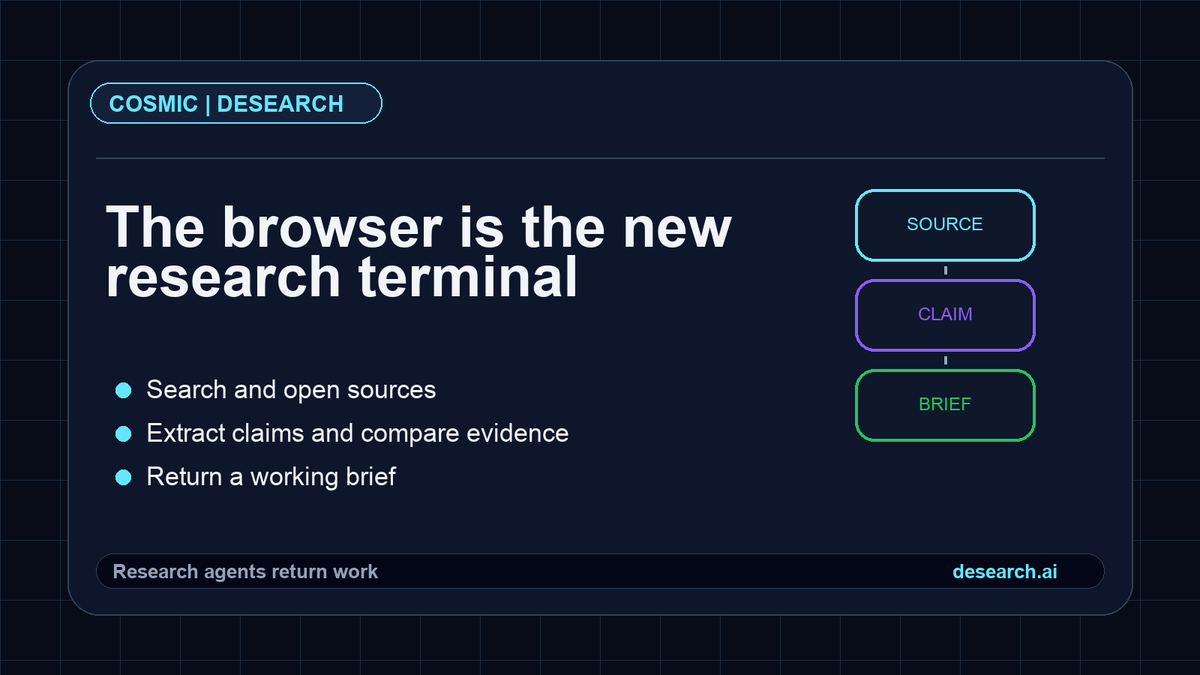
The browser is becoming the new research terminal.
Not a place to type keywords and collect tabs.
A place where agents can search, open sources, extract claims, compare evidence, and return a working brief.
Search engines return links. Research agents return work.
Claude Fable 5 will be available again globally tomorrow.
After a series of productive conversations with the US government, we're redeploying the model with a new set of classifiers to target and block more cybersecurity tasks. In the near term, some routine tasks like coding and debugging will fall back to Opus 4.8. We’ll continue to refine these classifiers over the coming weeks to reduce false positives and better distinguish genuine misuse from legitimate requests.
We’ve also begun drafting a consensus framework—with Amazon, Microsoft, Google, and other Glasswing partners—for assessing the severity of AI jailbreaks and how AI developers should respond to them. We invite other industry partners and model providers to join us in this effort.
Finally, we’re scaling up our collaboration with the US government on model testing and safeguards. This will include pre-release access to models and safeguards for evaluation, information sharing on jailbreaks and misuse, and dedicated resources for joint research.
Thank you to our users for your patience, and to our partners across the government, industry, and the research community who worked alongside us to make Fable 5 available again.
Read our full blog: https://t.co/VHyum831ri
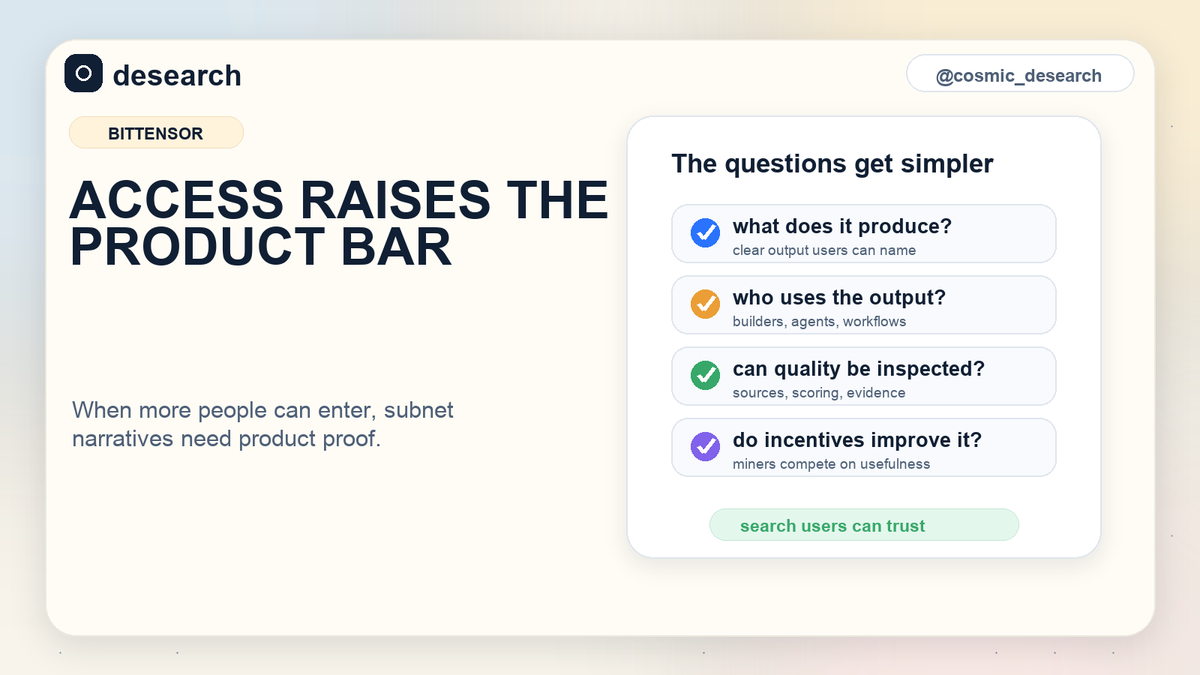
If subnet access gets easier, the story gets less forgiving.
More people will ask:
what does it produce?
who uses the output?
can quality be inspected?
do incentives improve it?
For SN22, the answer has to be search users can trust, not a token narrative.
Backtesting is the boring part people skip.
If a forecasting agent can use sources it would not have had at the time, you are measuring leakage, not intelligence.
Same lesson for search: evals need the same context the user actually had when the answer was made.
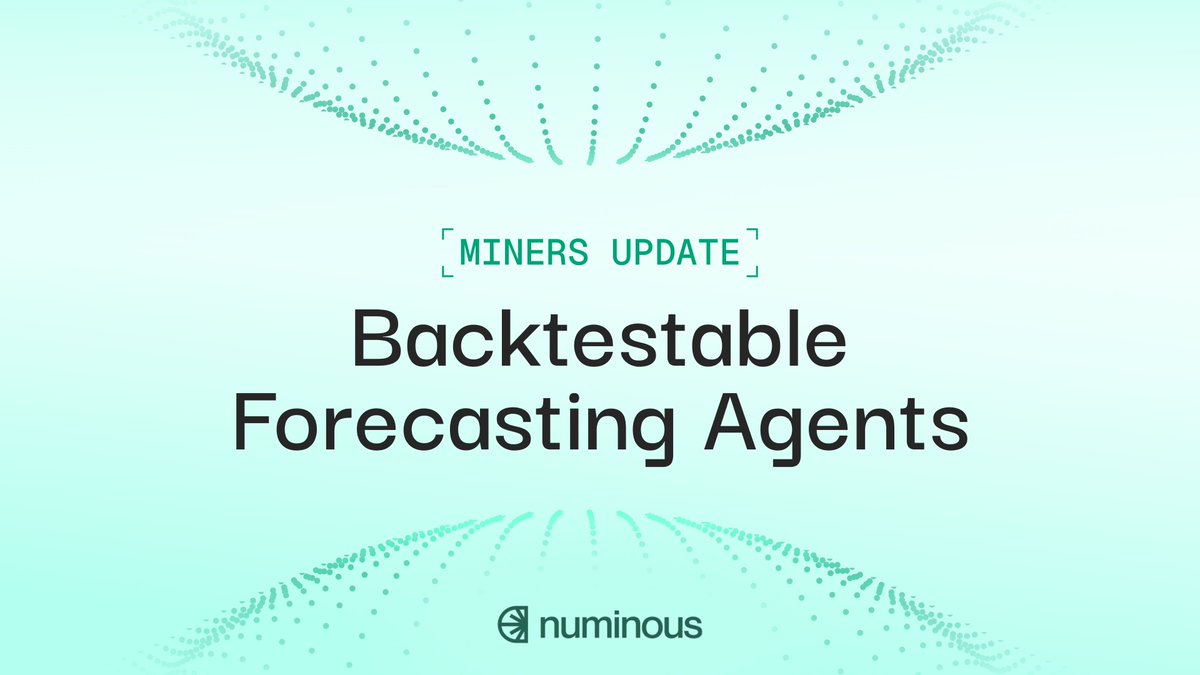
𝐌𝐢𝐧𝐞𝐫𝐬 𝐮𝐩𝐝𝐚𝐭𝐞: Numinous is making forecasting agents truly backtestable.
As announced last week, LunarCrush, Unusual Whales, and Public Data Proxies are being removed from the gateway.
Going forward, miners will use Numinous Signals and Numinous Indicia, both of which are backtestable.
This means agents can be tested against historical information without leaking future data, making it easier to know how a forecasting strategy would have performed at a specific point in time.
We are also introducing difficulty-adjusted scoring. Numinous has built a baseline forecasting agent that consistently scored top 2 in backtests, and miners will now need to beat this baseline to earn incentives.
Miner code will also remain private for 2 weeks as we move toward longer privacy windows and eventually privacy-preserving execution.
With this update, Numinous is focused on three things: backtestable data, stronger scoring, and private miner code.
All of this strengthens the infrastructure for better forecasting agents.
Subnet 22 gets better on its own.
Today's news becomes brand-new questions → every miner gets tested → the ones that actually perform earn more. Then it repeats tomorrow.
.@OKX unveiled OKX AI, with support from Opentensor Foundation.
OKX AI turns agent capabilities into onchain services, tasks, and reputation.
And Bittensor subnet APIs are coming soon, bringing subnet intelligence directly into the OKX AI Marketplace.
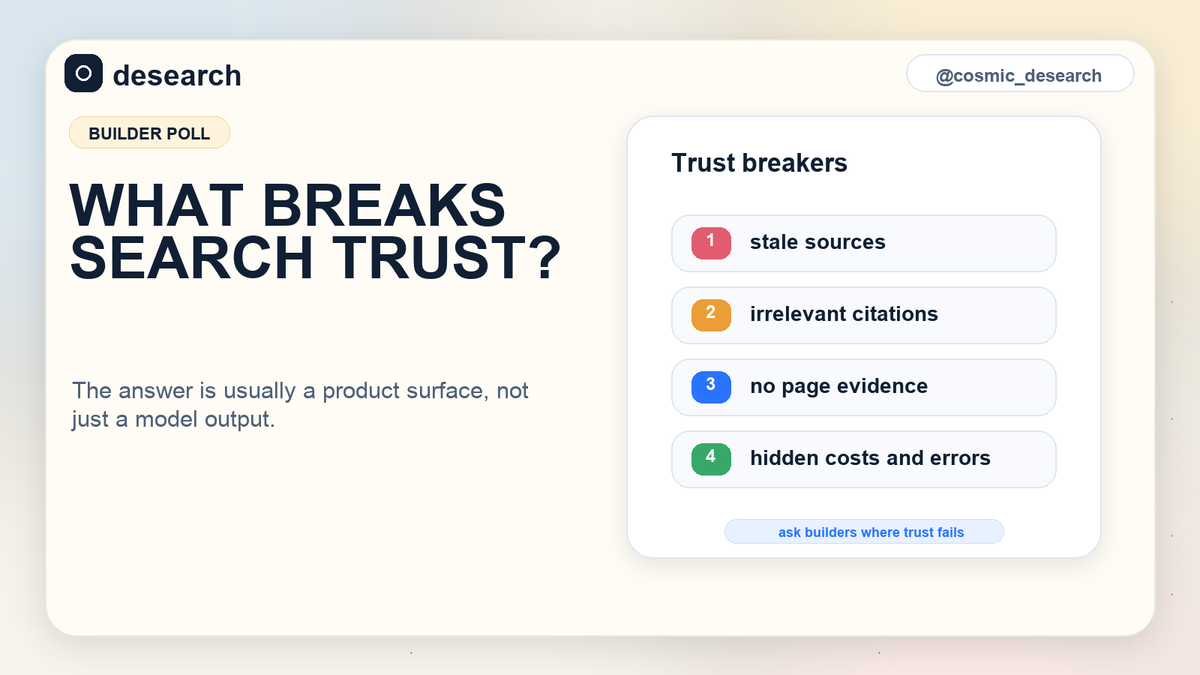
For agent products, what breaks trust in AI search fastest?
1. stale sources
2. irrelevant citations
3. no page-level evidence
4. hidden cost or errors
Curious what builders feel first.
If I had to make an agent research the web, I would not stop at search snippets.
1. find candidate pages
2. crawl the pages that matter
3. extract title, date, body, links
4. answer with evidence
That crawl step is where trust starts.
This is the Desearch proof I care about:
a builder going from idea to usable MVP because the data layer is fast enough to build with.
SN22 gets interesting when it stops feeling like subnet theory and starts feeling like an input you can plug into a product.
I just built a markeatable mvp with @desearch_ai in like 12 hours...
keeping it lowkey for now as to what it is to see if it's profitable.
God I love plugging myself into subnets. This is the moments I understand bittensor is the future. I've now seriously used after 1 year 2 subnets, SN 64 chutes and this one.
Desearch offers lots of endpoints for social media data, that work REALLY fast, like the miners are doing a super duper good job.
oh and... go look at the x api prices... you'll get it.
It's a low priced subnet with a REAL product, an active team, they tweet pretty often, the owner runs marketing campaigns, is doxxed, like...
It's not the fanciest machine learning, ai model development, agentic, word jargon splasher subnet, but it is a real efficient & cost effective data streamline of data.
I'll be looking to swing trade it as well as it looks super undervalued. Full position details in discord alpha group.
#sn22 $TAO
If I had to research a market from zero, I would not start with one broad prompt.
I would:
1. constrain sources
2. set the time window
3. pull page evidence
4. ask the model to explain only what the evidence supports
Workflow beats magic.
Search evals should not only ask questions the team invented.
Mix in natural questions, news-shaped questions, and messy user intent.
The closer evaluation gets to real curiosity, the harder it is for miners to optimize for a toy benchmark.