🚀 15 years ago, NASA’s Dawn spacecraft made history by entering orbit around Vesta, the second-largest object in the asteroid belt.
Dawn spent over a year studying Vesta’s surface, geology, and mysterious past before continuing its incredible journey to Ceres, becoming the first spacecraft to orbit two extraterrestrial bodies. 🛰️🌌
One mission. Two worlds. Countless discoveries. ✨
@NASAhistory A remarkable life and an unforgettable legacy. 🌕🚀 Celebrating his birthday in quarantine after making history on the Moon makes the story even more incredible.
@NASAhistory 55 years later, Apollo 15 remains a landmark in lunar exploration. 🌕🚀 From the Moon’s surface to a safe Pacific splashdown—an incredible chapter in human spaceflight history.
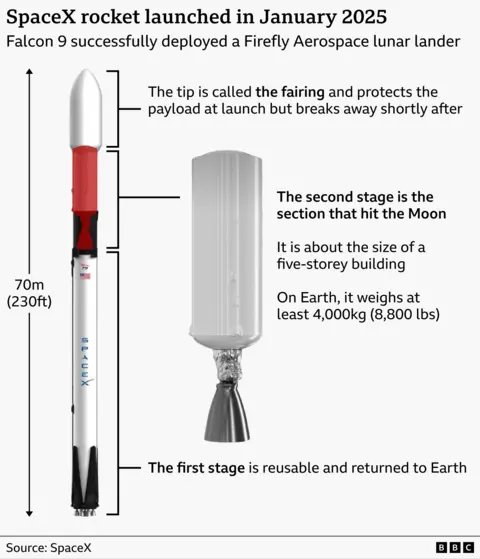
🌕 A rocket crash on the Moon could become an unexpected science experiment.
An empty SpaceX Falcon 9 upper stage is believed to have slammed into the lunar surface at roughly 5,400 mph (8,700 km/h), near the Einstein crater.
While the impact itself would have been difficult for amateur astronomers to observe, powerful observatories are analyzing data from the event.
For planetary scientists, the crash could provide a rare opportunity to study how a large artificial object interacts with the Moon’s surface.
The impact may help researchers better understand crater formation, lunar soil (regolith), debris patterns, and the physics of high-speed impacts—knowledge that could become increasingly valuable as humanity prepares for a new era of lunar exploration.
The Moon has been hit by asteroids for billions of years.
Now, humanity has accidentally added another experiment to the record. 🚀🌕🔬
Sometimes, even a rocket crash can teach us something about another world.
@SpaceX@Starlink 24 more Starlink satellites riding Falcon 9 into orbit. 🚀
What’s impressive isn’t just the launch—it’s how SpaceX has turned deploying an entire constellation into something that looks almost routine. 🛰️🔥
The future of space infrastructure is being built one launch at a time.
@marsrepublica He has built an impressive track record of scaling manufacturing at extraordinary speed. The ability to move from plans to massive operational facilities is a major competitive advantage. 🚀🏭
🚀 JUST IN: SpaceX Is Preparing to Launch Starlink Mobile
SpaceX is reportedly transforming its direct to cell initiative into a full retail mobile carrier called Starlink Mobile, with a consumer launch targeted for the end of 2027.
The service is expected to go beyond providing satellite backup through partners like T Mobile, combining satellite connectivity with terrestrial networks to offer customers a seamless mobile experience under the Starlink brand.
If successful, Starlink Mobile could reshape the telecom industry by taking on traditional wireless carriers and bringing satellite powered mobile coverage directly to consumers on a global scale. 📱🛰️🚀🌍
Inside ASML’s EUV system, 50,000 microscopic tin droplets are fired into a vacuum every second. Each one is hit twice by a CO₂ laser — a soft pre-pulse to flatten it, then a main pulse that detonates it into plasma at roughly 220,000°C. That is about 40 times hotter than the surface of the Sun.
That explosion emits light at 13.5 nanometres. That light prints the circuits inside your phone, your laptop, and every AI chip on the planet.
The newest one, the High-NA EXE:5200B, costs around $380 million and ships in 250 crates. Intel installed the first production unit in December 2025.
A star, ignited fifty thousand times a second, just so your phone can exist. Kubwa sana.
🌍 NASA has released a striking new map of Earth’s gravity field.
It reveals tiny variations in gravity across our planet—shaped by differences in Earth’s mass, terrain, oceans, and structures deep beneath the surface.
Earth isn’t perfectly uniform. Even its gravity tells a story. 🛰️🌎
@WorldAndScience A stunning reminder that cosmic beauty can exist in the middle of extreme violence. 🌌 The Jellyfish Galaxy is truly nature at its most dramatic.
@xdNiBoR Offshore launch and catch facilities could be a major evolution for Starship. 🚀🌊 Moving these operations away from land could unlock more flexibility—and potentially enable much higher launch and recovery cadence.
☀️ Scientists just captured the Sun’s surface in incredible detail like never before.
Using the Daniel K. Inouye Solar Telescope, these observations reveal the Sun’s turbulent surface with astonishing clarity—showing convection and magnetic structures across thousands of kilometers.
The closer we look, the more dynamic our star becomes. 🔥🔭
🌟 The Biggest Star in the Milky Way
Meet Stephenson 2-18—the largest known star in our galaxy. If it replaced our Sun, its outer layers would extend beyond the orbit of Saturn. Despite its unimaginable size, it is nearing the end of its life and will one day explode in a spectacular supernova.
LOOK AT THE SCALE! Sun ☀️ On February 18, 2024, the Sun experienced a significant coronal mass ejection (CME), the length of which was 210,000 km. For comparison, this is equivalent to 16.48 Earth diameters. However, due to the position of the planets, in particular Venus, this ejection did not have a significant impact on the Earth. Venus, being between the Sun and the Earth, took on the bulk of the solar plasma, thereby protecting our planet from possible geomagnetic storms.
On August 26, 2025, SpaceX’s Starship launched from Starbase, Texas, marking another important milestone in the development of a fully reusable launch system.
Super Heavy lifted off with all 33 Raptor engines firing, followed by a successful hot-staging maneuver as Starship’s six engines ignited and separated from the booster.
The booster then performed its boostback burn, initiated its landing sequence, briefly hovered above the ocean, and completed a controlled splashdown.
Meanwhile, Starship reached its planned suborbital trajectory and deployed eight Starlink simulators, demonstrating its first payload deployment capability. It also achieved the second in-space Raptor relight, an important capability for future missions.
During atmospheric reentry, Starship’s heat shield and structure endured extreme conditions before the vehicle performed its landing flip and final burn, ending with a soft splashdown in the Indian Ocean. 🌊
Flight 10 wasn't just about reaching the finish line—it was about collecting real flight data, testing new systems, and pushing Starship closer to becoming a truly reusable spacecraft.
Every flight teaches SpaceX something new.The road to rapid, full reusability continues. 🔥
The Moon has inspired astrophotographers for centuries, and every generation has captured it with better technology than the last.
The first photograph of the Moon, taken in 1839 by Louis Daguerre, looks blurry and damaged because it was created using an early photographic process called the daguerreotype. The long exposure, limited telescope quality, and age of the surviving image all reduced its detail. From Galileo's sketches to today's ultra high resolution images, every step has brought us closer to seeing our closest celestial neighbor in incredible detail.