My podcast with @StudyFetch cofounder and CEO @esandurrani is live!
Highlights:
1. Why 92% of StudyFetch users get better grades
2. How its creator program drove 2B+ views
3. Launching a B2B platform called Honen with NVIDIA
Check it out on YouTube! 👇
https://t.co/hz0hPbcQjm
My podcast with @suno cofounder and CEO @MikeyShulman is live!
Highlights:
1. Why Suno launched its initial MVP on Discord
2. How virality fueled Suno's growth to $300M ARR
3. New features in Suno's recent release of Suno v5.5
Check it out on YouTube!👇
https://t.co/iRW1SByifi
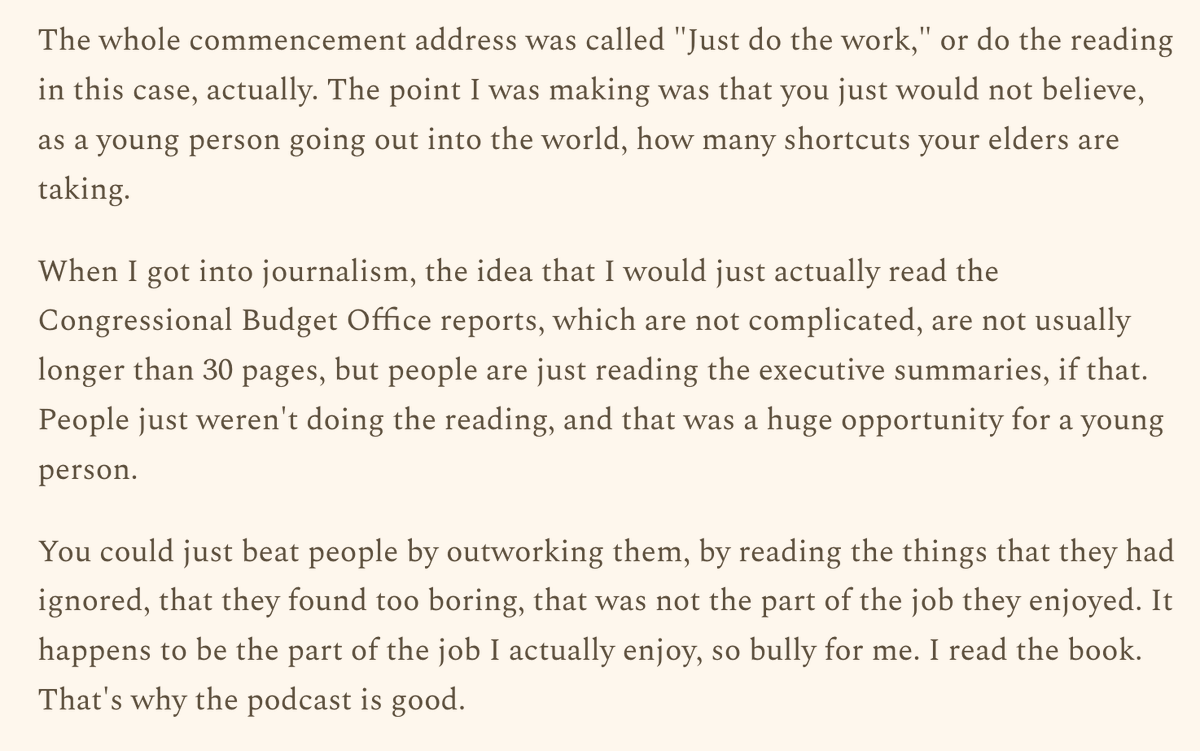
From Ezra Klein, more true than ever.
You would not believe how many shortcuts everyone else is taking.
In many areas, you can get way ahead of everyone just by doing the work.
More true than ever now, when more people are shirking and AI lets you do 10x if you try. 1/
Introducing Halo — the habit app with an AI coach.
It's like James Clear in your pocket.
Turn your good intentions into life-changing habits.
Now available on the App Store:
https://t.co/wKnBzK6U4v
Introducing Halo — the habit app with an AI coach.
It's like James Clear in your pocket.
Turn your good intentions into life-changing habits.
Now available on the App Store:
https://t.co/wKnBzK6U4v
My podcast with @HoneydewCare cofounder and CEO @DavidFutoran is live!
Highlights:
1. What inspired David to start Honeydew
2. Honeydew's path to get licensed in all 50 states
3. Scaling ads across Google, Meta, and Reddit
Check it out on YouTube! 👇
https://t.co/xV7vyRDEon
The average employee types 5 hours per day.
@WisprFlow has created an AI voice dictation tool that cuts that in half.
The average user types 72% of their characters with Flow across 70 apps with an 81% zero-edit rate.
Hear the full story on YouTube! 👇
https://t.co/N5H8ScXztj
My podcast with @superpower cofounder @maxmarchione is live!
Highlights:
1. Building a waitlist of 150k people before launch
2. Using a membership model to disrupt healthcare
3. Why AI doctors will surpass human capabilities
Check it out on YouTube! 👇
https://t.co/Tf7mDdRjY0
2025 letter: The future of @matter
There are years that ask questions, and years that answer. For us, last year was both.
Rob and I founded Matter together in 2020. In 2022, we became fathers, only three weeks apart.
Then, last year, we were both diagnosed with cancer.
I had radiation and two major surgeries. Rob had his lung removed. It was a surreal time.
Yet the world doesn’t stop for cancer. While we battled, Matter faced its own adversity.
We’d begun the year confidently, placing a big bet on paid growth. But by summer, it was clear the strategy wasn't working.
Still unable to walk, I made the painful decision to let go of half our team.
Rob and I had to face the truth: Matter is a great product—3x App of the Day, with many thousands of passionate users—but it isn’t the next Duolingo.
Its destiny is one of slow, steady growth and enthusiast appeal. And that’s okay.
Accepting this opened space for reflection, while confronting the prospect of death sharpened our conviction about how we want to spend our days.
At its best, working on Matter has been the most energizing of our careers—impactful, creative, and fun.
We asked ourselves: How do we amplify that?
The answer, we realized, had two parts.
The first is our team.
In addition to Rob and me, that team includes two exceptional individuals, @tianskylan and @HunterClarke .
Sky and Hunter joined us over three years ago, each bringing more than 15 years of technical expertise, Sky in iOS development, Hunter as a full-stack engineer.
Beyond their technical abilities, they possess rare product instincts, taste, integrity, and drive. In short, founder energy.
Today, we’re re-founding the company, formally making Sky and Hunter cofounders alongside Rob and me.
This decision reflects our desire to work together for a very long time.
Here, I want to recognize one other person who has been an important part of our journey: @mgsiegler .
More than just our lead investor, MG has been a steady source of support, guidance, and friendship, especially during our hard times. Lots of investors claim to be "founder friendly." MG lives it.
This support has always given us the confidence to follow our instincts, which brings me to the second part of our “answer.”
We’re building more products.
Our team’s competitive edge is developing consumer iOS apps that blend design and technology to create great user experiences. That’s what we love to do and what we do best.
Matter is a mature product that does its job well. We don’t want to suffocate it with features. It should be nurtured. It should be held to a high standard.
Given this natural pace of development, we have the ability to expand our vision.
We want to create a family of apps that help people live happier, healthier, more productive lives. Just like Matter.
While there are trade-offs to building more apps, we believe they’re positive ones. The pooled resources, creative momentum, and insights we gain will benefit all our apps in a virtuous cycle.
In business, as in life, we observe that the returns to playing the long game are very great indeed.
Longevity comes naturally when you’re playing a game you don’t want to end.
That’s what these changes are all about.
We’re healthy now, but last year confronted us with existential questions.
We have our answer. We choose to play.
Excited to announce the launch of Subversive, a podcast exploring the untold stories behind the world's best consumer subscription apps!
Our first three episodes feature conversations with industry leaders from Tinder, All Trails, and Ladder. 👇
The future of healthcare should be one where consumers are in control; companies compete on quality, and innovation drives better outcomes.
Health insurance in the U.S. was not previously designed for consumers — it has been sold to HR departments at corporations through middlemen, with little incentive to improve product experience. The industry’s high barriers to entry date back to WWII when employers offered insurance to offset frozen wages. Today, 155 million Americans are covered by employer-sponsored plans they did not choose. Without a free market, healthcare costs continued to rise, and customer satisfaction continued to decline. The individual market has started to change that, resulting in consumer choice, forcing competition, and driving innovation.
Mario and I founded Oscar after firsthand experience with the broken U.S. healthcare system. We were frustrated by its inefficiencies, lack of transparency, and poor customer experience. We underestimated the magnitude of the problem, the depth of systemic waste, and the immense effort required to build an insurer that truly put its members first.
More than a decade later, we continue to prove that a better system is possible. We may not always get it right, but our commitment remains unwavering: to deliver the best possible experience for our members. It is not just a moral obligation—it is a fundamental necessity in a free market.
Health insurance has some of the highest barriers to entry: capital intensity entrenched local monopolies, and legacy technology systems that have barely evolved in decades. With no off-the-shelf infrastructure, we built our own—from claims processing to care navigation. What started as a necessity is now a structural advantage: Oscar operates on a unified technology stack, unlike legacy insurers burdened by fragmented acquisitions and outdated systems. As AI reshapes healthcare, our model is uniquely positioned to deliver a superior, more efficient member experience.
The only way for Oscar to compete against large industry incumbents is to offer an exponentially better product. The impact of our product offering is real. Our customer satisfaction (60 NPS) far exceeds industry norms, as we must earn trust annually. Unlike employer-based plans that lock in customers, a free market ensures members stay only if they see real value.
Our journey has not been linear. We have weathered ACA volatility, a global pandemic, and a 95% market cap drop. Of 33 ACA-era insurers, only two remain—Oscar among them—a testament to our resilience and mission.
As we enter this next chapter with Mark Bertolini as our partner—one of the industry’s best leaders—we are more confident than ever. Competition pushes us forward, and real change happens when companies must earn their customers every day.
We have a lot to do, and we are just getting started.
We did it! We tested 300 Bay Area foods for plastic chemicals. We found some interesting surprises.
Top 5 findings in our test results:
1. Our tests found plastic chemicals in 86% of all foods, with phthalates in 73% of the tested products and bisphenols in 22%. It's everywhere.
2. We detected phthalates in most baby foods and prenatal vitamins.
3. Hot foods which spend 45 minutes in takeout containers have 34% higher levels of plastic chemicals than the same dishes tested directly from the restaurant.
4. The 1950s Army rations we tested contained surprisingly high levels of plastic chemicals.
5. Almost every single one of the foods we tested are within both US FDA and EU EFSA regulations.
Check out our full results below.