According to @TheEconomist's 2017 Democracy Index, democracy in the US has eroded over the past decade. The US is now a flawed democracy. We believe score voting has the potential to restore democracy, reducing polarization and increasing political participation. #DemoIndex
We'll be hosting a social event a the home of a member of the local League of Women Voters of Thurston County. Come learn about our effort to pass score voting via ballot initiative.
https://t.co/5hyuY7uPWN
Start your 2019 off right—help us build a healthier democracy from the ground up. Join us at Hart's Mesa in Olympia, WA on Jan. 5 for a Score Voting Social. All are welcome! https://t.co/0MJfeg4Qn5
Creating a world with better elections and a healthier democracy is a great New Years resolution. Make it happen! Join us for a Thurston County Score Voting Social on January 5 in Olympia, WA.
https://t.co/0MJfeg4Qn5
@nealmcb @CShentrup @DeanRWillis It’s definitely worth further study, both in comparing various proportional representation methods to each other and in comparing them to single-seat voting methods.
@nealmcb@DeanRWillis @CShentrup For just 2 city council seats up for election in 2017 (out of 7 total), Seattle had 15 candidates. That could be 50 candidates across all 7 seats, which is impractical to ask voters to rank and election offices to tally if you're using STV as your PR voting method, for instance.
@nealmcb@DeanRWillis @CShentrup Going to a single district PR system should reduce gerrymandering (although city boundaries can be changed for political reasons), but the practicality of PR even for city councils depends on the voting method and how competitive the election is.
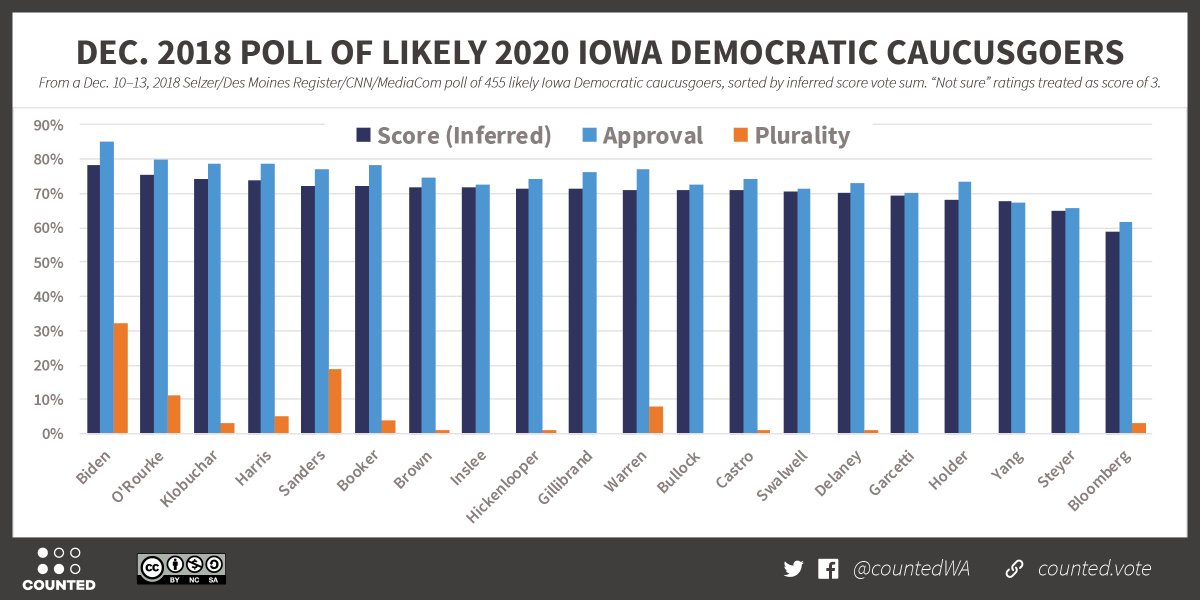
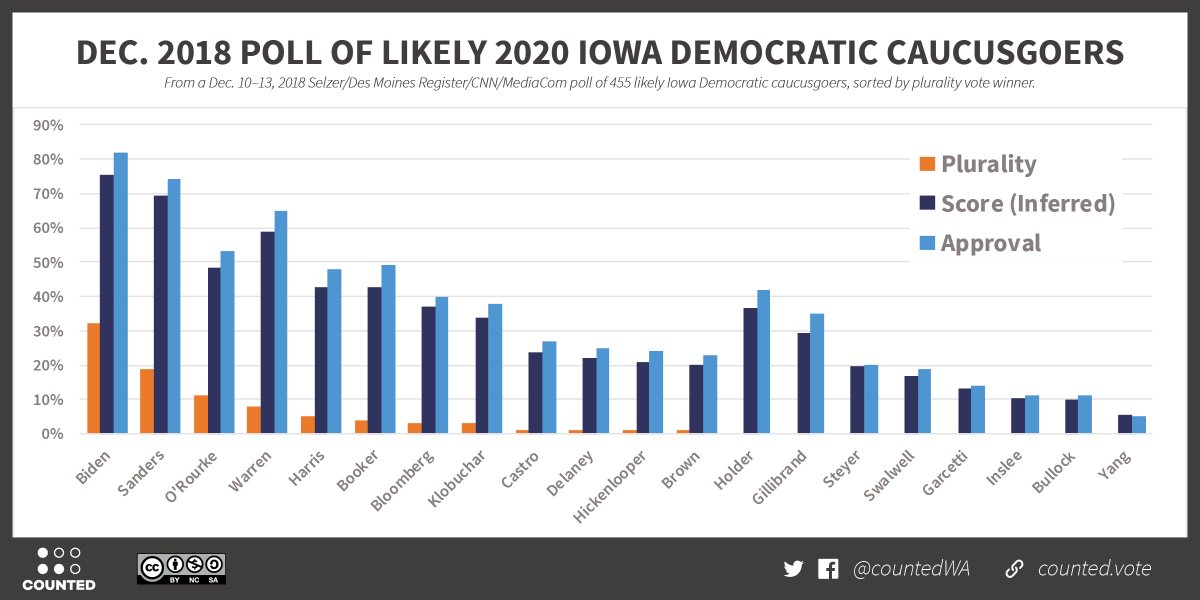
Obviously, candidate favorability isn't uniform. Some will stay unknown, some will become more popular, others will lose ground, and the public will likely have a mixed view of most. These charts give us a general sense of candidate potential in Iowa. #2020election#scorevoting
There's a new poll of likely 2020 Iowa Democratic caucusgoers out and, unfortunately, the main numbers being reported are the choose-one plurality poll results. #2020election#scorevoting https://t.co/wSoPCdyctn
Bloomberg's slim 2020 prospects also stand out. He's top 8 now, but that's an artifact of how unknown others are. With 31% viewing him unfavorably and only 29% unsure, as awareness of other candidates grows, Bloomberg drops to the bottom of the pack. #2020election#scorevoting
@TheWayWithAnoa The main Iowa poll numbers being reported focus on the wrong measurement. The plurality poll artificially deflates every candidate's support. Looking at favorability, Biden, Bernie, Warren, and Beto have majority support. 6 other candidates could catch up. https://t.co/0jVkzCADtI
When we solve vote splitting by using a more expressive ballot, as both approval and score voting do, an outright majority of likely Iowa Democratic caucusgoers support Biden, Sanders, Warren, AND O'Rourke, with Harris and Booker close behind. #2020election#scorevoting
@wvjoe911 We dug into the Iowa poll results and wrote a thread on why the media’s main takeaways are missing a big part of the picture. Short version: Biden, Sanders, Warren, AND O’Rourke have majority support and Holder and Gillibrand shouldn’t be counted out. https://t.co/VTWwiOaGJV
There's a new poll of likely 2020 Iowa Democratic caucusgoers out and, unfortunately, the main numbers being reported are the choose-one plurality poll results. #2020election#scorevoting https://t.co/wSoPCdyctn
Imagine how different our national conversation would be if favorability polls determined political debate eligibility. The ~15% plurality poll debate threshold elevates some candidates and excludes others due to vote splitting and an inherent limit of 6 or fewer candidates.
When we map candidate favorability ratings to score and approval votes, it becomes clear what's wrong with plurality voting. It not only artificially deflates support for every single candidate, it makes some contenders appear nonviable. #2020election#scorevoting
When we map candidate favorability ratings to score and approval votes, it becomes clear what's wrong with plurality voting. It not only artificially deflates support for every single candidate, it makes some contenders appear nonviable. #2020election#scorevoting
@CShentrup This is also very early and an Iowa-only poll. Iowa will thin the field, but it's entirely possible that Castro, for instance, or other potential candidates not included on this poll will perform well enough in other early primary states outside of Iowa to be viable nominees.
@roltyd @StevenTDennis Swalwell was in this poll. He had 0% support in the choose-one plurality poll and only 19% support in the less-harsh favorability rating poll (mapped to approval voting in this chart).