Because that category sets the wrong expectation.
“Back-office software” implies:
You’ll still do the work—just in a nicer interface.
You’ll still:
• Enter data
• Reconcile at month-end
• Fix errors
• Tie systems together manually
That’s not a solution. That’s a digital filing cabinet.
We don’t believe brokerages need better tools to manage manual work.
We believe they need a system that removes it.
So we changed how we describe what we do.
Not back-office software.
A financial operating system.
One system that connects every deal to every dollar:
Commissions. Accounting. Compliance. Payouts.
From closing to cash—automated, reconciled, and in sync.
This isn’t a rebrand. It’s a shift in what brokerages should expect from their technology.
Less work.
Fewer errors.
A system that actually runs the business.
Most “back-office software” didn’t eliminate the work—it just moved it onto a screen.
You’re still:
• Entering data
• Calculating commissions
• Reconciling at month-end
• Chasing down errors
That’s not automation. That’s digitization.
A real system should make this invisible:
Deals flow → commissions calculate → books stay in sync → numbers match.
No spreadsheets. No scramble.
If your team is still doing the work manually, the software isn’t solving the problem—it’s just organizing it.
#realestatebrokerage #proptech #operations #automation #loft47
Most brokerage managers I talk to start their morning the same way. Open the deal management system. Check the commission queue. Skim trust. Eyeball what's closing this week. Then start the actual day.
It takes 30 to 45 minutes, every morning, and most of it is just gathering. Not deciding.
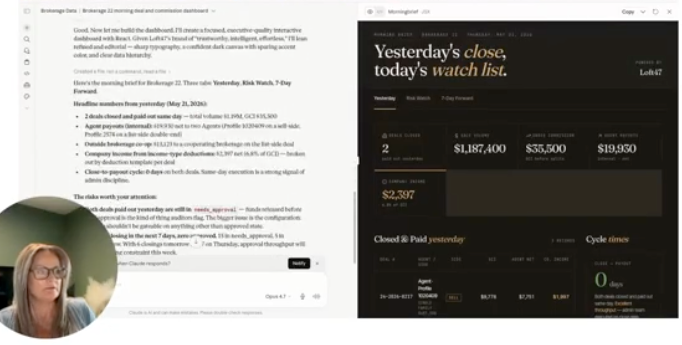
This video shows a different version of that morning. The brief is generated for you by 5am, what closed yesterday, what's projected to close this week, where there's compliance risk worth your attention, and which agents might need a touchpoint today. All pulled from your @loft_47 data.
The piece that makes it possible is something called MCP (Model Context Protocol). It's a new connection type that lets AI tools like Claude work directly with the systems you already use. Your data stays in Loft47. The AI goes and gets what it needs and brings it back, shaped however you want to see it.
Built end to end in five minutes. Saves a half hour every morning, every week, forever.
https://t.co/zLMA1Si77W
It’s month-end.
Somewhere, a brokerage admin is staring at a spreadsheet wondering why the numbers don’t match. Again.
Tabs open.
Emails flagged.
Deals cross-checked line by line.
One small discrepancy holding everything up.
They’ve done this before. They’ll do it again next month.
Because month-end isn’t a process—it’s a ritual.
If this is your team right now, you’re not alone — and it doesn’t have to be this way.
There's a new standard called MCP. The name is boring on purpose. What it does isn't.
MCP (Model Context Protocol) is a way for AI tools like Claude to work directly with the software a brokerage already uses. Commissions, CRM, transaction management, accounting. Instead of logging into five tools to answer one question, you ask once.
That sounds small but the impact isn't.
A trust account audit that took your back office three days now takes ninety seconds. The compliance gap sweep you run at month-end can run every morning at 6am, before anyone logs in. The "why is my commission this number" email that interrupts your manager twenty times a day starts answering itself.
Your brokerage data stops being trapped inside any one vendor. The AI working for you doesn't care which tools you picked. Workflows become as specific as your jurisdiction demands.
Sixteen years building software for brokerages, and I haven't watched a shift this clean before.
Full writeup on the Loft47 blog.
What's actually changing, why it matters for margins, and what I'd be doing if I were running your brokerage today.
If any of it lines up with something you're working on, get in touch!
The problem with “back-office software” is that it still makes you do back-office work.
Sure—it moved things out of paper and into a system.
But you’re still:
Entering the same data
Calculating commissions
Reconciling at month-end
Chasing down errors
It didn’t remove the work.
It just changed where the work happens.
That’s not modernization. That’s digitization.
A real system should make the work invisible:
Deals flow through
Commissions calculate themselves
Books stay in sync
Numbers match—without the scramble
If your team is still doing the work manually, the software isn’t solving the problem.
It’s just organizing it.
It’s been one week since our team delivered our MCP server, and I can’t stop digging into data, creating reports, building dashboards, and pushing the limits of what this next layer of automation can do for our clients.
This is where things get really interesting.
We’re not talking about AI hype. We’re talking about agents that can actually work. Helping brokerages understand their financial data, automate repetitive work, surface better insights, and get their financial house in order.
In this 10-minute video, I show how Loft47 is using AI in the application today, and more importantly, how brokers can use MCP and tools like Claude CoWork to take their back office to a new level. https://t.co/ZK18vwedix
The opportunity to help brokerages automate, make better decisions, and become more profitable is massive.
The beta is open.
If you’re ready to help define the next evolution of brokerage back office, contact me or the team at https://t.co/oOZf6iGsaq.
Back-office software manages tasks. A financial operating system manages outcomes.
Most brokerages are running on tools that handle pieces of the process:
A spreadsheet for commissions.
Accounting software for the books.
Email for approvals.
Manual steps to tie it all together.
A financial operating system is different.
It connects every deal to every dollar; commissions, accounting, compliance, agent payments allnin one automated flow.
From closing to cash, everything is tracked, reconciled, and aligned in real time.
And it doesn’t replace your accounting system, you keep QuickBooks or Xero.
It orchestrates everything in between.
Because the problem isn’t a lack of tools.
It’s the lack of a system.
Why Your Brokerage's Back Office Is the Last Department That Hasn't Been Modernized
Over the past decade, brokerages have poured time and money into modernizing the front office.
CRMs.
Lead generation platforms.
Automated marketing.
AI-powered outreach.
The agent experience on the revenue side has been optimized, tracked, and refined.
But walk into the back office, and it’s a different story.
Commission tracking still lives in spreadsheets.
Payouts require manual reconciliation.
Documents are scattered across systems (or worse; email threads).
Processes depend on “the one person who knows how it works.”
It’s not uncommon for critical financial workflows to run on a mix of Excel, PDFs, and institutional memory.
In other words: paper, spreadsheets, and prayer.
This gap didn’t happen by accident.
Front-office investments are easy to justify—they drive visible growth. More leads, more deals, more revenue.Back-office improvements, on the other hand, are seen as operational overhead. Necessary, but not https://t.co/WGf7NV9Q6F they get delayed. Patched. Worked around.Until the hidden costs start compounding:
Hours lost to manual reconciliation
Increased risk of errors and disputes
Slower payouts that impact agent satisfaction
Limited visibility into real financial performance
And perhaps most importantly—no scalability.
Because while your agents are operating in a modern, fast-moving environment, your back office is still catching up deal by deal.The result is a structural bottleneck: growth on the front end, friction on the back end.The brokerages that win over the next few years won’t just invest in growth—they’ll modernize the infrastructure that supports it.
Not as a back-office upgrade.
But as a strategic priority.
Because the real question isn’t whether your back office will need to change.
It’s how long you can afford to wait.
A broker told us they spend 14 hours/month reconciling commissions by hand—for a 60-agent office.
Do the math:
14 × $50 = $700/month
$700 × 12 = $8,400/year
That’s just reconciliation.
Not included: errors, rework, agent questions, admin drag.
This isn’t a technology problem. It’s a priority problem.
All behind the scenes. All time-consuming. All dependent on someone catching every little detail.
And when you’re handling multiple deals at once, that chain gets messy fast.
This isn’t about people not doing their jobs — it’s about how many steps they’re expected to manage manually.
Now imagine if most of that just… happened.
#BackOffice #RealEstateOps #BrokerageLife #PropTech #Automation
The real estate industry has a back-office problem.
Most brokerages aren't losing margin on splits. They're losing it in the back office.
Manual commission calculations.
Messy payout workflows.
Compliance risk hiding in spreadsheets.
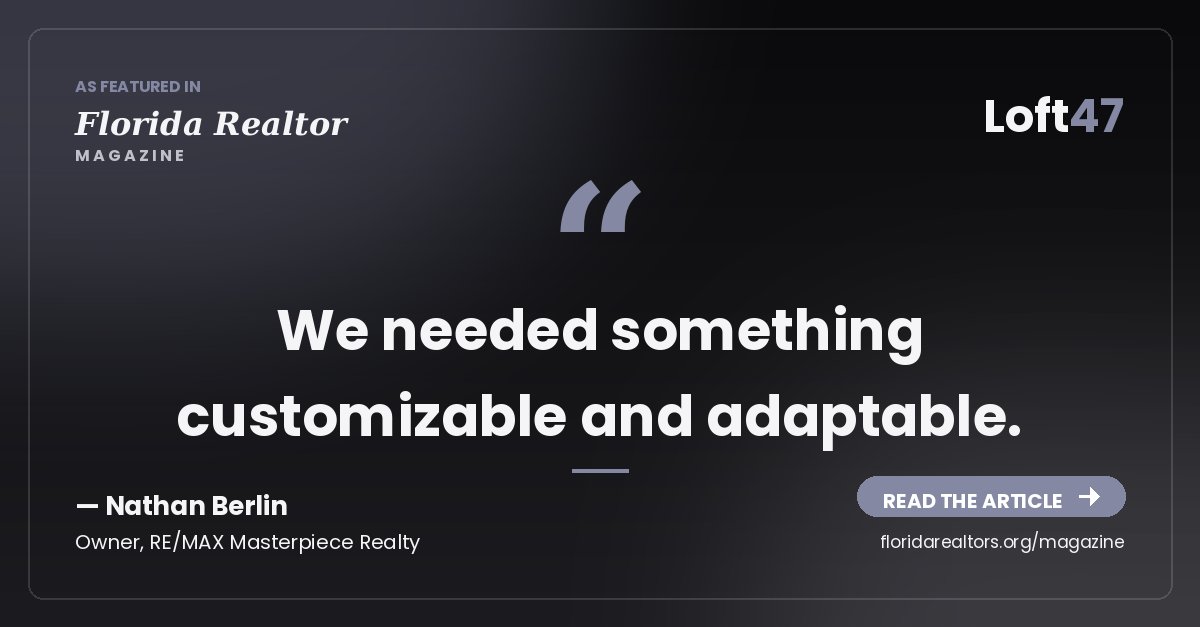
For years, the industry just accepted it. Nathan Berlin didn't.
He took RE/MAX Masterpiece Realty from a single Port St. Lucie office to four offices and 78 agents across Florida and Michigan and the back office had to scale with him, not slow him down.
Huge thanks to Florida Realtor Magazine and writer Leslie C. Stone for the spotlight, and to Nathan for sharing how he actually runs the business!
This is exactly the shift we've been betting on at @loft_47 The back office isn't a cost center. It's infrastructure.
If it's slow, manual, or error-prone, you don't scale. You stall out.
We've spent the last decade building for the part of the business no one else wanted to touch because accuracy, trust, and compliance actually matter. Now with AI supporting workflows (not making the decisions), brokerages on Loft47 are:
→ Reclaiming hours every week
→ Reducing errors
→ Operating with real financial clarity
That's the difference between doing deals and building a business.
Worth the read 👇
https://t.co/Wk4p4Djysh
Spreadsheets don’t scale.
Neither does hiring another admin every time you add 20 agents.
Most brokerages hit a breaking point around 50–100 agents:
– Late commission payments
– Reconciliation errors
– Month-end fire drills
It’s not a people problem.
It’s a process problem.
And almost everyone hits it.
#RealEstateOps #BrokerageGrowth #BackOfficeMatters #Loft47 #PropTech #ScaleSmarter
Every brokerage has a number they don't track: the hours their top people spend
on commission math,
reconciliation,
and compliance paperwork.
What's the one back-office task you'd automate tomorrow if you could?
Here’s the simplest way to think about it:
Most brokerages don’t actually have a *system* for their back office. They have a collection of tools.
A spreadsheet for commissions.
Accounting software like QuickBooks or Xero.
Email threads for approvals.
Manual steps to connect everything together.
That’s what we call back-office software. It helps your team *do the work*—but it doesn’t ensure the work is accurate, connected, or scalable.
So what happens?
Data gets re-entered.
Commissions are calculated manually.
Reconciliation becomes a month-end fire drill.
And critical financial workflows depend on people instead of systems.
It works… until it doesn’t.
A financial operating system is a different approach entirely.
Instead of managing tasks, it manages outcomes.
Every deal flows through a single system.
Commissions are calculated automatically.
Accounting stays in sync in real time.
Reconciliation happens continuously, not just at month-end.
From closing to cash, every dollar is tracked, matched, and accounted for.
Importantly, it doesn’t replace your accounting software—you still use QuickBooks or Xero.
It sits in between, orchestrating everything that happens from deal close to agent payout and financial reporting.
The result isn’t just efficiency.
It’s:
• Fewer errors
• Faster payouts
• Real-time visibility
• A back office that can actually scale
Because the real gap in most brokerages isn’t effort.
It’s the absence of a system that connects every deal to every dollar.
I got back from @InmanConnect a week ago and the energy was undeniable.
AI is the conversation.
I had a great time on our panel. We talked about navigating tech adoption and how to think clearly about AI inside your brokerage. But if I’m honest, the biggest takeaway for me was the confusion.
We are all trying to answer some of the same questions like, what’s actually working today? What should I steer clear of? Where is the risk? How do I separate signal from noise?
It doesn't feel like real estate professionals are resisting AI, they’re just trying to sift through it.
Because Loft47 sits at the center of finance and compliance for brokerages, we have to look at AI differently.
Front of house AI can experiment.
Back office AI can't afford to guess.
In accounting, payouts, compliance, and contract review accuracy matters more than speed. AI can assist, flag, extract, and suggest. But humans make the decisions. And in regulated environments, that distinction matters.
We need to be thoughtful about where automation belongs.
Curious what others walked away with from INNY. What felt real to you and what felt like noise?
My sincere thanks to Jonathan Delozier and @HousingWire on the deep dive covering the launch of our new AI compliance and workflow automation functionality. Applied AI works best when it removes friction, not responsibility. And we're removing a LOT of friction.
Loft47 now handles the full transaction flow from contract to payouts and precision accounting, with AI assisting in workflow, compliance and exception handling. Humans still make decisions in Loft47, which is critical to handling financial and regulated transactions.
These features shift administrative work from data entry and manual reviews to quality control and managing exceptions. We're so excited to hear early feedback from customers experiencing an instant 25% time savings. That is AI doing REAL work.
We're turning the back office from a cost center to a strategic advantage. Join us!
https://t.co/KgpQJvtH3z