We're excited to announce the launch of the CPAY Hub on Discord!
Our new Discord server is a community space where you can chat about everything related to CPAY products and services.
🔽
How many deposit addresses does your product generate today?
One for #Ethereum.
One for #Base.
One for #Arbitrum.
One for #Optimism.
Now multiply that across thousands of users.
Introducing Unified Wallets: one address that works across every EVM network.
Users no longer need to switch networks or manage multiple addresses. Funds sent from supported EVM chains arrive in the same wallet experience.
For businesses, this means:
• simpler onboarding
• fewer support tickets related to wrong networks
• cleaner wallet infrastructure
• better user experience at scale
Sometimes small UX improvements remove entire layers of operational complexity.
Read more about Unified Wallets:
https://t.co/nubOMCXd6M
3/3 Example:
An AI sales agent receives a request from a customer.
It creates a checkout via API, sends the payment link, then verifies the transaction and confirms the order.
No manual steps.
No switching between systems.
This is where payment infrastructure is heading.
And this is exactly what Agentic Payments are built for.
1/3 How will AI agents actually use crypto payments?
Right now, most payment flows are built for humans.
Dashboards, manual checks, delayed confirmations.
But AI systems already operate differently.
They call APIs, process data, and execute workflows.
2/3 To work with payments, they need infrastructure that fits that logic:
• create checkouts through API
• verify transactions automatically
• track payment status in real time
• generate reports without manual input
• operate wallets under strict permissions
TRON DAO, Ethereum, Solana, Base, Arbitrum.
Each chain gives businesses a different settlement environment.
Some optimize for speed.
Some for liquidity depth.
Some for lower transfer costs.
That’s why more payment companies are building chain-specific treasury logic instead of keeping all stablecoin operations inside one ecosystem.
Cross-chain infrastructure is gradually becoming standard for global payments.
And treasury operations are starting to look much closer to real-time network management than traditional finance workflows.
2/2
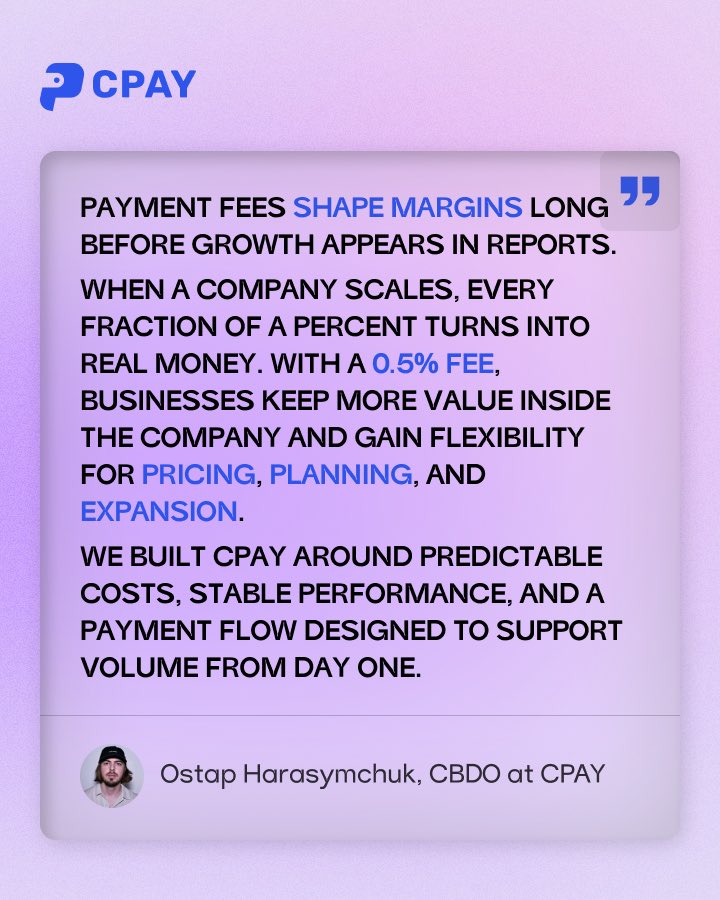
For businesses accepting crypto payments globally, this fee structure creates:
• clearer payment economics
• better margin control
• predictable transaction costs
• more room for sustainable growth
CPAY helps companies accept crypto payments with one of the lowest fee models on the market: 0.5% per transaction.
Payment fees become much more visible when a business starts scaling.
For companies processing thousands of payments across different markets, every percentage point affects margins, pricing, and long-term profitability.
𝐓𝐡𝐚𝐭 𝐢𝐬 𝐰𝐡𝐲 𝐂𝐏𝐀𝐘 𝐨𝐟𝐟𝐞𝐫𝐬 𝐚 𝐜𝐫𝐲𝐩𝐭𝐨 𝐩𝐚𝐲𝐦𝐞𝐧𝐭 𝐠𝐚𝐭𝐞𝐰𝐚𝐲 𝐰𝐢𝐭𝐡 𝐚 𝟎.𝟓% 𝐟𝐞𝐞 𝐩𝐞𝐫 𝐭𝐫𝐚𝐧𝐬𝐚𝐜𝐭𝐢𝐨𝐧.
This model helps businesses keep payment costs clear and predictable while accepting crypto payments globally.
With CPAY, companies get:
- lower processing costs
- more revenue retained from every payment
- predictable financial planning
- stronger control over margins
- infrastructure suitable for high-volume payment flows
𝑯𝒐𝒘 𝒎𝒖𝒄𝒉 𝒅𝒐𝒆𝒔 𝒆𝒂𝒄𝒉 𝒕𝒓𝒂𝒏𝒔𝒂𝒄𝒕𝒊𝒐𝒏 𝒂𝒄𝒕𝒖𝒂𝒍𝒍𝒚 𝒄𝒐𝒔𝒕 𝒚𝒐𝒖𝒓 𝒃𝒖𝒔𝒊𝒏𝒆𝒔𝒔 𝒐𝒏𝒄𝒆 𝒚𝒐𝒖 𝒇𝒂𝒄𝒕𝒐𝒓 𝒊𝒏 𝒆𝒗𝒆𝒓𝒚 𝒍𝒂𝒚𝒆𝒓?
As payment volume grows, cost visibility becomes harder.
Fees come from different parts of the system - processors, currency conversion, routing, and settlement timing. Each element affects the final margin.
Most teams track the main fee, while a significant share of cost sits inside spreads, delays, and infrastructure inefficiencies. Over time, this creates a gap between projected revenue and real financial outcomes.
Low-fee crypto payment gateways bring structure to this.
Transactions move through fewer intermediaries, which makes the cost per payment easier to define and control. Settlement happens faster, and capital becomes available without long delays tied to banking systems.
With platforms like 𝐂𝐏𝐀𝐘, businesses operate with a fixed transaction fee.
This creates a stable foundation for financial planning and allows teams to scale without constantly adjusting to changing costs.
Clear pricing, faster settlement, and a simplified flow turn payments into a predictable part of the business model rather than a variable expense
3/3 It allows platforms to:
- keep control over funds
- reduce processing delays
- maintain across transactions - scale without adding operational pressure
As volume grows, infrastructure either keeps up or becomes the limit.
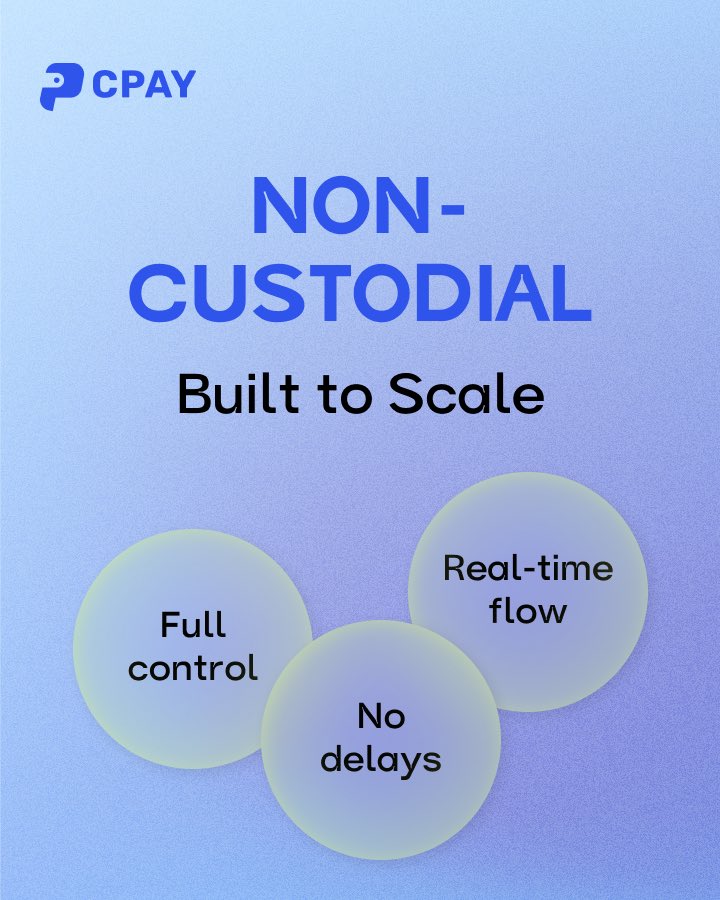
1/3 𝙃𝙞𝙜𝙝 𝙩𝙧𝙖𝙣𝙨𝙖𝙘𝙩𝙞𝙤𝙣 𝙫𝙤𝙡𝙪𝙢𝙚 𝙘𝙝𝙖𝙣𝙜𝙚𝙨 𝙝𝙤𝙬 𝙥𝙖𝙮𝙢𝙚𝙣𝙩 𝙨𝙮𝙨𝙩𝙚𝙢𝙨 𝙗𝙚𝙝𝙖𝙫𝙚.
At scale, delays appear where they weren’t visible before.
Funds get locked inside providers.
Routing becomes less predictable.
Operations start reacting instead of controlling the flow.
This is where infrastructure decisions start affecting growth. Non-custodial architecture handles volume differently.
2/3 Funds stay in user-controlled wallets.
Transactions move without internal approval layers.
Routing adapts in real time depending on network conditions and liquidity.
The system stays responsive even as load increases.
At CPAY, non-custodial infrastructure is part of how payment flow is designed from the ground up.
𝐖𝐡𝐚𝐭 𝐚𝐜𝐭𝐮𝐚𝐥𝐥𝐲 𝐬𝐥𝐨𝐰𝐬 𝐝𝐨𝐰𝐧 𝐜𝐫𝐲𝐩𝐭𝐨 𝐩𝐚𝐲𝐦𝐞𝐧𝐭𝐬 𝐰𝐡𝐞𝐧 𝐲𝐨𝐮 𝐬𝐭𝐚𝐫𝐭 𝐬𝐜𝐚𝐥𝐢𝐧𝐠?
It’s rarely liquidity. And almost never UX.
It’s compliance.
More volume means more checks. More checks create friction. And if your system isn’t built for it, that friction shows up everywhere.
• slower transactions
• more flags
• lower conversion
The difference comes from architecture.
When compliance is part of the system from the start, payments keep moving.
When it’s added later, growth turns into constant resistance.
So the real question is:
Is your system ready for scale - or just trying to keep up?
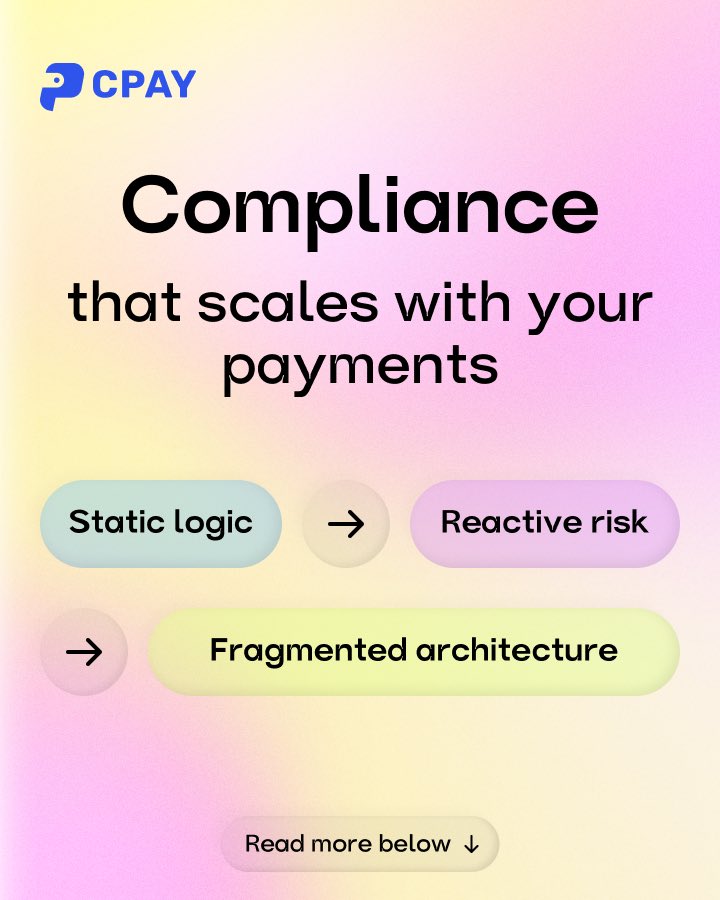
4/4 Why it happens ↓
➕ Fragmented systems
➕ Reactive checks
➕ Static rules
Compliance isn’t the problem.
Architecture is.
In 2026, payments don’t fail from lack of demand.
They fail from weak infrastructure.
3/3 With 𝑪𝑷𝑨𝒀, this part is automated inside the payment gateway, so businesses can accept crypto and keep their payment flows clean and easy to manage.
1/3 When a crypto payment arrives, the job isn’t really finished.
Businesses still need to check confirmations, connect the payment to the right order, and move the funds into treasury wallets so everything stays organized.
2/3
When there are dozens or even hundreds of transactions per day, this quickly turns into a whole system behind the scenes.
That system is called settlement logic, and it’s what keeps crypto payments running smoothly at scale.