$TPIA dari 10,650 jadi 1,205. Turun 88%. Saham petrokimia terbesar Indonesia milik Prajogo Pangestu.
Terus 4 hari naik 62%. Dari 1,205 ke 1,955. Apa yang terjadi?
MSCI keluarkan $TPIA dari index-nya. ETF global wajib jual otomatis. BRPT dan Prajogo jaminkan 3,675 miliar saham ke BNI, BTN, dan HSBC — kalau harga terus turun, margin call bisa picu forced selling lagi. Itulah kenapa crash-nya sedalam ini.
Tapi di tengah kepanikan, sesuatu menarik terjadi.
SCG Chemicals, partner strategis Thailand yang udah pegang 30% saham sejak 2011, lepas 12,85 miliar saham. Kepemilikan turun jadi 15,71%. Raup Rp 14,33 triliun.
Kedengeran bearish? Lihat siapa yang beli.
Maybank net buy +4,98 juta lot dalam sehari. 98,1% clean buyer. DBS Vickers +3,2 juta lot, 100% bersih. UBS beli terus 3 hari berturut — +737K, +1,14M, +618K lot. Broker BUMN juga masuk — Mandiri +1,07 juta lot, BRI +777K lot.
Ini bukan retail yang average down. Ini institusi asing dan pemerintah yang serap barang SCG.
Direktur TPIA, Raymond, borong 4,57 juta saham senilai Rp 8,21 miliar selama crash. Dia beli dari 4,300 sampai 1,375. Insider yang tau kondisi internal, gak berhenti beli.
Fundamentalnya? Q1 2026 EBITDA rekor USD 421 juta. Laba bersih USD 205 juta. Integrasi aset Shell Singapore dan ExxonMobil Singapore yang diakuisisi 2 tahun lalu mulai kelihatan hasilnya. JP Morgan upgrade dari Underweight ke Netral, target 1,750.
Free float naik dari 11% jadi 25,7% setelah SCG divestasi. Saham yang tadinya terkunci di 2 tangan, sekarang lebih likuid. Proyek CA-EDC senilai USD 1 miliar udah 70% selesai, target operasi 2027.
$TPIA ini bukan cerita "saham jatuh terus bangkit". Ini cerita forced selling dari MSCI exit dan margin call yang bikin harga turun jauh di bawah nilai wajar, sementara smart money dan insider rebutan barang di bottom.
Yang bikin penasaran: Maybank beli hampir 5 juta lot di hari yang sama harga ARB. Mereka tau sesuatu atau ini average down gila-gilaan?
Riset lengkapnya ada di https://t.co/QUD828EfKY
Gue bawa ke kantor langsung habis dimintain. Resepnya:
3/4 kotak teh tubruk, sangrai di wajan, tuang 3-4 sendok gula pasir, sangrai sampe lengket di wajan, tuang susu 500ml, aduk sampe mendidih.
Tuang ke wadah, campur susu lagi 500ml, dah dapet banyak banget tuu
in some of the groups im in. I've noticed a really common theme lately where people just hold onto a bad trade wayyyy too long. they just can't let it go. they can't accept the loss, so the loss grows
they commit to a position based on what they have already lost. Instead of focusing on forward looking expected value. their decisions are based on the past losses vs future opportunities. which is basically just the sunk cost fallacy
Rationally. You are suppose to allocate capital to the best risk adjusted places regardless of where prices currently sit. the market doesn't know or care what we paid for something.
one has been in eth since last year. he has known he can get better returns since then, but has been frozen. there is obviously a financial cost to it, but there is an emotional cost as well, and then the opportunity cost. all 3 can be very expensive.
a lot of that is also just a result of thesis drift where the original thesis gets invalidated and then a new thesis arrives on why the trade should continue
if you think there is a better opportunity elsewhere, and have something to support it then i think its better to make the jump. its a big reason why i mainly switched to stocks over a year ago. you could see the bubble brewing.
its part of a mental framework we all have to work on, and constantly improve on.
Only so many times you'd want to see price revisit 60/61s....
Regime is still trend down - no base being built yet
Knife catchers - becoming forced seller....
Rallies are late shorts - covering...
If you're one - then you're probably being outpeformed by a simple set of H1 - 12/25 ema....
Sweet Science....
Summarized by Claude.
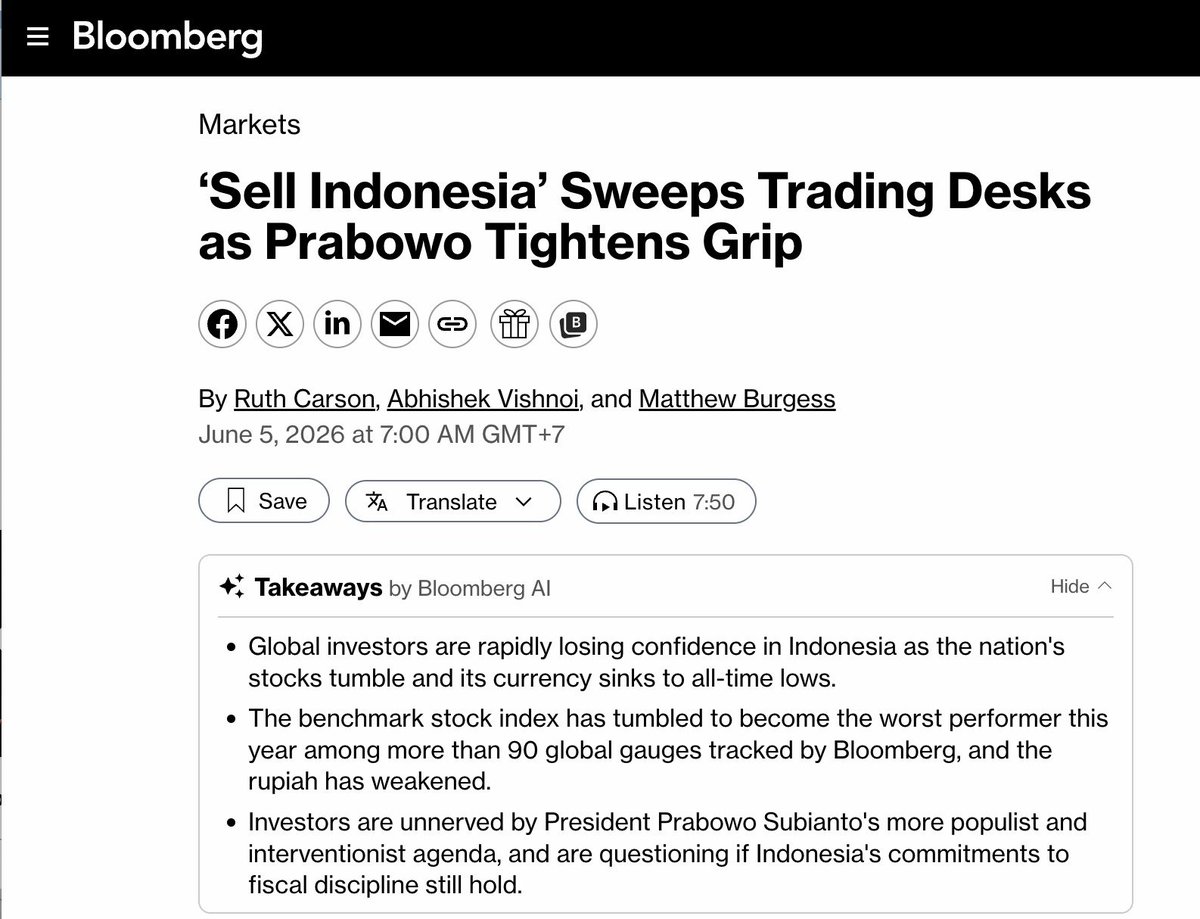
What's happening: IDX is down 36% YTD, worst performer among 90+ global indices. Rupiah hit 18,000/USD (all-time low), down ~14% since Prabowo took office. Foreign funds have pulled ~Rp86 trillion from bonds.
Why: Prabowo's populist/interventionist pivot, Danantara, free meals program, commodity export controls, has spooked markets. Sri Mulyani's departure was the turning point; she was the "fiscal anchor." Now investors question Indonesia's investment-grade credit ratings and MSCI EM status.
What investors want to come back:
1) A credible fiscal anchor, central bank independence
2) Danantara transparency
3) Clearer policy implementation.
Until then, the trade consensus is simply: SELL.
already seeing pretty big drops in equties in the hot sectors, some of the leaders down 10-15% or more in semis, ewy is -13%, some of the mid caps and small caps down more than 15-20%, and some markets like kospi down nearly 10% already.
I will have some ideas and chart over the weekend. Not in a huge rush yet to buy. I'd like to be patient here. I also looked at some of your guys requests too so will share some interesting ones
i think overall we shifted gears at a good time in terms of how to trade this. Going from chasing momentum to waiting for a dips.
The next major headache for the Indonesian government may not be foreign portfolio outflows. It may be Chinese investors quietly looking for the exit.
Reports of Tsingshan considering Madagascar, Lygend looking at Tanzania, and renewed interest in New Caledonia should not be dismissed as isolated developments. They are signals. Capital rarely leaves overnight. It leaves gradually, one project at a time.
The concern is not that existing operations will suddenly shut down. Billions of dollars have already been invested and those assets cannot simply be picked up and moved elsewhere. The bigger issue is future capital allocation. Once investors begin directing incremental investment toward alternative jurisdictions, the long-term growth trajectory changes.
The timing is particularly concerning because Indonesia’s broader investment momentum is already slowing. Foreign direct investment reportedly declined 6% in 2025 after growing 19% the previous year. Mining investment peaked in 2024, while new investment into base-metal refining appears to have plateaued. That should command policymakers’ attention.
Valuation-wise, Indonesia is arguably one of the cheapest equity markets in Asia today. Many well-known blue-chip companies are trading at what can only be described as crisis-like multiples despite maintaining healthy balance sheets, dominant market positions, and attractive dividend yields.
BBCA trades at roughly 11x forward earnings and 2.6x book value. Bank Mandiri trades at around 6x forward earnings and 1.2x book value. BRI trades at approximately 7x forward earnings and 1.3x book value. Astra sits at 6x forward earnings. Kalbe trades at 9x forward earnings. Amman trades at roughly 10x forward earnings. The list goes on.
Many of these companies also offer high single-digit dividend yields, with some names approaching double-digit yields. On paper, this should attract significant investor interest. Yet share prices continue to drift lower.
The obvious question is: where are the buyers? Where are all the investors who have spent years believing Indonesia’s long-term potential? Indonesia’s weight in MSCI Emerging Markets remains only around 0.5-0.6%, remarkably small relative to the size of its economy, population, and long-term growth aspirations.
More importantly, where is Danantara? It was presented as a potential new source of domestic capital and a stabilizing force for Indonesian financial markets. If the local market is trading at distressed valuations, this should be the type of environment where a large domestic institutional investor helps establish confidence.
The problem, however, is that cheap valuation alone is rarely enough. Markets ultimately pay for growth.
Indonesia’s core challenge today is not valuation. It is earnings growth. Aggregate earnings growth for the market has slowed materially, with many sectors struggling to generate meaningful expansion. Compare that with South Korea and Taiwan, where investors are being offered direct exposure to AI, semiconductors, advanced manufacturing, memory, and high-performance computing. Foreign investors are naturally willing to pay higher multiples for companies whose earnings are compounding rapidly.
Currency concerns add another layer of complexity. Investors are not simply underwriting Indonesian corporate earnings. They are also underwriting the rupiah. If currency depreciation continues to offset equity returns, valuation discounts can persist far longer than expected.
There is also a credibility issue that should not be ignored. For years, many foreign investors have complained that parts of the Indonesian market function primarily as distribution channels rather than genuine capital formation venues. Domestic equity sales teams routinely promote names that later become exit liquidity for local institutions seeking to reduce exposure. Over time, repeated experiences like this erode trust.
The persistent allegations of wash trading, questions around effective free float, concentrated ownership structures, and concerns over genuine liquidity have further damaged confidence. Investors do not simply buy low valuations. They buy governance, transparency, liquidity, and confidence in future earnings.
This is why cheap markets can remain cheap for years. A stock trading at 6x earnings can still fall to 5x. Valuation itself is not a catalyst.
The harsh reality is that Indonesia does not have a valuation problem. It has a growth and confidence problem.
Until investors see stronger earnings growth, more credible policy execution, better market governance, improved liquidity, and a clearer path for capital to generate attractive real returns, low multiples alone will not be enough to attract meaningful foreign capital back into the market.
Cheap without growth is a value trap. Cheap with deteriorating confidence is even worse.
Instead of doomscrolling,
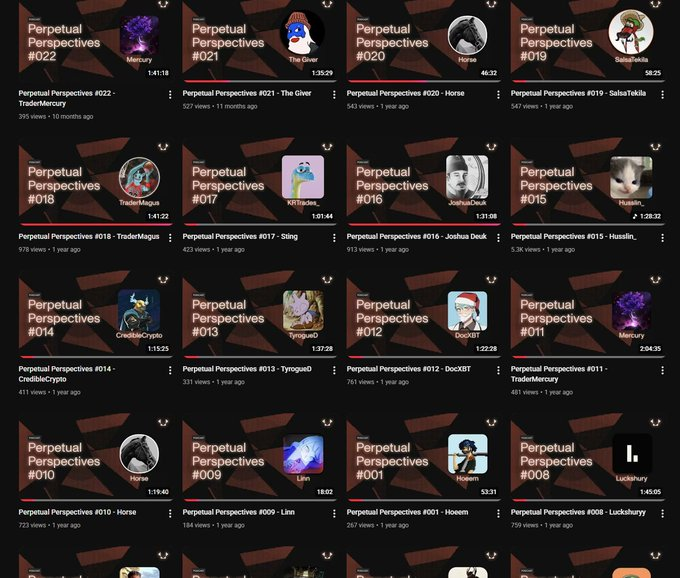
search "Perpetual Perspectives" on Youtube or Spotify
Few know that I hosted what I believe is one of the most genuine set of conversations (won't even call it a podcast).
26 episodes over the course of 2024 and part of 2025.
The motivation behind this was fueled out of passion and my own curiosity.
I spoke to people I genuinely wanted to have a conversation with (hence the sparse episodes).
Episodes include conversations with Huss, Mercury (2x), Doc (2x), TheFlowHorse (2x), Magus, CredibleCrypto, Giver, 0xKun, Joshua, Luckshury, NikAlgo, Sting, Mayne, Linn, Hoeem, CryptoBully and more.
Still get DMs about people listening to some of these 2-3 times which makes me feel somewhat satisfied that I was able to give back in some form.
We will be shorting this coin to $1
1. Ppl have “big” unrealised P&L but not enough liquidity
2. Everyone buying now will be used as exit liquidity
3. If any ( individual ) is selling spot $LAB tokens you can dm me it should be at least 7-8 figures in size
My basket of AI stocks:
MU
SNDK
ARM
NBIS
MRVL
INTC
CRWV
Just a copium hedge for my crypto portfolio, and I guess over time I'm going to increase the equities portion of my portfolio...
I’ve said this before, & I’ll say it again one last final time…
If you missed $NOW at $82.
Missed $NBIS at $63.
Or even missed $ARM at $130…
Then you cannot miss out on $CRWV at $124 with a $300+ Target by year end.
With $88B worth of backlog (2027-2031), 129% YoY revenue growth, & $3B in cash you cannot be more bullish.
Save this to look back on later…
Trying to predict short-term price action is hard, as I generally consider the short-term moves akin to a random walk, or geometric brownian motion.
..but..
if i had to guess, I would guess that BTC tags $70k soon, then gets a small bounce.
But after the bounce is over (likely a few days to a week or so), I do think BTC will head back to the lows from February 2026.
If I'm wrong about BTC revisiting the lows from February, I will quote tweet this and simply say "I was wrong."
And then I will let every bull dunk away.
pre mkt thoughts - 2 jun 26
US yields continue to soften with the 30y at 4.95 and the 10y at 4,43. This is about 20bps lower across the curve. In asian trading, both NKY and KOSPI are thus far a little softer. What is interesting to talk about however is that the HK listed equities have finally started to bounce. 700 HK - Tencent is up 8.4% on the day while BABA is up 5.6% in HK trading. These names have been beaten down for extremely long, esp 700HK near the 430 support zone. For readers unfamiliar with them, BABA owns some of the most integrated AI stacks in China with their own chip unit, qwen, alibaba cloud etc. Executives of Alibaba AND Deepseek have reportedly been required to ask for permission for overseas travel - such is the level of BABA's strategic importance to china now.
In memory land, 285A continues to rally towards 77k. Again, for those unfamiliar with the numbered name - 285A is Kioxia, who owns and operates the fabs where SNDK gets their wafer via a JV.
On the neocloud trade, i have posted about it already so i dont want to rehash the points too much.
Lets talk about what happened overnight - $GOOG is set to raise 80B via a 40B ATM AND also via selling 10B to Berkshire at a discount - while this is distinctly positive for semis and capex spend. 2 issues i see coming up. First, the hyperscalers are brushing past the point of where their FCF is enough to service the capex, they will soon need to dip into debt financing AND equity financing. Secondly, the rest of the hyperscaler complex is selling off, because investors are rightfully asking - "if $GOOG needs to do an ATM, the rest of them probably do as well!"
Again - this comes back to the same theme that i foresee the market trading towards - compute is scarce and IF everyone is continuing to invest into capex - the earlier you invest, the more you will be rewarded. $ORCL is a good case in point for a name that the market punished initially but is rewarding now. It is directly bullish for neoclouds.
Next up! Jenson has said that $MRVL is a trillion dollar company.... $MRVL is trading up 15% on that.... which goes to show you the strength of this bullish sentiment that we have.
Given how cheap downside skew is - I would take the opportunity to add protection to the book for cheaps while punting for all these opportunities.
Also since the Apr lows, $IGV is up almost as much as $SMH! but with 10x less noise. Surprising? IMO a huge amount of the software rally was just erasing past losses, many names are well below their ATH and i expect them to grind back as the market reduces the AI fear factor.
Good luck!
My strategy for the 2027/28 crypto cycle
With the tradfication of crypto I presume that the driving theme of the next cycle will be revenue generating protocols, the success of which, and the appetite for which has recently been demonstrated by Hyperliquid
Many natives will move from pure speculation towards fundamentals driven analysis
That is why I am building a portfolio of revenue generating crypto native businesses
My strategy is simple
Crypto overshoots to both the upside and the downside
I will buy tokens that are trading at low multiples, say 10x, and sell them when they trade at a 50x-60x multiple, targeting a return of 300%-500% on my portfolio over multiple years
Listen to ME. Get READY for the rotation.
Hold your AI winners like $MU, $INTC, $AMD. But NON-tech companies will start to OUTPERFORM very soon.
Make SURE you have NON-tech exposure in your portfolio to BALANCE heading into the summer months.
What you need to do:
1. Trim AI winners. Never sell FULLY. But consider taking 20% profits. $MU, $INTC, $AMD, etc. Keep your winners for the long-term.
2. Hold bottom formations in software like $NOW, $CRM, etc., healthcare like $LLY, etc.
3. Buy NON-tech laggards - look at companies like $NKE, $LMT, other clothing apparel, food, consumer staples, or contrarian buys. They will surprise people.
4. SLOWLY build positions in Stage 2 AI - $CRWV, etc. - they don't have the big volume yet, still EARLY.
Overall you should have AI + emerging AI + non-tech laggards + defensive positions heading into the SUMMER.
Let's go. I will tell you EXACTLY what to do - GET READY.