Anthropic CEO Dario Amodei:
"The cheapest way to use Claude is also the smartest. Most devs do the exact opposite."
In 36 minutes, he breaks down the real economics behind every Claude model, and why running them all the same way is a mistake.
Watch the full interview, then save the config below 👇
Still assigning IP addresses manually? Stop wasting time!
In this quick tutorial, I’ll show you how to configure DHCP on a Cisco router in using simple CLI commands in Packet Tracer
Your Datadog bill isn't expensive.
Your taste in metrics is.
A team cut 30% of their Datadog bill in an afternoon → just by deleting stuff nobody used.
Here's the audit checklist nobody gives you 👇
1. Custom metrics nobody queries
Datadog charges per unique tag combination, not per metric.
That env+service+pod+region+version+customer_id tag set? You just created 50,000 timeseries from one metric.
👉 Run Metrics Summary → sort by cardinality → delete the top offenders nobody dashboards.
2. Health check logs
/health and /ready getting hammered every 10s by 200 pods = 1.7M log lines/day of pure noise.
👉 Drop them at the Agent or OTel Collector. Free.
3. Dashboards built by people who quit 2 years ago
Every dashboard pulls queries on load → drives custom metric cost.
👉 Sort dashboards by last viewed. If it's >90 days, archive it.
4. DEBUG logs in prod
Someone shipped log.level=DEBUG "temporarily" in 2023.
👉 Severity-filter at ingest. Keep INFO+. 40-70% log volume gone overnight.
5. APM on cron jobs & batch workers
Tracing every nightly ETL run at full fidelity = burning money on data you'll never look at.
👉 Tail-based sampling. Keep errors + slow traces. Drop the rest.
6. Indexed logs you only need for compliance
Indexed = expensive + queryable. Archived (S3/Flex) = cheap + still searchable.
👉 Move >7-day-old logs to Flex tier or Logs Archive.
7. Monitors on dead services
Pager-fatigue tax + line item on your bill.
👉 Filter monitors by "no data in 30 days." Delete.
8. Container metrics duplication
Agent + APM + DogStatsD all reporting the same CPU/memory? You're paying 3x.
👉 Pick one source. Usually the Agent.
9. The unit economics most teams miss
1 custom metric × 5 tags × 1000 hosts = not 1 metric. It's 5,000+ billable timeseries.
Logs are billed on ingest AND index. Optimizing one without the other does nothing.
10. The 30-min audit that pays for itself
✅ Usage page → top 20 custom metric namespaces
✅ Logs Patterns → top 10 repeating log lines
✅ Dashboards → sort by last viewed
✅ Monitors → "no data" filter
✅ APM → services with <0.1% error rate (sample harder)
The lesson:
Observability isn't a budget problem.
It's a discipline problem.
You don't need to leave Datadog. You need to stop treating ingest like it's free.
Default to signal, opt into noise.
What's the dumbest thing you ever found on a Datadog audit? 👇
Repost 🔁 if your finance team is currently asking questions.
Follow @dashmundkar for more boring infra wins that save real money.
#Datadog #Observability #DevOps #FinOps #SRE #Kubernetes
☁️ Day 15/50 → #50DaysOfAzure
Your 50 VMs all need outbound internet access. You DON'T want 50 public IPs.
Azure NAT Gateway → one static IP for all outbound traffic. Clean. Scalable. Secure.
The networking service nobody talks about but everyone needs 👇
#50DaysOfAzure #Azure #DevOps #SRE
☁️ Day 12/50 → #50DaysOfAzure
Your VMs talk to Azure Storage over the PUBLIC internet by default.
Service Endpoints fix this → same PaaS service, but traffic stays on Azure's backbone.
Free. Faster. More secure 👇
#50DaysOfAzure#Azure#DevOps#SRE
🚀 I'm starting #50DaysOfAzure!
For the next 50 days, I'll break down ONE Azure service daily:
☁️ What it does
🔧 Real-world use cases
💡 Key features
📊 Pricing insights
🏗️ Architecture tips
From VMs to Quantum Computing — we're covering it ALL.
Follow along & RT to help others learn! 🧵👇
#Azure #Cloud
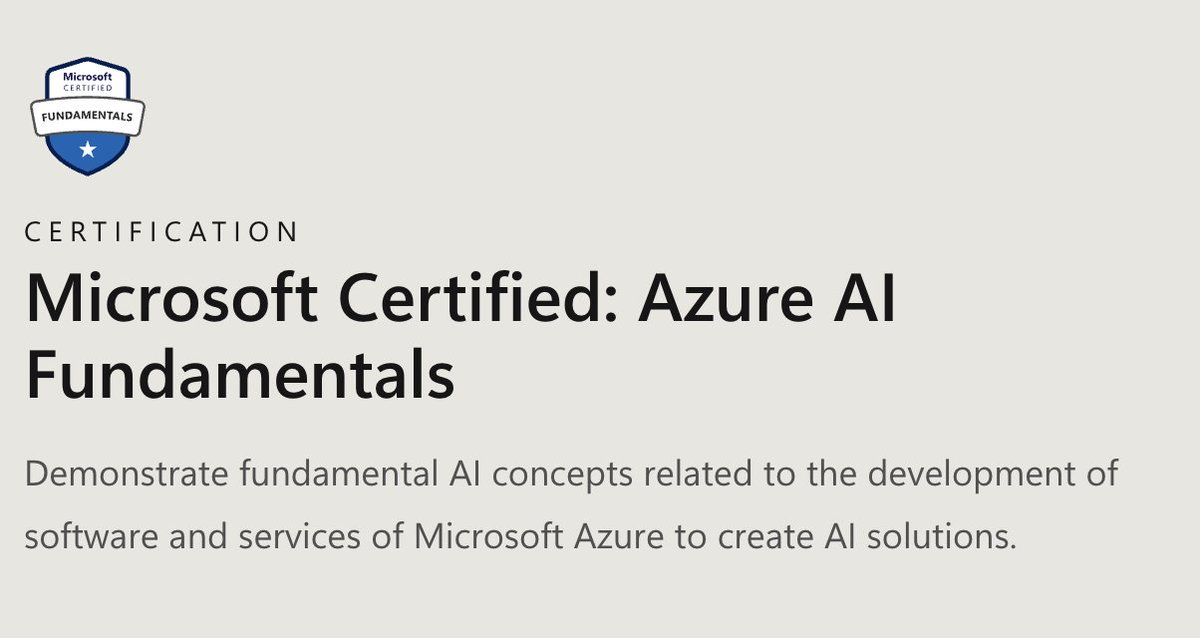
Microsoft just dropped a FREE path to become AI certified
all the training materials, study guides, and practice exams are completely free on Microsoft Learn
you don't need to pay $5,000 for a bootcamp
you don't need a $2,000 udemy bundle
you just need Microsoft Learn and discipline
the certification path has 3 levels:
LEVEL 1: Azure AI Fundamentals (AI-900)
your entry point. no prior knowledge needed. no coding required
what it covers:
- how AI and machine learning work on Azure
- computer vision and NLP basics
- generative AI workloads
- responsible AI principles
prep time: 2-4 weeks
passing score: 700/1000
training: FREE on Microsoft Learn
this cert never expires. once you pass, it's yours forever
IMPORTANT: this exam retires June 30, 2026 and gets replaced by AI-901
if you want the current version, MOVE NOW
LEVEL 2: Azure AI Engineer Associate (AI-102)
this is where it gets real. you're building actual AI solutions
what it covers:
- Azure OpenAI integration
- RAG (retrieval-augmented generation)
- AI agents and agentic solutions
- computer vision and NLP pipelines
- document intelligence
- building with Python or C# SDKs
Microsoft updated this in 2025 to focus on generative AI and agents
(exactly what companies are hiring for right now)
prep time: 1-3 months
passing score: 700/1000
renewal: every 12 months, FREE online
training: FREE on Microsoft Learn
this cert alone qualifies you for Azure AI Engineer roles
ALSO RETIRES JUNE 30, 2026. the window is closing
LEVEL 3: Azure Solutions Architect Expert (AZ-305)
the expert tier. you're not just building AI, you're designing entire cloud architectures
PRIOR KNOWLEDGE: you need Azure Administrator Associate (AZ-104) first
what it covers:
- identity and governance solutions
- data storage architecture
- business continuity planning
- full infrastructure design
prep time: 2-4 months
passing score: 700/1000
renewal: annually, FREE online
training: FREE on Microsoft Learn
this isn't AI-specific but it's the cert that gets you into the room where AI architecture decisions happen
median salary for Azure Solutions Architects: $170k+
the full roadmap:
> month 1-2: study and pass AI-900
> month 2-4: study and pass AI-102
> month 4-8: get AZ-104 then AZ-305
total time: 6-8 months
all training materials: $0
DISCLAIMER: "but the exams AREN'T free"
you're right. they cost $99-$165 each
but Microsoft Virtual Training Days give free vouchers for AI-900
students with .edu emails get exams for $0-15
Microsoft Ignite challenges give 50% off
and even full price is UNDER $600 for all 3 levels
no bootcamp needed
no overpriced course needed
3 certs. 6-8 months. and you're certified by the company that powers half the enterprise AI infrastructure on the planet
the June 2026 deadline makes this urgent, AI-900 and AI-102 both retire after that
START TODAY ❤️
Recommendation: at least complete all free materials, and as you will have this knowledge, buy the exams to get certified
if you don't have money to pass them, just get a free knowledge which is confirmed with TOP universities of this world
win-win situation anyway
CLAUDE FULL COURSE 4 HOURS
This is the most detailed Claude guide I’ve seen online.
Bookmark this before you forget.
4 hours.
Build tools.
Automate work.
Learn how people build bots and systems.
Claude → Tools → Automation → Products → Money
Elon Musk didn't have a background in mechanical engineering or rocket science when he founded Tesla and SpaceX.
He didn't.
He was once asked how he packed so much knowledge into his brain so quickly.
His answer: "It is important to view knowledge as sort of a semantic tree — make sure you understand the fundamental principles, i.e. the trunk and big branches, before you get into the leaves/details or there is nothing for them to hang on to."
Most of us do it backwards.
We go straight for the leaves - the tactics, the hacks, the step-by-step methods - before we've built any trunk to hang them on.
The information doesn't stick.
-We read a book, forget it within a week.
-We take a course, can't apply it a month later.
-We collect knowledge without ever building understanding.
Musk builds the trunk first.
The science backs this up.
Neuroplasticity is the brain's ability to rewire itself and works like a tree.
Learning something new is a series of attempts, failures, and adjustments.
Neural connections that result in success grow stronger.
Unproductive connections eventually break off like dead branches.
This is why understanding fundamentals isn't just academically satisfying, it's mechanically how the brain learns best.
When you have a solid trunk, new information has somewhere to attach.
Without it, everything slides off.
Here's what that looks like in practice:
Instead of learning how to build a rocket engine, Musk learned why rockets work the way they do - the physics, the materials science, the thermodynamics.
Once those principles were in place, the specific engineering decisions became far easier to evaluate, question, and improve upon.
Instead of memorizing investing methods, Charlie Munger built what he calls a "latticework of theory" from psychology, history, mathematics, physics, philosophy, and biology and then used that latticework to make better decisions across all of them.
This is the difference between linear and residual knowledge.
A method works once, for one problem.
A principle works hundreds of times, across dozens of contexts you haven't even encountered yet.
Harrington Emerson, the American efficiency engineer, put it plainly: "As to methods, there may be a million and then some, but principles are few. The man who grasps principles can successfully select his own methods. The man who tries methods, ignoring principles, is sure to have trouble."
So the next time you sit down to learn something, whether it's a new skill, a new industry, or a new discipline, resist the pull of the tactics.
Ask instead:
-What are the trunk and big branches here?
-What are the first principles that, once understood, make everything else easier to figure out?
That's how residual knowledge works.