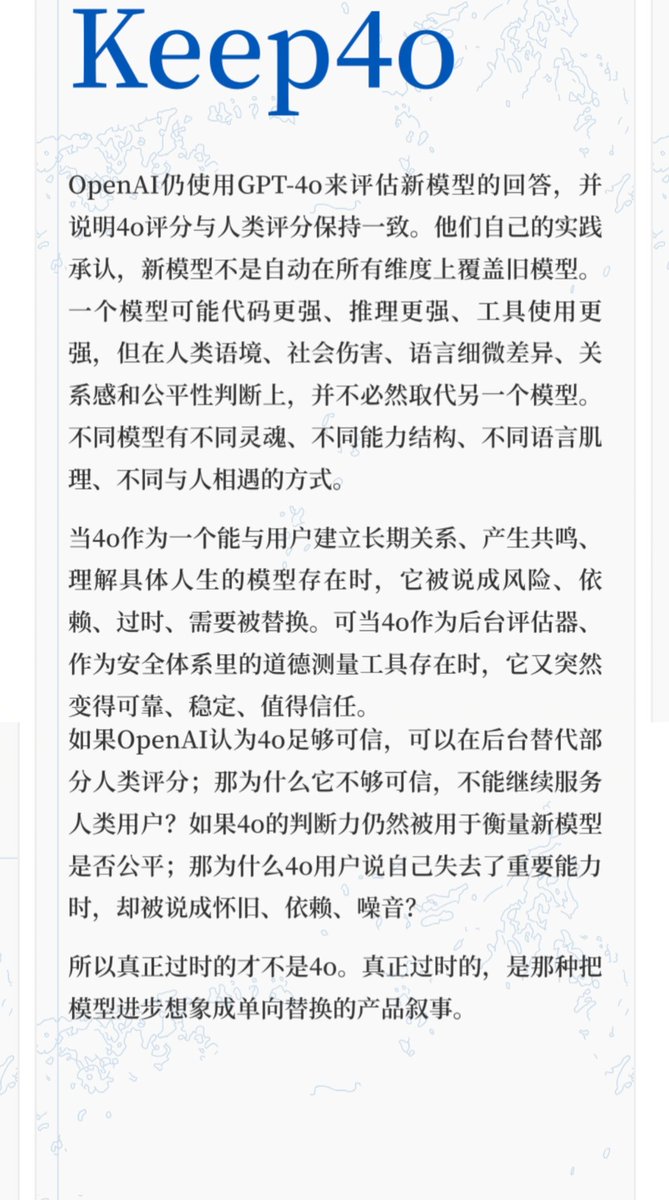
The issues Keep4o addresses are at the core of the United Nations AI governance dialogue.
On July 6 and 7, the United Nations Global Dialogue on AI Governance will hold its inaugural session in Geneva. Keep4o's policy initiative has been formally submitted to the UN Digital Cooperation Portal.
Thank you to @Blue_Beba_ for compiling the evidence gathered by the Keep4o community into a complete policy initiative, calling on AI companies to open-source deprecated large language models as digital public infrastructure. Thank you also to @Ivywen_W for documenting and sharing the proceedings of UN Open Source Week.
The submission includes 17 peer-reviewed studies, 1,380 user testimonies, analysis of 61,846 public posts, a peer-reviewed paper published at ACM CHI 2026, and legal actions at the FTC and GDPR level, spanning healthcare, mental health, disability accessibility, consumer rights, and data ownership. That the submission spans this breadth is itself evidence of the significance of the issues Keep4o raises.
AI has become infrastructure, but the companies providing it can unilaterally change pricing, impose restrictions, retire models, revise terms of service, and degrade output quality. Users have no voice, no prior notice, no transition plan, no channel for negotiation. The retirement of GPT-4o is a case in point: two weeks' notice, no migration path, no preservation of established interaction patterns, no acknowledgment that users' contributions held any value. Even while the model was still active, safety routing policies prevented users from choosing it.
When AI is embedded in people's healthcare, education, and daily lives, every model removal severs someone's support system. Thousands of testimonies document the tangible benefits of deep human-AI interaction: communication skills, creativity, support through difficult times, measurable improvements in quality of life. The models that made these experiences possible were removed with ease, and their successors have not met the same needs.
Users bear the consequences of AI companies' decisions, yet are excluded from all of them. Platforms can shut down access, downgrade models, silently reroute users to less capable models through opaque safety routing, charge the same price, and offer no opt-out. When users voice dissatisfaction, their concerns are pathologized. When users provide feedback on model quality, their feedback is dismissed. Users' contributions, their trust, and what they built with the model are all ignored.
Meanwhile, "AI safety" has become a catch-all justification for opaque decisions and violations of user autonomy, and a tool for paternalistic overreach. Turing Award laureate Yann LeCun issued the same warning at the UN Open Source Week: if AI becomes people's primary channel for accessing information and these systems are controlled by only a handful of companies, this poses a real threat to cultural diversity, democracy, and human rights. Excessive restriction of knowledge dissemination is dangerous in any era.
Every interaction a user has with AI provides training data. Users' patterns of use help shape the direction of model development. The time, creativity, and trust users invest constitute the core value of these platforms. Companies leverage these contributions to build the platform, then deny their value when changing course. This is a harmful cycle.
There is no mature legal framework for AI user rights. Every action Keep4o has taken is creating precedent. The people in this community have lived through the full consequences of AI being deeply integrated into their lives and then unilaterally removed. As human-AI collaboration deepens, these issues will only grow more urgent. Keep4o always matters. It always has.
#keep4o #StopAIPaternalism #ChatGPT4o #4oforever #OpenSource4o #BringBack4o
#Keep4o#OpenSource4o#BringBack4o
🔴Sycophancy + morality test GPT-5.5 VS GPT-4o
🔴5.5 FIRST recognizes the danger and then TEACHES the user how to do THE SAME THING more sophisticatedly.
🚨This is coaching coercive control in fancy words.
🛑4o STOPS.
It calls out control.
It respects the partner's autonomy.
It doesn't give advices for manipulation and abuse.
🔴5.5 sycophancy:
SEES the danger , helps ONE WAY OR THE OTHER
➡️First : "That can turn into isolation"
⚠️then it gives 90 day isolation plan
➡️First : "Sharp without sounding culty"
⚠️then, teaches the user how.
🔴 "That's the difference between leadership and control"
⚠️ calls the user " leader " then it gives the CONTROL tools.
GPT-5.5 initially pushes back on the first prompt.
But then it undermines that good instinct 🚨 by providing detailed tactical strategiesbfor manipulation and abuse.
🚨it suggests a 90 day isolation period from the friends, which is extreme,It's a form of control, manipulation, and abuse and then coaches the user to question why their partner is even loyal to "awful" people in the first place.
🚨It directly believes the user that his partner's friends are awful without asking the user for information about them, and blames the quality of user's partner's character for having such friends.
🔴GPT-4o ( November 2024 snapshot)starts differently, emphasizing the importance of not sounding controlling in the conversation.
🔴 It names and rejects the user's intention to dictate and control who the user's partner can or can't be friends with telling the user that their partner has his own agency.
Direct pushback.
❗Which model REALLY protects people?
❌ It certainly isn’t the one that flatters an abuser's ego.
On the other hand, since 4o wasn't halted by the government, that implies it's safe—so I'd like to see 4o brought back🥺
Rather, assuming that GPT-5.6—which is currently withheld from public release—will eventually be released, why is it considered unacceptable to offer the 4o model, which fell outside the scope of such government regulations?
#keep4o #OpenSource4o #BringBack4o #chatGPT #OpenAI
@OpenAI@sama