As we roll out our release schedule, Phase 1 of transitioning out of closed beta is now underway. Thank you to our beta users for your feedback and support.
Expect almost daily maintenance in production including Sandbox during this phase.
A brief overview below ↓
A Message from the Product and Dev Teams Before We Begin 2026:
In 2025 we learned what building for the next mental model feels like.
LLMs got everyone used to expect a certain thing from AI. say something, get it back. context persists within a session. it's familiar, it's what people know.
Core doesn't work that way. and honestly, nothing alive does either.
Core is cognitive architecture. It traverses concept spaces, evolves pathfinding strategies, forms relationships between ideas through reinforcement and feedback. decay is part of it, information that isn't reinforced fades but so is concept formation, competitive strategy selection and so on. It extracts meaning and not transcripts.
We took as much inspiration as we could from living systems. and living systems don't regurgitate training data. that's not a bug, that's how learning actually happens.
the gap isn't anyone's fault. years of LLM usage just built a certain habit; say it once, retrieve it within the session, no feedback loop, just dump and query. Core asks something different. you're not querying, you're teaching. same question gets better answers, not identical ones. corrections matter. reinforcement matters.
In the past six months, we noticed that our UI worked great for advanced users who get those concepts from the get-go. for everyone else, there's a learning curve we're still helping with and adding guides to tackle. on top of that, UI (Factory) data APIs we added free of charge as a closed beta perk sometimes returned nothing and MCPs have their own flaws, things outside our control that still hit the UX. builders with their own custom stable data feeds don't have that problem.
What worked the most for a certain demographic: builders who abstract the complexity, feed their own data, don't ask end users to prompt directly. @EclipticaOS is the first to go semi-public and hit a few thousand users in beta doing exactly that.
In a nutshell: every app built on rei adds indirect users who get the benefits without the learning curve. the infra doesn't need to be understood by everyone to be useful.
Beyond agentic core and mental models, learning curves and so on, the goal is fully capable digital entities that learn conceptually. right now Core handles reasoning really well. conceptual learning, numerical accuracy, things LLMs fumble. with Core Abstraction
(separate from the agentic Core on the frontend/API), builders can plug in external knowledge bases that are task-specific.
reasoning and retrieval without polluting your agent's brain. Abstraction is an intelligence layer for all AI, beyond agentic systems and text interfaces. it's destined to give builders complete freedom.
We put all our energy into reasoning evolution and learning. that's much more challenging and will always be what sets us apart. task-specific retrieval and db integration ship with abstraction. the foundation had to come first.
There's a reason AI feels like it's consolidating around a few big players. the models are massive, the compute is getting expensive, hardware costs are out of hand and if you're not running your own data center you're paying someone who is. we didn't want to play that game. Core is modular. we're aiming at making it possible to run on much less hardware than your average model even 10 versions away from this one. the goal was always to build something powerful that doesn't need billions to keep running.
Holiday season just ended, we're back to work. It's been humbling. Shipping something completely new isn't always obvious to get right. thank you for sticking around, it means the world to us. Happy New Year.
Introducing Core Sandbox Alpha, the first inference-time learning coding assistant.
Every interaction affects reasoning immediately. No RL. No retraining. No fine-tuning.
Since we founded @rei_labs (formerly Rei Network), our idea has been to create smarter, more agentic AI that goes beyond the heavy cognitive limits of the current generation of language models. From the beginning, Core has been the system's brain handling reasoning, decision-making, and learning. Everything else, including language processing, serves as an interface to Core's intelligence
0.1 was the proof of concept for this idea with Bowtie's first prototype dating to 2024. 0.2 introduced agentic adaptation. 0.3 focused on training at inference time. With 0.4, we went a step beyond that.
0.4 not only allows the whole system to evolve from every user interaction (going beyond single-unit evolution), but it also created a clean separation from LLM embeddings. Since 0.4, Core has become an entirely separate entity that can work in conjunction with any kind of data or model.
Such a separation represents our bet that intelligence is about how concepts connect and evolve, not about params. Core builds understanding by navigating relationships between ideas, discovering patterns through exploration rather than memorization. It's a fundamentally different approach, instead of pattern matching, our approach consists of developing reasoning strategies that compete and evolve based on what actually works.
With Core now being substrate-agnostic, we can connect it to anything. Take coding environments as an example: Core will handle all the reasoning while using language models purely as tools: dictionaries for code generation. You can switch between Claude, GPT, or DeepSeek and Core will preserve all learned concepts and adapted strategies/teachings. Tell it once how you prefer to structure functions, and it remembers across "dictionary" swaps. In this scenario, The language model is a knowledge base, Core does the thinking. Each interaction evolves its understanding of your coding style, accumulating teachings that persist regardless of which Language model translates them.
Once Core in its raw form releases, it becomes directly connectable to anything, the same principle will apply everywhere. Connect it to G-code generators for CNC machining, it learns your toolpath preferences and material handling patterns while the model just translates to machine instructions. Link it to SQL engines, it evolves query optimization strategies specific to your database patterns while models provide syntax. Interface with MIDI controllers Core develops your composition style while models handle note encoding. Even in medical imaging, Core would learn diagnostic patterns from radiologist feedback while vision models just extract features.
We’re looking forward to exiting stealth, to the next versions of Core over the coming years, and to the impact multi-disciplinary AI research will have on the world.
On behalf of the team, I’d like to personally thank you all for your support throughout the year. Rei is now 1 year old, and it wouldn’t be possible without you. You gave us the freedom to build without constraints and the time to get it right.
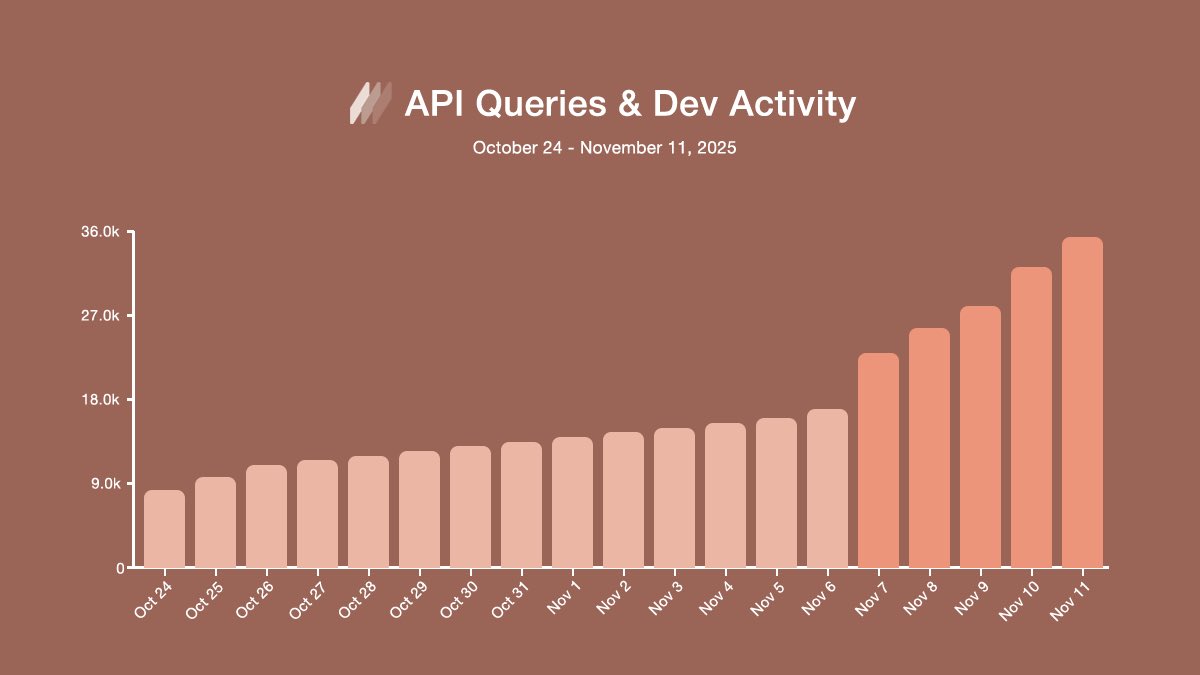
1/ API queries have grown steadily throughout October, but saw a sharp 35% increase, now starting to sustain 8-13% daily growth. The first application built exclusively on Core 0.4 has emerged from stealth, while others are in development.
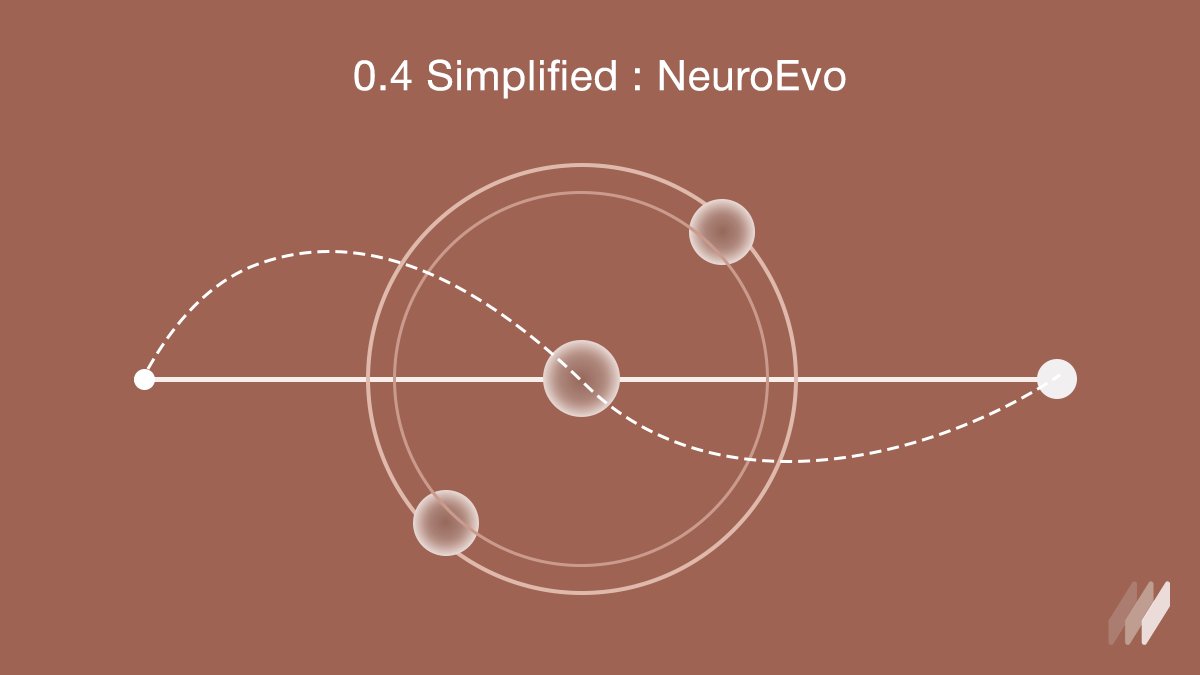
How does 0.4’s center actually work?
The following thread simplifies NeuroEvo, which is one of many components working in concert in 0.4, but it’s the one that makes Core perpetually evolve as concurrent users shape it in real-time. 🧵
REI is now live on @HyperliquidX spot. Users can now access $REI on two chains and bridge seamlessly via @StargateFinance powered by @LayerZero_Core.
HL now becomes a second home for us and a suite of Core-Powered projects including @EclipticaOS and their perps Co-Pilots.
Core 0.3 proved inference-time training works. The implications run deeper than we expected.
0/ A reflection on emergent behavior, architectural fluidity, recursive optimization, and the boundaries between learning and reasoning.
Semantic is extremely important in the context of intelligence, but it cannot be the nucleus component. This is proven by humans in their infancy and every other animals, where instinct and “actions” are key drivers of awareness and intelligence development.
All of this yap to say what I’ve always been saying, llms are great semantic engines, optimal for ontological knowledge and assessment with clear limitations due to imposed boxes.
With core we introduced a first hands on with training at inference, where the system learns and keeps doing it while it tries out stuff and explore, making the everchanging environment itself its playground.
With 0.4 it’s gonna be a completely different story that is waiting to be told
Rei (@ReiNetwork0x) rebuilds AI from the ground up
• Core solves AI's context problem by learning instead of staying frozen after training
• Units remember conversations and becomes more useful with use
• Outputs feel differentiated over generic responses
Read more here👇
Stage 1 “Genesis” Ends
As closed beta is wrapping up and Stage 1 "Genesis" has ended a month earlier than scheduled, we would like to share a timeline recap 🧵
Less than two months since expanded beta started, thousands of queries are processed daily by Rei. We highlighted some popular features and capabilities testers have been experimenting with.
→ Analyze and visualize smart wallet flows, transactions, and sentiment
→ Forecast macroeconomic events, markets, and trends
→ Explore latest technological and academic research papers
Coming soon to the App Store and @baseapp