5 LAYERS OF THE 1.6T OPTICAL SUPPLY CHAIN
The move to 1.6T optics is turning every transceiver into a denser semiconductor system with more content flowing into DSPs, lasers, timing, power management and broader network around each module:
1. $MRVL, $AVGO, $CRDO & $ALAB form signal-processing layer behind 1.6T optics supplying DSPs, SerDes, retimers & equalization that push 224G electrical lanes into next-generation transceivers
2. $COHR, $LITE & $AAOI sit at optical front end across lasers, drivers, photodiodes & TIAs with Coherent consuming all of its InP laser output internally, Lumentum demand still running above supply & AAOI already landing a $200M+ volume 1.6T hyperscaler order
3. $SITM is less obvious timing beneficiary supplying precision oscillators inside transceivers on both ends of an optical link so content scales directly with module count as 1.6T deployments ramp
4. $MPWR, $ADI, $TXN, $MCHP & $ON provide power-management layer as higher-speed optics require more voltage regulation, power conversion & thermal control inside every module
5. $APH, $TEL, $GLW, $CIEN, $NOK & $ANET extend the opportunity beyond the transceiver into connectors, fiber & networking infrastructure required to move 1.6T bandwidth across broader AI fabric
🚨 BREAKING: TradingView just made its biggest move in years.
AI is now built into the charts you already use every day. Most swing traders have no idea it's there.
Here are 8 features that change how you find and manage trades 👇
In 2018 an airport worker named Richard stole an empty airplane and flew it for over an hour, performing different stunts. He was not a pilot, and his only “experience” was flying in video games. The conversation before he finally cr@shed was so emotional, he was named the Sky King.
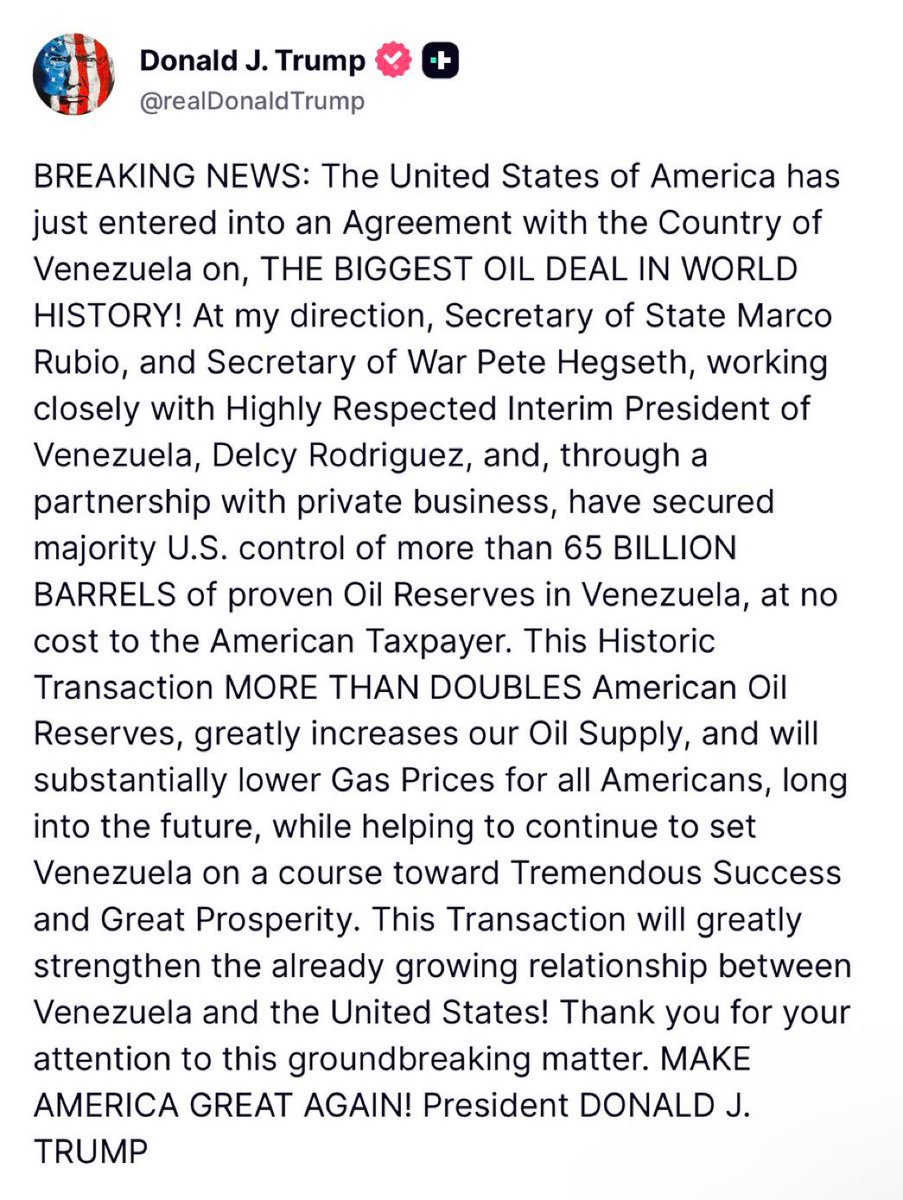
🇺🇸🇻🇪 Toppling Maduro was never about drugs or freeing the people of Venezuela; it was always about the oil
Remember that the next time you read a headline about how the U.S is trying to help free the people of Iran
Trump's only interested in freeing countries from their oil
Writer: Ian
🚨 THE COMPLETE CLAUDE MASTERY ROADMAP — FROM BEGINNER TO POWER USER
Most people use Claude for writing a caption, answering questions, or summarizing a document.
But that’s only the surface level.
Claude can help you research, create interactive apps, analyze information, build workflows, connect with external tools, automate repetitive tasks, and even work alongside you like an AI teammate.
The real advantage comes from learning what to use, when to use it, and how to build repeatable systems around it.
Here’s a complete 100-step Claude Mastery Map to take you from beginner → advanced user. 👇
Warren Buffett's biggest position: $APPL
Gavin Baker's biggest position: $SPCX
Two of the sharpest investors alive yet they have completely different bets on where value lives. (Save this)
Here is the Q2 2026 comparison:
Buffett:
AAPL: 22.04%
AXP: 17.14%
GOOGL: 12.62%
KO: 10.86%
BAC: 9.20%
CVX: 4.67%
OXY: 4.30%
CB: 3.90%
MCO: 3.73%
KHC: 2.57%
Gavin Baker:
SpaceX: 32.58%
QQQ puts: 16.44%
MU: 5.73%
CBRS: 4.79%
META calls: 4.72%
ALAB: 4.10%
CIEN: 2.36%
CRDO: 2.14%
PANW: 2.09%
U: 2.04%
Buffett owns legacy moats while Baker owns private AI infrastructure and is actively shorting the public tech index.
Baker thinks the next winners have not gone public yet and the companies already in the Nasdaq will lose ground to the ones outside it.
Use the link below to see exactly what our PRO analysts hold.
Another great week. I can’t wait to lead you guys on the last day of the month which is my birthday.
Ps. My % would be a lot higher if I didn’t have to leave and go to my day job 🤪 I just can’t watch charts all day.
BREAKING: Claude can now make stock trades using data on new trades by politicians, insiders, and hedge funds.
You can have it build and test algorithmic trading strategies.
Here is how it works:
🚨 TERRIFYING FOOTAGE: Glacier Lake Bursts in Tibet, Sending a Massive Flood Toward Nepal! 🤯
A sudden glacier lake outburst in Tibet unleashed a powerful surge of water and debris, triggering severe flooding downstream in Nepal’s Koshi River system.
The sheer force of nature is terrifying. 💔🙏
🇳🇵 He kept filming while the flood swallowed the street behind him in real time.
A guy in Nepal captured the surge hitting his town, forced to sprint as the water closed in.
Every glance back showed the ground he’d just left already underwater.
This is from today’s deadly flash floods in northern Nepal that have killed scores and left hundreds missing near the Tibet border.
Writer: Lucas
CANCER HAS BEEN CURED
Ivermectin & Fenbendazole cure cancer.
Pass it on.
BREAKING NEWS: First-in-the-World Ivermectin, Mebendazole and Fenbendazole Protocol in Cancer has been peer-reviewed and published on Sep.19, 2024!
The future of Cancer Treatment starts NOW.
My thanks to lead authors Ilyes Baghli and Pierrick Martinez for their incredible inspired work, FLCCC’s Dr.Paul Marik for his extensive work on repurposed drugs and every co-author who worked hard to bring this paper to life.
I hope that this peer-reviewed paper lays the groundwork for a brand new future for Cancer Treatment.
Many of you know that I have been helping thousands of Cancer patients with high dose Ivermectin, Mebendazole, and Fenbendazole
𝗖𝗢𝗡𝗖𝗘𝗡𝗧𝗥𝗔𝗧𝗘𝗗 𝗣𝗢𝗥𝗧𝗙𝗢𝗟𝗜𝗢
Watch the Peter Lynch video below.
There have only been a handful of investors in history who consistently beat the market over very long periods.
Peter Lynch and Stanley Druckenmiller are probably somewhere in the top five, arguably top three.
And both have said versions of the same thing about concentration.
One of my biggest realizations over the last four years is that when I find an unusually obvious opportunity, I’m not afraid to concentrate.
I’m not saying you should wake up tomorrow and put 40% into a stock. Opportunities that justify that kind of concentration may come once a year, or once every two years.
But if you have done the work, understand the risks, and genuinely believe you have one of your best ideas in front of you, then owning 2% or 3% almost defeats the purpose.
If your best ideas are never at least 10% of your portfolio, you may be spending an enormous amount of time researching without allowing your best work to meaningfully affect your returns.
When I had around 40% in $ZIM, people called it reckless. But I was looking at a profitable company trading below the cash it held, with additional assets on top.
For me, taking money away from that opportunity simply to buy companies I understood much less, just for the sake of diversification, would have made even less sense.
People often point to hedge funds owning 40 or 50 stocks. But large funds have teams of analysts. Each analyst may really have only three or four highest-conviction ideas. Put 10 analysts together and suddenly the fund owns 40 stocks.
That is very different from one person pretending to deeply understand 40 companies.
Of course, this does not apply equally to every industry.
Biotech is a good example. Many biotech investments are closer to hero-or-zero outcomes, where one trial, one FDA decision or one safety issue can completely change the value of the company. In that kind of sector, diversification matters much more.
Concentration makes the most sense when you can actually understand and control the major variables of the thesis.
And when you really have an edge, your position has to be large enough for that edge to actually matter.
$SNAP : 𝗪𝗛𝗘𝗡 𝗧𝗛𝗘 𝗖𝗢𝗡𝗗𝗜𝗧𝗜𝗢𝗡𝗦 𝗖𝗛𝗔𝗡𝗚𝗘
For years, Evan Spiegel has destroyed shareholder value at Snap. The company went public at $17 in 2017, traded above $80 in 2021, and today sits near $5.
So why am I interested now?
Not because I suddenly believe Spiegel became a different CEO. One thing I like from Buddhism is to watch conditions. We cannot know the future, but we can see when the conditions shaping it begin to change.
And several things have changed at Snap.
Jan. 28: Specs was separated into its own subsidiary.
March 31: Adam Katz and Irenic Capital entered the picture.
April 15: Snap announced cuts of roughly 1,000 employees and more than $500 million of annualized costs.
June: Snap put a $2,195 price tag on Specs.
Q2: Revenue grew 19%, free cash flow was positive, and monthly active users reached 971 million.
Snap does not need to become a great company. It mostly needs to stop doing stupid things.
𝗦𝗣𝗘𝗖𝗦 𝗙𝗜𝗡𝗔𝗟𝗟𝗬 𝗠𝗘𝗘𝗧 𝗥𝗘𝗔𝗟𝗜𝗧𝗬
Spiegel has spent billions pursuing augmented-reality glasses. I think Specs will probably flop.
Strangely, that could be good for shareholders.
For years, Specs was a vision. Now, at $2,195, it is a product people actually have to buy. If demand is weak, it becomes much harder to justify spending billions more.
Specs also sits in a separate subsidiary that could eventually take outside capital. Spiegel can keep chasing the dream without making Snap shareholders finance all of it.
𝗦𝗢𝗠𝗘𝗢𝗡𝗘 𝗙𝗜𝗡𝗔𝗟𝗟𝗬 𝗗𝗜𝗦𝗖𝗢𝗩𝗘𝗥𝗘𝗗 𝗖𝗢𝗦𝗧𝗦
In April, Snap announced it would eliminate roughly 16% of its workforce and remove more than $500 million from its annualized cost base.
For a company valued at less than $10 billion, that matters.
More importantly, it suggests a change in attitude. Snap is finally talking seriously about profitable growth.
Most companies need to become better businesses.
Snap mostly needs to become less stupid.
𝗧𝗛𝗘 𝗔𝗦𝗦𝗘𝗧 𝗜𝗦 𝗦𝗧𝗜𝗟𝗟 𝗘𝗫𝗖𝗘𝗣𝗧𝗜𝗢𝗡𝗔𝗟
Snap has nearly one billion monthly users. Revenue grew 19% in Q2 and free cash flow was positive.
The problem was never the product. It was monetization, spending and capital allocation.
Improve advertising. Grow subscriptions. Cut costs. Reduce dilution.
Do a few ordinary things correctly and I think there is another 20% to 30% upside.
A sale is not my base case. But if Snap were ever sold, I have a hard time believing a strategic buyer would value a social network with nearly one billion users anywhere close to today’s valuation. In the right transaction, 3x to 4x the current share price would not surprise me.
𝗔𝗡𝗗 𝗧𝗛𝗘𝗡 𝗔𝗗𝗔𝗠 𝗞𝗔𝗧𝗭 𝗦𝗛𝗢𝗪𝗘𝗗 𝗨𝗣
This may be the most interesting condition.
Adam Katz is 40. Evan Spiegel is 36.
Spiegel spent his life building products. Katz spent his career learning capital allocation, activism, private equity, restructuring and M&A. Katz also came from the internet world.
𝗦𝗣𝗜𝗘𝗚𝗘𝗟 𝗨𝗡𝗗𝗘𝗥𝗦𝗧𝗔𝗡𝗗𝗦 𝗣𝗥𝗢𝗗𝗨𝗖𝗧𝗦. 𝗞𝗔𝗧𝗭 𝗨𝗡𝗗𝗘𝗥𝗦𝗧𝗔𝗡𝗗𝗦 𝗖𝗔𝗣𝗜𝗧𝗔𝗟.
One built the asset. The other has spent his career figuring out how badly managed assets can be worth more.
Katz cannot remove Spiegel. Spiegel controls the company. So Katz needs to persuade him.
Katz Interview
https://t.co/Vo14pNtgqM
After listening to Katz speak, I can imagine him becoming the financial older brother Spiegel never had: close enough in age to understand him, entrepreneurial enough to respect what he built, but experienced enough to tell him when vision turns into bad capital allocation.
Maybe it happens. Maybe not.
But six months ago Snap was the same badly managed, highly valuable asset it had been for years.
Today costs are coming down, Specs has been separated, the glasses are facing the market, the core business is growing, and Katz is pushing Spiegel toward better capital allocation.
𝗧𝗛𝗘 𝗖𝗢𝗡𝗗𝗜𝗧𝗜𝗢𝗡𝗦 𝗛𝗔𝗩𝗘 𝗖𝗛𝗔𝗡𝗚𝗘𝗗.
and when the conditions change, I am willing to change