Elon Musk's first wife once described what it's like to watch him fail.
She said he doesn't react the way normal people react. When a rocket explodes, most people in the room go silent. Some cry. Some start calculating the financial damage.
Musk pulls out his phone and starts making calls. Not emotional calls. Engineering calls. "What failed. When can we fix it. When's the next launch." His voice doesn't change. His face doesn't change. The rocket that just cost $60 million is already in the past. The next one is all that exists.
She said it was the most unsettling thing she'd ever witnessed. Not because he was cold. Because he genuinely wasn't affected. The failure didn't register as failure. It registered as data. An experiment that produced results. Results that inform the next experiment.
This is why he wins. Not because he doesn't fail. He fails more spectacularly than anyone in history. He wins because failure occupies zero psychological space. It enters as data and exits as action.
Most people lose not because they fail but because they spend weeks processing the failure before acting again. Musk spends zero seconds. The gap between failure and next attempt is a phone call.
NVIDIA CEO Jensen Huang just said the quiet part out loud about what the education system will never admit.
For a century, we built humans to think like calculators.
The algorithm made that skillset obsolete overnight.
Huang: “The definition of smart is somebody who’s intelligent, solve problems, technical. But I find that that’s a commodity. And we’re about to prove that artificial intelligence is able to handle that part easiest.”
Software engineering was supposed to be the safe play.
Superintelligence cleared it first.
The SAT was supposed to measure intelligence. It was measuring the ability to follow instructions. Raw technical processing isn’t a competitive edge anymore. It’s the floor the machine stepped over before you woke up.
The question isn’t what you can calculate.
It’s what you can see before the data shows up.
Huang: “People who are able to see around corners are truly, truly smart. And their value is incredible. To be able to preempt problems before they show up, just because you feel the vibe.”
That vibe isn’t magic.
It’s the collision of first principles, human empathy, and lived experience no model can fake.
Huang: “That vibe came from a combination of data, analysis, first principle, life experience, wisdom, sensing other people.”
The operators who see around corners will command the AI.
The ones waiting for dashboards to update will be replaced by it.
Huang: “I think long term the definition of smart is someone who sits at that intersection of being technically astute, but human empathy and having the ability to infer the unspoken, around the corners, the unknowables.”
The unspoken variables are the new leverage.
The human psychology inside a market. The invisible friction in a negotiation. The instinct to build something nobody asked for yet.
You can’t spreadsheet your way there. You can’t prompt your way to that perception. It comes from decades of watching what doesn’t show up in the metrics.
Huang: “And that person might actually score horribly on the SAT.”
The future doesn’t belong to people who memorized answers.
It belongs to people who sense the questions before anyone thinks to ask.
The old system tested your ability to follow orders. The new one tests your ability to move through the unknown. And the machine can’t help you with that part.
That part is entirely on you.
For the folks thinking of skipping spring phosphate applications because it will be cheaper in the fall, 2 biggest reasons why it may not:
1. China doesn't look to export until August this year
2. Cost of production is skyrocketing w/ NH3 & sulfur prices skyrocketing.
"We shall have a vast network of reporters, rating the crop in terms of good and excellent"
"We'll use those ratings to determine crop size, right?"
"No, we shall not"
China’s export cuts and India’s demand keep phosphates firm, while NOLA urea dropped $70 after a spring spike.
StoneX’s @JLinvilleFert explains why the usual summer reset may sizzle and where farmers might still secure lower prices.
Read more: https://t.co/9pvzG4HWTL
#Fertilizers #Urea #Phosphate
I'm only pushing so I can brag that I have the highest viewed StoneX TV video! I promise I'll slow down after I hit that (about 150 views away)!
If you have 7 minutes, take a listen/watch to get this week's fertilizer highlights.
https://t.co/UCTwmdxEji
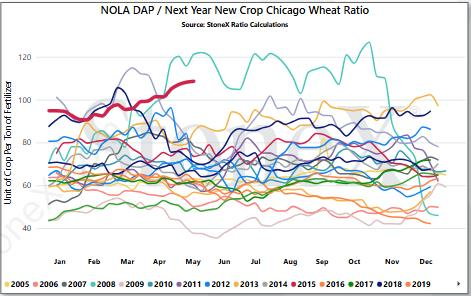
Phosphate values are incredibly high priced with few signs it will soften. This will be incredibly hard on wheat farmers who have to make decisions in coming weeks.
NOLA DAP @ $680
July '26 Wheat @ $6
113 ratio...only 8 bushels less than the 2008 value during same period.
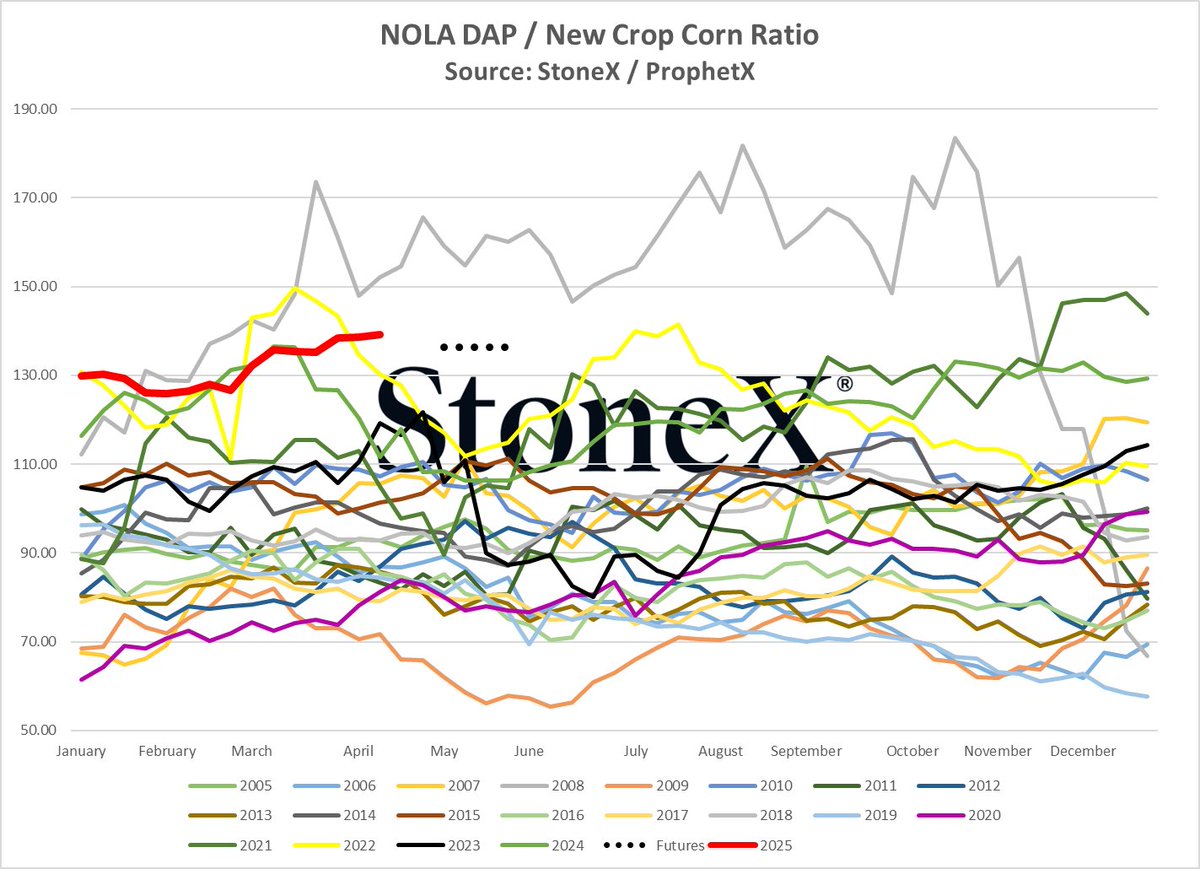
Today's NOLA DAP/corn ratio is the 2nd highest/worst in history. That means phosphate has to drop, right?
Wrong.
Early 2022 saw values several hundred dollars higher than today on the back of $7 - $8 corn.
Today, the supply situation is SIGNIFICANTLY worse.
It can go higher.
Did you see the latest episode of This Week in AgriBusiness featuring our own Craig Dick, VP of Sales and Marketing at @phospholutions ? Watch the last five minutes to hear how @RhizoSorb is helping growers boost their margins.
https://t.co/We3Ixmd8BY
Fears continue with N.A. tariff's.
Fert supply questions with rising corn acres.
Uncertainty around the world.
How can farmers put their minds at ease?
Talk to your retailer/supplier.
They likely either have the product on hand, or can take steps to prepare.
Have the convo.
Group CEO of @Ryanair, Michael O’Leary telling students. A degree in agriculture science “will stand to you for life”.
“I will always interview and give someone an interview if they grew up on a farm because you know how to work and you know how to take responsibility”.
Fertilizer is headed into the weekend with a lot of strength.
Nitrogen supplies are tight and big demand coming.
Phosphate sitting tight with Chinese exports still low and spring demand coming.
Potash showing strength but industry trying to use tariff fears to push higher.