The Fed does not move the gold market. Dollar liquidity does.
When the Iran conflict shut down shipping through the Strait of Hormuz, traders caught short on oil and long on gold got trapped. Ships stuck, positions underwater, margin calls piling up.
The fix was not complicated. Sell the gold. Raise the dollars. Meet the margin.
Meanwhile India and Turkey are doing the opposite of what the headlines suggest. Both governments are actively pressuring citizens out of gold and into their own currencies, one with import duties, the other with import quotas.
So you get selling pressure from the funding side and demand suppression from two of the biggest gold markets on earth, at the same time.
That is not a story about central banks. It is a story about who needs dollars, who does not have them, and what they are forced to sell to get them.
@RealKeithWeiner
Just watched Dunkirk for the first time, loved it.
I couldn't help noticing Nolan used zero diversity casting.
1940s English people looked like they would have looked.
2017 was a long time ago I guess.
🚨 JUST IN: Treasury Sec. Scott Bessent drops this chilling line on the Iranian regime — he's tracking the Ayatollah's accounts and assets WORLDWIDE and just FROZE $130M in crypto wallets
"We found the money man for the Ayatollah! We are tracking the Ayatollah's properties around the world. We hope to soon be able to print his $100 million-plus properties and show the addresses."
"We are tracking these accounts all over the world. We froze a crypto wallet linked to the IRGC worth $130M."
"Their currency has collapsed, it's in free fall, we think their inflation is 180%!"
ECONOMIC ASSASSIN MODE 🔥🔥
🚨 JUST IN: Treasury Sec. Scott Bessent drops this chilling line on the Iranian regime — he's tracking the Ayatollah's accounts and assets WORLDWIDE and just FROZE $130M in crypto wallets
"We found the money man for the Ayatollah! We are tracking the Ayatollah's properties around the world. We hope to soon be able to print his $100 million-plus properties and show the addresses."
"We are tracking these accounts all over the world. We froze a crypto wallet linked to the IRGC worth $130M."
"Their currency has collapsed, it's in free fall, we think their inflation is 180%!"
ECONOMIC ASSASSIN MODE 🔥🔥
SpaceX $SPCX share unlock schedule ending at 100% December 2026.
Keep in mind only 5% of float is trading right now and most early investors bought for $0.02 - $1.22 per share.
That's a lot of selling coming...
"The whole world must see that Israel must exist and has the right to exist. I will always take a stand against antisemitism. It’s wrong and evil."
Martin Luther King Jr. was a proud Zionist. 🇮🇱🙏
Lol. The only way out is through "growth". Get ready Trump/Bessent/Warsh are going to run the economy as hot as possible. It's over for the USD as the world's reserve currency.
The Gold Goes Home
People forget how quickly the world can change.
In February 1965, Charles de Gaulle stood in front of hundreds of journalists at the Élysée Palace and said the one thing no Western leader was allowed to say.
He called for the world to return to gold.
Not to the dollar. Not to promises.
To the one asset, he said, that "has no nationality" and is "eternally and universally accepted."
Washington laughed at the old general.
Then France stopped laughing and started converting.
Through the mid-1960s, the Banque de France redeemed hundreds of millions of American dollars for American gold, ship after ship, drawdown after drawdown.
And de Gaulle's economist, Jacques Rueff, kept telling the world exactly what the game was:
America could spend more than it earned, forever, without consequence… a "deficit without tears," he called it, because it paid its bills in paper only it could print.
Finance minister Valéry Giscard d'Estaing gave the arrangement the name that stuck:
America's "exorbitant privilege."
The pressure worked too well.
On August 15, 1971, President Nixon closed the gold window rather than keep paying out metal.
The last link between the dollar and gold was severed on a Sunday night, on television, precipitating a period of confusion and shock.
France asked for its gold.
The world got the fiat era instead.
Keep that story in mind. Because sixty years later, France just did it again and almost nobody noticed.
The quietest repatriation in history
Starting in July 2025, the Banque de France began unwinding its position at the Federal Reserve Bank of New York.
But there were no armoured convoys.
No transatlantic flights.
No diplomatic incident.
Instead, across 26 separate transactions over seven months, France sold 129 tonnes of old bullion sitting in the New York Fed's vault, bars so old some dated to the late 1920s, cast before modern purity standards existed and bought back the identical tonnage in Europe.
Newer bars. Higher standard. Stored in Paris.
Repatriation without a single bar crossing the Atlantic.
And here's the part that should make every treasury official weep:
They got paid to do it. By selling old New York stock at record prices and repurchasing in Europe, the Banque de France booked a realized gain of roughly €11–13 billion, nearly $15 billion, enough to swing the entire central bank back to profit for the year.
All 2,437 tonnes of French gold, the fourth-largest hoard on Earth, now sit in La Souterraine, the vault carved into the rock beneath Paris.
Governor Villeroy de Galhau insists the move was "not politically motivated."
Of course he does.
Central bankers always say that.
France is not alone.
Watch what they do, not what they say.
Germany repatriated 674 tonnes from Paris and New York, a program announced in 2013 after German politicians grew tired of being told their gold was fine, trust us, no you can't audit it.
Turkey pulled 220 tonnes out of the Federal Reserve.
The Netherlands brought home 122 tonnes.
Poland repatriated 100 tonnes from vaults in England.
And the vaults themselves tell the story in aggregate.
The share of central bank reserve gold stored in London has fallen from 64% to 57%.
The New York Fed's share has dropped from 17% to 14%.
Percentage point by percentage point, decade by decade, the metal is migrating home.
Onto sovereign soil.
The bigger picture
This is not happening in isolation. It's happening inside the largest shift in reserve behaviour in a generation.
Gold now exceeds US Treasuries as a share of global reserves for the first time since 1996.
Read that again.
The world's central banks, the issuers of fiat currency, the operators of the printing presses, collectively hold more of their reserves in a 5,000-year-old metal than in the debt of the United States government.
And a record 45% of them say they plan to buy more gold in the next twelve months.
Ask them why, and you'll get the paragraph about diversification.
But diversification doesn't explain the geography.
You don't move gold out of London and New York to diversify.
You move it because possession has started to matter again.
Because you watched $300 billion of Russian reserves get frozen with a keystroke.
Because you've realized that gold in someone else's vault is not gold. It's a claim on gold.
And a claim is just another word for credit.
The lesson?
Countries are beginning to think differently, not only about how much gold they own, but where they hold it and in what form.
Old bars are being upgraded to modern standards. Foreign custody is being converted to domestic possession. Claims are being converted to metal.
But strip away the financial engineering, and it's the same instinct that sent French ships across the Atlantic in the 1960s.
The same instinct that has moved men and nations for five thousand years.
When nations lose confidence...
They ask for their gold.
The last time France asked, the entire monetary system broke within six years.
This time, nobody's even pretending the window is open.
If you enjoy stories like this, please share it. Last week I wrote a story about JPMorgan. I will continue writing stories like this every weekend.
— GT
I don’t want to "download the app" to pay for parking. I don’t want to "create an account" to see a menu. I don’t want to "provide feedback" on a 30-second interaction. I just want to exist in the physical world without a digital leash.
Plenty of people sitting on a $2,000,000 portfolio still spiral over a $15,000 trip with the family.
It’s not that the money isn’t there.
It’s that the account balance never got translated into a green light.
Their net worth climbed. Their personal “allowed to spend” settings stayed frozen.
So the person who had to pass on a $15,000 vacation at 35 is still running the exact same mental spreadsheet at 48. Despite the numbers living in a different universe now.
Getting rich is challenge one. Letting yourself enjoy it without self-punishment is challenge two.
Most people stop after the first.
Housing Affordability Will Return the Hard Way
New homes selling for less than existing homes means builders are being forced to respond to the market before homeowners are.
Builders carry construction loans, land costs, payroll and unsold inventory. They cannot wait indefinitely, so they cut prices, reduce square footage and offer mortgage rate buydowns. Existing owners with 3% or 4% mortgages can simply refuse to sell. Price discovery is therefore appearing first in new construction while resale prices remain supported by restricted supply.
The comparison is not perfectly equal because new homes are increasingly smaller and concentrated in lower-cost regions. Even so, the reversal matters. A market that historically placed a premium on new construction now requires discounts to move inventory.
Mortgage Demand Has Collapsed
The deeper signal is mortgage activity. The purchase application index is roughly 35% below its long term average and about 70% below its 2005 peak. Application volume has fallen toward levels last seen around 1995 even though the U.S. population is nearly 29% larger.
Measured per person, purchase application activity is therefore about 22% lower than it was three decades ago. In practical terms, a much larger country is producing nearly one quarter fewer mortgage applications per capita.
This is not a lack of interest in owning a home. It is a failure of affordability. Mortgage rates were around 7.5% to 8% in 1995, but the median new home cost roughly $133,000. Today rates are somewhat lower, yet home prices are more than three times higher. Monthly payments have risen much faster than household incomes, while down payments, taxes and insurance have become larger barriers of their own.
Transactions Usually Break Before Prices
The historical pattern is that housing volume weakens before home prices fully adjust. That happened during the 2006 to 2008 downturn. Buyers disappeared first, inventory accumulated later, and prices fell more decisively once unemployment rose and forced selling increased.
Today the mortgage lock in has delayed that process. Owners with low rates are holding properties off the market, preventing inventory from rising enough to clear prices. Builders do not have that luxury, which is why they are cutting first.
Why Lower Rates May Not Be Enough
Lower mortgage rates alone could bring sidelined buyers back and place another floor under prices. Real affordability requires both lower financing costs and lower home prices relative to income.
That combination usually appears when the economy is weakening. Rising unemployment reduces household formation, forces some owners to sell and breaks the lock in effect. Inventory rises just as demand falls. Mortgage rates decline because growth and inflation are deteriorating, but lending standards tighten and fewer people feel secure enough to buy.
That is the cruel part of the housing cycle. Homes become more affordable only after buyers become scarcer. The people who benefit most are those who retain employment, liquidity and access to credit through the downturn.
Hormuz Could Accelerate The Reset
A sustained Strait of Hormuz disruption would intensify this process with a lag. Higher oil prices raise gasoline, freight, airline, food and production costs. Households lose discretionary income, businesses see margins compressed and hiring slows.
At first, the inflation shock could keep long term yields and mortgage rates elevated even as demand weakens. Later, if unemployment continues to rise and consumption deteriorates, rates would fall because the economy is breaking beneath the surface.
That is the most likely path back to affordability. Not a painless return to cheap mortgages, but a recessionary reset in which employment weakens, forced supply increases and falling rates arrive too late to protect everyone.
#SILVER - I just went on a historical study again, this time #silver's relation to the 200 DMA.
I backtracked 30 years back in time.
The #silverprice is currently -20% below the 200 DMA
The past 30 years the #silverprice have only been more down from the 200 DMA five times:
2020: -31% below 200 DMA
(Bounced +156.90% in 142 days after that)
2014: -26% below 200 DMA
(Bounced +31.29% in 52 days after that)
2013: -37% below 200 DMA
(Bounced +38.14% in 62 days after that)
2011: -28% below 200 DMA
(Bounced +43.36% in 62 days after that)
2008: -47% below 200 DMA
(Bounced +75.66% in 120 days after that and went on to run +495.25% in 911 days in total)
During 2022 we had 3 seperate times within a 4 month bottom-building period where #silver reached between -19% to -21% below the 200 DMA (similar to todays -20%). That was when we printed the absolute low at $17.5. From that low, #Silver never looked back and went on its rally to $121. A +593% move in 1238 days to be precise. Also worth knowing: From everytime the price reached this -20% area below the 200 DMA in 2022 it bounced +14.69% +20.55% and +23.12% in 32,34 and 33 days.
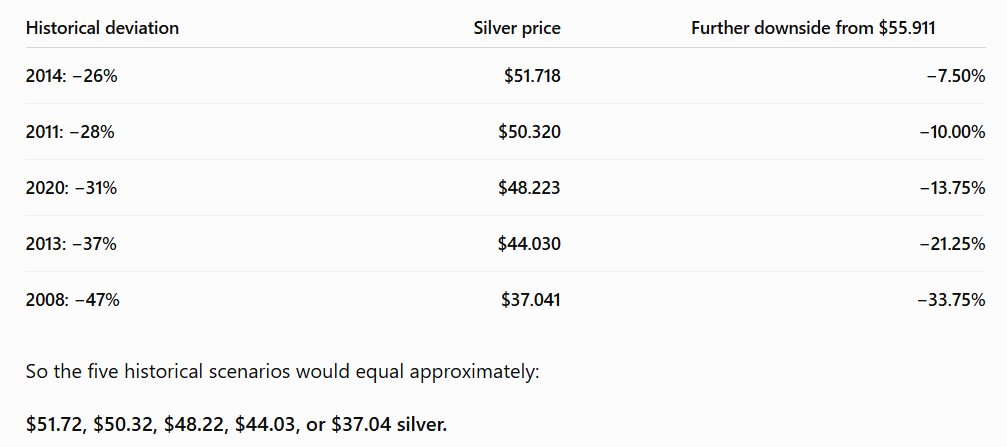
If silver were to match any of the five most extreme deviations below its 200-day moving average over the past 30 years, these are the price levels it would reach - and the additional downside from today’s price:
(SEE PICTURE)..
-------------------------------------------------
Sidenote regarding the reposted material:
Considering #silver hasnt dropped more than -10% (and only intraday or in one day) below the lower end bollinger band - we looking at like $48 here (-10% below current lower end bollinger band).
-------------------------------------------------
Picture #2: Bonus example if we only fall -10% more from here.
-------------------------------------------------
Last important note:
The 2008 drop (that bounced +75.66% in 120 days after that and went on to run +495.25% in 911 days in total) was from a total silver drop of -60% in 230 days..
The 2020 drop (that bounced +156.90% in 142 days after that) was from a total silver drop of -40%.
Current silver drop is -55%.
The biggest #silver drop for this data the past 30 years is the 2008 drop (-60%).
FINAL THOUGHTS:
Unless #Silver is heading for its most extreme drop below the 200-day moving average in 50–100 years - and more than -10% below the lower Bollinger Band for the first time in over 30 years - there likely isn’t much downside left from here.
Hundreds of children in Sudan are being orphaned after their parents are killed by Islamist extremists.
All this is happening right nowin these very months. Not ten years ago.
Where in UN?
Where is Greta?
Where is the Media?
Where is Macron?
Where is Human rights?
United Healthcare is beating estimates and having their revenue skyrocket. Just in Q2 they are reporting $112 BILLION in revenue
They are expected to do just under HALF A TRILLION in revenue in one year. Again, this is just one Big Health Insurance company
It’s time to drastically regulate Big Health insurance companies, they are robbing us blind and making astronomical revenues
It’s time to end this insane scam, it’s time to end this absurd for-profit racket these companies have on our healthcare system
¿Por qué Musk odia tanto el trabajo remoto?
Porque lo considera inmoral.
Puedes quedarte en casa en pijama, con tu café y tu laptop, “produciendo”.
Pero quien fabrica el auto que usas, construye tu casa, cocina tu comida o te la entrega a domicilio no tiene esa opción. Ellos deben presentarse para que tu vida funcione.
El trabajo remoto no es un derecho universal. Es un privilegio de la clase que trabaja frente a una pantalla: solo ellos pueden desconectarse del mundo real mientras otros mantienen el sistema.
Musk va más allá: en la oficina se innova más rápido, se resuelven problemas en minutos y los nuevos aprenden observando a los mejores. En videollamada todo eso se diluye.
Por eso en Tesla, SpaceX y X la regla es clara y sin excepciones: a la oficina.
No es capricho de jefe autoritario. Es su forma de evitar crear una nueva casta de privilegiados mientras el resto carga el peso.
¿Estás de acuerdo o crees que se equivoca?
Liberals: Why do they call us retards?!?!
You can't be the party of human rights and support abortion.
You can't hate the police and call them when you need them.
You can't demand wide open borders and lock your own doors at night.
You can't love the planet and fly private jets to climate conferences.
You can't champion women's rights and erase women's sports and private spaces.
You can't preach tolerance and cancel everyone who disagrees.
You can't fight for equality and demand special treatment based on race and identity.
You can't say my body, my choice and then force vaccines and masks on everyone.
You can't be anti-fascist while using fascist tactics to silence dissent.
You can't preach body positivity and promote surgeries that mutilate healthy body parts.
There. Hope this clears it up for you.