Helping Millennials cut taxes, boost income, and build wealth • @InvestmentNews Best Wealth Managers Under 40 • @Investopedia Top 100 FA • Tweets ≠ Advice
Yesterday I explained why far more than 10% of my net worth sits in one company, and why I'm not selling it down.
It comes down to one question (and it isn't what percentage to cap a stock at).
↓
https://t.co/BJe0soTilt
Heading to Austin next month for the first Crossover Retreat.
Going to be in a room with some of the best young firm owners in the U.S.
Looking forward to learning how they’re building systems, using AI, and growing their firms.
BIG ANNOUNCEMENT! 🚨 🚨 🚨
We have been keeping a HUGE SECRET. We’ve been planning the biggest surprise event for almost a whole year for financial advisors that are building the best practices in the US.
Our podcast, Advisor Freedom, has (amazingly!) exploded over the last 18 months and has been so much fun to run.
We thought the greatest way to celebrate that is to do the opposite of what every podcast seems to do (World Tours) and instead host an awesome and massive event for incredible financial advisors in Austin TX!
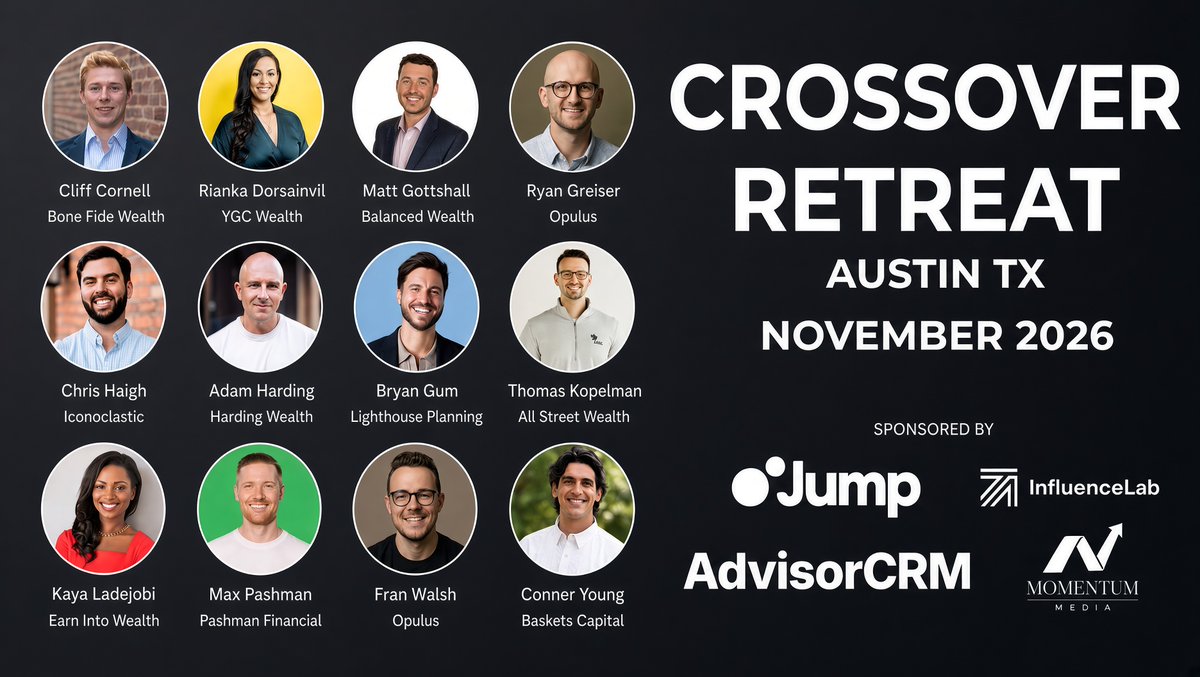
Soooo, we are excited to host the Inaugural Crossover Retreat!
I am obsessed with learning from other financial advisors (especially these superstars) on how they’re building their practices, growing their firms/social media reach and utilizing AI everyday.
That’s exactly what Crossover is for. Sharpening with and learning from some of the best minds in the same room.
If you want more info comment CROSSOVER and I'll send you info and event details.
Big thank you to our sponsors: @JumpAdvisorAI , AdvisorCRM , InfluenceLab and Momentum Media
Excited to explode with this year’s cohort!
@cliffcornell_ - Bone Fide Wealth
@Rianka_D - Founder, YGC Wealth
@matt_gottshall - Balanced Wealth Group
@Greiser - Co-founder, Opulus
Bryan Gum - Founder, Lighthouse Planning
@iconocapital - Founder, Iconoclastic Capital
@hardingwealth - Founder, Harding Wealth
@TakeActionCopy - Founder, Influence Lab
@TKopelman - Co Founder, All Street Wealth
Kaya Ladejobi - Founder, Earn Into Wealth
@maxpashman - Founder, Pashman Financial
@FranWalsh73 - Co Founder, Opulus
And we’re not done with surprises (👀)… Stay tuned!!!
BIG ANNOUNCEMENT! 🚨 🚨 🚨
We have been keeping a HUGE SECRET. We’ve been planning the biggest surprise event for almost a whole year for financial advisors that are building the best practices in the US.
Our podcast, Advisor Freedom, has (amazingly!) exploded over the last 18 months and has been so much fun to run.
We thought the greatest way to celebrate that is to do the opposite of what every podcast seems to do (World Tours) and instead host an awesome and massive event for incredible financial advisors in Austin TX!
Soooo, we are excited to host the Inaugural Crossover Retreat!
I am obsessed with learning from other financial advisors (especially these superstars) on how they’re building their practices, growing their firms/social media reach and utilizing AI everyday.
That’s exactly what Crossover is for. Sharpening with and learning from some of the best minds in the same room.
If you want more info comment CROSSOVER and I'll send you info and event details.
Big thank you to our sponsors: @JumpAdvisorAI , AdvisorCRM , InfluenceLab and Momentum Media
Excited to explode with this year’s cohort!
@cliffcornell_ - Bone Fide Wealth
@Rianka_D - Founder, YGC Wealth
@matt_gottshall - Balanced Wealth Group
@Greiser - Co-founder, Opulus
Bryan Gum - Founder, Lighthouse Planning
@iconocapital - Founder, Iconoclastic Capital
@hardingwealth - Founder, Harding Wealth
@TakeActionCopy - Founder, Influence Lab
@TKopelman - Co Founder, All Street Wealth
Kaya Ladejobi - Founder, Earn Into Wealth
@maxpashman - Founder, Pashman Financial
@FranWalsh73 - Co Founder, Opulus
And we’re not done with surprises (👀)… Stay tuned!!!
You did everything right with your money.
So why does spending still feel wrong or come with a guilt trip?
Yesterday's newsletter has an answer, and it has nothing to do with willpower.
↓
https://t.co/CjehN94Yqj
This morning's newsletter is about the $170,000 most high earners leave on the table in their taxable account.
Not from bad investing.
From a fund structure that can't do what an individual stock position can.
Here's the gap, and how to close it:
↓
https://t.co/uDM8faeQMl
7 years ago today, Fran and I walked away from our broker-dealer to start Opulus.
No mahogany office. No sales scripts. No suit-and-tie culture.
We didn't have a plan so much as a conviction: we could build something better if we just stopped asking permission.
A handful of clients said yes. So did some friends and family. About 50 people trusted us with roughly $12M.
That was the whole company.
Today we work with close to 200 families across 32 states. Median age 41. We're closing in on $115M under management.
And somewhere along the way, the thing that used to get us in trouble became the thing that built the business. We went from being banned from social media at our old firm to sharing our thinking every single day, for free, so people can either use it themselves or bring us in to do it with them.
Between me and Fran, that's grown into about 27,000 followers on here and 4,750 people who subscribe to our newsletter.
I believed in 2019 that we were building something worth building. I did not believe it would look like this.
I'm grateful for every client who bet on two guys with no track record and who didn't want to wear a suit and tie to the office. I'm grateful for the supporters, and honestly the critics too. You sharpen us whether you mean to or not.
Most of all: my wife and our three kids gave me the room to take this risk in the first place. None of this happens without that.
And Fran. Seven years in, he's not a business partner anymore. He's family.
If you're an advisor, or really anyone, sitting on the idea that you could do this differently, betting on yourself is still the best decision I've ever made.
Thank you 𝕏.
— Ryan