A Goofy Movie (1995) hits completely different once you’re older. What felt like a goofy road trip as a kid slowly turns into a story about a dad trying way too hard to stay connected to his son before he drifts away.
Beneath a quiet West Virginia mound, archaeologists found eleven people laid around one central burial, a pattern so deliberate it still unsettles the imagination.
What makes Criel Mound linger in the mind is not simply its age, but the care buried inside it. Deep beneath the earth, eleven people were found together at the base, arranged around one central burial in a layout that looked intentional, ceremonial, and impossible to dismiss as random.
That arrangement is the detail people remember, because it suggests a community making a statement in earth and ritual. Ten individuals surrounded the central figure, and the finds around that middle burial made excavators believe this person held unusual importance.
Today the mound stands in South Charleston, but long before streets and businesses surrounded it, this was part of a much larger ceremonial landscape in the Kanawha Valley. The mound was once among extensive earthworks that stretched for miles on both sides of the river, evidence that this was not an isolated monument but part of a broader sacred geography.
Archaeologists generally connect the mound to the Adena world, with the West Virginia Encyclopedia placing such builders in the Ohio and Kanawha drainages between roughly 1000 and 200 B.C. The commonly repeated estimate for Criel Mound itself is around 250 to 150 B.C., though some older nomination language also noted a mingling of Adena and Hopewell traits in the material recovered there.
Even in altered form, the mound still conveys scale. Sources describe it as about 33 feet high after historic damage, making it one of the largest surviving burial mounds in West Virginia and second only to Grave Creek Mound in the state.
But Criel Mound was not left untouched by the modern world. Before the Smithsonian excavations, its summit had already been leveled for a bandstand or judges’ stand, tied to a racetrack that once circled the mound, so by the time investigators arrived part of the original form had already been lost.
That loss matters, because every change to a mound like this erases context that can never be fully restored. What survives is precious not because it is complete, but because it endured despite being treated for years as scenery, usable land, and public space rather than as an irreplaceable archive of Native history.
In late 1883, Smithsonian investigators began cutting a shaft from the top down toward the original ground surface. Near the upper levels they found burials at shallow depths, and the associated artifacts led later interpreters to believe those upper interments were intrusive and from a later period rather than part of the mound’s first use.
Then came a long stretch of earth with no major discovery. Only when excavators neared the base, roughly 31 feet down, did the original burial deposit appear and reveal the moment for which the mound had first been raised.
The dead at the bottom were found on a prepared setting of bark and ash, then covered with another layer of bark. Postmolds and structural traces suggested some form of tomb or vault, which helps explain why this was understood as a formal, deliberate burial event rather than a casual accumulation of graves.
The central burial drew the most attention, and not only because of position. Copper near the head, shell beads, and weapon points were associated with that individual, while some of the surrounding burials had fewer or no objects, creating a pattern of difference that likely reflected status, role, or ceremony.
Older retellings often fixate on the size of the person in the center. Some sources and later retellings describe a skeleton around 6 feet or even 6 feet 8 3/4 inches long, but the West Virginia Encyclopedia stresses that Norris reported the individuals as adults of medium size, and the National Register form itself warns that the extreme height may have been exaggerated by pressure from the earth.
#archaeohistories
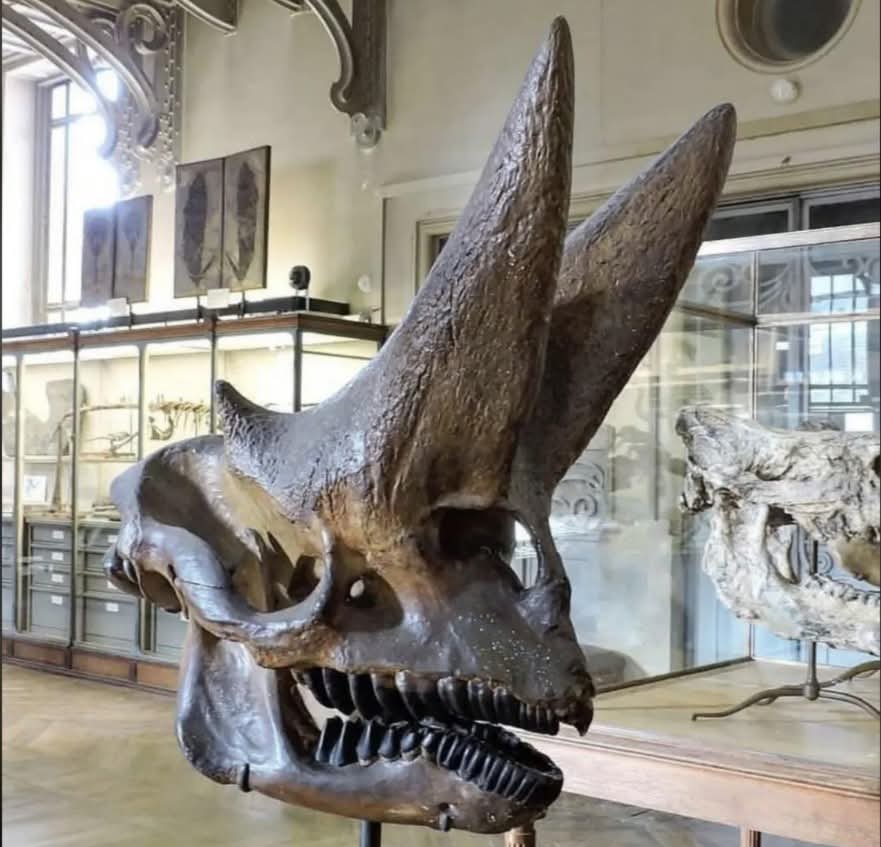
Skull of Arsinoitherium zitteli, discovered in Egypt in 1902. Dating back to the Late Eocene (36-30 Ma)
The skull of Arsinoitherium zitteli, first described in 1902 from fossils discovered in Egypt’s Fayum Depression, belongs to one of the strangest large mammals of the Late Eocene, about 36–30 million years ago. Despite its rhinoceros-like appearance, Arsinoitherium was not closely related to rhinos; it belonged to an extinct group of African mammals called embrithopods, which were more distantly related to elephants, hyraxes, and manatees within the Afrotheria lineage.
The animal likely weighed 1.5–2 tons and stood about 1.7 meters (5.5 ft) tall at the shoulder, with two massive keratin-covered horns that grew from the nasal bones and could reach over 60 cm (2 ft) long. A second pair of smaller horns sat just behind them. Its teeth suggest it was a herbivore that fed on soft vegetation, living in swampy, river-edge environments that covered much of northern Africa during the Eocene.
The Fayum fossil beds where Arsinoitherium was discovered have also produced some of the earliest known ancestors of modern elephants and whales, making the region one of the most important paleontological sites for early mammal evolution.
#drthehistories
Mike Flanagan will bring Stephen King's THE MIST back to the screen with a brand new movie for Warner Bros.
Flanagan will write & direct the new adaptation of King's tale, which was previously turned into a 2007 movie and a one-season TV series in 2017.
Source: @DEADLINE
January 2026 starts out strong on streaming services with THE LONG WALK, BLACK PHONE 2 and THE BEAUTY bringing the horror home to you. https://t.co/Wayb4JEgHH
So after waiting 6+ hours with NOTHING I left. Got tired of asking for help and getting told to just wait my turn. I sat there and watched multiple people being taken back to be treated yet I’m at the point of passing out. They watched me and did nothing!
Went to the emergency room, with high blood pressure, vomiting, nose bleeds, and a severe migraine. The kind that makes you so dizzy, sick and blurry vision so bad you can’t even see anything other than shapes. After having a CTscan Waited 6+ hours no results. They did NOTHING!!
Went to the emergency room, with high blood pressure, vomiting, nose bleeds, and a severe migraine. The kind that makes you so dizzy, sick and blurry vision so bad you can’t even see anything other than shapes. After having a CTscan Waited 6+ hours no results. They did NOTHING!!