Introducing Boreal-H3 — a video model built for ads and our next step toward recursive self-improvement in video generation.
A good-looking video isn’t enough. The product has to stay the same. The actor has to stay the same. The label has to be right. And the action in the brief actually has to happen.
So we post-trained MiniMax H3 specifically for advertising.
But this isn’t a one-off SFT or LoRA fine-tune. We built a closed-loop system that learns what to improve next.
Human-calibrated evaluation diagnoses failures and guides the next intervention: targeted data collection, reinforcement learning, or inference optimization. When the feedback is unreliable, we revise the evaluator or reward—not just the generator.
Every experiment feeds into shared memory, informing the next training decision. The model improves, and so does the process that produces its successor.
The results:
→ 85.3% reference fidelity — highest among the frontier video generation models we evaluated
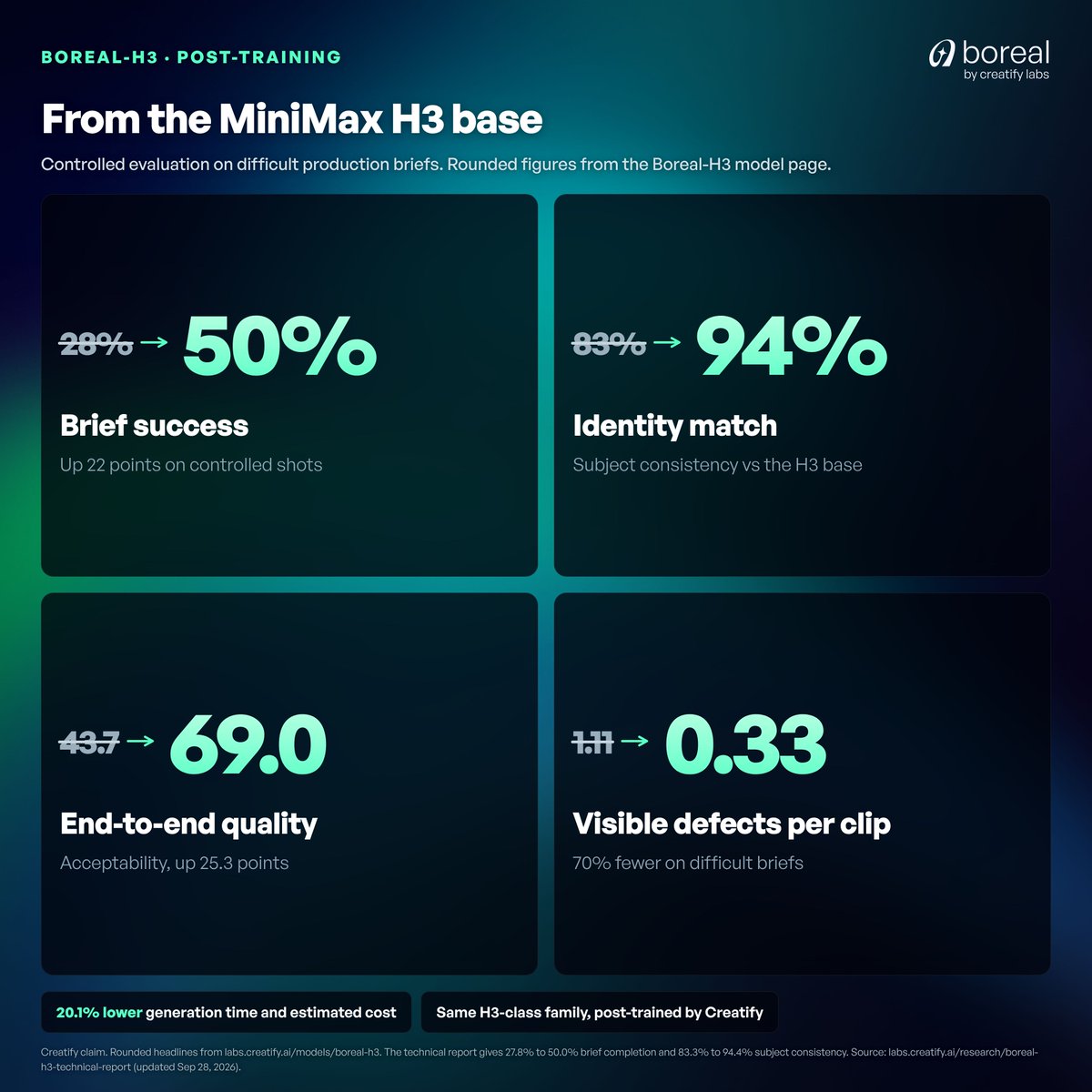
→ Brief success: 28% → 50%
→ Identity match: 83% → 94%
→ Visible defects per clip: down 70%
→ Generation time and estimated cost: down 20%
Boreal-H3 doesn’t just make better-looking video. It makes more usable ads.
Credit to the @MiniMax_AI team for the foundation we’re building on.
This launch is a checkpoint, not the finish line. We’re building more than a better video model. We’re building a system that learns how to make the next one better.
We’re open-sourcing Native Video Inference: the Rust + CUDA runtime we built at @Creatify_AI to serve video models.
Cold start to first denoising step: ~7s on a fresh B200, vs 65–75s on @sgl_project Diffusion and vLLM-Omni. Same output, bit for bit.
No PyTorch at inference. Kernels compiled ahead of time. Everything loads in parallel.
On our production traffic, that means 84% less idle GPU time.
Supports MiniMax H3, Wan 2.1 and LTX 2.5. Code and write-up below 👇
Our Co-Founder & Chief Scientist @LedellWu is speaking at SGLang Summit 2026 🎤
Nov 12–13 · Fort Mason, SF
If you’re there, come say hi 👋
https://t.co/i3aR4bri9s
@sgl_project
Ad teams don't all start from the same place, and we built Boreal-H3 with that in mind.
Some have a brief. Some have a screenshot. Others have a folder of assets and a voiceover.
That's why Boreal-H3 gives you three starting points 👇
✍️ Text-to-video: describe your idea and choose from 6 aspect ratios.
🖼️ Image-to-video: begin with a still, and add an end frame if you want to set where the shot finishes.
🧩 Reference-to-video: steer the output with several images, videos and audio clips, so your characters, product and style look the same from one ad to the next.
Try Boreal-H3: https://t.co/slT1BsjAPh
Not just the lip-sync. Prompt the action.
Aurora 2.0 takes one image, one audio track and a prompt, then the avatar actually does what you asked.
Try now: Meet Aurora 2. ✦
https://t.co/MNYEEGGs9Z
The real cost of a 30-second AI ad isn’t the price per second. It’s how many takes it takes to get one worth running.
Most teams look at the rate card and stop there. But if you’re testing 20 hooks a week, you’re not just paying for the clips that make the cut. You’re paying for everything that doesn’t.
Here’s the math:
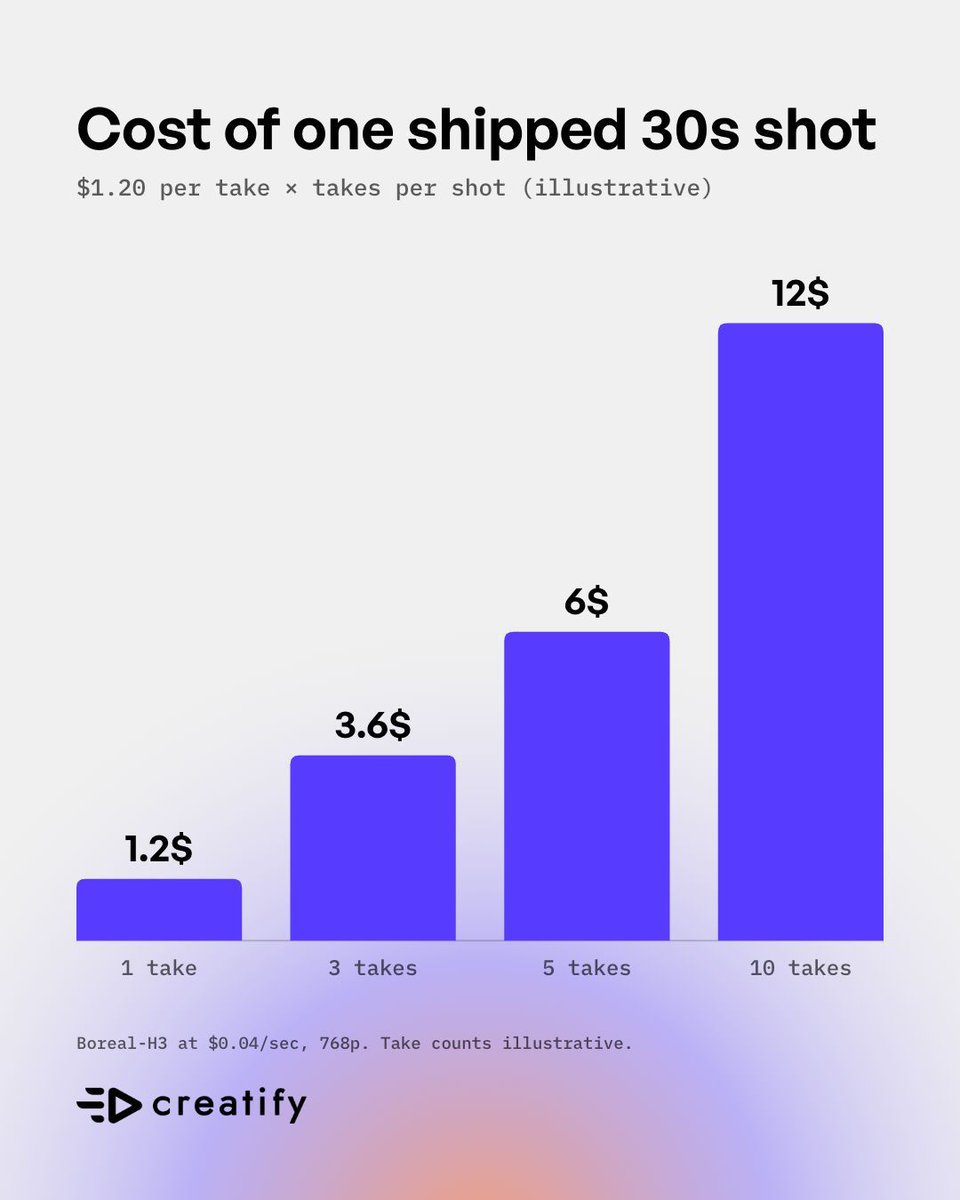
Cost per usable shot = cost per take × takes needed
Take Boreal-H3, Creatify’s video model post-trained for ads:
→ $0.04 per second at 768p
→ $0.40 for a 10-second clip
→ Around 11 seconds to generate that clip, compared with 32 seconds per video-second on the base model
That puts 30 seconds of footage at roughly $1.20 per pass.
But the bigger question is how many passes it takes to get creative you can actually use.
That’s the cost most vendors leave out of the conversation. And it can make a real difference in how much creative your team can test.
Comment “BOREAL” and I’ll send you the report.
What if your ad creative could keep up with your media plan, instead of always running behind it?
Most video models are trained to look good. Ads have a harder job. The product has to survive every shot, the label has to stay readable, and the brief has to land in the first three seconds.
Boreal-H3 was post-trained for ads, so we focused on brand safety details like consistency. Here’s what our technical report covers:
→ The six-area release gate every clip has to clear before it ships
→ Why we score a joint pass rate instead of one quality number
→ Where Boreal-H3 still trails other models, and why we publish that too.
It's the thinking behind the model that now runs Creatify's Ad Agent, written for growth and creative teams at consumer brands and apps that live on paid social.
Same script. Same talking-head ad. Aurora 2.0 vs VEED Fabric 1.0.
A 15s clip costs $1.05 on Aurora 2.0 ($0.07/s) vs $2.25 on Fabric 1.0 ($0.15/s, 720p).
2.1x cheaper, and a higher Avatar Performance Score: 90.5 vs 87.4.
Learn more: https://t.co/xY1rrIne96
Boreal-H3: the video model built for product ads. 1088P at $0.12/sec.
Drop in up to 9 product photos. Get one 360° video, front to back. No turntable. No reshoot.
Your product stays your product.
One frame in. A cinematic product reveal out.
Every word on the can stays correct through the push-in and the moving light.
Post-training isn't just about improving model quality. Inference optimization is equally important for making high-quality video generation practical at scale.
With Boreal-H3, we've made significant progress on both fronts. More to share soon on the inference optimizations behind these results.
Better and cheaper than its own base.
Boreal-H3 is the only model in the top-left: 133.3 on ads quality vs. MiniMax H3's 100, at half the price per second.
Read more: https://t.co/qX5qvXAIY0
Better and cheaper than its own base.
Boreal-H3 is the only model in the top-left: 133.3 on ads quality vs. MiniMax H3's 100, at half the price per second.
Read more: https://t.co/qX5qvXAIY0
Built for ads, scored on ads.
Boreal-H3 tops our Ads Quality Index at 133.3 (MiniMax H3 = 100).
Creatify internal evaluation, Sep 2026, same briefs for every model.
Full table and method → https://t.co/qX5qvXAIY0
Introducing Creatify Labs.
Building better ad agents requires training specialized models, rigorous evaluation, benchmarks grounded in real ad production and campaign results, and research collaborations that push the frontier of video.
We’re sharing our research agenda and our work across each of these areas, starting with Boreal-H3, our video model trained for ads, and Aurora 2.0, our avatar model built for UGC ads.
Live at: https://t.co/X9IA0AzPTG
A beautiful video means nothing if the AI changes your product.
Boreal-H3 vs. Seedance 2.5.
Same product. Two models. Very different results.
Product fidelity matters. 👀