1/
What if your everyday activity on X could do more than generate likes and impressions?
That's an interesting idea behind PushX.
A platform turning everyday engagement into points, opportunities, and new ways to grow.
Let's explore. 🧵
1/5 🧵
Growing on X takes time, but what if your daily engagement could also earn you rewards?
That's the idea behind PushX.
A platform designed to turn social activity into points and opportunities.
1/7
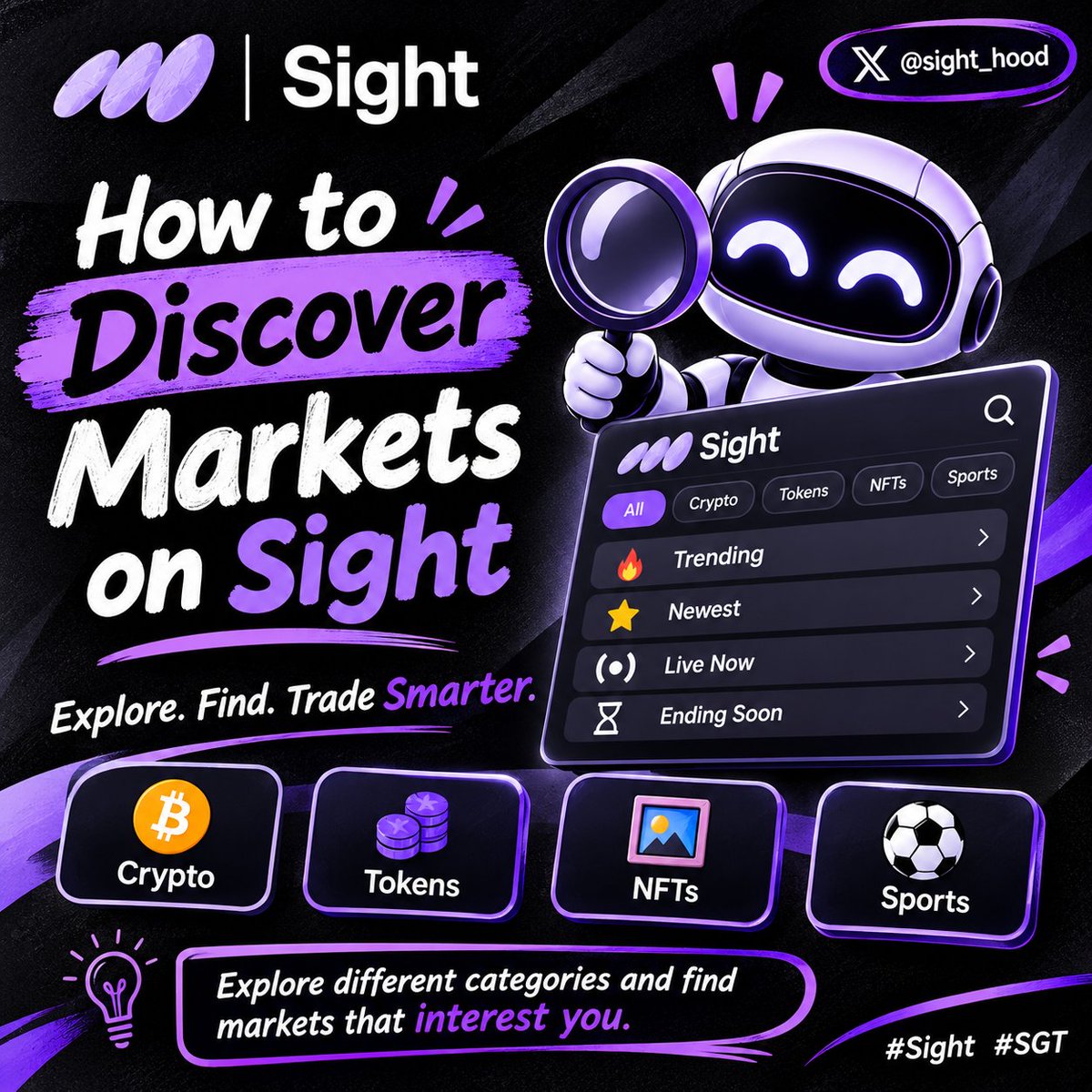
Finding interesting prediction markets is part of the experience.
But scrolling endlessly without knowing what to look for can make it difficult to discover markets that interest you.
Sight provides different categories and discovery options. Let's explore them. 🧵
1/8
Buying shares in a prediction market is different from simply placing an UP or DOWN prediction.
On Sight's AMM markets, every position represents a specific possible outcome.
But do you understand what you're actually holding after buying those shares?
Let's break it down
1/7
You don't have to enter every market you find interesting.
Sometimes, the smartest first move is simply to watch.
Sight has a Watch feature that lets users keep track of markets without placing a prediction.
Let's explore why this matters. 🧵
1/7
Opening a prediction market and knowing what to look at are two different things.
Sight displays several details that can help you understand what's happening during a token round.
Let's break down how to read a Sight market page. 🧵
A Market Isn't Over Until You Understand the Claim Process
Today’s topic moves beyond predicting an outcome to understanding what happens after a Sight market is resolved.
One important detail users shouldn't overlook is the difference between winning a market and claiming the payout.
A common misconception is that once a market resolves, the winnings automatically appear in your wallet. On Sight, that isn't how it works.
After resolution, eligible winning positions and refunds become claimable balances. You still need to complete an onchain claim transaction to receive them. Sight Docs +1
How does the process work?
* The market resolves: The smart contract determines the outcome according to the market's rules.
* Your position is assessed: Winning positions and eligible refunds become claimable.
* You check your positions: Open your Sight profile and look under the Open, Claimable, and History tabs.
* You claim: Confirm the transaction using your wallet. The payout is sent to your wallet in ETH on Robinhood Chain. Sight Docs +1
The payout depends on the type of market:
* Token UP/DOWN rounds: Winners receive their share of the pool after the applicable protocol fee. Eligible refunds return the stake according to the contract rules.
* AMM markets: Winning shares can be redeemed for 1 ETH per share. Cancelled markets have refund rules, while losing shares have no payout. Sight Docs +2
Here's the detail users really need to remember: the 14-day claim window.
Sight gives users 14 days from the market's onchain resolution time to claim eligible winnings or refunds.
If you miss that deadline, the claim function expires. Remaining funds may be swept according to the protocol rules, and you can permanently lose the right to claim them.
It doesn't matter whether you forgot, experienced wallet issues, or didn't check your positions. The deadline does not automatically extend. Sight Docs +1
This is why participating in a prediction market shouldn't end with watching the result.
You also need to monitor your positions, understand the settlement outcome, keep enough ETH for network fees, and complete any eligible claims on time.
A winning prediction is only one part of the process. Understanding how to receive your payout is equally important.
Learning the mechanics, one detail at a time, with @sight_hood.
#Sight
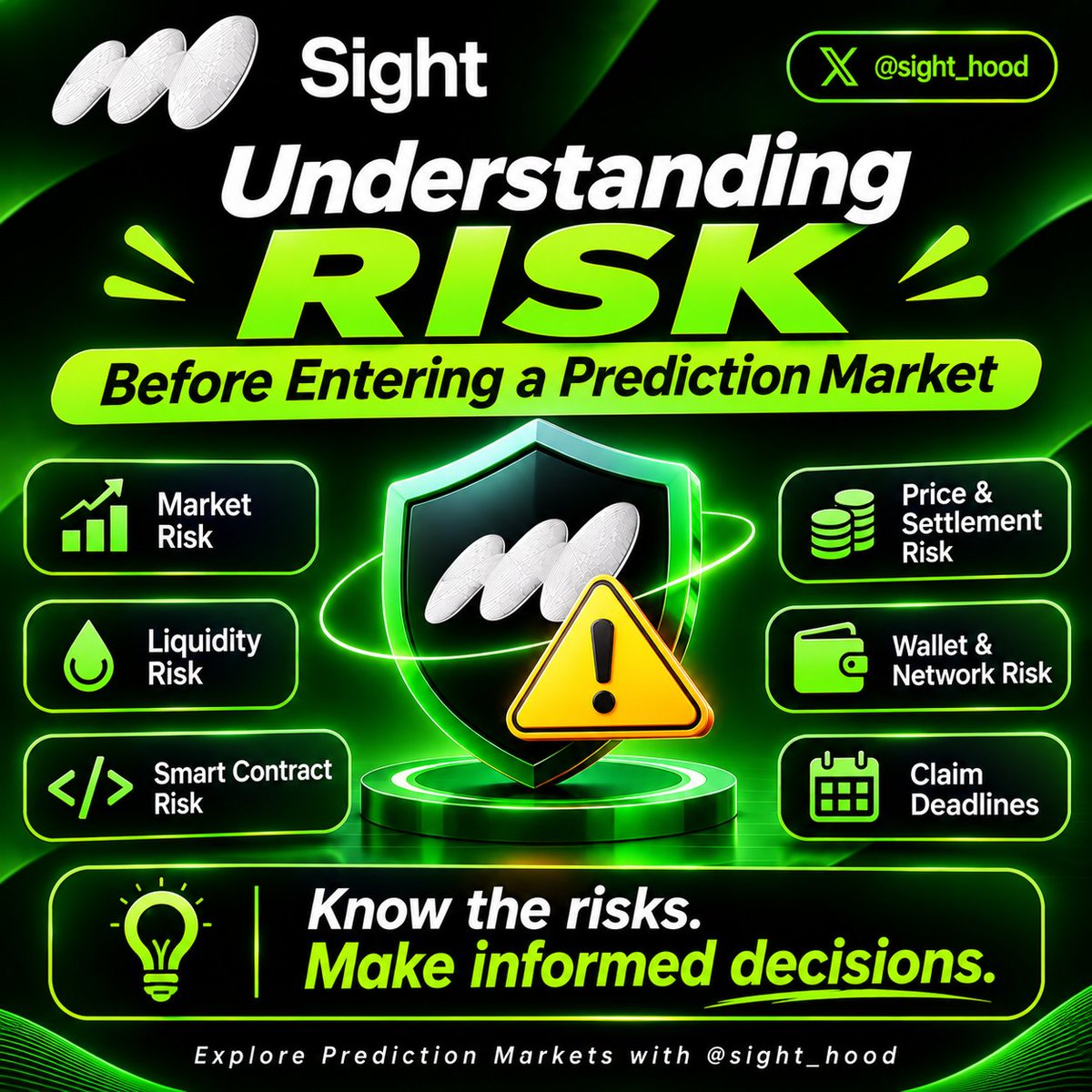
Understanding Risk Before Entering a Prediction Market
One of the biggest mistakes people can make in prediction markets is focusing only on the possible reward while ignoring the risks involved.
A market may look attractive. The prediction may even seem obvious. But understanding how the market works is just as important as deciding which outcome you believe in.
A prediction can be wrong, but even when your prediction is correct, other factors can affect your experience.
What risks should users pay attention to?
1\. Market risk
If a market resolves against your position, you can lose the amount you committed. A high implied probability doesn't guarantee an outcome.
2\. Liquidity risk
Low liquidity can affect how easily you enter or exit a position. In AMM markets, selling before resolution may return less than you originally paid.
3\. Smart contract risk
Sight uses smart contracts to manage market activity and settlement. However, smart contracts can still contain bugs or experience unexpected technical issues. Blockchain transactions are generally irreversible.
4\. Price and settlement risk
The price source used by a market may differ from prices displayed on centralized exchanges. Volatility, unusual activity, or data-source problems can also affect settlement.
5\. Wallet and network risk
Sight operates on Robinhood Chain and uses native ETH. Users must check their network, verify transactions before signing, protect their private keys, and keep enough ETH for gas.
6\. Claim deadlines
Winning positions and eligible refunds must be claimed within the applicable 14-day window. Forgetting to claim can mean permanently losing access to those funds.
These aren't reasons to avoid learning about prediction markets. They're reasons to approach them with the right knowledge.
Before entering any market, take time to understand:
* What exactly are you predicting?
* How is the outcome determined?
* What could cause you to lose?
* How does liquidity affect your position?
* What fees and transaction costs apply?
* What happens after the market resolves?
One more thing worth remembering: never risk money you cannot afford to lose.
The goal shouldn't be to enter every market or chase every opportunity. It should be to understand the mechanics, evaluate the risks, and make informed decisions.
Prediction markets become easier to understand when users look beyond potential rewards and pay attention to the systems behind them.
That's an important part of learning how Sight works.
Exploring prediction markets with @sight_hood.
#Sight #SGT
Understanding Market Prices and Implied Probability
When you open a prediction market, one of the first things you may notice is the price of each outcome.
But that price is more than just a number. It can tell you something about how the market currently values the likelihood of an outcome.
Understanding this is important because market price and actual probability are not the same thing.
On Sight's categorical AMM markets, the displayed percentages represent implied odds. They change as people buy and sell shares.
For example, imagine a market with three possible outcomes:
* Outcome A: 60%
* Outcome B: 25%
* Outcome C: 15%
This suggests that the market currently places more weight on Outcome A than the others.
But here's the important distinction: those percentages are not guarantees, and they don't mean the outcome has a scientifically proven 60% chance of happening.
They're market signals shaped by trading activity. New information, buying pressure, selling pressure, and liquidity can all influence them. Sight Docs +1
Why does this matter?
A common mistake is to see an outcome displaying 80% and assume it's almost certain to win.
But a high implied probability doesn't remove uncertainty. The market can still resolve differently.
Instead of blindly following the highest percentage, users should consider:
* What is the market actually asking?
* How many possible outcomes are available?
* What are the current implied odds?
* How much would it cost to buy the shares?
* What would those shares pay if the outcome wins?
* How could liquidity and fees affect the position?
On Sight, winning AMM shares redeem for 1 ETH per share, while losing shares have no payout. Users can also sell their shares before the market closes, with the actual sale quote affected by the market and applicable fee. Sight Docs +1
The bigger lesson is simple:
Market prices communicate expectations, not certainty.
Learning to interpret those expectations is an important skill for anyone exploring prediction markets.
Don't just look at the percentage. Understand what is behind it.
Another day of learning the mechanics of onchain prediction markets with @sight_hood.
#Sight #SGT
Understanding Fees: The Small Details That Affect Your Returns
When participating in a prediction market, many people focus on the entry price and potential payout.
But there's another detail that deserves attention: fees.
Understanding the fee structure helps users calculate what they actually spend, what they may receive, and how much of their potential return remains after costs.
A key distinction on Sight is that the fee structure depends on the type of market.
1\. Token UP/DOWN rounds
On decisive rounds, a default 2% protocol fee is taken from the total winning pot before payouts are distributed.
But what happens when a round is refunded?
If the opening and closing prices tie, or there are no opposing bets, the round enters refund mode. Eligible users get their stakes back, and no protocol fee is charged. Sight Docs +1
2\. Categorical AMM markets
For NFT and stock markets, the default fee is also 2%, but it works differently:
* Buying shares: The fee is added to the purchase cost.
* Selling shares: The fee is deducted from the sale proceeds.
* Claiming winnings: There is no additional protocol claim fee. Sight Docs +1
3\. Don't forget network gas
Protocol fees aren't the only cost to consider.
Sight operates on Robinhood Chain, where transactions such as entering positions and claiming payouts require native ETH for gas.
That means users should keep some ETH available beyond the amount they intend to commit to a market. Sight Docs +1
Why does all this matter?
Imagine buying shares in an AMM market. Looking only at the amount you intend to spend isn't enough. You should also understand the fee included in the purchase, what you could receive if you sell, and the payout if your outcome wins.
The same principle applies to UP/DOWN rounds: the estimated payout is not necessarily the amount you'll receive until the market resolves and the contract calculates the final payout.
Before entering any market, understand the fee, the potential payout, and the transaction costs.
Good market decisions start with knowing the full cost, not just the potential reward.
Learning the details behind prediction markets with @sight_hood.
#Sight #SGT
Why UP/DOWN Payouts Can Change
In prediction markets, many people focus on one question:
If my prediction is correct, how much will I receive?
But the answer depends on more than simply choosing UP or DOWN.
On Sight's token prediction rounds, payouts use a pari-mutuel system.
Here's how it works.
When users enter a round, their ETH positions are grouped into two pools:
- UP pool: participants predicting that the token price will increase.
- DOWN pool: participants predicting that the token price will decrease.
When the round ends, the smart contract compares the opening and closing reference prices to determine the winning side.
If UP wins, eligible participants in the UP pool share the combined pot.
If DOWN wins, participants in the DOWN pool share it instead.
But how is each person's payout calculated?
The winning pool is distributed proportionally according to each winner's contribution.
For example, imagine a simplified round:
- Total UP stakes: 40 ETH
- Total DOWN stakes: 60 ETH
- Total pool: 100 ETH
If UP wins, the UP participants share the winning pot after the applicable protocol fee.
Someone who contributed 10 ETH to the UP side would receive a larger share than someone who contributed 2 ETH.
The payout is based on each participant's stake relative to the total winning-side stake.
This is why the payout isn't a fixed amount determined when you enter.
Why should users understand this?
Because the size of the opposing pool and the total winning-side participation affect the final distribution.
An estimated payout shown while a round is active is not necessarily the amount you'll eventually receive. More participants can enter before the market locks, changing the pool distribution.
There are also important exceptions.
If the opening and closing prices are equal, or only one side has participants, the round enters refund mode. Eligible stakes are returned instead of creating a normal winning payout.
A decisive round has a default 2% protocol fee taken from the pot before winners are paid. Refund-mode rounds do not incur that protocol fee.
The bigger lesson is this:
Choosing the correct direction is only part of understanding a prediction market. You should also understand how the payout is calculated.
Before entering a Sight UP/DOWN round, look beyond the estimated return. Pay attention to both pools, your stake, the round's status, and the settlement rules.
Understanding the payout mechanism helps you evaluate what you're actually participating in.
Learning the mechanics of onchain prediction markets with @sight_hood.
#Sight #SGT
1/7
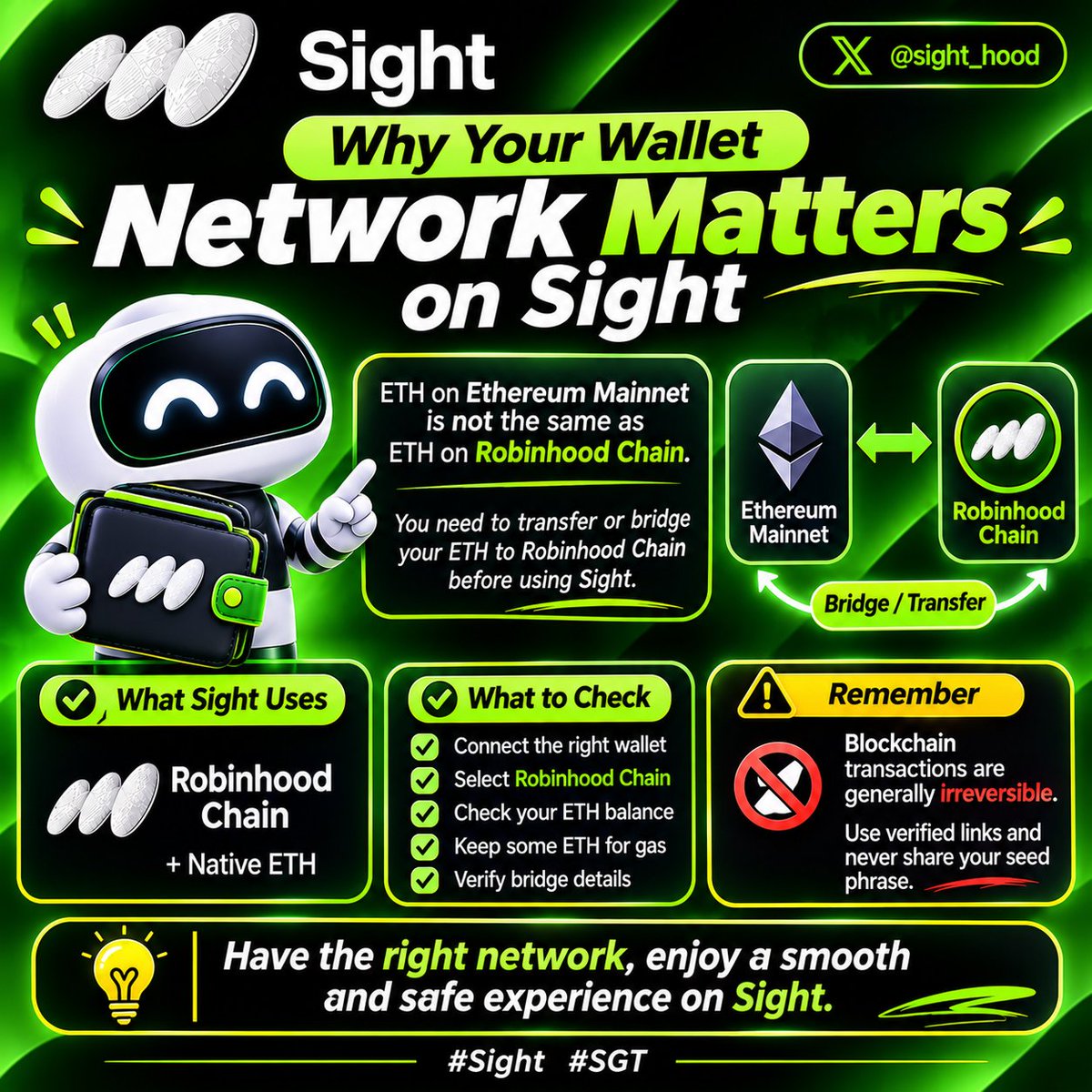
Having ETH in your wallet doesn't automatically mean you can use it on every blockchain.
This is something every user exploring onchain prediction markets should understand.
Let's look at why your wallet network matters on Sight. 🧵
1/8
Before taking a position on Sight, don't just ask yourself whether an outcome will happen.
Ask yourself whether you understand the market you're entering.
Here are 6 things worth checking before making your next prediction. 🧵
Retail trades on emotion. Institutions trade on systematic backtesting.
@quantarcai is bringing community-owned AI finance and strategy engines to everyone.
Their Creator & Ambassador Program is live (Scout → Vanguard → Sentinel). Time to stop watching from the sidelines.
Why Price Sources Matter in Prediction Markets
One of the most important parts of a prediction market is something many users overlook: how the final outcome is determined.
A market can attract thousands of participants, generate activity, and display constantly changing prices. But when the round ends, there must be a clearly defined and reliable method for deciding who was right.
This is where price sources and settlement mechanisms become essential.
On Sight, UP/DOWN rounds work by comparing two reference prices:
• Opening price: The reference price recorded when a round begins. This becomes the price to beat.
• Closing price: The reference price recorded when the round ends.
If the closing price is higher, the result is UP.
If it's lower, the result is DOWN.
If both prices are equal, the round is refunded.
It sounds simple, but understanding where those prices come from makes a big difference.
Why should users care about the price source?
Imagine participating in a market predicting whether ETH will move up or down.
You check Binance and see ETH trading at $3,000. However, the market's settlement reference may come from a specific onchain liquidity pool.
Those prices may not be identical.
Different exchanges and liquidity pools can have slightly different prices because they operate with different liquidity, trading activity, and market conditions.
So, checking a centralized exchange chart alone may not tell you exactly how a Sight market will settle.
The important thing is understanding the reference source defined by the market's rules.
This is also why onchain settlement matters.
Sight uses smart contracts to handle market outcomes according to predefined rules. Instead of relying on someone manually deciding the winner, the settlement process follows the mechanism established for that market.
That creates a more transparent process, but transparency should never be confused with zero risk.
Low liquidity, unusual market activity, volatility, and problems with price data can still affect market outcomes.
Before taking a position, users should understand:
1. What asset or outcome is being predicted?
2. Which price source determines the result?
3. When does the round open and close?
4. What happens if prices are equal?
5. What risks could affect settlement?
Prediction markets are not just about guessing whether an asset will go up or down.
They're also about understanding the rules, data, and mechanisms that turn a prediction into a final outcome.
The better users understand these mechanics, the better informed their decisions can be.
That's one of the things worth exploring as onchain prediction markets continue to develop.
Learning the mechanics with @sight_hood.
#Sight #SGT
The Future of the Creator Economy Must Be Built on Contribution, Not Just Attention.
Over the past few weeks, I've spent time exploring an important question:
What would the creator economy look like if we measured the value creators bring instead of simply counting the attention they attract?
For too long, creator campaigns have relied heavily on familiar numbers: followers, impressions, likes, reposts and engagement.
These metrics can tell us how far content travels, but they don't always explain its actual value.
A creator with a smaller audience might produce a detailed research piece that helps people understand a complex protocol. Another might have millions of impressions but generate little meaningful understanding or interest.
Both generate attention, but their contributions are not necessarily equal.
This is the problem the Hazels Attention Layer is working to address.
And I believe its bigger vision can be understood through five important principles:
1. Discovery should go beyond follower count.
Projects need creators whose audiences and expertise align with their campaign objectives, not simply accounts with the biggest numbers.
2. Quality should matter more than content volume.
Originality, accuracy, relevance and usefulness should be important when evaluating creator contributions. Publishing more should not automatically mean contributing more.
3. Measurement should be evidence-based.
Campaign performance needs context. Views, wallet connections and transactions should not be treated as proof of impact without appropriate evidence.
4. Transparency should build trust.
Creators deserve clear campaign briefs, understandable evaluation criteria and accountability in the review process.
5. Reputation should reflect demonstrated contribution.
A sustainable ecosystem should recognize consistent, meaningful participation rather than allowing popularity alone to define a creator's value.
What makes this vision interesting is that these principles are connected.
Better discovery leads to more relevant participation. Better evaluation creates stronger contribution records. Reliable measurement supports better decisions. And transparency helps build the trust required for long-term growth.
That's how a creator ecosystem can move beyond temporary campaign hype.
My biggest takeaway from exploring Hazels is that the next evolution of the creator economy shouldn't simply reward who gets the most attention.
It should create better ways to recognize who contributes meaningful value, why that contribution matters and how it supports the ecosystem's objectives.
This campaign may be reaching its final day, but the conversation around creator value is far from over.
I'm looking forward to seeing how Hazels continues developing this vision.
The future belongs to ecosystems that understand the difference between being seen and making a difference.
@0xhazels
One of the most interesting features of @sight_hood is its UP/DOWN prediction market.
But how does it actually work, and what happens behind the scenes when someone takes a position?
Let's break it down.
First, understand the concept.
A Sight UP/DOWN market is a short-duration prediction round built around a token's price movement.
The question is straightforward:
Will this token move UP or DOWN within a specific time window?
Sight currently supports three round durations:
• 5 minutes
• 15 minutes
• 1 hour
The duration depends on the token's trading volume and market activity. More active tokens generally have shorter rounds, while less active ones may have longer windows.
1. Understanding UP and DOWN
When a round opens, a reference price is established. This becomes the price participants need to beat.
If the token's closing reference price is higher than its opening reference price, UP wins.
If the closing reference price is lower, DOWN wins.
If both prices are equal, the round enters refund mode.
This means the outcome isn't determined by how popular a particular prediction is. It follows predefined settlement rules.
2. What happens after you enter a position?
Sight follows a structured round lifecycle:
• Open: Participants can take UP or DOWN positions using ETH.
• Locked: New positions are generally disabled during the final 30 seconds.
• Ended: The prediction period finishes.
• Resolved: The smart contract determines the outcome using the configured onchain price data.
• Claim: Eligible winners or participants in refund mode can claim their ETH.
Every stage has a specific purpose, helping establish a clear process from participation to settlement.
3. How are winning participants paid?
This is where things get particularly interesting.
Sight uses a pari-mutuel pool structure.
Instead of offering fixed odds, participants' stakes form two separate pools: UP and DOWN.
When a decisive outcome occurs, the winning side shares the distributable pool proportionally to their individual stakes, after the applicable protocol fee.
For example, imagine:
- UP receives 70 ETH.
- DOWN receives 30 ETH.
If UP wins, eligible UP participants share the distributable pool. The amount each participant receives depends on their contribution relative to the other winning positions.
This is an important distinction because estimated payouts can change as more participants enter the market.
4. What happens when there is no clear winner?
Not every round produces a winning side.
Sight has refund conditions, including:
- When opening and closing prices are equal.
- When only one side has received positions and there are no opposing participants.
- When valid settlement price data cannot be retrieved.
In these situations, eligible participants can claim refunds according to the protocol rules.
5. Why does onchain settlement matter?
A prediction market needs a reliable way to determine its outcome.
Sight uses configured onchain price sources and smart contract rules to resolve token rounds.
This is important because the price displayed on a centralized exchange may differ slightly from the reference price used by Sight.
The smart contract's settlement result is what determines the outcome.
It also means participants should understand the market's reference price rather than assuming every exchange will show exactly the same result.
6. What should participants understand before entering?
Prediction markets involve real financial risk.
A wrong prediction can result in losing the entire position. Market liquidity, volatility, settlement rules and transaction costs all matter.
There is also a 14-day claim window after resolution. Winning positions and eligible refunds must be claimed within that period.
Understanding these details is part of participating responsibly.