Publication alert🚨 🦟🦠
Haemoproteus spp. and Culicoides spp.: insights into their relationships and challenges of research, with the confirmation of Culicoides minutissimus as a competent vector of a new Haemoproteus sp. lineage https://t.co/DUOKKr19R9
We are happy to present to you Dr.@crfchagas, Senior Researcher at the Nature Research Centre in Vilnius and the co-leader of WG3 🦟 Her research focuses on vector–parasite relationships🦟↔️🦠, spatio-temporal variation🌐♻️, and the diversity of haemosporidian parasites 📈
What parasites are hiding in Europe's water frogs? 🐸
https://t.co/N6wRceAdWs
By examining 239 frogs from Slovakia, this new paper combined morphology with DNA data to reassess Dactylosoma cf. ranarum. Surprisingly, none of the sampled flying insects carried the parasite.
#Amphibians #Apicomplexa
Nuevo artículo en @bugbittentweets sobre el papel de los Culicoides en la transmisión de parásitos de las aves silvestres 👇🏻 excelente colaboración de @WIMANETscience https://t.co/HEJmlYWkpO
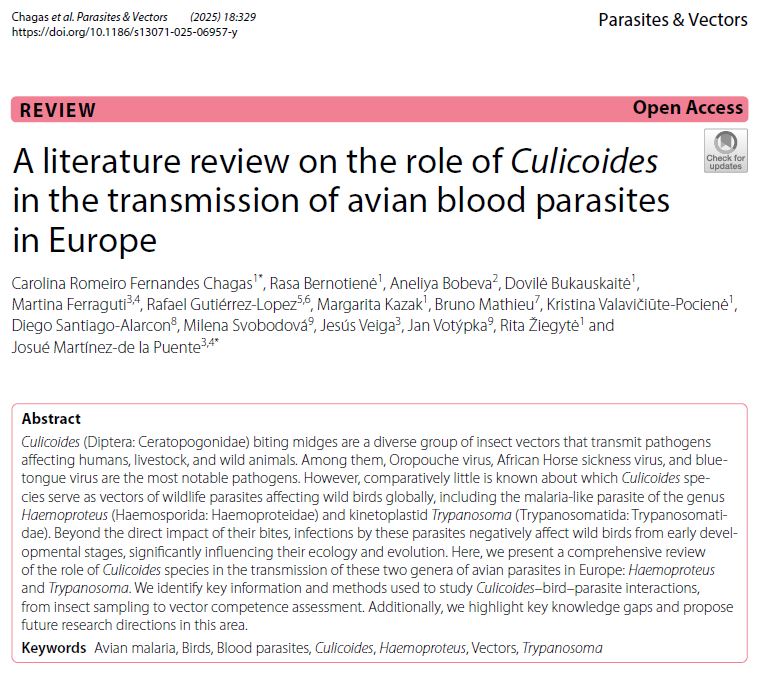
Wimanet People are publishing!! Check this new review about #Culicoides🪰 and their role in the transmission of #AvianBloodParasites 🦠🐦⬛
👇
https://t.co/taJN6xM0z0
Next WIMAMET Workshop is in Vilnius this summer 🦠🪱🔬
🗣️ Registration is open!!! Deadline for grands 10th March!
We hope to see all you there!! 👩🔬
More details 👇
𝗡𝗲𝘄 𝗽𝗮𝗽𝗲𝗿 𝗶𝗻 𝗽𝗿𝗲𝘀𝘀 𝗶𝗻 𝗣𝗔𝗥𝗔𝗦𝗜𝗧𝗘:
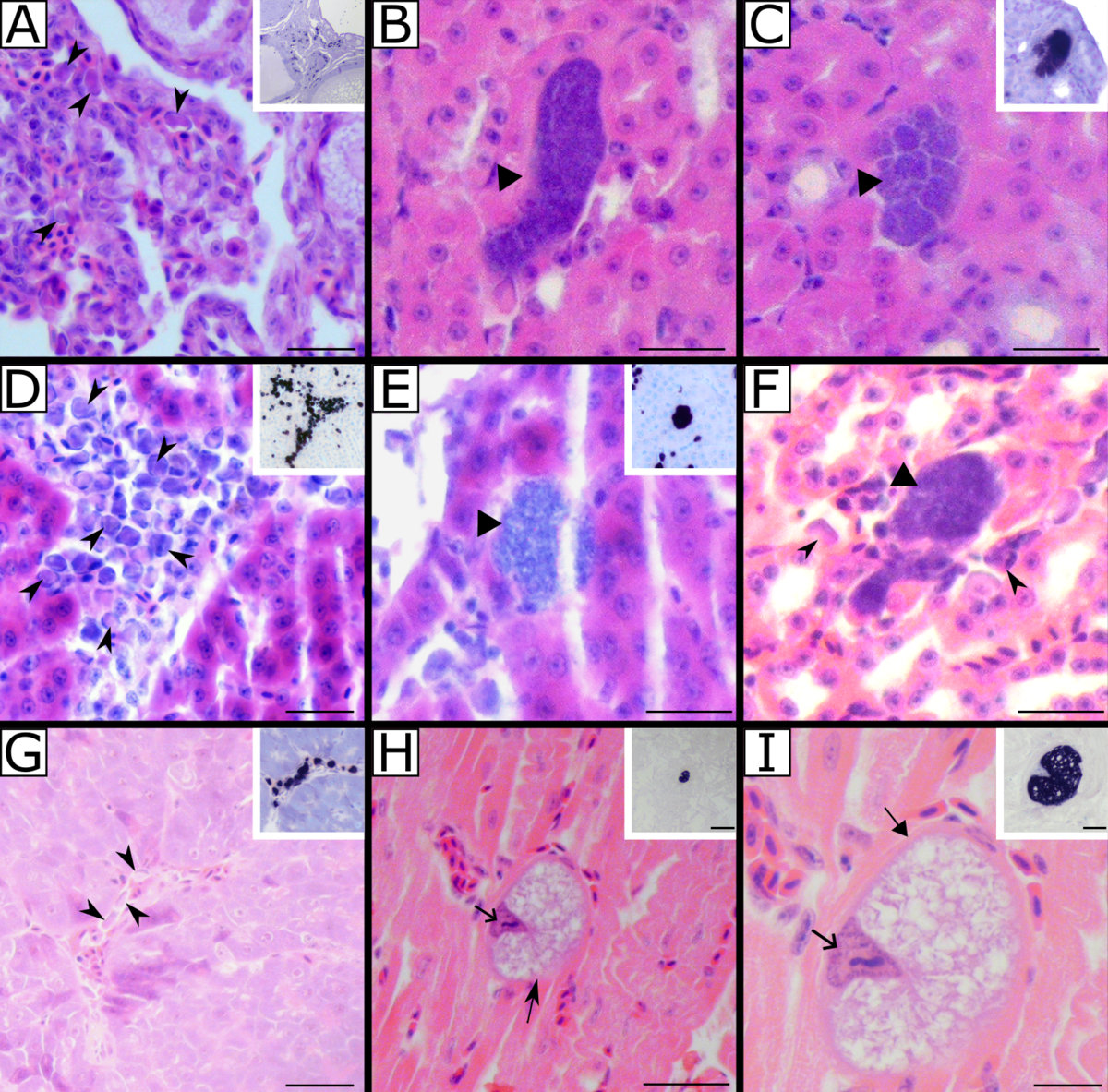
Leucocytozoon infections in tits (Aves, Paridae): blood and tissue stages investigated using an integrative approach
🔜 https://t.co/yMsdEkYflU
Abstract: Leucocytozoon species are cosmopolitan and prevalent avian parasites, with some infections being lethal, mainly due to the exo-erythrocytic development of the parasite in bird tissues. The patterns of exo-erythrocytic development in Leucocytozoon spp. infections in wild birds remain poorly studied. This study investigated the development ofLeucocytozoon spp. tissue stages in tits (Paridae). Great tits (Parus major), Blue tits (Cyanistes caeruleus), and Coal tits (Periparus ater) were screened for infections using an integrative approach that consisted of microscopic analysis of thin blood smears, histological techniques, chromogenic in situ hybridization (CISH), PCR-based methods, and phylogenetic analysis. In total, 41 individuals were analyzed (eight naturally infected that were selected and euthanized, and 33 found dead in the wild and opportunistically sampled). Among the naturally infected birds, all individuals that were microscopically positive for Leucocytozoon species were also PCR-positive for these parasites. Co-infections with Plasmodium spp. and Haemoproteus spp. were commonly found, mainly among the opportunistically sampled birds. Two morphotypes were identified, Leucocytozoon majoris (Laveran, 1902) and Leucocytozoon fringillinarumWoodcock, 1910. Tissue stages were present in three birds sampled exclusively during the non-breeding season, two of them with meronts developing in the kidneys and liver, and one individual with a megalomeront in the heart. All the exo-erythrocytic stages were confirmed to be Leucocytozoon spp. by CISH using a Leucocytozoon genus-specific probe. Phylogenetic analysis placed parasite lineages with different morphotypes in separate clades. The developmental patterns of exo-erythrocytic stages of Leucocytozoon spp. in naturally infected passerines are poorly understood, requiring further research.
Résumé
Infections à Leucocytozoon chez les mésanges (Aves, Paridae) : stades sanguins et tissulaires étudiés à l'aide d'une approche intégrative
Les espèces de Leucocytozoon sont des parasites aviaires cosmopolites et répandus. Certaines infections sont mortelles, principalement en raison du développement exo-érythrocytaire du parasite dans les tissus des oiseaux. Les schémas de développement exo-érythrocytaire dans les infections à Leucocytozoon spp. chez les oiseaux sauvages restent peu étudiés. Cette étude a examiné le développement des stades tissulaires de Leucocytozoon spp. chez les mésanges (Paridae). Des mésanges charbonnières (Parus major), mésanges bleues (Cyanistes caeruleus) et mésanges noires (Periparus ater) ont été examinées pour détecter les infections à l'aide d'une approche intégrative consistant en une analyse microscopique de frottis sanguins minces, des techniques histologiques, une hybridation chromogène in situ (CISH), des méthodes basées sur la PCR et une analyse phylogénétique. Au total, 41 individus ont été analysés (huit naturellement infectés qui ont été sélectionnés et euthanasiés et 33 trouvés morts dans la nature et échantillonnés de manière opportuniste). Parmi les oiseaux naturellement infectés, tous les individus qui étaient microscopiquement positifs pour les espèces de Leucocytozoon étaient également positifs pour ces parasites par PCR. Des co-infections avec Plasmodium spp. et Haemoproteus spp. ont été couramment trouvées, principalement parmi les oiseaux échantillonnés de manière opportuniste. Deux morphotypes ont été identifiés, Leucocytozoon majoris(Laveran, 1902) et Leucocytozoon fringillinarum Woodcock, 1910. Des stades tissulaires étaient présents chez trois oiseaux échantillonnés exclusivement en dehors de la saison de reproduction, deux d'entre eux avec des mérontes se développant dans les reins et le foie, et un individu avec un mégaloméronte dans le cœur. Tous les stades exo-érythrocytaires ont été confirmés comme étant des Leucocytozoon spp. par CISH en utilisant une sonde spécifique au genre Leucocytozoon. L'analyse phylogénétique a placé les lignées de parasites avec différents morphotypes dans des clades distincts. Les modèles de développement des stades exo-érythrocytaires de Leucocytozoonspp. chez les passereaux naturellement infectés sont mal compris et nécessitent des recherches supplémentaires.
Excited to share our lastest publication exploring sandfly vector community and their hosts from a network perspective!
They show an opportunistic feeding behaviour including human and wild species #Epidemiology#VectorEcology#Leishmania#PublicHealth https://t.co/4Mkdukh5Wi
@jennycdunn presenta @WIMANETscience en el congreso @MalariaConf2024. Si estáis interesados en el estudio de los vectores de malaria de fauna silvestre, sois más que bienvenidos a participar en el WG3!
🔬 @crfchagas recently completed her #STSM at the @ebdonana with @JMartinezPuente! They discussed ideas for the 3rd #WIMANET Summer School, among others ideas. 🦟📚 When two researchers of their caliber come together, great ideas and contributions to science are sure to follow!
Do you have a subscription to our newsletter?? 📰📣🆕 Please if you want to be updated about our later news (courses, workshops, new publications...) do not hesitate to subscribe here 👉🏼https://t.co/KMB70p8Q0w
🔊New paper out!
Our first output as WG6 has been published in the International Journal for Parasitology: Parasites and Wildlife @ElsevierConnect
If you want to know more about the @WIMANETscience Action @COSTprogramme, check it out in #openaccess 👇👇👇
https://t.co/FaykeKzw86
🚨Publication alert!!🚨
Check our new paper about #Culicoides feeding preference and how it can influence #avianparasite#avianmalaria transmission. https://t.co/2NgbgFXNTD
We recently reviewed the evidences about the relationships stablished among avian malarial parasites and the invasive Ae. albopictus. A collaboration of #WIMANET researchers @crfchagas@gaiarrido@GarrigosMarta@JMartinezPuente. Check it in https://t.co/Omq5JaAcFR