@Ron_George I think this doesn't only apply to English. We need information on obstetric analgesia and anesthesia procedures in obstetrics available in a multilingual version for all women regardless their origin and language they speak
Improving informed consent for patients with limited English proficiency requires
✔️ Interpreter training for clinicians
✔️ Earlier antenatal engagement
���️ Multilingual education tools
✔️ Faster interpreter access in emergencies
Equity needs infrastructure, not intention alone.
Language barriers don’t just affect communication ⇒ they shape care
In #OBAnes patients with limited English proficiency face real risks:
▪️ Less effective consent
▪️ Reduced access to epidurals
▪️ Higher likelihood of general anesthesia
We need system-level change
The third MaCriCare report focuses on maternal experience in ICU and post-discharge care, identifying opportunities to improve support for women and staff. Now published and open access: https://t.co/TC4onTi7YB
@cri_care@Krawczyk_PW
The third report from the MaCriCare survey is now available, revealing important insights into ICU practices related to maternal experience, psychological screening, and staff support. A must-read for anyone in #MaternalHealth#ICU#OBanes
https://t.co/6ZwElR7i9V
The 2nd MaCriCare study report is online:
“Obstetric units' preparedness to manage critically ill women”
Please check the availability of services and facilities to diagnose, resuscitate, and treat
critically unwell obstetric patients in your hospital
https://t.co/M01oYohqY8
🔎 Editorial on maternal critical care
🔓 https://t.co/0vKUIsuy1Z
Refers to 🏴 study on #ICU admission during/shortly after pregnancy, associated to
🔍2 fold readmission rate in puerperium
🔍40 fold 1y mortality
🔍12-fold ⬆️ in stillbirth
🔍7-fold NICU
🔓 https://t.co/tnHZfJvSqH
Pregnant and postpartum women admitted to critical care suffer short- and long-term physical and mental health complications.
Maternal critical care needs more attention.
#OBAnes#OBCritCare@ICULone
@nelson_piercy @valerie_luyckx
https://t.co/kR2gzn7UUZ
https://t.co/Lrv7Gpcptb
Thinking of #VirginiaApgar on her birthday (6/7/1909) & the tremendous impact she has as a @Columbia obstetric anesthesiologist who thought out of the box
https://t.co/OQyT9FhPro
The Apgar score developed in 1952 still shapes neonatal resuscitation @womenofimpacti1
The MaCriCare study is truly unique and puts the needs of the deteriorating obstetric patient in the spotlight. The first part is now published https://t.co/C6Mz067VPG, and second part accepted. Well done to all who contributed! @cri_care@Krawczyk_PW
🤰Każda rodząca ma prawo do łagodzenia bólu porodowego‼️
Dlatego szukamy przyczyn nierównego dostępu do analgezji porodu w Polsce
https://t.co/EG6GnAfu2p
Małgorzata Zimny @KatarzynaKotfis@pumszczecin Paweł Krawczyk Patrycja Ostrogórska-Gonszewska @JagiellonskiUni@IntensywnaPL
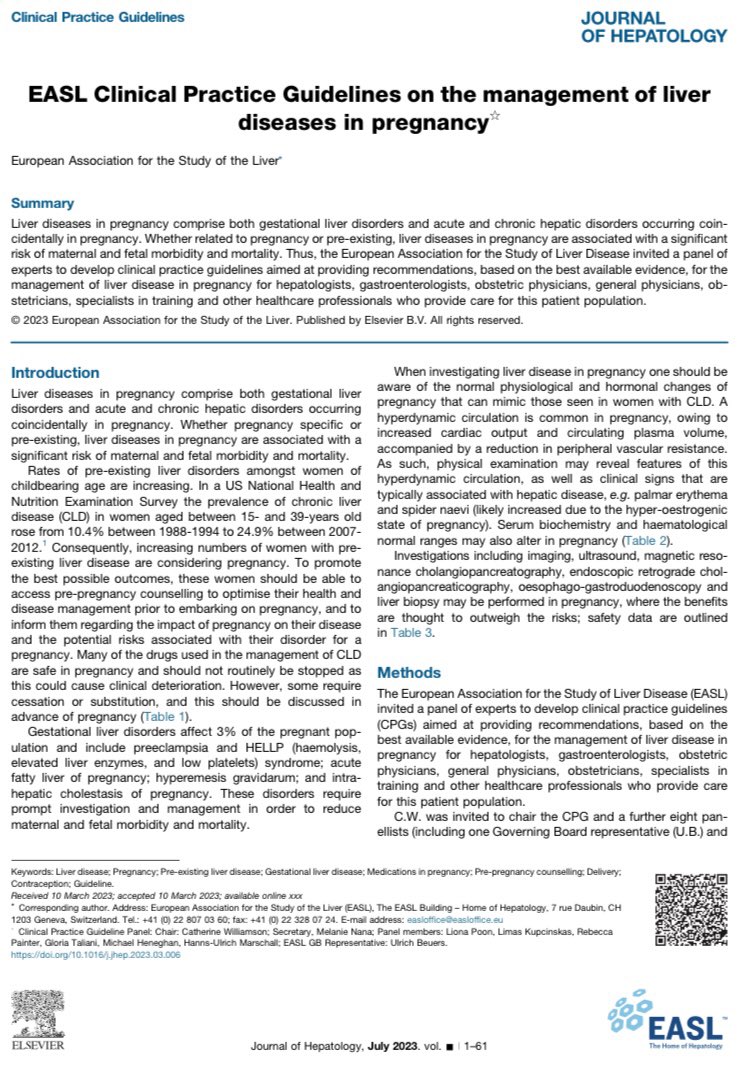
So proud to see the @EASLnews Guideline for Liver Disease in Pregnancy is now out, chaired by @cathwilliamson5
Covering:
⭐️ Pre-existing liver disease
⭐️ Gestational liver disorders
⭐️ Drug Safety tables
⭐️ Management flowcharts
Link to full guideline: https://t.co/wA6H7ch8Ry
Canadian maternal mortality/morbidity in @OBMedicine :
Canada's maternal mortality statistics by @KayvanAflaki
https://t.co/vhkfN46IoU
Trends in ICU admissions in Montreal by @IsabelleMalhame@DrNatDayan
https://t.co/ZgeW9XswwA
Time for @DSouzaLabMac's https://t.co/2fGvtzv3Nw