I love you Paul ❤️ God bless you for all your job you did for all of us. I wanna thank you from my heart thanks to you I became a libertarian, proud member of the Mises Institute, Bitcoin evangelist.
If you travel frequently for work—or simply enjoy exploring—this article is packed with practical ideas we've learned the hard way.
No gimmicks.
Just decades of experience from people who spend a lot of time in airports and on airplanes.
✈️ Read it here:
https://t.co/0gOj9Ct1vh
If you still eyeball range deviations instead of stepping through it, this is 5 steps in under a minute.
Worth the rewatch this weekend.
https://t.co/hLAx2g8yI6
@swisstrader09 you are honest and true , and this is gold in this world..i appreciate you a lot ..and i am sure you will be good soon and i follow you 🫡👊
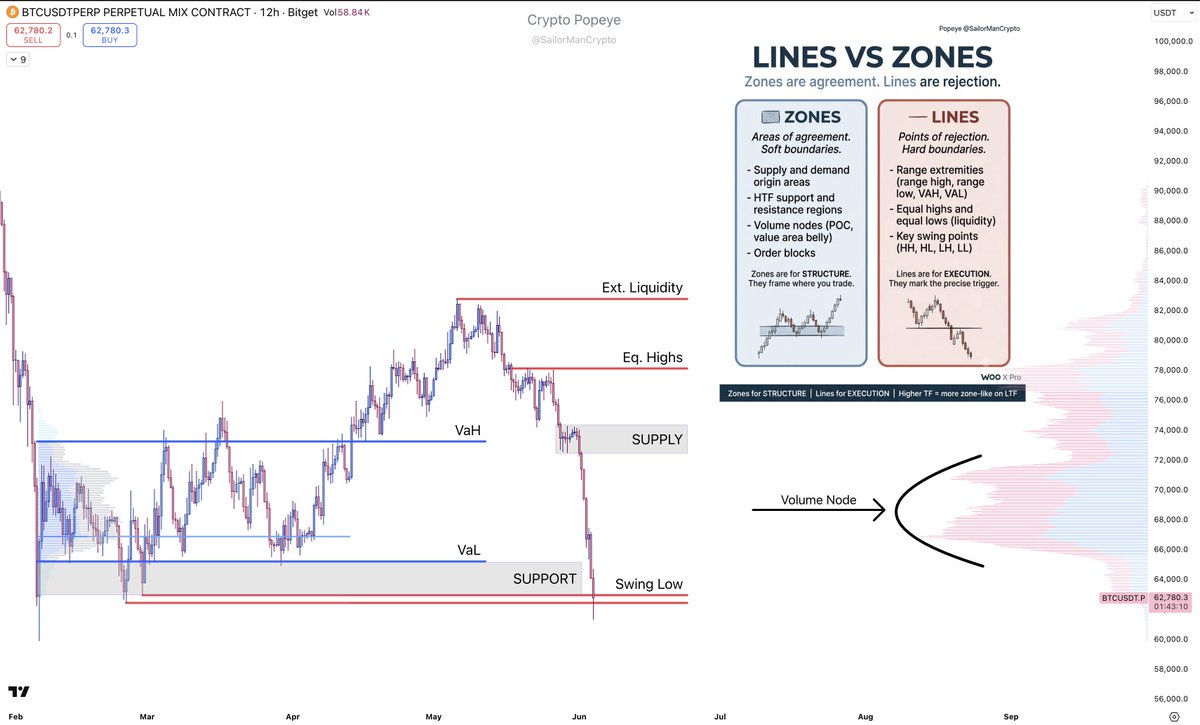
When to Mark Lines and When to Mark Zones - Cheat Sheet
This post is sponsored by WOO X Pro. Trade with zero fees on spot: https://t.co/iWxTrgYsA3
Most traders mark price levels the same way no matter what they're looking at. That is why their charts look messy and their reads are inconsistent.
The fix is simple: zones and lines do different jobs.
𝗭𝗼𝗻𝗲𝘀 𝗮𝗿𝗲 𝗮𝗴𝗿𝗲𝗲𝗺𝗲𝗻𝘁. Where the market camped, accepted, traded back and forth. Soft boundaries. Mark a zone when you see:
- Supply and demand origin areas
- Support and resistance regions, especially HTF
- Volume nodes (POC, value area belly)
- Order blocks
𝗟𝗶𝗻𝗲𝘀 𝗮𝗿𝗲 𝗿𝗲𝗷𝗲𝗰𝘁𝗶𝗼𝗻. Where the market sharply turned. Hard boundaries. Mark a line when you see:
- Range extremities (range high, range low, VAH, VAL)
- Equal highs and equal lows (liquidity)
- Key swing points (HH, HL, LH, LL)
𝗛𝗼𝘄 𝘁𝗵𝗲𝘆 𝘄𝗼𝗿𝗸 𝘁𝗼𝗴𝗲𝘁𝗵𝗲𝗿:
Zones are for STRUCTURE. They tell you where you would want to trade.
Lines are for EXECUTION. They tell you the precise level for entry, stop, and target.
You do not pick one or the other. You map zones first to frame the picture. Then you mark lines inside or at those zones for the trigger.
𝗧𝗶𝗺𝗲𝗳𝗿𝗮𝗺𝗲 𝗻𝘂𝗮𝗻𝗰𝗲:
The same level can be a line on HTF and a zone on LTF. A swing high looks like a clean line on the 4-hour but reveals itself as a zone on the 5-minute because the wick takes multiple candles to form. Same with VAH and VAL.
Rule of thumb: the higher the timeframe you derived the level from, the more zone-like it behaves when you drop down.
𝗖𝗼𝗺𝗺𝗼𝗻 𝗺𝗶𝘀𝘁𝗮𝗸𝗲𝘀:
- Drawing a supply zone as a single line. You will get wicked through every time.
- Marking equal highs as a zone. You lose the liquidity precision.
- Treating an HTF S/R level as a sharp line on LTF execution. Use it as a zone and let price work inside it.
- Using lines where zones belong and vice versa. The whole framework starts with knowing which is which.
Levels are not all equal. Some are areas of agreement. Some are points of rejection. Treat them differently and your reads get cleaner overnight.
Popeye
WOO X Pro, zero fees on spot: https://t.co/iWxTrgYsA3
Aging is arguably the root cause of most major diseases (loss of function in our cells). Four years ago, we made a bet that aging was treatable, and NewLimit was born.
NewLimit now has a prototype drug that reverses the age of some human cells (restores function they had when they were younger), and a clinical trial scheduled for next year (with more drug candidates in the pipeline).
Grateful to Founders Fund, Thrive, Greenoaks, and the rest of the investors for this latest round. @jacobkimmel and the team are just getting started.
Fiat currencies are in an eternal bear market against gold:
Since 1971, the US Dollar has lost -99.24% of its value against gold, the 2nd-largest decline among major currencies.
Over the same period, the British Pound has declined -99.57%.
The Euro would have lost -99.08% against gold if it had existed since 1971.
Furthermore, the Japanese Yen and Swiss Franc have dropped -98.27% and -96.07%, respectively.
Meanwhile, gold prices in US Dollar terms are up +11,119% over the same timeframe.
Own assets or be left behind.
Jamie Dimon’s evolution:
❌ 2017 - BTC around $5,600
“If you’re stupid enough to buy Bitcoin, you’ll pay the price one day.”
✅ 2026 - JPMorgan now
“Hey, buy Bitcoin products from us. It’s not a tulip bubble anymore - we found a way to charge fees on it.”
Legacy finance 🤡
You need to watch this interview with Jamie Dimon and understand how incredibly important the Clarity Act is for the banks to maintain absolute power over the people.
Jamie Dimon (aka the God King of fiat) speaks for the banks they are about to lose control to Bitcoin and crypto.
This is the single most important event in the institutionalization of crypto since the spot Bitcoin ETF was approved in January of 2024.
There are compromises being made on both the crypto lobbyist side as well as TradFi banking — Dimon does not want to compromise — he wants the banks to maintain absolute control like they have for decades — why wouldn’t he?
I am not a huge fan of Coinbase but Brian Armstrong is spearheading this campaign (with significant incentives) to offer a better opportunity for all investors in the U.S. and in crypto largely.
Dimon is trying to stifle innovation and Armstrong is pushing for it. Everyone should be rallying behind Coinbase and Brian right now — Dimon looks like a buffoon showing up on FOX to say he is “full of sh*t”.
This will eventually blow up in his face. The race to adopt crypto is much bigger than any one person, even Jamie Dimon. You cannot stop a technology whose time has come.
When the technology ultimately benefits the common person, those standing in the way of freedom technology will soon be run over.
As a young socialist, Hayek read Ludwig von Mises’ 1920 paper “Economic Calculation in the Socialist Commonwealth.”
Mises showed that socialist central planning isn’t merely inefficient, it’s impossible.
Without private property and genuine market prices, planners lack any rational way to allocate scarce resources or determine real costs and needs.
Even Oskar Lange, a leading socialist in the calculation debate, effectively conceded the point.
While he promoted “market socialism” with trial-and-error pricing by a central board, real-world socialist planners in Eastern Europe quietly relied on world capitalist market prices as a guide.
Without external free-market price signals, pure socialism would be economically blind and coordination would collapse.
Mises went further, arguing that interventionism, the “middle way” of government meddling, is inherently unstable.
Each intervention creates problems that invite more interventions, eventually leading to full socialization.
Price controls cause shortages, subsidies distort production, and the cycle continues until the economy is fully planned.
The lesson is clear.
Rational economics requires genuine market prices emerging from voluntary exchange and private property.
Half-measures don’t stabilize the system. They accelerate the drift into central planning.
The Austrian School understood this decades before the collapse of the Soviet bloc proved it in practice.
The best thing about being comfortable with trading is, I don't own anything.
I have no stress, no liability, no bank or wordly obligations.
Just one laptop, travelling and stopping wherever I want and a few T shirts because I don't have dress for office.
Live wherever I want. Eventually I'll settle down but nothing else could give me this freedom.
A man spends 50 years teaching at MIT.
He knows his time is running out.
So he records one last lecture — everything he knows, distilled into a single hour.
He died 5 months later.
This is that lecture.
The most important hour you'll watch this week. 👇
Bookmark it for later