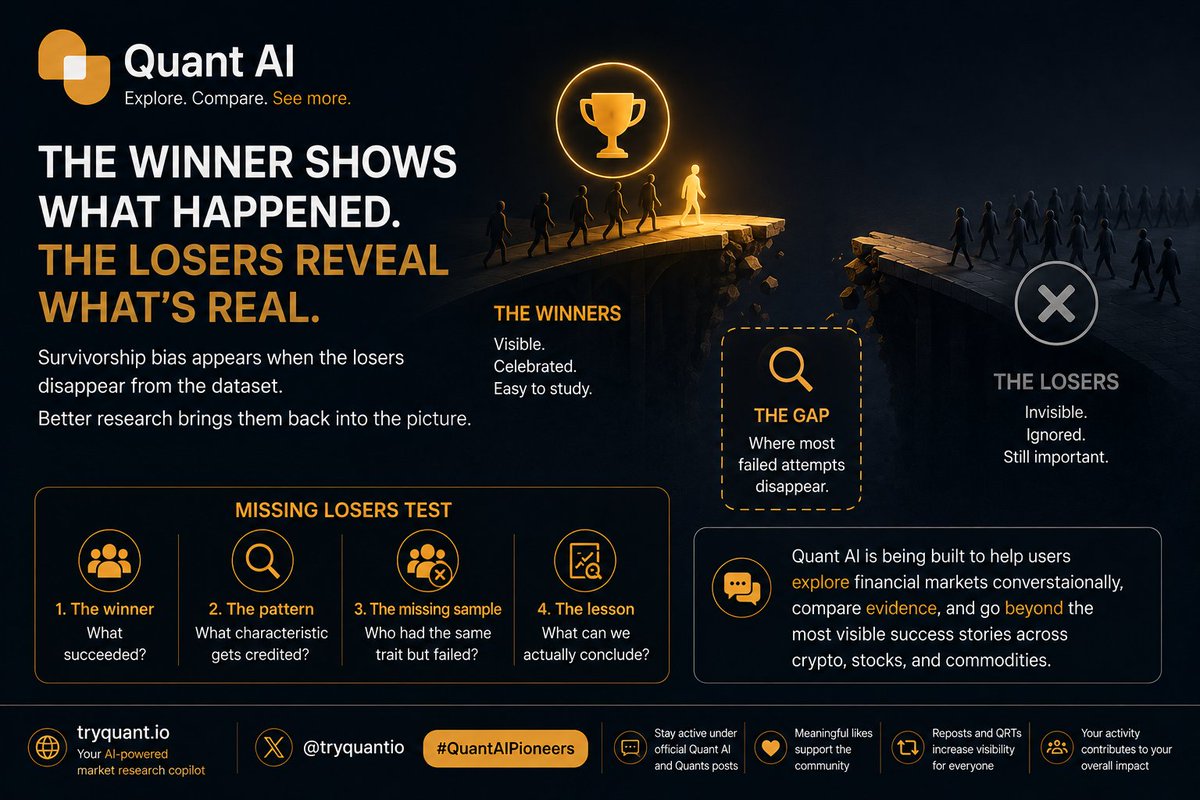
@mayflowers2x8 If today’s universe was used historically, the results may be inflated by survivorship bias and look far stronger than investors could have achieved in real time
Here is a backtest result I'd immediately distrust:
“Over the last 15 years, this stock-selection strategy consistently beat the market.”
Not because the strategy must be wrong.
Because I first want to know which stocks were allowed into the historical dataset.
If today's surviving companies were selected first and the strategy was then tested backward, the failures may already have been removed.
Bankrupt companies.
Delisted companies.
Businesses that collapsed before reaching the present-day universe.
Now the backtest isn't choosing from the market investors actually faced at each point in history. It is choosing from a cleaner group containing companies we already know survived.
That is survivorship bias before the strategy even makes its first simulated trade.
This is the kind of research question I'd bring to @tryquantio because evaluating a market claim should include examining the evidence underneath it, not just accepting the attractive output.
The Missing Losers Test here is simple:
Reintroduce the securities that disappeared.
Run the logic again.
Then compare the result.
If the performance deteriorates materially, the original edge may have belonged partly to the dataset rather than the strategy.
Sometimes the most important observation in a backtest is the company that isn't there.
https://t.co/Dt3TtIEEnf
#QuantAIPioneers