Women entered the workforce.
They built careers.
They took on professional lives that looked nothing like their mothers'.
But when they came home, nothing had changed.
Dr. Allison Daminger's research shows that as women's professional roles expanded over the last half century, the mental load of running a household stayed almost entirely on their plate.
As a result, women didn't replace one job with another. They added one on top.
Dr. Daminger explains what that hidden load actually looks like, and what it's costing women at home, at work, and in their relationships.
🎧 https://t.co/MwC0dWV1cc
#genderroles #cognitivelabor
Most of the time, it's not really about the dishes or the laundry.
Today’s episode looks at household responsibilities, gender roles, and the invisible work that often creates a mental load heavier than the physical tasks themselves.
🎧 Listen in: https://t.co/JRYKAEDkUK
#Narcissists rarely operate alone.
Dr. @ElizabethScott describes a tactic called "flying monkeys" - where a narcissist recruits other people in someone's life to do their bidding, often by attacking or undermining the person who's tried to set a boundary or call out the behavior.
The unsettling part: the recruits usually don't know they're being used. They believe they're defending someone who's been wronged, when in reality they've been pulled into the narcissist's narrative through gaslighting and charm.
Understand how this dynamic shows up in families, friend groups, and workplaces - and why it makes leaving a relationship with a narcissist so much harder than it sounds.
🔗 https://t.co/MwC0dWV1cc
#narcissisticabuse
Narcissism isn't just confidence or vanity - it's a clinical pattern with specific diagnostic criteria.
So what actually qualifies, and why does the most dangerous version, malignant narcissism, go even further?
🎧 Tune in to the full episode: https://t.co/MwC0dWVz1K
#narcissisticpersonalitydisorder #CriticallySpeaking @ElizabethScott
Not all narcissists are the same.
Dr. @ElizabethScott, psychologist and author of 8 Keys to Stress Management, explains that malignant narcissism is narcissism "on steroids" - the grandiosity and lack of empathy of typical narcissistic personality disorder, combined with an aggressive, antisocial streak.
The defining trait: a sadistic streak.
A malignant narcissist doesn't just fail to feel bad when they hurt someone - they can actually derive pleasure from it.
Dr. Scott joins Dr. Therese Markow on Critically Speaking to break down how to spot the difference between an everyday narcissist and a malignant one.
➡️ Understand why that distinction matters for anyone trying to protect themselves: https://t.co/MwC0dWV1cc
#narcissism #malignantnarcissist
#Narcissists are not always easy to spot at first.
Tune in to our latest episode to understand the the patterns, red flags, and emotional confusion that can make these relationships so hard to understand.
🔗 https://t.co/JRYKAEDkUK
In the early 2000s, four labs - studying yeast, roundworms, and fruit flies, with no coordination between them - independently arrived at the same conclusion: a single genetic pathway, centered on a protein called MTOR, regulates the pace of biological aging across two billion years of evolution.
By 2009, a National Institute on Aging��funded mouse study went further, showing that a drug targeting that same pathway - rapamycin - could extend lifespan even when treatment started in "middle age."
Later studies pushed that effect as high as a 30% increase in lifespan, with measurable improvements across nearly every organ.
Dr. Matt Kaeberlein was one of the original scientists behind that convergence.
So how did an organ-transplant drug found in soil samples on Easter Island became one of the most studied compounds in aging research?
➡️ Tune in to find out: https://t.co/MwC0dWV1cc
#longevityscience #CriticallySpeaking
We spend billions treating individual diseases, but almost nothing targeting the one risk factor that drives all of them.
Dr. Matt Kaeberlein breaks down the biology of aging and why slowing it may be the most important thing medicine isn't prioritizing.
🔗 This is just a start. Listen to the bigger conversation: https://t.co/MwC0dWV1cc
#agingresearch #CriticallySpeaking
Most people think their loved ones die from cancer, or heart disease, or dementia.
Dr. Matt Kaeberlein says that's not wrong, just incomplete.
Those are the diseases we see at the end of life. But the thing driving all of them is aging itself.
His case isn't theoretical. His mother had colon cancer, and curing it was all he wanted. But zoom out to the population level, and he argues the math points elsewhere: investing in prevention - targeting aging itself rather than disease after disease - costs less, lightens the load on families and the healthcare system, and could buy people more healthy years than any single cure ever could.
Dr. Kaeberlein explains why prevention, not disease-by-disease treatment, is where the real opportunity lies in our latest episode.
🎧 https://t.co/MwC0dWV1cc
#aging #longevityscience
Curing cancer adds about 2 years to life expectancy. Slowing aging could add 20.
Dr. Matt Kaeberlein joins us to explain why aging - not any single disease - might be the biggest opportunity in medicine.
🎧 New episode is live: https://t.co/MwC0dWV1cc
#agingbiology #longevityscience
Your Teflon pan. Your stain-resistant couch. Your waterproof mascara. Your food packaging. Your period products.
PFAS, also known as forever chemicals, are intentionally added to hundreds of consumer products for their ability to repel water, resist grease, and last a long time. They are also in your food through agricultural fields fertilized with PFAS-containing sewage sludge and in your drinking water through decades of industrial discharge and firefighting foam.
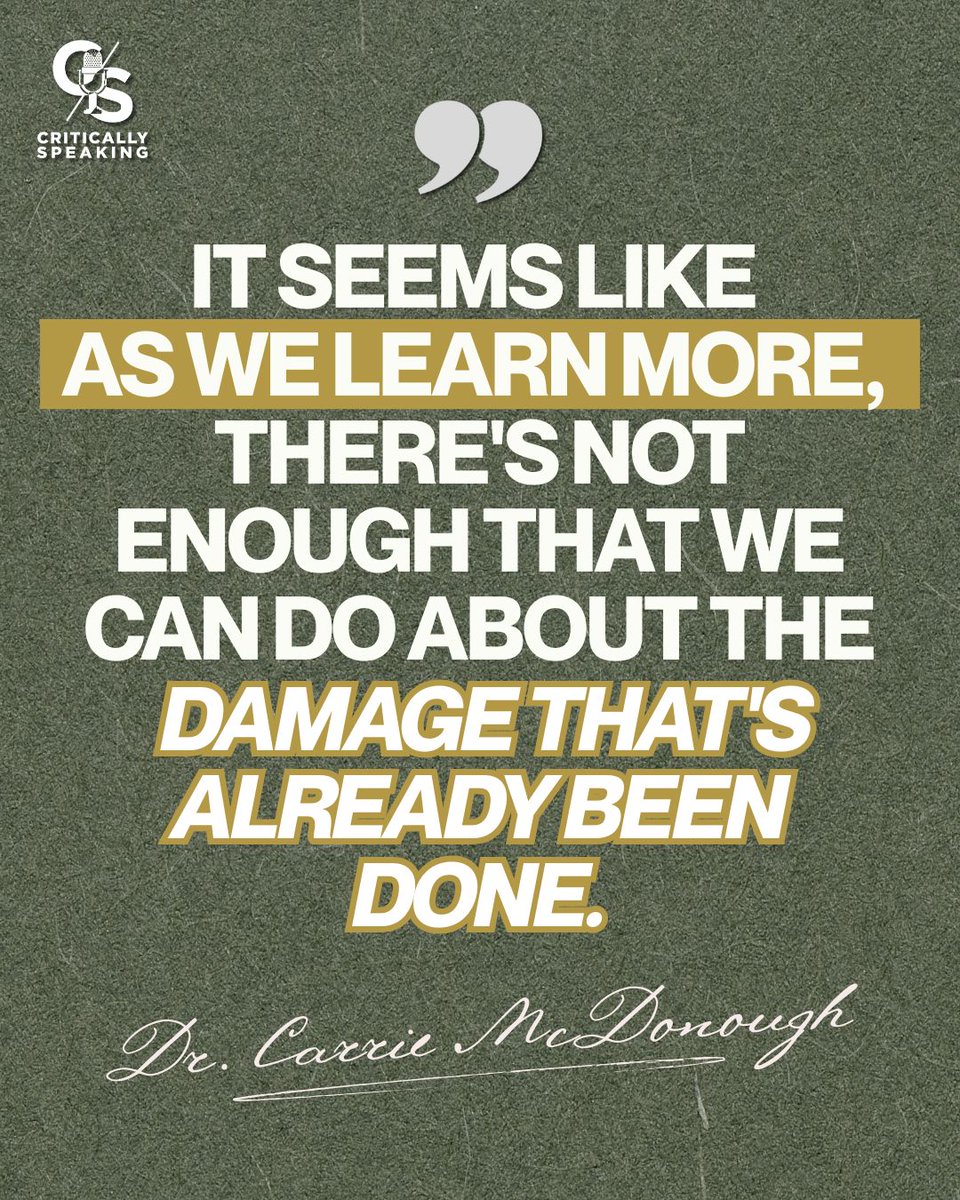
Dr. Carrie McDonough's research reveals that women carry higher levels of unidentified PFAS than men - likely because of the products they use - and that marginalized communities face disproportionately higher exposures because of where they live and what they can afford to change about it.
This isn't a problem for the future. It's already in your body.
🔗 Learn how this impacts you: https://t.co/MwC0dWV1cc
#womenshealth #PFAS
You didn't choose to have forever chemicals in your body.
PFAS (per and polyfluoroalkyl substances) have been manufactured and released into the environment since the 1940s. They ended up in drinking water, agricultural fields, food packaging, cosmetics, stain-resistant fabrics, and firefighting foam used at every military base and airport in the country. And they are now present in virtually every human being on earth.
For some portion of the decades they were being produced, manufacturers knew they were toxic. They didn't tell anyone.
Dr. Carrie McDonough shares why rolling back the regulations that were finally beginning to address them is one of the most consequential environmental decisions being made right now.
➡️ Listen now: https://t.co/MwC0dWV1cc
#environmentalhealth #scienceandsocietypodcast
The safe level of PFAS in drinking water has been lowered from 400 parts per trillion to 70 parts per trillion to 4 parts per trillion - and the EPA now says the ideal safe level for two of the most studied compounds is zero.
This isn't regulatory overcaution. This is what happens as the science catches up. Each time researchers study these compounds more carefully, they find that lower and lower levels are acceptable for human exposure. And that's only for the two compounds that have been well studied. There are hundreds - maybe thousands - of other PFAS that we know far less about, and early evidence suggests that mixtures of them may be more toxic than the two compounds currently under regulation.
Dr. McDonough joins Critically Speaking to explain what PFAS are, how they get into your body, and why the regulatory rollback matters for every person drinking water in this country: https://t.co/MwC0dWV1cc
#PFAS #foreverchemicals
Forever chemicals don't break down. Everything ever manufactured is still in the environment - in the water, in the soil, in the food chain. And at the top of the food chain is you.
The latest episode of Critically Speaking is available today to explain how we got here. 🎧
#PFAS #foreverchemicals
The people promoting peptides online are not giving you the full picture.
Dr. Leigh Baxt went looking for the research behind some of the most popular ones - here's what she found:
The most hyped gray market peptides - BPC-157 and TB500 - have no defined molecular target. Nobody has mapped out what receptors they bind to, which biological pathways they affect, or what happens when they interact with other substances in the body. One human trial was registered for BPC-157 more than ten years ago. The results were never published.
Meanwhile, physicians are posting videos and maintaining websites that cite "scientific evidence" for these products.
When Dr. Baxt looked up the citations, they were studies performed on rats. Not one randomized controlled trial in humans.
This is not the same evidence base that approved insulin. It is not the same evidence base that approved GLP-1 drugs. And the people selling these products are banking on the assumption that their customers won't know that - or won't ask.
🔗 Learn how to read the evidence, what questions to ask, and why the peptide craze is moving so far ahead of the science: https://t.co/MwC0dWV1cc
#peptides #misinformation
Autoimmune diseases are rising globally. So are food allergies. Both come down to one thing: an immune system shaped by an environment it wasn't built for.
The branch of the immune system behind allergic reactions evolved to fight parasites. In the developed world, parasites are mostly gone - and that system is still scanning for threats, now reacting to peanuts and eggs instead.
Meanwhile, the autoimmune epidemic is being driven not by genetics but by decades of environmental exposures that tip the immune system toward attacking the body itself.
Dr. David Hill and Dr. Frederick Miller have both spent their careers studying what's going wrong and why it's getting worse.
Tune in to both these episodes to learn more:
🎧 Dr. David Hill - Food Allergies: https://t.co/hL4BY0vwWs
🎧 Dr. Frederick Miller - Autoimmune Disease: https://t.co/OaMFx1Og8S
#autoimmunedisease #foodallergies
These are the same peptides being promoted by influencers, sold at med spas, and injected by people who believe they're optimizing their health.
The vials are labeled "for research use only" - a legal workaround that allows manufacturers to sell substances that have never been tested in human clinical trials, never been evaluated for sterility or purity, and never been required to disclose what else might be in the syringe.
Dr. Leigh Baxt, Drug Development Lead at Therapeutics Bridge Labs at Memorial Sloan Kettering Cancer Center, has spent her career understanding what it actually takes to establish that something is safe and effective in humans.
She explains why the gap between "interesting animal data" and "safe for human use" is far wider than most people realize.
🎧 Listen now: https://t.co/MwC0dWV1cc
#peptides #wellnessmisinformation
Seven in ten divorces are initiated by women. Most people assume it's because something dramatic happened. Usually it isn't.
It's the cognitive labor nobody tracked. The emotional weight nobody shared. The years of doing the majority of the household work while also managing every appointment, every meal plan, every social obligation, every detail of a life that two people are supposed to be running together.
So what happens to women in unequal relationships? Most don't wake up one day and decide to leave - they exhaust ever other option first.
Learn the four ways women relate to household inequality — and what the data says about where each path tends to lead.
🎧 https://t.co/MwC0dWV1cc
#WomensHealth #GenderEquality
Since the overturn of Roe v. Wade, reproductive rights have been dismantled state by state. But the conversation doesn't stop at abortion.
Justice Clarence Thomas has already suggested revisiting the 1965 ruling that made contraception legal in the first place. And as Dr. Chelsea Polis revealed on Critically Speaking, Project 2025 called for the CDC to promote fertility awareness methods as having "unsurpassed effectiveness" - while the same political forces work to restrict access to every other option.
We've covered this from two angles. If you haven't listened yet, start here.
🎧 Dr. Eve Espey on what the post-Dobbs landscape actually looks like for women seeking reproductive care: https://t.co/jfhfHyCh5e
🎧 Dr. Chelsea Polis on the science - and the politics - behind fertility tracking and contraception: https://t.co/P9wmY0YeBb
#reproductiverights #womenshealth
In the average American household where both partners work, one person does about 65% of the household labor. The other does 35%.
And that split doesn't even account for cognitive labor - the mental load of anticipating needs, planning meals, scheduling appointments, and managing every moving part of family life.
What makes this statistic more alarming: when a baby arrives, men tend to do less household labor than before. The unspoken social message is that a new father's job is to provide financially, not to lean into caregiving. And so the gap widens at exactly the moment it becomes most consequential.
Dr. Mangino, author of Equal Partners: Improving Gender Equality at Home, joins Dr. Therese Markow to explain how this imbalance starts, why it's so hard to reverse, and what couples can do about it before it becomes a crisis.
🎧 Understand the real consequence of this imbalance: https://t.co/MwC0dWV1cc
#genderequality #marriage