#CCR26 is over!
12 outstanding RCTs presented!
😍Save and share this figure to keep a concise overview of the key information!
🎨 Color coding reflects my personal overall interpretation:
🟢 Benefit
⚪ No difference
🔴 Harm
Few practice-changing results but plenty to discuss!
🆕💥🔴Multicenter retrospective study of ICU patients with pneumonia
BIOFIRE® PN Panel implementation was associated with improved early antimicrobial de-escalation and appropriate therapy, with the greatest benefit in hospitals with comprehensive antimicrobial stewardship infrastructure #idxposts https://t.co/2frRdGEbyO
Asociar una cefalosporina Anti-SAMR (#ceftarolina o #Ceftobiprole) a #DAPTOMICINA en bacteriemia por #SaureusMR🩸🍇🛡️? En @CIDJournal cohorte retrospectiva 465 pacientes donde esta combinación🍸tuvo MENOR mortalidad 📉☠️que otros regímenes antibióticos
🔗🆓https://t.co/xsBJjJ5NYe
La pregunta ya no es si la diálisis peritoneal funciona en la LRA.
La evidencia dice que sí. La verdadera pregunta es: ¿por qué seguimos utilizándola tan poco?
Ventajas:
-Mayor estabilidad hemodinámica
-No requiere acceso vascular ni anticoagulación sistémica
-Menor riesgo de bacteriemia asociada a catéter
-Útil en estados de hipercoagulabilidad y entornos con recursos limitados
🧠 Intracranial pressure monitoring in the ICU should never be reduced to one number.
Invasive ICP monitoring remains the reference standard in acute brain injury, especially when neurological examination is unreliable because of coma, sedation, paralysis, or mechanical ventilation (Stein et al., 2023). External ventricular drainage has the advantage of measuring and treating ICP through CSF drainage, while intraparenchymal probes are easier to place but cannot drain CSF and may drift over time.
But ICP management is now multimodal.
CT remains the emergency gatekeeper: hematoma, edema, mass effect, compressed cisterns, midline shift, hydrocephalus, herniation, and loss of gray white differentiation. MRI adds lesion characterization, posterior fossa detail, diffuse axonal injury, venous thrombosis, ischemia, and brainstem injury when the patient is stable enough.
TCD helps follow cerebral hemodynamics: MCA velocity, pulsatility index, vasospasm, impaired autoregulation, low flow states, and cerebral circulatory arrest patterns. ONSD ultrasound can support suspicion of raised ICP, with recent meta analyses suggesting useful diagnostic accuracy, but thresholds vary and it should not replace invasive monitoring when that is indicated (Berhanu et al., 2023; Chen et al., 2023).
EEG does not measure ICP, but it detects seizures, non convulsive status, sedation depth, cortical suppression, ischemic patterns, and prognostic signals in encephalopathy. The 2025 French ICU encephalopathy consensus supports structured neurological examination, coma scales, EEG, neuroimaging, and complication screening in severe acute encephalopathy (Sonneville et al., 2025).
Physical examination still matters: falling consciousness, pupillary asymmetry, abnormal posturing, Cushing response, new cranial nerve deficits, papilledema, vomiting, seizures, and herniation signs. But in the sedated ICU patient, examination alone is not enough.
The practical message:
Use invasive ICP when the risk is high and management depends on real time pressure.
Use CT and MRI to understand anatomy and cause.
Use TCD and ONSD as bedside trend tools.
Use EEG to detect electrical brain failure.
Never treat ICP without cerebral perfusion pressure, oxygenation, CO₂, temperature, sodium, hemodynamics, and imaging context.
The ICU question is, It's the brain being compressed, underperfused, seizing, herniating, or recovering?
#ICU #NeurocriticalCare #IntracranialPressure #TBI #POCUS #TCD #ONSD #EEG #CriticalCare #BrainInjury
References 📚
Berhanu, D. Journal of the Neurological Sciences, 454, 120853. https://t.co/s4QQPCPNsv
Chen, W., Biomedical Reports, 19, 103. https://t.co/5xBxpWfOEV
Robba, C.. Intensive Care Medicine, 51(1), 4–20. PMID: 39847066
Sonneville, R. Annals of Intensive Care, 15, 37. https://t.co/JKzksc2e3S
Stein, K. Y., . Neurotrauma Reports, 4(1), 474–491. https://t.co/xVWmAEQuLn
📢 Actualización clínica relevante sobre la bacteriemia por Enterococcus faecium (BSI), basada en un consenso Delphi internacional (ESGBIES).
⚠️Un microorganismo cada vez más frecuente y asociado a elevada morbimortalidad.
🆕💥🟢Updated systematic review and meta-analysis
22 studies: 10 cohort+ 12 RCTs( none direct comparison)
Comparison of ceftolozane–tazobactam & ceftazidime–avibactam for the treatment of infections caused by drug-resistant Pseudomonas aeruginosa #idxposts
https://t.co/EvdnkQecvL
🧵 ASMA 2026 · Clinical Year in Review
Un año donde el SABA solo murió oficialmente, donde un biológico se inyecta 2 veces al año, donde el eosinófilo entró a urgencias y donde los GLP-1 nos sorprendieron a todos.
Lo esencial, en 14 tweets ↓
Paralelismos de la final Cruz Azul vs Pumas
-Boca vs River en Libertadores 2018
-Verstappen vs Hamilton 2021
-Calderón vs AMLO 2006
No hay mañana después de esto
REVISION:
Nuevas combinaciones (-BACTAM) con CEFEPIME: no son “más de lo mismo”.
+ Enmetazo-➡️ BLEE/AmpC/OXA-48; opción ahorradora de carbapenémicos
+ Tanibor- ➡️ Carbapenemasas, incluidas algunas MBL.
+ Zide- ➡️ Prometedor en XDR y P.aeruginosa difícil.
🔗https://t.co/Bj8b1ki7hu
🧠⚡ EEG may be one of the most underused monitoring tools in modern intensive care.
This new 2026 perspective in Critical Care argues something provocative:
EEG should evolve from a specialist diagnostic test into a true bedside monitoring system for intensivists.
The paper highlights a reality we face daily in ICU:
Many critically ill patients develop: • delirium
• non convulsive seizures
• metabolic encephalopathy
• hypoxic ischemic injury
• sedation related cortical suppression
Yet much of this cerebral dysfunction remains clinically invisible.
Especially in: ⚠️ sedated
⚠️ mechanically ventilated
⚠️ unconscious patients
Clinical examination alone is often insufficient.
One of the strongest points of the article:
The authors argue EEG should follow the same trajectory as: 📌 bedside echocardiography
📌 lung ultrasound
Not every intensivist needs to become a neurophysiologist.
But intensivists should learn to recognize: • background suppression
• asymmetry
• burst suppression
• epileptiform activity
In the same way we identify: • RV failure
• tamponade
• B lines
• pneumothorax
This is a major conceptual shift.
The proposed model is particularly interesting.
The authors describe a tiered EEG system: 🟢 simple bedside alarms for nurses
🟡 simplified interpretation for ICU physicians
🔵 qEEG trend analysis for trained intensivists
🔴 full raw EEG interpretation for neurophysiologists
Combined with: 🤖 AI assisted pattern recognition
The objective is not replacing experts.
The objective is: faster recognition of dangerous brain physiology.
One of the most important messages:
Current ICU monitoring focuses heavily on: • blood pressure
• oxygenation
• cardiac output
• ventilation
But often ignores the organ we are ultimately trying to protect: 🧠 the brain.
EEG may become the missing physiological layer of multimodal ICU monitoring.
The article also raises a very practical concern: alarm fatigue.
If EEG systems generate excessive false positives, ICU staff will rapidly ignore them.
This is where AI may become transformative: continuous surveillance without fatigue.
Particularly fascinating is the potential future of:
📡 point of care EEG
📡 emergency department EEG
📡 prehospital EEG
📡 tele neurophysiology
Imagine: an ambulance transmitting simplified cerebral activity before hospital arrival.
That possibility no longer sounds futuristic.
My personal takeaway:
Critical care spent decades refining cardiovascular monitoring.
The next frontier may be: continuous functional brain monitoring.
Not simply detecting seizures.
But integrating cerebral physiology into real time ICU decision making.
📖 Reference
Taccone, F. S., Critical Care, 30, 195. https://t.co/RqVX8PXbkv
🫀📈 One of the most controversial debates in critical care may be shifting again.
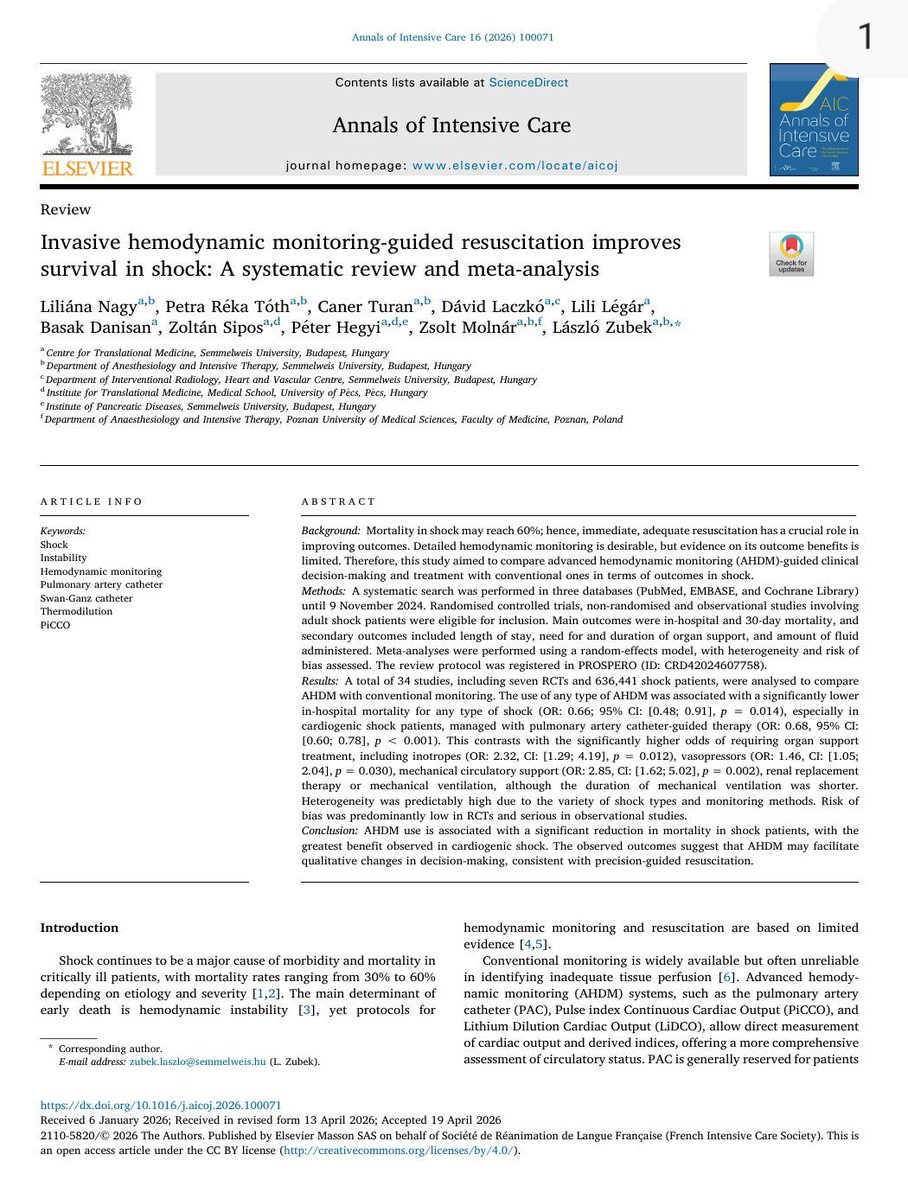
This new 2026 systematic review and meta analysis in Annals of Intensive Care challenges that narrative directly.
The study analyzed:
📊 34 studies
📊 636,441 shock patients
📊 PAC, PiCCO and advanced hemodynamic monitoring guided resuscitation strategies
Main finding: ✅ significant reduction in in hospital mortality with advanced hemodynamic monitoring guided management (OR 0.66)
The strongest signal appeared in:
⚠️ cardiogenic shock particularly with pulmonary artery catheter guided therapy.
One of the most interesting physiological observations:
Patients monitored with advanced hemodynamic systems received:
• more vasopressors
• more inotropes
• more mechanical circulatory support
• more RRT
Yet mortality was LOWER.
That is extremely important.
This suggests the benefit may not come from the device itself, but from:
🧠 earlier recognition of instability
🧠 physiology informed escalation
🧠 more precise therapeutic targeting
In other words: better decision making.
The paper strongly supports a concept many intensivists intuitively recognize at bedside:
Not all shock is “vasoplegia plus fluids.”
Different hemodynamic phenotypes require:
• different vasoactive strategies
• different fluid approaches
• different escalation timing
• different mechanical support thresholds
Advanced monitoring may allow clinicians to move away from: “one size fits all resuscitation.”
Another important nuance:
The mortality benefit was strongest in cardiogenic shock.
The evidence in septic shock remains less definitive, although trends still favored advanced monitoring.
This may reflect an important reality: cardiogenic shock is fundamentally a hemodynamic disease.
One particularly valuable message from this paper:
The authors emphasize that modern AHDM is not simply “placing a Swan Ganz catheter.”
It is:
📌 integrating dynamic physiology
📌 interpreting perfusion targets
📌 understanding ventricular interactions
📌 identifying fluid responsiveness limitations
📌 tailoring escalation
Technology without physiology remains insufficient.
Interesting practical point:
The analysis did NOT show major increases in serious complications related to advanced monitoring devices.
That matters because procedural fear has been one of the strongest arguments against invasive monitoring.
My personal takeaway:
Critical care may be entering a new era where: precision hemodynamics returns to the center of shock resuscitation.
Not because catheters are fashionable again because modern shock management increasingly requires individualized physiology rather than protocolized averages.
📖 Reference
Nagy, L., Tóth, P. R., Turan, C., et al. (2026). Annals of Intensive Care, 16, 100071. https://t.co/z6ITSu4ubU