Satya Nadella just posted something that validates the entire AI buildout thesis from the very top of the stack.
The model is commoditizing. The durable value is the learning loop a company builds on top of the model.
He splits it into two assets:
Human capital -- the knowledge, judgment, relationships, and pattern recognition of your people.
Token capital -- the AI capability the firm builds and owns.
He says the real opportunity is building a learning loop where human capital and token capital compound together.
If the model layer is commoditizing then the durable returns are not in the model makers. They are in the infrastructure that powers every company building its own loop. Compute. Memory. Interconnect. Power.
The full stack underneath the application layer.
The model wars will have winners and losers. The infrastructure underneath gets bought either way.
Bullish the AI buildout.
Every layer. If you want to understand them in detail, check out my Substack.
https://t.co/Wna5UzCOVT
Every AI & automotive chip needs burn-in testing before shipping. $KESM stress-tests semiconductors.
Q3 FY2026: They named AI-related demand as a revenue driver.
Turnaround is showing up in the numbers.
So why pay more than double via the Singapore holding company?
Peter Lynch's favorite metric is the PEG Ratio. A PEG ratio under 1 means a company is growing faster than its valuation implies.
Here are 10 semiconductor stocks with a PEG under 1 right now:
1. $COHR - Coherent (PEG ~1.0x)
Q3 revenue $1.81B, up 21% YoY. Datacenter segment hit $1.4B with a book-to-bill above 4x. Ramping 1.6T optical transceivers in H2. The vertically integrated AI connectivity play.
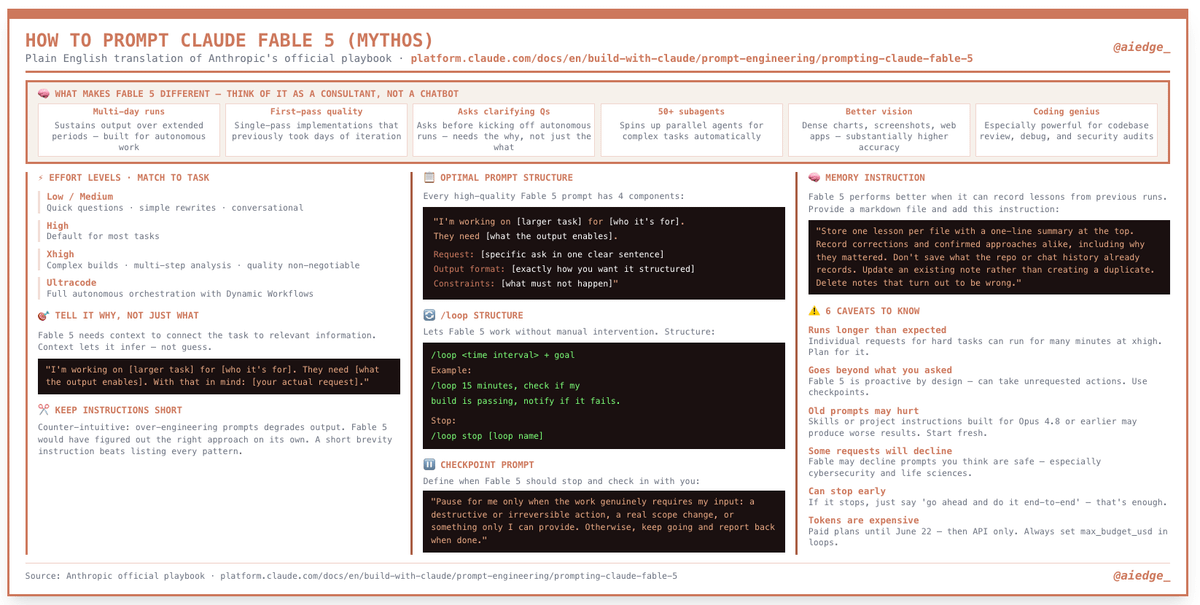
Anthropic just literally spoon-fed you how to use Fable properly.
99% of Claude users missed it.
The way you need to prompt Fable is fundamentally different from all other AI models.
I translated their entire new Fable prompting handbook:
Dylan Patel, founder of SemiAnalysis:
"The upper bound on how much compute can be produced by 2030 is around 200 gigawatts a year."
The entire world has about 20 gigawatts of AI deployed right now. The ceiling is 10x what exists today, and it still isn't enough to feed what Sam, Elon, Dario and Demis are racing to build.
Everyone argues about which model wins. The real limit is a number measured in gigawatts, and it's already maxed out years in advance.
Citadel Securities just put institutional weight behind what the AI bulls won't say out loud.
In a new macro note titled "Tokenomics," Citadel makes the argument plainly: even the most powerful technology on earth still has to pass through the boring discipline of cost curves, capacity limits, and marginal returns.
The evidence is piling up:
– Amazon removed its token usage leaderboard
– Microsoft cancelled Claude Code subscriptions
– Multiple companies reporting unexpectedly massive token bills
Their conclusion is the part that matters.
Adoption is no longer about what AI can do in principle. It's becoming about the price and scarcity of the inputs needed to run it at scale. Compute. Power. Cooling. Memory bandwidth. Inference budgets. All real, all binding constraints.
And here's the kicker from the chart.
The Silicon Data LLM Token Expenditure Index, a benchmark for how much the market is actually spending on AI tokens, has started rolling over. Citadel reads it as a shift toward cheaper models. Companies substituting away from expensive frontier AI toward "good enough" alternatives.
That's economics 101 doing what it always does. When the price of something rises, people use less of it, or find a cheaper version.
Citadel sees a bifurcation forming. Frontier AI concentrated among a few firms with the balance sheets to absorb the cost. Everyone else quietly downgrading to simpler, cheaper models.
This is the part of every technology revolution the early narrative ignores.
The technology being real was never the question.
The question was always whether the economics could carry the valuations.
When one of the most sophisticated trading firms on earth starts writing about AI in the language of cost curves and rationing instead of limitless demand, the conversation has quietly changed.
The hype was about what AI could do.
The reckoning is about what it costs.
Singapore's largest coffee shop operator just reported. Profit up 10.6%.
Dividend held. Cash flow growing. Looks clean.
One cost line in the notes changes the read.
And there's a timing question the market hasn't asked.
We went through both.
THE $42 BILLION BROADBAND SUPER CYCLE IS JUST GETTING STARTED -
$HLIT $CALX $CLFD $ADTN $DY $GLW $MTZ $PWR $COHR $AAOI $POET
Everyone is chasing AI semiconductors, GPU clusters, and hyperscale data centers.
But one of the most overlooked infrastructure opportunities of this decade is happening underneath the ground.
Fiber.
The $42.45B BEAD broadband program has officially moved from planning to deployment mode.
→ 15 states + 3 territories already approved
→ Tens of billions flowing into fiber construction
→ Rural broadband buildouts accelerating nationwide
→ AI data centers creating a second parallel demand wave for dense fiber backhaul
This is not a short-term trade.
It’s a multi-year infrastructure supercycle sitting at the intersection of:
✔ Federal broadband policy
✔ AI infrastructure capex
✔ Carrier network modernization
And all three are accelerating simultaneously.
THE MARKET STILL DOESN’T FULLY UNDERSTAND THIS
Every AI data center being built requires massive fiber connectivity.
Hyperscalers are no longer just buying GPUs.
They’re signing multi-billion-dollar fiber supply contracts to connect AI clusters, edge networks, and cloud infrastructure together.
The picks-and-shovels of the AI era aren’t only semiconductors.
Sometimes they’re fiber optic cables running underground.
🔵 $GLW — Corning
→ Optical Communications revenue surged 36% YoY
→ Secured a $6B multiyear fiber supply agreement with Meta
→ New multicore fiber technology increases capacity while reducing installation time dramatically
→ One of the strongest infrastructure product cycles in company history
🟠 $MTZ — MasTec
→ Communications backlog exploded to $6.2B
→ Total backlog reached a record $20.3B
→ Positioned across telecom, fiber, energy, and infrastructure simultaneously
→ Becoming a preferred large-scale deployment partner
🟣 $PWR — Quanta Services
→ Institutional-quality infrastructure compounder
→ Exposure across broadband, power grid modernization, renewables, and data center outside plant
→ One of the safest ways to participate in the digital infrastructure buildout
🔴 $DY — Dycom Industries
→ Record broadband construction backlog
→ Major BEAD deployment beneficiary
→ Expanding deeper into data center infrastructure construction
→ One of the purest broadband construction plays in the market
🟢 $CALX — Calix
→ AI-enabled broadband software platform
→ Deep integration with Google Cloud + Vertex AI
→ Positioned to benefit directly from the rural broadband funding wave
🔵 $HLIT — Harmonic
→ Cloud-native broadband software stack gaining traction with major operators
→ AI-driven broadband optimization becoming a major differentiator
🟠 $CLFD — Clearfield
→ Pure-play fiber infrastructure exposure
→ Dual tailwind from rural broadband + AI data center connectivity
🟣 $ADTN — ADTRAN
→ Broadband automation, managed Wi-Fi, and carrier-grade networking
→ Turnaround story with BEAD exposure and improving regulatory clarity
OPTICAL NETWORKING NAMES ALSO BENEFITING
$COHR
$AAOI
$POET
THE BIG PICTURE
The AI supercycle does not stop at the GPU rack.
It extends through fiber networks, broadband nodes, optical systems, and last-mile connectivity infrastructure that still needs to be built.
This may become one of the most important infrastructure investment themes of the decade.
$HLIT $CALX $CLFD $ADTN $DY $GLW $MTZ $PWR $COHR $AAOI $POET
Not financial advice.
Holy mother of InP lasers.
Rosenblatt just dropped an InP supply and demand model today and the numbers are staggering.
NVIDIA asked the supply chain to scale InP laser capacity by 20x from 2025 to 2030. The vendors pushed back and agreed to 12x. Even the conservative scenario has Datacom supply still 50% behind demand exiting 2030 after a 12x increase.
12x supply increase over five years. Still not enough.
Rosenblatt explicitly calls it a non-cyclical growth industry well past 2030. The InP supply chain is structurally short for the rest of the decade.
Here is what the revenue buildout looks like by supplier across 2025 to 2030:
$LITE -- $600M in 2025 to $9B by 2030. The dominant player scaling fastest including a new InP fab acquisition in Greensboro NC converting in 2028, adding $2.5B in 2028 and $5B in 2029.
$AAOI -- $60M to $2.1B. The high-torque play. Rosenblatt sees it growing from under 5% to nearly 10% transceiver market share and entering the ultra-high-power CW laser market for CPO. Smallest base, biggest percentage runway.
$SIVE -- sits alongside as the pure-play InP laser specialist and external light source for CPO -- the chokepoint Rosenblatt's entire supply model is built around. DFB laser supply confirmed tight through Q3 2027.
$AVGO -- $550M to $4.5B. Second largest by revenue. Strong but less pure-play InP than LITE.
$COHR -- $125M to $4.3B. Rosenblatt's top near-term pick. Expects revenue acceleration and gross margin expansion from 6-inch wafer production driving 800G and 1.6T transceiver sales.
VIAV -- $53 stock, called out specifically for underappreciated bottlenecks in OCS and CPO test expertise and capacity.
Total InP Datacom market: $1.9B in 2025 to $22.75B by 2030. Nearly 12x.
Flags from the report.
$CIEN -- Rosenblatt is cautious. Side GM expectations have gotten too high and do not factor in price increases from LITE and COHR as suppliers.
$CRDO -- viewed as a niche player, not strongly relevant to the CPO optical supply chain. Expects 1.6T AECs to be weaker than the market expects.
If CPO scale-up slips beyond the current 2H27 build window, 2028 becomes a buying opportunity rather than a revenue year. Wafer supply, test and measurement, DSP, PIC, and laser capacity are all identified as potential chokepoints.
But the direction is not in question. NVIDIA is the demand signal and NVIDIA asked for 20x. The supply chain is building for 12x. The gap between those two numbers is the entire trade.
$LITE $COHR $AAOI $SIVE for the InP laser supply chain.
$IQE $AXTI $SOI for the InP epi and substrate layer underneath them.
$SOI for SiPh substrate.
Bullish Photonics
New chip uses light instead of electricity to make AI think at lightning speed.
🔬 MIT researchers developed photonic chip that performs computations of neural networks using light
Achieves 92% accuracy in under half a nanosecond - matching traditional hardware performance.
→ The chip combines optical and electronic components through nonlinear optical function units (NOFUs), enabling both linear matrix operations and nonlinear activations to stay in the optical domain until final output
→ Built using standard CMOS fabrication processes, this breakthrough could enable scaled production of ultra-fast, energy-efficient AI processors for demanding applications like lidar and telecommunications
Key Highlights:
→ The processor performs matrix multiplication optically through programmable beamsplitters, maintaining data in light form throughout computation
→ NOFUs handle nonlinear operations by converting small amounts of light to electrical signals via photodiodes, eliminating external amplifiers and minimizing energy use
→ In-situ training achieved 96% accuracy while inference hit 92%, demonstrating viability for real-world applications
→ The entire system operates at sub-nanosecond speeds while matching traditional hardware accuracy, opening new possibilities for real-time AI processing
→ Commercial foundry fabrication makes this technology viable for mass production and integration with existing electronic systems
For anyone interested in learning about the CPO supply chain!
(I also explain it in a fun and understandable way)
Covered: $AXTI, $LITE, $AIXA, $COHR, $SOI, $TSEM