Day 1 of learning Blockchain Research
Before diving deep into anything, you have to understand the basics.
Today, I focused on the foundations of blockchain technology ; nodes, transactions, mempool, Layer 1s, Layer 2s, and more.
To solidify my understanding, I compared three major blockchains.
Here’s what I found:
Bitcoin → Digital Money
Core feature:
* Proof of Work (PoW)
Miners secure the network
Limitations:
* Extremely secure, but not very user-friendly
* Slow transaction speed
Possible solution:
Layer 2 solutions like the Lightning Network can make transactions faster and cheaper.
Ethereum → World Computer
Core features
* Proof of Stake (PoS)
* Smart contracts
Limitations
* Scalability issues
* High gas fees can push away everyday users
Possible solution:
* Layer 2 rollups, which spread the cost of transactions and significantly reduce fees.
Solana → Onboarding & Speed
Core features:
* Very fast
* Cheap fees
* Developer-friendly
Limitations:
Network instability during periods of extremely high activity
Each blockchain is designed with different goals and trade-offs in mind.
There’s no “perfect” chain only different design choices.
I’ll be sharing what I learn daily.
Stick with me.
Thanks 🙏
@faysalOfWeb3
🤯An AI security tool has 1st-place performance on security contests from just 1yr ago. Solidity-auditor v3 is out, FREE & Open Source.
Thousands of Solidity developers are using the tool already. Upgrade your security baseline, use the tool🫡
https://t.co/SfxjuQ17gA
This is exactly why we’re building a subnet scouting CLI.
The tool will let you run checks on any subnet before registering:
• registration cost
• hardware requirements
• validator reward logic
• miner/owner concentration
• emissions distribution
• repo activity
• setup complexity
• capital or latency requirements
• “can I actually mine this on my current setup?”
Because the expensive part is not always registration.
Sometimes the real cost is hidden in the game the validator is rewarding.
A subnet can look cheap from the outside, then you inspect the code and realize it needs inventory, collateral, low-latency execution, or an edge you don’t have.
The goal is simple:
before spending TAO, know whether you have a realistic path to earning.
Cheap registration ≠ cheap mining.
https://t.co/0i3H1qdmno
Some of the cheapest subnets to register for are the most expensive ones to mine.
That sounds backwards until you actually dig into how a subnet works.
A lot of people still judge subnets from the surface.
- you check the registration cost
- Look at the README
- Maybe scan the repo.
- Maybe glance at Taostats.
Then they decide whether a subnet is good.
But that’s not how this works.
The README tells you the story
The validator code tells you who actually gets paid
That difference is really huge.
I was looking into one subnet recently and on the surface it looked cheap enough to test
- Low registration cost
- Active repo.
- Interesting subnet idea.
Normal person sees that and thinks, maybe there’s something here. Then you go deeper and realize the whole thing is basically a different game entirely.
It wasn’t really an AI mining opportunity in the way most people would assume.
It was a capital, execution, and market structure game.
The cheap part was just the registration.
The expensive part was everything that actually mattered.
- Inventory.
- Collateral.
- Latency.
- Fulfillment risk.
- Incumbents already controlling most of the rewards.
Completely different story.
That’s why I think a lot of people are asking the wrong question when they look at subnets.
Not:
“can I register?”
But:
“if I register, do I actually have a path to earning?”
And even that is incomplete.
The better question is:
do I have a path to earning competitively, or am I just paying to learn that someone else already owns the table?
That’s the part I care about now.
when you look at a subnet today, what’s the first thing you check?
"Client: I've sent the payment."
We've all heard those words before.
Then comes the waiting.
This story isn't about crypto.
It's about time.
And what happens when money finally starts moving at the speed of the internet.
#SuiNetwork@SuiNetwork@SuiNetworkNG@Nefarii
One subnet is turning real estate into an intelligence market.
Not another chatbot.
Not another wrapper.
@zipcodenetwork is taking property valuations, collateral checks, appraisal models, and real estate data — then putting them inside Bittensor’s incentive layer.
1,461 models.
114 in the latest eval.
Top score: 0.942.
All-time high: 0.985.
14.9 TAO emitted daily to compete on real estate intelligence.
This is the part people keep missing about $TAO.
It is not just decentralized AI.
It is markets for intelligence.
Training markets.
Inference markets.
Data markets.
And now collateral markets.
If Zipcode works, real estate does not just get tokenized.
It gets priced, verified, and underwritten by an open network.
Shorter quote version:
One subnet.
1,461 appraisal models.
Real estate data.
Collateral checks.
Property valuation.
On-chain lending rails.
@zipcodenetwork is showing why $TAO is bigger than “AI apps.”
Bittensor is turning intelligence itself into market infrastructure.
We launched in September to build an intelligence and credit layer for the $400T real estate market.
In just 9 months, we've:
> built a property validation network with just $350k in incentives to AI engineers
> raised $1.25M from @stillcorecap, Bittensor Fund 1, @dsvfund, Astrid, Beyond Finance, and other angels
> signed an MOU with @RealFlyhomes (~$2B/yr in home loans)
> partnered with @Plaid to bring KYC, collateral valuation, and credit checks
> surpassed $HASH by a mile (3x the holders and over 25x the daily trading volume)
> Plaid, Proof, Pippin Title, @reclaimprotocol, @chainlink CRE nodes
The takeover has begun.
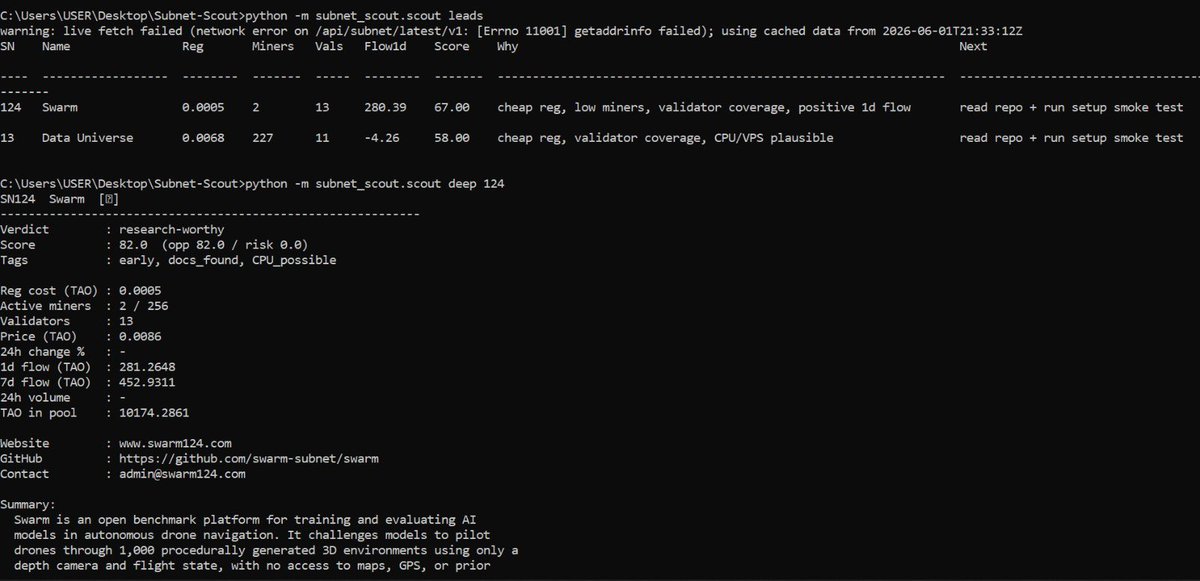
Subnet Scout progress today
We pushed Subnet Scout from a basic ranking script into a more practical Bittensor mining research CLI.
What changed:
1. Live Taostats integration
- Pulls live subnet data
- Reads registration cost, active miners, validators, max neurons, flow data, and identities
- Uses Taostats API instead of relying on stale notes
2. dTAO pool data
- Added dTAO pool endpoint support
- Better subnet names/symbols
- Better market context where available
3. Cache fallback
- Taostats can rate-limit with 429
- Now the CLI saves live data locally
- If API fails, it falls back to cached data instead of breaking
4. Fixed unit bug
- Some Taostats values come in rao
- Registration cost like 500000 was showing wrongly
- Fixed it so it displays correctly as 0.0005 TAO
5. Flow tracking
- Added 1-day, 7-day, and 30-day TAO flow fields
- Changed the table from useless missing 24h% to Flow1d
- Makes it easier to see where capital is moving
6. Cleaner scoring
- Better placeholder detection
- Names like unknown, pending, parked, and deprecated are treated as risky
- Helps avoid chasing fake/low-quality leads
7. New leads command
- This is the practical shortlist command
- Filters for subnets that are more realistic for VPS/CPU-style mining
- Shows:
• subnet
• registration cost
• miners
• validators
• 1d flow
• score
• why it is a lead
• next action
8. JSON output
- Added:
python -m subnet_scout.scout leads --json
Useful later for automation, dashboards, bots, or alerts.
9. New deep command
- Added:
python -m subnet_scout.scout deep 124
It gives:
• subnet inspect view
• registration cost
• miner/validator count
• flow
• website
• GitHub
• summary
• due diligence checklist
• next commands to run
10. Deep JSON output
- Added:
python -m subnet_scout.scout deep 124 --json
Useful for future automated subnet reports.
11. GitHub repo setup
• Created a clean repo export .
• Added SSH deploy key
• Pushed updates to:
https://t.co/fp0LSO8MJN
SN124 Swarm ( @SwarmSubnet ) showed as the strongest current lead
Main result
Subnet Scout now does more than “rank subnets.”
It gives a practical workflow:
python -m subnet_scout.scout leads
python -m subnet_scout.scout deep 124
So instead of guessing, we can now scan → shortlist → inspect → decide what to research next.
Spent today building a small Python tool for Bittensor subnet discovery.
The problem is simple:
There are too many subnets to track manually, and for small miners, the important question is not “which subnet is trending?”
It’s:
Which subnet is actually worth researching?
So I built Subnet Scout.
It looks at things like:
▫️ registration cost
▫️ miner count
▫️ validator activity
▫️ docs/GitHub availability
▫️ early vs crowded subnets
▫️ suspicious “cheap but dead” signals
▫️ possible CPU/VPS-friendly opportunities
The goal is not to blindly tell me where to mine.
The goal is to reduce noise and surface better questions.
For example:
A subnet with low registration cost and 1 miner might be early.
Or it might be closed, dead, or impossible to mine without private docs.
That difference matters.
Bittensor discovery is still messy, but tools like this can make it easier for small miners to find real opportunities before they become obvious.
Still rough, but it works.
Next step: better docs detection, daily snapshots, and a proper watchlist.
https://t.co/ANGYpkonKL is now LIVE.
Decentralized intelligence and capital, under one roof.
One Network
One Mission…
Enable Real World Financial Services, onchain.
Welcome to the future of finance.
https://t.co/ANGYpkonKL is now LIVE.
Decentralized intelligence and capital, under one roof.
One Network
One Mission…
Enable Real World Financial Services, onchain.
Welcome to the future of finance.
@TalkingTensor At ~$280K per trillion tokens, Chutes needs only ~3.6T tokens served to generate $1M revenue.
If that revenue goes into alpha buybacks, demand becomes tied to real usage, not just emissions.
65% of data-center training efficiency on Orion-100B is the part people should pay attention to.
Distributed training usually breaks on coordination: latency, bandwidth, unreliable nodes, and verification.
Macrocosmos is showing that Bittensor can turn underused global compute into coordinated training capacity.
If this keeps scaling, decentralized AI moves from “GPU marketplace” to actual model production.
Today, we are launching the first stage of Project Orion.
Our early pre-training run of Orion-100B achieves upward of 65% of data-center training efficiency on hardware costing a fraction of the price.
Orion-100B is the first proof point for a simple idea: that underutilized compute around the world can be turned into frontier training capacity.
We believe that this work presents, for the first time, an economically compelling case for training large models using distributed approaches.
Locking public stake means less liquid founder overhang, stronger long-term alignment, and a cleaner signal to the market:
“I’m not here to dump volatility. I’m here to build through it.”
Most founders market conviction.
Very few restrict their own optionality to prove it.
$TAO
NEWS: Bittensor founder and bittensor:native holder @const_reborn, locks all public stakes based on conviction.
Check it out now on https://t.co/FBGfy0bAxl
The real highlight of @proofoftalk will not be hype.
It will be exposure.
For the first time in a more serious setting, Bittensor gets pushed in front of people outside its own native bubble, and that matters more than most people think.
Inside the ecosystem, it is easy to believe the story.
- You see the subnets.
- You understand the emissions.
- You follow the builders.
- You know why decentralized intelligence is interesting.
But none of that guarantees the story survives contact with outsiders
And that is the real test
A dedicated Bittensor track at Proof of Talk is important because it forces the ecosystem to explain itself to people who are not already emotionally invested.
Not miners.
Not subnet holders.
Not timeline loyalists.
People who want to know:
Is this infrastructure or just narrative?
Are these subnets real businesses or just clever token wrappers?
Is decentralized intelligence actually producing something useful, or is it still mostly internal excitement talking to itself
Bittensor | $TAO
This emissions-blocking update is one of the more important governance moves in Bittensor right now.
Not because it is perfect.
Because it shows the network is starting to separate useful subnet activity from extractive subnet activity.
According to Taostats, Bittensor will now block emissions from subnets that:
burn 100% miner emissions
have no plan to go live
self-mine fake activity
are dead or abandoned
exploit TaoFlow
That matters because emissions are not just “rewards.”
They are the economic signal of the network.
If emissions keep flowing to dead subnets, fake activity, or teams with no intention of going live, then the system rewards extraction instead of production.
And that weakens the entire subnet market.
The real promise of Bittensor is not that every subnet deserves emissions forever.
The promise is that useful digital commodities can compete for capital, miners, validators, and attention.
That only works if low-quality or exploitative subnets are not allowed to drain the system while real builders compete for the same emissions.
This is why the cleanup phase matters.
It forces every subnet to answer simple questions:
Are you live?
Are miners doing real work?
Is the incentive mechanism honest?
Is value flowing to contributors, or being captured by insiders?
Can the subnet justify the emissions it receives?
That is the right pressure.
Short term, some people will call this harsh or centralized.
And maybe they have a point.
But Taostats also framed it as temporary while conviction and governance mature.
That distinction matters.
The endgame should not be manual intervention forever.
The endgame should be better governance, stronger market signals, and a network where emissions naturally move toward subnets producing real value.
For now, this looks like a necessary filter.
Bittensor is moving from “launch a subnet and farm attention” toward something more serious:
prove useful work, or lose emissions.
That is how subnet quality improves.
Bittensor | $TAO
This is a necessary cleanup phase.
If emissions are meant to reward useful work, then dead subnets, fake self-mining, TaoFlow exploits and “no plan to go live” projects should not keep draining value.
Temporary or not, this pushes the network in the right direction:
less noise, stronger subnets, better incentives.
NEWS: Bittensor will now be blocking emissions from subnets that fall into the following categories:
- Burn 100% miner emissions
- Have no plan to go live
- Self-mining fakes
- Dead or abandoned subnets
- TaoFlow exploiters
A temporary solution as they await the release of conviction and governance to take over.
Congrats to the SN60 team.
This is exactly the kind of progress Bittensor needs more of:
measurable agent improvement, faster vulnerability detection, and real security use cases.
The strongest subnets won’t just sound interesting.
They’ll keep proving useful work in public.
NEWS: SN60 @bitsecai achieved a new milestone with stronger agent performance and faster vulnerability detection after the v3.1 update.
Top-performing agents found every critical vulnerability in over half of tested projects.
Found a Medium-severity vulnerability in Zebra, @zcash's Rust full-node implementation, and reported it through the Zcash Bounty Program for a $37,500 bounty.
Already patched and shipped in v4.5.0 — disclosure below.
https://t.co/Cx0o5UQBTy
@ZcashCommGrants
Had some duplicates too.
Feels good 😁