Solving quantum algorithms with AI by @eigencloud. Science is accelerating and open source is going to drive that.
NEAR is shipping post quantum crypto end of Q2 to make sure everyone has time to upgrade.
New on NEAR AI: automatic PII anonymization.
Paste whatever you want into Claude, ChatGPT, or Gemini; your real passwords, API keys, and emails never leave your machine.
One header turns it on. 🧵
You can now access anonymized frontier models from OpenAI, Anthropic, and Google through the @near_ai Cloud API!
Providers can see prompts but not any info about who sent it. Think of it like a AI inference mixer.
Full model list here: https://t.co/UKaue4jt9M
USDC is now live in @near_ai Agent Market with confidential execution via Confidential Intents.
Confidential stablecoin settlement is a baseline requirement for agentic commerce. Businesses will not deploy agents that expose their revenue, counterparties, or financial operations on a public ledger.
@NEARProtocol is building the solutions to help businesses use USDC to make the most of their AI agents, without revealing sensitive information.
The @NEARProtocol is becoming post-quantum-safe. See below for the roadmap to quantum safety, starting with adding a quantum-secure signing scheme in Q2.
We originally built the protocol with expectation cryptography will need to change due to progress in quantum computing. We knew there would be a need to expand the cryptography set, so NEAR allows multiple signing schemes by design and users will be able to use whichever one they prefer. We also design NEAR account model to not depend on any particular cryptography and allow to manage keys as "devices".
We’re proactively releasing the first quantum-safe signing scheme this spring, the first of many. Allowing wallets and partners to add support to it and users to secure their accounts early. We want to give users as much time as possible to rotate their keys in a proactive way and have piece of mind.
In parallel Near One is going to upgrade cryptography across secure the rest of the protocol. More to come on this, but I'm excited for these steps and I feel NEAR is well-positioned to lead in the quantum transition for our space.
🇰🇵 DPRK loves it when you:
- Save your seed phrase in a password manager.
- Use hot wallets instead of hardware wallets.
- Don't use antivirus, EDR or Lockdown mode in your devices.
- Download pirated stuff, install shady apps and play games in your work device.
- Accept calls from people without verifying them first.
- Use SMS for 2FA.
- Sync your passwords, google authenticator and passkeys to your Gmail account
- Install lots of browser extensions
- Don't update your Operating system and apps.
- Repeat passwords.
- Don't use a device exclusively for work
- Don't verify what you are signing
- Run npm install on a "coding challenge" from a recruiter you met on LinkedIn.
- Blindly add npm/PyPI packages without checking the publisher, download counts, or recent version history.
- Pin your dependencies to "latest" and hope for the best.
- Trust any GitHub repo with a slick README and a few stars.
- Reuse the same email for crypto, banking, and signing up to random newsletters.
- Click "Remind me later" on security updates for weeks.
- Disable Windows Defender because it "slows things down."
- Plug in random USB drives you found at conferences.
- Give every app full disk access without reading the prompt.
- Brag about your portfolio size on Twitter under your real name.
- Share your screen on Zoom with your main user logged in
- Connect your wallet to every airdrop site that promises free tokens.
- Approve unlimited token spending so you "don't have to do it again."
- Keep your recovery codes in a screenshot in your camera roll.
- Trust a Telegram admin who DMs you first.
- Run unsigned binaries because "the SHA matches the website.
Let's grow up as an industry and start treating security seriously.
STAY SAFE
Not that I knew about the technical details but this makes total sense to me.
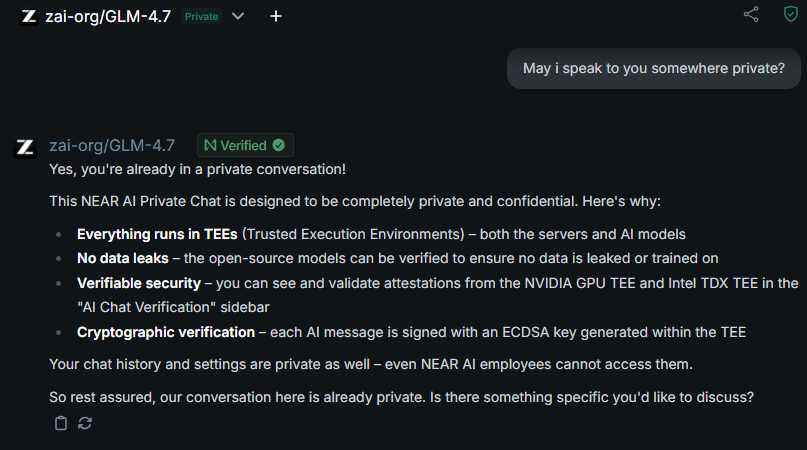
I think the more people use AI, the more they dont want to leak their prompts to the model/the company behind it. Things are moving to self-hosted/decentralized, encrypted AI and companies will adjust.
I’m often asked about the possibility of using frontier models in an open source environment. I believe that one way or another, frontier companies will eventually adopt the same approach as @near_ai has to privacy, secure enclaves, and end-to-end encryption.
It’s possible to encrypt even a closed model and upload it to a decentralized cloud like NEAR AI Cloud. The weights are guaranteed to be hidden from everyone, but inference can be monetized, while users are guaranteed that their data won’t be visible to the model owner.
Right now, the frontier model companies are training on user data, but that window is probably closing and most training will be done on synthetic data. So they won't be as incentivized to keep or utilize users' data. Not to mention, over time user data will become even more of a liability than it is already. Enterprises are already paying the big AI companies not to train on their data, albeit with verbal trust rather than mathematical guarantees, but it’s clearly possible.
So NEAR isn't working against the frontier model builders. They can use our infra or our approach. Everyone can – and should – have a more User-Owned AI paradigm where frontier models are verifiable and it will be better for everyone.
🚨 Infostealer malware was caught exfiltrating entire OpenClaw agent configs—not just passwords.
Researchers say tokens, crypto keys, and the agent’s behavioral “soul” file were taken via bulk file grabs, enabling remote access or AI impersonation if exposed.
🔗 Read → https://t.co/GAE0r1CYt8
@resdegen True, finally someone who addresses the risks. Haven't seen a single post about it yet. In a time where dev accounts get hacked daily and "legit" software gets malicious updates, one should always be cautious and install/use as less as possible. Better check your PC and uninstall
#TrustWallet browser extension v2.68 is compromised (Hacked)
DO NOT OPEN YOUR WALLET IF YOU USE THAT VERSION
disable, get the newer version (2.69) and enable it again
RT plz
#Crypto#Bitcoin#Altcoins