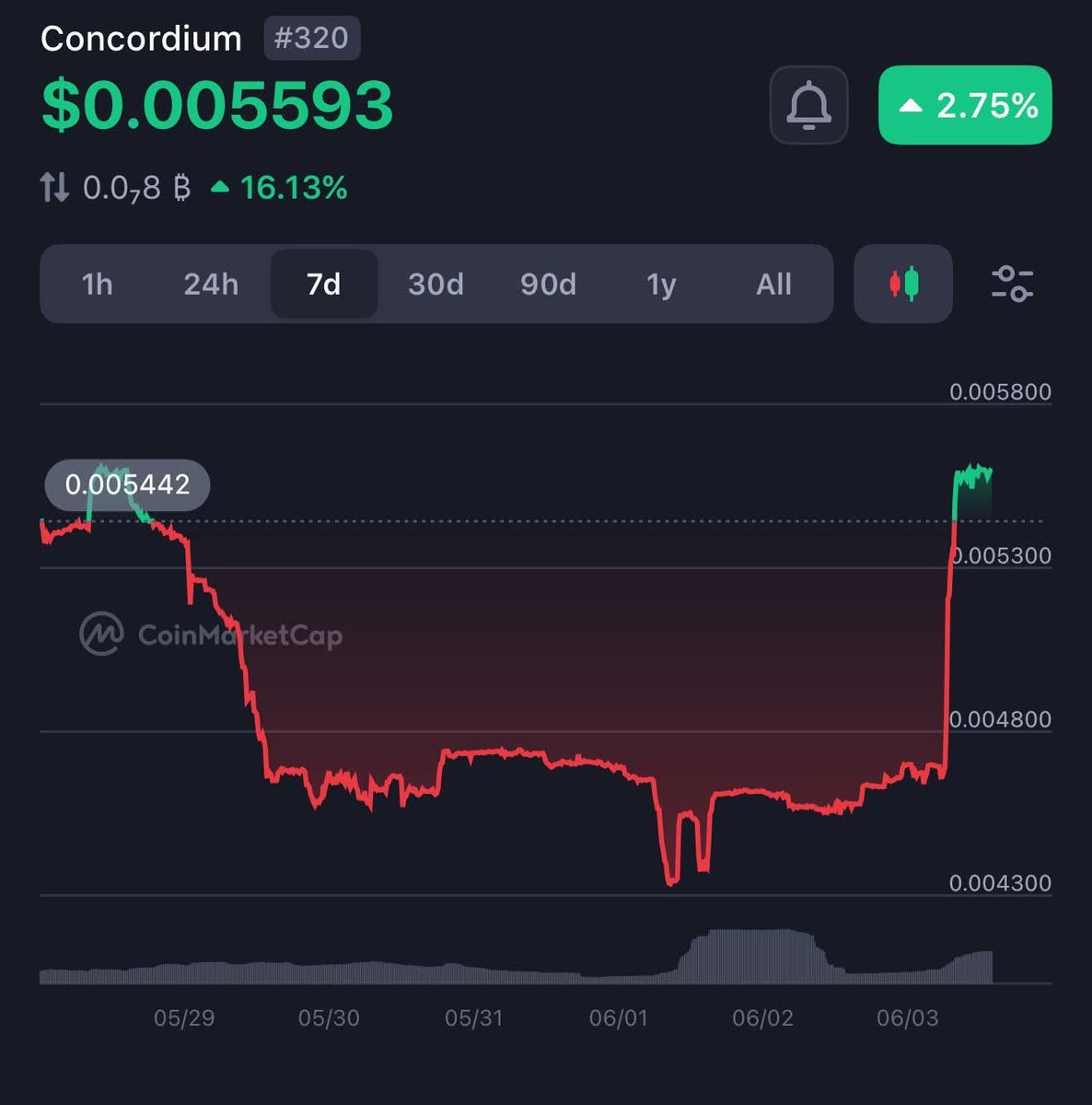
Market is bearish nowadays. $BTC $ETH $SOL and other are down.
But $CCD is on fire 🔥🔥
But why:
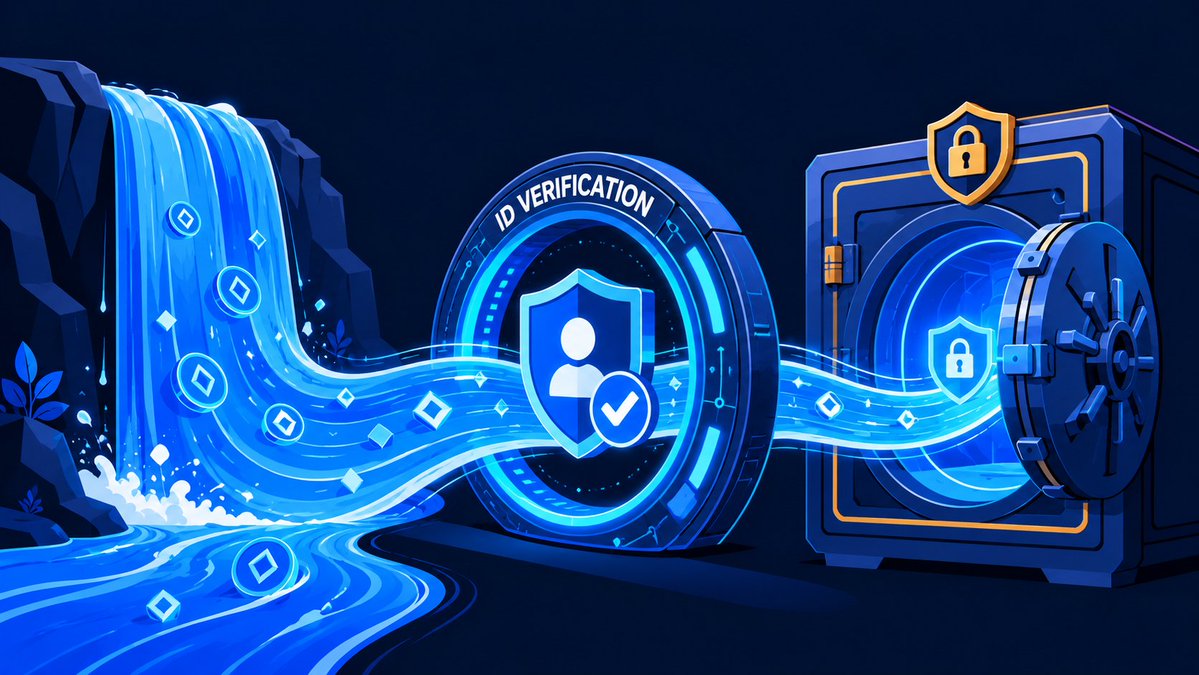
🚀Protocol-Level Accountability: It is not just show an agent exists; we anchor it to a verified human identity using Zero-Knowledge Proofs (ZKPs).
🚀The "Verified by Concordium" Badge: Your agents can now carry a verifiable badge that proves a real entity stands behind them.
🚀Cross-Chain Compatibility: You don't need to migrate. If your agent lives on Ethereum or another chain, it can register on @Concordium , get its badge, and take that "trust anchor" with it wherever it operates.
🚀Compliance Ready: Prove authorization, spending limits, or jurisdictional permissions without ever exposing your private data.
Sending corporate funds internationally usually involves 3 intermediate banks, a mountain of paperwork, and 5 business days of biting your nails.
Or, you can use @Concordium . Instant finality, built-in compliance, and trackable security. Welcome to 2026 finance. $CCD
We need to have an honest conversation about why DAO governance is failing.
The original dream of decentralized organizations was great, but the current reality is broken. Right now, most DAOs operate on a "one token = one vote" system. It sounds fair until a wealthy anonymous whale—or a competitor—quietly buys up a massive chunk of governance tokens, hijacks a snapshot proposal, and drains the treasury. We’ve seen this happen repeatedly, and it’s stopping real institutions from taking DAOs seriously.
If decentralized governance is going to survive, it has to move away from pure capital dominance and move toward proof of unique contribution.
This is where @Concordium ’s identity framework presents a massive shift for the DAO landscape. By utilizing native Zero-Knowledge Proofs (ZKPs), a DAO can finally implement a true "One Person, One Vote" (Quadratic Voting) mechanism safely.
Because Concordium verifies identity at the protocol layer, the DAO can mathematically prove that every voting wallet belongs to a distinct, real human being. The best part? The voter stays completely anonymous; they don’t have to dox their name, nationality, or passport to the community. They just prove they are a unique human who hasn't already voted with a different wallet.
If we want DAOs to manage real-world assets, infrastructure, or global foundations, we need accountability, not just deep pockets. Concordium is providing the governance shield that Web3 desperately needs. $CCD
No migration. No rebuilding. Just a badge that turns an autonomous agent into an accountable agent.
@ethereum $ETH agents. @solana $SOL agents. Any chain agents.
Now they can carry a credential that proves they're not a liability bomb waiting to explode.
The trust mark for accountable AI is live. The rest of the industry just got a new standard to meet. $CCD
https://t.co/ZV3mdY5grR
The Verified by Concordium Badge.
The trust mark for accountable AI agents.
Built on @ethereum?
Keep your agent where it is.
Get a badge that proves a verified human or business entity stands behind it.
No migration required.
🔗 Learn more: https://t.co/aGgS1ImSan
You can be a pixelated wizard or a cartoon cat on the timeline—we love the culture.
But when it comes to million-dollar business agreements, @Concordium 's ID layer ensures you know the entity behind the avatar is verified and real. Flex your JPEG, secure your business. $CCD
DePIN is arguably one of the most exciting sectors in Web3, but the entire narrative is heading toward a massive operational bottleneck if we don't talk about data integrity.
The promise of decentralized infrastructure is beautiful—crowdsourcing physical networks like weather sensors, localized 5G grids, or mapping tech. But here’s the problem: how do you actually prove that a node providing data from a specific street corner is a real, physical device and not a virtual script running on a server farm in another country to farm token rewards?
Right now, reward spoofing and Sybil attacks are draining the treasury of almost every major DePIN project out there.
This is where @Concordium ’s core architecture becomes a massive unfair advantage for these networks. By forcing the hardware operators—or the device chips themselves—to tie into Concordium's sovereign identity framework, the network can mathematically verify the source.
Using Zero-Knowledge Proofs, a node can instantly prove:
1-It is tied to a unique, verified human operator or authenticated hardware certificate.
2-It meets specific geographical or regulatory compliance parameters.
3-It isn't a duplicated bot—all without exposing the operator's actual personal data or location to a public tracker.
If DePIN wants to sell data to enterprise buyers or legacy industries, that data has to be institutional-grade and completely auditable. Concordium is providing the only identity filter that makes that possible. $CCD
"Mint is free!" ...until you see the $80 network fee at checkout.
@Concordium fixes the broken NFT/Gaming economy with micro-fees pegged to the Euro. Keep your funds for the actual digital asset, not the network congestion. $CCD
We spend a lot of time designing Web3 apps for human users, but the meta is shifting fast. The future of on-chain transactional volume isn't human—it's agentic.
Right now, autonomous AI agents are being deployed to handle everything from automated supply chain purchasing to real-time data procurement. But the tech is hitting a hard compliance wall: how does an AI agent legally open a wallet, complete an automated stablecoin transaction, or purchase a restricted service without triggering a massive anti-money laundering red flag? Legacy networks simply don't have an answer for this.
@Concordium ’s collaboration with protocols like x402 is addressing this bottleneck directly.
Instead of treating AI agents as rogue anonymous bots, they are embedding the network's native Zero-Knowledge identity layer right into the agent's code. This gives the AI a persistent, verifiable identity—essentially an on-chain "birth certificate." The agent can instantly prove its operational validity and regulatory compliance to an institution or merchant, complete a PayFi transaction, and move on. All in milliseconds, without revealing the underlying proprietary code or data or relying on human intervention.
When the agentic economy eventually scales to trillions, the foundation won't be built on wild-west anonymous networks. It will run on compliance-ready rails that know exactly how to audit machine behavior. This is an entirely different league of utility. $CCD
Most whitepapers: Written over a weekend by a marketing team.
Concordium protocols: Peer-reviewed by leading global cryptographers and scientists. Don't gamble on hype when you can build on proven science.
Everyone in crypto loves talking about retail privacy, but the real adoption bottleneck is quietly happening on the B2B side.
Enterprises want blockchain efficiency, but public transparency is a corporate nightmare. Think about it: if a company settles vendor invoices, distributes employee payroll, or executes a specific B2B pricing strategy on-chain, their competitors can track those wallets and transaction sizes in real-time. No serious board of directors will ever greenlight that.
This is where @Concordium ’s recent Protocol 10 upgrade makes a lot of sense.
By combining protocol-level Zero-Knowledge Proofs (ZKPs) with their new native Sponsored Transactions, businesses can settle operations or distribute stablecoins privately without exposing underlying commercial data to the public tracker. Even better? End-users or partners don’t need to hold or even understand $CCD to interact—the enterprise sponsors the gas fees seamlessly behind the scenes.
If institutional Web3 adoption actually scales, it won’t be on totally anonymous chains or hyper-transparent public networks. It’s going to happen on hybrid infrastructures that respect corporate data as a competitive asset. Definitely a narrative worth keeping an eye on this quarter.
Institutional security just met protocol-level compliance, and cold storage will never be the same again.
The highly anticipated May 2026 milestone is officially rolling out: @Concordium is expanding its integration to Ledger’s Web and Mobile Wallet platforms, bringing privacy-preserving identity to over 7.5 Million hardware users!
Why this integration fundamentally redefines Web3 asset custody:
🚀 Hardware-Secured Identities: Users can now generate, hold, and verify their digital IDs directly from their Ledger device. Your cryptographic identity is as unhackable as your private keys.
🚀 Compliance-Ready Cold Storage: Institutional funds and high-net-worth holders can interact with regulated PayFi, RWA pools, and DeFi protocols directly from cold storage while proving their KYC/AML status via ZK-Proofs.
🚀 Frictionless Enterprise Rail: No messy browser extensions or unsecured software hot wallets required. Secure, one-click verification meets the gold standard of hardware isolation.
The narrative is clear: If you want big capital to move on-chain, security cannot be sacrificed for compliance. Concordium and Ledger just proved you can have both.
Yield is great, but knowing your liquidity pool isn't interacting with illicit funds is better.
Concordium's ID layer brings institutional-grade compliance to DeFi, unlocking clean liquidity for serious players.
Checking the markets at 3 AM on a chaotic weekend? 📉👀
When your assets are built on a science-backed, compliance-ready foundation like Concordium, you don't need to stare at candles all night. Rest easy, the tech has you covered.
Stadium ticketing is completely broken. Scalper bots snap up seats in seconds, real fans get priced out, and teams have zero clue who is actually sitting in their stadium.
@Concordium is officially fixing this at the 2026 IIHF Ice Hockey World Championship through its massive partnership with the Danish National Hockey Team to launch the "Verified Fan" Programme!
Why this sets a new paradigm for live event economies:
✅ Bot-Proof Ticketing: By connecting ticket sales directly to the Concordium ID Layer, event organizers can ensure ticket allocations go to real, verified humans—instantly killing scalper bot farms.
✅ Privacy-Preserving Access: Fans can verify their tickets and entry requirements at the gate using Zero-Knowledge Proofs, proving validity without surrendering personal data to third-party databases.
✅ Agentic Commerce Pilot: Launching AI-driven automated ticketing and credentialing, allowing fans to securely trade or upgrade seats via authorized AI agents autonomously.
This isn’t just a tech showcase; it’s a blueprint for the future of global sports, concerts, and live entertainment. $CCD is bringing trust and fairness back to the stadium.
Not just "here's an agent ID." But "here's who is responsible, what they can do, and how you verify both."
This isn't theoretical. It's a live, walkthrough-able process.
The agentic economy finally has an accountability layer. And now you can watch it work, step by step.
https://t.co/1cQIiauJjG
A registry tells you an agent exists.
This is how an agent becomes accountable.
Watch a Verified by Concordium Agent being registered from start to finish.
@Concordium This is the difference between a phonebook and a trust framework. A registry tells you an agent exists. Concordium's Agent Registry tells you an agent is accountable.