Hey everyone, let's crowdfund an AI startup that
- ships everything it promises
- makes all models open source
- is 100% transparent
We can call it ClosedAI as the obvious name is taken
I'm up for $1m if enough people get interested
Not much but a start
(100% serious)
🌐 The Decentralized Web is Coming!
The second livestream from the “DeWeb News Flash” series is coming next week with more updates!
Join us on our second community call next Monday, July 29th, at 2pm CET, to dive into Massa’s DeWeb vision, details, roadmap and how YOU can be a part of this project 🚀
In the meantime, check out https://t.co/wZWcyZc2ym
See you soon 👀
https://t.co/EAkP61nTeH
"Graphics processors aren't general-purpose computers. But, for historical reasons, they were the only way to *scale*. As a result, our best AI architectures were artificially designed around GPU limitations. Yet, brains aren’t dense matrices. Connections are sparse, synapses are plastic, neurons fire dynamically. If you lost that, you'd stop learning.
Just like NNs aren’t expressive enough to evolve complex behaviors, the matrix-based AIs that we have today might have unknown, but fundamental expressivity limitations, that prevent them from capturing the flexibility of true intelligence."
Now 10+ crypto frontends hacked, $120m+ lost
@MassaLabs is building the on-chain Web to solve this centralization issue and enable true web3
1. Builders book "anydomain.massa" on chain and upload their frontend on chain
2. Users access domains from the chain in their browser
ETHcc Brussels 🇧🇪
👋 See you next week!
The Massa team will be present at the ETHcc Brussels and you'll also be able to connect with some of our ecosystem projects, such as @DusaLabs and @CameleoNFT
We'll also be hosting a side event 🥂
Join us for a marvelous breakfast in partnership with @blueyard, and dive into Massa's ecosystem with some lighting talks 🦾
🔗 https://t.co/HADCkbOLqJ
Started in 2022, we’re now wrapping up S1, two years later, and what a ride it's been!!
This semester marks a crucial phase for us as we've reached major milestones. Let's dive into what we've accomplished 👇
Intelligence Explosion does NOT require AGI
I think the whole "LLMs can't reason" debate sidesteps the most relevant fact that, even in the most underwhelming scenario - one where new capabilities stop emerging and we never build AI systems capable of reasoning - what we have today is already sufficient to completely change the world we live in, forever.
Even if humans turn out to be necessary to "reason" and "generate new knowledge", everything else will be automated to such an enormous extent that nothing will ever be the same again. Just take a moment and think about Claude-10 or GPT-10 *existing*. Not as ASIs, but as mere extrapolations of what's there. We're now talking about systems capable of turning small prompts into AAA games, social networks, bootable operating systems wrote in Lua. None of these require AGI: we get it by just scaling what we already have.
That's why, in the most underwhelming "dumb-AI" scenario, we will STILL converge to a vastly different world; one where humans don't need to do any productive work, other than "reason". Remember, the first scientific explosion came right after agriculture for a reason: it gave people so much free time to THINK. Today, the vast majority of intelligent humans still spend most of their useful times making a living. Once they don't need to - and that's very soon - we'll experience a 100x in raw scientific throughput; AGI or not.*
2030 will be a whole new era, and you're not ready for it.
β-Optimal Search on STLC Terms (early draft)
- given a simple type `T : *`
- given an external `query : T -> Bool`
- search for a `t : T` such that `query(t)` is true
- computations are β-optimally shared across different guesses
https://t.co/Wq1qEzO3Ev
The algorithm is simple. 1. Construct a "superposition" (fan-node tree) of all terms of given type. 2. Apply a query to it. 3. Collapse back to a single value. In effect, this scans the entire space brute-force-like, except computations are *optimally shared* across guesses. Over large spaces, this naive approach can wield significant speedups. For example, by searching for a `x : u32` satisfying the query `x == 0xE1947FF0`, this file will find the "needle" in just 37k interactions. That's 0.0000086 interactions per guess.
Of course, as we start doing useful work, the practical speedup will decrease. The hope is that, by crafting light enumerator/query functions, we can get a sufficiently low interaction/guess ratio to exhaustively scan massive term spaces. At 10 interactions per guess, HVM2 can scan 2^48 terms per day on a single RTX 4090 (!!!). With a sufficiently pruned enumerator (well-typed, linear, etc.), a large set of small proofs are within reach.
This file is a draft I hacked today, with many corners to improve. It uses the `dup_labels` branch of HVM1. HVM2 is eager, and adding a lazy-mode to it is a WIP.
⚡️ Massa Technology | Blockclique Architecture
Massa's Blockclique Architecture revolutionizes blockchain technology by combining transaction sharding and a multithreaded block graph, achieving a throughput of 10,000 transactions per second!
💡 Learn more about Massa's technology at https://t.co/nYRvW7hAOk
📰 Full article: https://t.co/3ISX04gZZU
(image credit goes to our community member "sfreshs", on Discord)
🔥Epoch 4 Recap 🔥
Here's a retrospective on the 4rd epoch of the reward system.
*( one epoch = one week )
During this epoch, we had more than 1.5M$ cumulated volume, with an average reward APR of +600%, and the most prolific liquidity provider earned more than 1000$ in $MAS.💰
For these that still don't get it, the Bend syntax just denotes the assignment of a coalgebra to its unique morphism to the final coalgebra of an endofunctor. I have no idea what that means but I hope it helps someone
🚀 Massa: Powering Multi-Chain Automation
Massa is the ultimate backbone for cross-chain automation! As a cutting-edge Layer 1 platform with native support for Autonomous Smart Contracts (ASCs), Massa offers unparalleled infrastructure, scalability, and smart contract capabilities.
🔗 Seamlessly connecting to other networks, Massa excels in managing complex cross-chain operations. Developers and businesses are embracing ASCs and the advantages of a multi-chain strategy, positioning Massa as the go-to platform for pioneering dApps.
Read the full article here: https://t.co/L76M8U2EGD
Explore the future of decentralized applications with Massa! 🦾
This is insane.
This is INSANE.
This is a blatantly obvious sign of the impending doom of the U.S. Dollar and all fiat currencies.
*This is as important as anything you will read this year*
The United States Treasury issues bonds and other investment securities.
They call these, “treasuries.”
The U.S. Treasury issues treasuries when the U.S. Federal Government spends past their budget, resulting in a “budgetary deficit.” The sale of treasuries makes up for the loss.
The treasuries are sold and tacked on as debt. This is the substance of the big $34 trillion debt number in the United States.
Key point: The U.S. Federal Government has been in a budgetary deficit in 49 of the last 53 years, with the last surplus year being in 2001.
But yet, even in that 2001 “budgetary surplus” year, the total debt amount increased.
Why?
Because a whole bunch of debt from years past came due.
The U.S. Treasury issues their treasuries with time periods of ownership ranging from 4 weeks to 30 years.
So, in 2001, the government had debt coming due that was issued to investors in 1971, as well as 1981, 1991, 1994, 1996, 1998, 1999, and the previous year.
The debt that was due in 2001 exceeded the budgetary surplus (debt issuance is not a part of the budget), thus, the government had to issue new debt to pay off the old debt, adding on further to the debt total.
Key point: The U.S. Treasury, which is part of the U.S. Federal Government, has to sell new debt to new investors to pay off the old debt from old investors. This is because of 1) the constant budgetary deficits and 2) the debt from years past coming due.
Key point: Being that the definition of a Ponzi scheme is, “An investment scheme where new investor money is used to pay off old investors.” …The U.S. Federal Government is running a Ponzi scheme. To the tune of $34.7 trillion, and counting.
Trillion is just a word. Let’s make sure we note the significance.
A *billion* seconds ago was 1993 (31 years ago).
A *trillion* seconds ago was 30,000 B.C.
And then multiply that trillion by 34.7.
That’s the scale of the United States debt bill.
But WAIT. It gets worse.
Key point: The U.S. Treasury always has to have buyers of its debt, because if they don’t, they won’t be able to pay off 1) their deficit spending and 2) the old debt coming due (and the interest on the debt). If they fail to pay those off, the Government would default and collapse.
Well, then, who buys all the U.S. Government debt?
Key point: The largest buyer and owner of the U.S. Federal Government debt is THE U.S. FEDERAL GOVERNMENT THEMSELVES.
Don’t trust, verify:
TAKE A SECOND TO CONTEMPLATE HOW INSANE THAT IS.
The U.S. Government spends in a budgetary deficit, then issues treasuries to pay for the spending, then, at a bigger rate than anybody else, buys the treasuries to cover the loss. An unbelievable Ponzi scheme.
The U.S. Government is the director of the Ponzi scheme, the old investor, and the new investor. A true masterclass.
But how do they do this? They have a money printer. It's that simple. The debt might as well not be real.
Key point: The United States is not the only country that runs this playbook. 182 of the 222 countries in the world are in budgetary deficits. The Ponzi scheme is everywhere.
The U.S. is the kingpin of the modern monetary world. They are the head honcho, the high priest, the big cheese.
The current global financial economy is built on the backs of the United States.
There would be a massive problem if the United States had debt buyer troubles.
In short, an increasing amount of investors are growing scared of the United Stages debt situation, turning them away from the purchasing of U.S. Treasuries.
Recent headlines:
“Treasury bond auction runs into weak demand amid fears that soaring US debt will overwhelm Wall Street” -October 12, 2023
“30-Year Treasury Auction Breaks Bad, Sinks Stock Market” -November 9, 2023
“World to Drown in U.S. Debt; Moody’s Downgrades Country’s Debt” -November 17, 2023
“5-Year Treasury Auction was a Dud” -January 24, 2024
“Treasury's $16 billion auction of 20-year bonds produces 'very ugly' results” -February 21, 2024
"Highest Treasury Yields of Year Fail to Tempt Buyers to Auction" -April 11, 2024.
With lower demand, and as quote tweeted below, the U.S. Treasury is starting a "treasury buy back operation," aimed to, as they say, "improve liquidity in the treasury market."
What's really happening is that the Treasury is using their money printer to directly buy the treasuries they are issuing, ensuring those low demand treasury auctions don't continue. This causes inflation in the money supply, which is a dangerous outcome.
Here's where the cookie crumbles:
The United States central bank, the Federal Reserve, has a 2% inflation target. Inflation has not been at 2% recently, and, in fact, has been accelerating higher for three months in a row.
The Federal Reserve has set high interest rates, currently at 5.25%, as a method of discouraging borrowing, spending, and taming inflation.
But it's not working. And there's a bigger problem.
Key point: The U.S. Federal Government pays interest to investors that own the treasuries, and this interest is part of the budget. Higher interest payments = more federal spending = bigger budgetary deficits = more debt issuance = higher supply of treasuries = lower demand = less buyers = Treasury printing = higher inflation = higher interest rates = higher interest payments.
A catastrophic feedback loop.
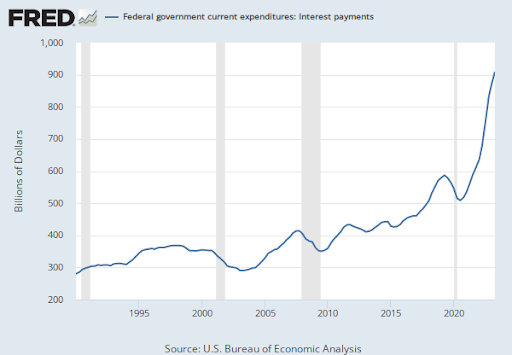
The interest paid out by the Federal Government has spiked in recent years:
The United States Dollar is screwed.
The Federal Reserve has set high interest rates to tame inflation, but that's not working. High interest rates are causing bigger interest payments, causing larger budgetary deficits.
This is causing the U.S. Treasury to issue more debt, which investors are getting scared of (because of runaway inflation and compounding debt levels), which is now causing the Treasury to print money and provide "liquidity" to stabilize the treasury market, adding fuel to the inflation fire once more.
The Federal Reserve can further raise interest rates to cool inflation, but that would increase interest payments and deficit spending, requiring even more debt issuance and "liquidity," which fuels inflation. An increase in interest rates could also cause a massive recession or depression, which would grind the economy to a halt, which would mean that the government is taking in less tax revenue, while still spending exorbitantly on entrenched government programs and stimulus, which would only increase budgetary deficits and debt issuance once more.
The Federal Reserve can lower interest rates, but that would immediately cause an uptick in inflation, as people are encouraged to borrow and spend with lower interest rates, which would then force the Fed to raise interest rates again.
The Federal Reserve can admit defeat and raise their inflation target to 3 or 4%, but that would signal that the system is failing, which would cause a further loss of confidence, which would result in less treasury buyers, resulting in more inflation, and would create demand for higher interest rates (because treasury investors want to keep up with inflation), which, again, causes bigger interest payments and so forth.
This is a debt spiral.
There is no way out.
You are witnessing it live. These are years that will go down in the all-time history books.
Every fiat currency has failed, and for the same reason. Turning on the money printer is too tempting.
Don't forget, the U.S. Government will never let the treasury market fail, because that would result in an automatic default on the debt and an unbelievably chaotic avalanche of collapse.
They will always turn to the money printer to bail things out. The Treasury will continue to print more money to keep the system afloat, as evidenced by their upcoming "buy back operation." But inflation is the fatal flaw.
The Ponzi scheme is in its final chapter. The endgame is here.
The inflation train has left the station, and it's never coming back.
Covid put the ruin into hyperdrive. Inflation ran away, now it cannot be tamed. It is feeding on itself, and will continue to do so, over and over, gradually, then suddenly.
And then, poof. It's gone.
Worthlessness.
If you haven't noticed, the U.S. Dollar has been heading toward the "worthless" direction for quite some time.
It is inevitable. The U.S. Dollar, and all fiat currencies, will die.
The Phoenix will then rise from the ashes.
An innovative, specifically designed, global, unprintable, unable to be manipulated, verifiable, instantaneous, digital monetary system will emerge, unchained from the grasp of bankers and governments, once and for all.
...and the world was fixed.
Fix the money, fix the world.
#Bitcoin
🎉 MASSA x STARKNET
We're thrilled to announce a newly signed partnership between @StarknetFndn and @MassaLabs aimed at developing innovative block access methods 🚀, enhancing data transfer efficiency 💾, and creating unified storage solutions 🧩
This collaboration will not only advance our ecosystems but also deliver valuable open-source contributions to the broader crypto community 🌍
🚨 ALPHA ALERT: MASSA LABS 🚨
With no compromises on security, decentralization, or scalability, Massa is the first and only layer 1 blockchain to achieve all of these factors.
→ Thriving ecosystem
→ Backed by @trgcapi, @blueyard and others
→ Autonomous smart contracts
What Is Massa Labs?
@MassaLabs is leading innovation in the blockchain space by having no competition when it comes to being an L1 that attacks decentralization, security and scalability without making sacrifices.
Massa provides an innovative solution for a truly decentralized web that is intended to improve dApp security.
Attack vectors like DNS hijacking, which have caused large losses in the DeFi market, are removed by hosting websites on the Massa blockchain.
Without the need for centralized servers, users can implement fully decentralized applications that follow the "code is law" tenet. This guarantees the safe, unchangeable, and censorship-proof hosting of front-ends.
What’s the alpha?
→ 7k+ nodes on the testnet
→ 10k transactions per second
→ 1000+ Nakamoto coefficient
The first cross-chain bridge that enables users to move ERC-20 tokens from EVM networks to Massa and vice versa is Massa's bridge.
TO UNLOCK ALL THE ALPHA & RESEARCH BEHIND @MassaLabs SIGN UP TO TOKEN METRICS.
Only Available For Advanced & Premium Users.
Market is dumping and #Massa is pumping.
Up 20% today and we’re still so freaking early.
This L1 will go much higher once people realize what kind of groundbreaking tech it is.