Today, we’re excited to announce that we have also initiated a buyback scheme under our long term goal to remove and burn as much of the circulating token supply as possible.
$PUMP buybacks & burns have been programmed to occur at 50% of revenue via an irreversible locked smart contract for 1 year.
This means 50% of all net revenue from the pump fun Bonding Curve, PumpSwap & Terminal is automatically used to purchase $PUMP on the open market and immediately burn 100% of those purchases.
Buyback & burns are carried out as follows:
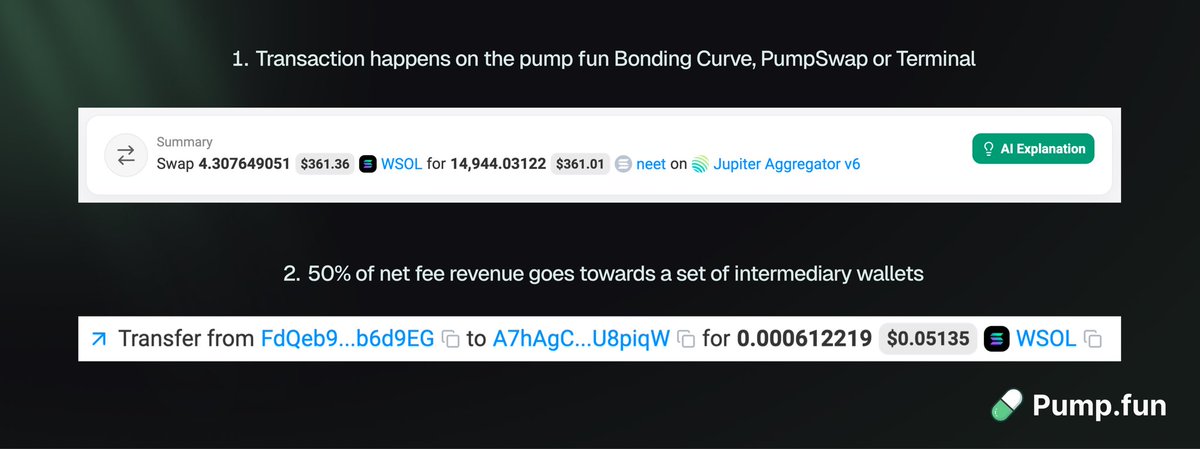
1. Transaction happens on the pump fun Bonding Curve, PumpSwap or Terminal
2. 50% of net fee revenue goes towards a set of intermediary wallets
3. Periodically, all intermediary wallets consolidate funds into 1 of 2 buyback & burn wallets
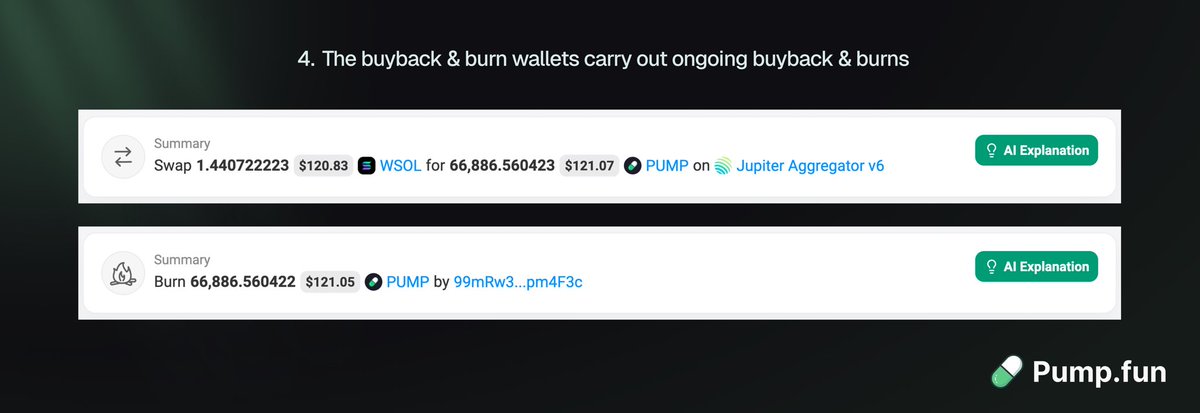
4. The buyback & burn wallets carry out ongoing buyback & burns
Example transactions (random txn, not affiliated with pump fun):
1 & 2: https://t.co/2jk4dcK1GY
3: https://t.co/NvUCL7TrFN
4 (buy): https://t.co/Xfifz9QnLx
4 (burn): https://t.co/yDqPc2BZ0Y
Track ongoing buybacks & burns at https://t.co/fV9PUOPf6O.
The only accurate way is to pull the onchain data from Etherscan, identify the wallets with vesting contracts, and backtrack how much actually went to CEXs, etc.
Or to keep it simpler just track the unlocked tokens - unclaimed.
(Let Claude do it, get their API.)
In doing so, you will see how many protocols actually do not follow their disclosed tokenomics and how something as simple as circulation is inaccurate in most protocols.
CMC and CG datasets are very inaccurate and easy to game. For example, CMC does not consider insider tokens as part of circulation.
https://t.co/QU487FYhNn
If you need any help feel free to dm.
Most crypto funds can track unlocks.
Very few can verify what is actually happening onchain.
We’re now rolling out onchain tokenomics monitoring
5 spots left for the first cohort.
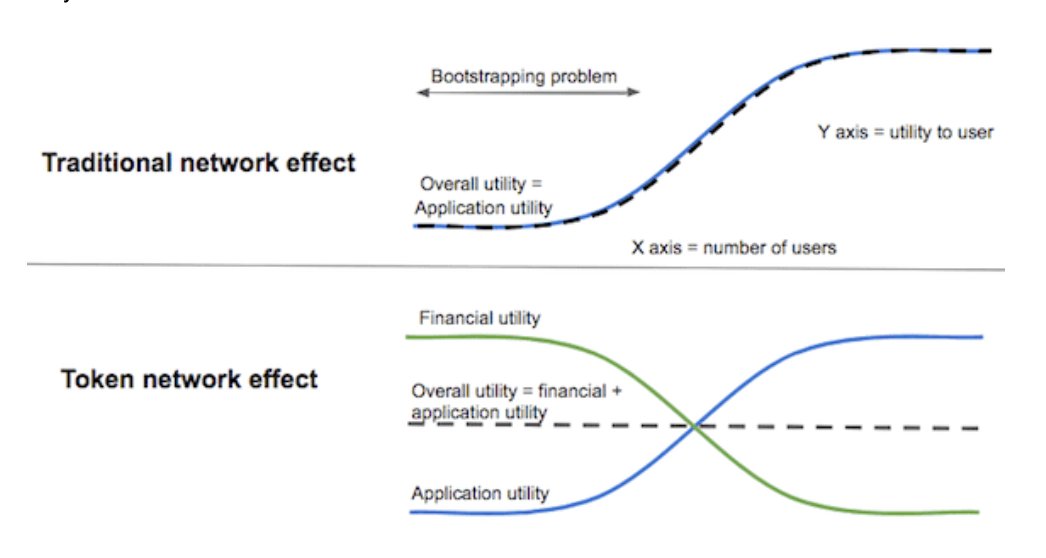
Great presentation guy, I’m completely aligned under the theory that early on during the bootstrapping phase when network effects haven’t kicked in, you need to provide users with financial utility via token rewards to make up for the lack of native utility.
But what most DePIN protocols lack, is that once the network reaches critical mass, it MUST start accruing value back into the token (buybacks for example)
If you analyze it from first principles, early on it’s not only the project itself bearing the cost of the bootstrapping phase; it’s also effectively subsidized by early investors through dilution.
users, builders, and early investors should benefit from the the network effects rather than only funding the growth without participating in the upside.
Incentives will only be truly aligned when value starts accruing back into the token.
Here you have a clear breakdown of their vesting schedule:
https://t.co/VpxDaxJa1F
The $FOGO token schedule was reconstructed directly from their documentation:
https://t.co/D6SqTnyTWD
Worth adding a clause that if tokenomics change in any way, the bet terminates immediately.
From first principles: they launched with a low float. (based on whats truly in the public's hands)
Vesting compounds inside the cliff and unlocks in September 2026, creating a material supply shock as effective float expands.
Token was listed yesterday, but vesting started long before.
Hope it helps Kyle, take his soul.