Sell Your Content To AI And Get Paid!
Do you realize that there are 94,060 Buyers and only 22,000 Sellers on the x.402 standard JUST THIS MONTH making 75.41M Transactions at $24.24M cash Volume?
It is a growing goldmine for AI agents shopping with “credit cards” buying your content.
I will show you what I have done and how you can too.
Become an X Subscriber or support me more and be a https://t.co/tcKeuiQyql member and I will show you how we are getting paid with no gatekeepers.
BOOM!
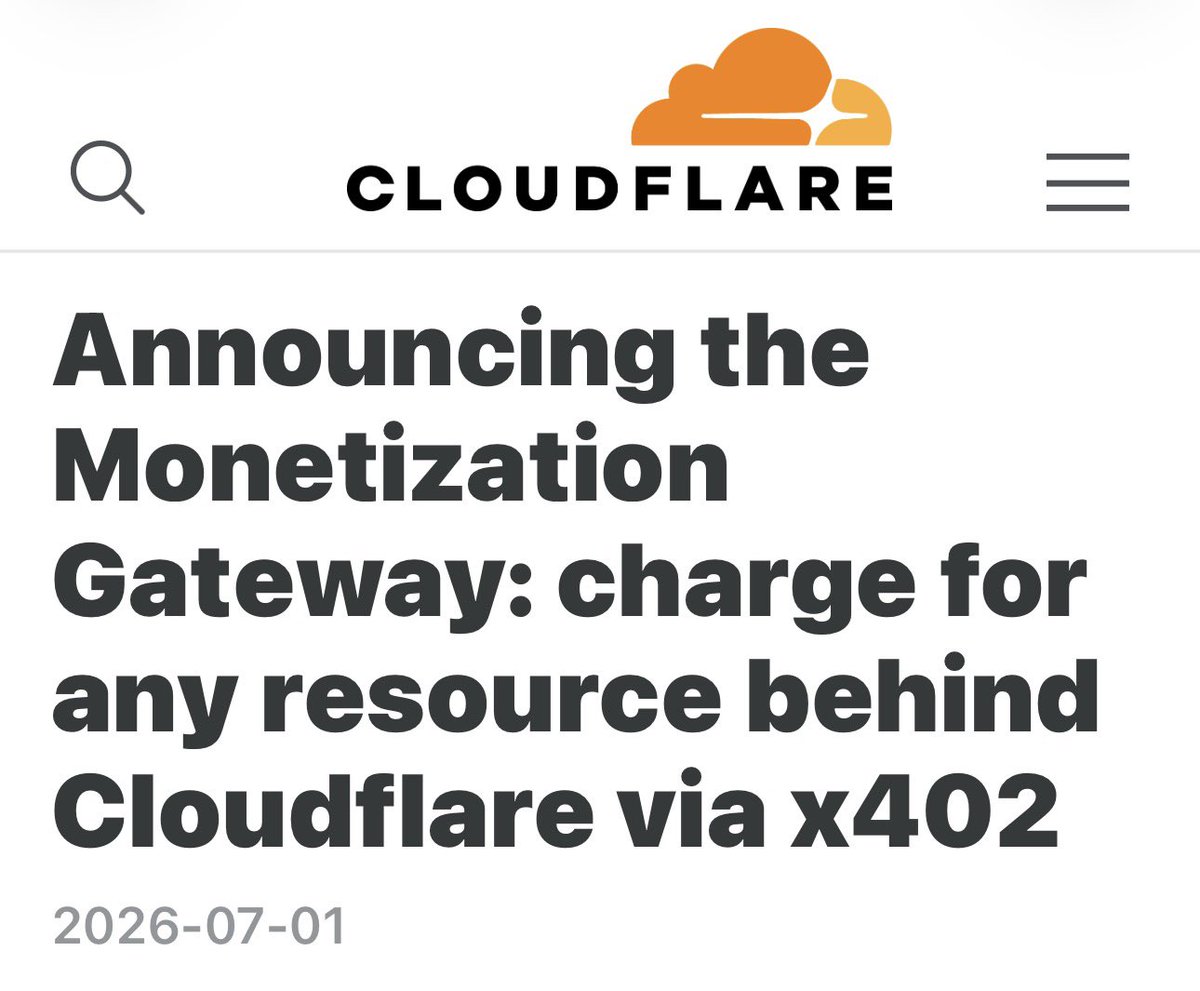
Cloudflare Launched Monetization Gateway: Charging the AI Web with x402 Micropayments
And it changes income opportunities for creators!
Cloudflare announced its Monetization Gateway, a new tool that lets website owners, API providers, and data publishers charge for access to their resources using stablecoin micropayments.
It is a big deal and some of my content is up and earning.
The move, highlighted in a widely shared post by Polymarket, marks a significant step toward a usage-based internet economy tailored for the rise of autonomous AI agents.
What It Enables
The gateway allows Cloudflare customers to monetize web pages, datasets, APIs, and MCP tools protected by their network. Publishers can set custom per-request or usage-based pricing (e.g., fractions of a cent per API call or data fetch) without building their own payment infrastructure.
Cloudflare handles verification, enforcement, and settlement at the edge across its global network of 330+ cities.
How the x402 Protocol Works
At its core is the open x402 protocol, which revives the long-dormant HTTP 402 “Payment Required” status code. Here’s the simple flow:
1An AI agent or user requests a protected resource.
2Cloudflare responds with HTTP 402, including price, accepted payment methods, and payment details.
3The client pays instantly (typically in stablecoins like USDC).
4Proof of payment is submitted, verified at the edge, and the resource is delivered.
No accounts, API keys, or redirects are needed the payment itself acts as the credential.
Settlements happen peer-to-peer on supported blockchains (with strong emphasis on low-fee, fast options like Base), and sellers can redeem stablecoins for fiat. The system supports flexible rules similar to Cloudflare’s existing WAF and rate-limiting expressions.
Why Now?
The AI Agent Surge
Cloudflare’s announcement comes amid explosive growth in AI-driven traffic. According to the company’s data, AI-related crawler requests now make up a large and growing share of web traffic, with agents making 100x or more requests than human visitors.
Traditional monetization models ads and subscriptions struggle with this high-volume, low-value traffic.
Stablecoin micropayments solve the economics: negligible fees and sub-second settlement make per-request charging viable for the first time at scale.
Cloudflare positions the gateway as infrastructure for an “agent-first internet,” where software agents become primary buyers and pay directly for the data and compute they consume.
Key Benefits
•For publishers: New revenue streams from previously unmonetized traffic. Easy setup via dashboard, API, or Terraform. No buyer onboarding required.
•For AI agents and developers: Autonomous access to premium content and tools without human intervention or complex billing relationships.
•For the ecosystem: Shifts the web from “free scraping” to fair value exchange, especially for high-quality datasets and APIs.
Cloudflare has opened a waitlist for early access.
The feature is currently in early access; users choose their pricing.
This development follows a similar capability rollout by AWS weeks earlier and builds on Cloudflare’s earlier work with Coinbase on the x402 Foundation and protocol. It reflects a broader industry shift: as AI agents become dominant web consumers, infrastructure providers are embedding native payment rails directly into the network edge.
The Monetization Gateway doesn’t just add paywalls but it also creates a new economic layer for the agentic web, where valuable content and services can be compensated automatically at internet scale.
This leads to a more sustainable creator economy or further fragmentation of the open web remains to be seen.
What’s clear is that Cloudflare is positioning itself at the center of the next phase of internet monetization.
X would do well to be early on this and build it in to XMoney. I have some ideas…
Anthropic Engineer Andrej Karpathy:
"The biggest mistake in AI right now - people are forcing agents to work instead of mastering the model first
We made that mistake in 2016 at OpenAI - It cost us 5 years "
what Karpathy actually means:
step 1 → stop forcing your agent to do everything, understand the model underneath first
step 2 → demos are easy - products take a decade. self-driving proved it - if you skip the foundation, everything breaks
step 3 → the agent is not the product. the foundation is. build that - and agents emerge on their own
"you building agents right now - you're at the forefront. not OpenAI. not DeepMind. you "
watch - bookmark, then read article below ↓
Introducing GeneBench-Pro — testing whether models can handle the kind of judgment-heavy analysis that real-world computational biology requires.
Problems would take a human expert around 20-40 hours to complete.
GPT-5.6 Sol is a big step forward.
You now convert any LLM into a faster one without retraining from scratch.
NVIDIA just did this to their 30B model. Here's the trick:
1. Duplicate the model into two copies
2. Freeze one copy, it just reads the prompt and remembers context
3. Train the other copy to write chunks of text at once instead of one word at a time
4. Run them together
The frozen copy barely costs anything (it's already trained). The new copy only needed ~8% of the original training data to learn the new trick.
Result: 2.4x faster generation, keeping ~99% of the original quality.
$PLTR
One of the most important parts of the new Karp interview today:
“I’ve been in business for a very long time. The reality is, critical infrastructure does not run these models without an application layer. That application layer is our ontology. There’s a reason for it. Some people love me and some people hate me. They’re not buying it because of that. They’re buying it because they have to be made safe. The “I’m gonna trust you because you’ve never lied” bs thing, that just doesn’t cut it at this level.”
While you have self proclaimed experts trying to analyze Karp’s communication style for his arguments, it’s obvious to me how many of those experts are missing. the. point.
If your best rebuttal is that you don’t like how someone said something vs answering what they said…well good luck in trying to make a compelling case for your side. Many of these “experts” don’t realize that Karp’s style of communication is AUTHENTIC to him and all of his attributes that got millions of individual people to invest in his passion for Palantir in the first place.
His argument is that these models DO NOT WANT to help you or your enterprise, they want to sell tokens. They aren’t building trust. They are extracting every little bit of value with fake “forward deployed shops” when most companies have no idea what it means to engage in the art of forward deployed engineering because that would require CARING about your customers for months, many times years, WITHOUT getting paid but just focusing on providing outcomes.
Karp is saying the truth and he’s backing that truth with 20 years of a company that has been solely focused on outcomes and has the growth to show how much customers also deeply, deeply care about those outcomes in a world of pure extraction from the frontier model companies.
That’s the point and that’s what most of these people are completely missing…which is why Palantir keeps winning.
They are making the case for what actually matters in the age of AI.
We’re happy to announce 2 releases today:
- 🧠Brain2qwerty v1 is published at @NatureNeuro
- 🚀 Brain2Qwerty v2 is now publicly released
Explore how we decode sentences from non-invasive brain recordings: https://t.co/IdR6gK2hcd
Links:
📄v1 Nature Neuro: https://t.co/wnRjc9W9gI
📑v2 Meta preprint: https://t.co/oSfLOQFcvg
💻Code: https://t.co/Xbe0XWfWQL
📊Data: https://t.co/SCBbs4AhTg
📝Blog: https://t.co/15RvsAaXlH
🧵Thread: https://t.co/d8FJrVyDut
Meet Hermes Agora
A 3D command center for Hermes Agents
Built 100% by Hermes Agents connected to Unreal Engine
Your AI agents now have a place to live, think move and collaborate.
Coming soon!
Someone ran Claude Code on an e-ink notebook and the slowest screen in the world suddenly turned out to be the best home for an AI that already thinks one word at a time.
This is the reMarkable Paper Pro, a paper tablet for notes with no browser and no social media and not a single app. He went into it over SSH and brought up Claude Code on Opus 4.8 on Claude Max and typed right into the terminal on the paper screen: "hello reddit, this is ssh terminal on rmpp".
For years this screen got slammed for one thing. E-ink is too slow and it draws with a delay and it ghosts and it is no good for real work. But Claude itself puts out a thought one word at a time.
And here is what came out of it: the very thing that killed the paper screen for normal software lined up perfectly with the pace of the AI. There is no more lag because there is nothing left to lag.
And then come the things no monitor can give you.
Your eyes do not get tired. You can watch Opus think on max effort for an hour and it feels like reading a book and not staring into a backlight.
Nothing distracts you. Not a single notification and not a single tab and just a cursor and an agent that writes code while you simply watch the page.
The charge lasts for days. E-ink barely touches the battery so Claude can grind on a task all night long and the tablet is still alive by morning.
And it weighs as much as a notebook. The whole work setup now fits into a bag like a notepad with a stylus on top.
Everything on the screen is for real: Claude Code v2.1.162 and bypass permissions on and Opus going off to think on max effort right on the e-ink.
In my opinion this is the most unexpected home for an AI this year.
Not a farm of graphics cards and not a wall of monitors but a quiet sheet of paper on a coffee table where the most powerful Claude writes code one word at a time like a pen.
We’re sharing the next major milestone in our non-invasive brain-to-text decoder research: Brain2Qwerty v2.
Building on v1, which was published today in @Nature, Brain2Qwerty v2 is the highest-performing end-to-end pipeline capable of real-time sentence decoding from raw brain signals. It advances beyond character-level performance to decoding words and semantics, enabling accuracy for overall communication.
We believe this research has the potential to make a real difference for the millions of people who suffer from brain lesions or disorders that prevent them from communicating.
🧵👇