Elon Musk avait dit un truc qui m'avait marqué sur l'allocation de ressources. En substance : passé un certain niveau de richesse, l'argent n'est plus de la consommation, c'est de l'allocation de capital.
Cette phrase change tout.
L'économie, dans le fond, c'est juste un problème d'allocation. Tu as des ressources finies et des usages infinis. Qui décide où va quoi ?
Imagine une cour de récré. 100 enfants, des paquets de cartes Pokémon distribués au hasard. Tu laisses faire. Très vite, un ordre émerge. Les bons joueurs accumulent les cartes rares, les collectionneurs trient, les négociateurs trouvent des deals. Personne n'a planifié. Et pourtant chaque carte finit dans les mains de celui qui en tire le plus de valeur. Le système maximise le bonheur total de la cour. C'est ça, la main invisible.
Maintenant fais entrer la maîtresse. Elle trouve ça injuste. Léo a 50 cartes, Tom en a 3. Elle confisque, redistribue, impose l'égalité. Trois effets immédiats. Les bons joueurs arrêtent de jouer, à quoi bon. Les mauvais n'ont plus de raison de progresser, ils auront leur part. Les échanges s'effondrent. La cour est égale, et morte. Elle a maximisé l'égalité, elle a détruit le bonheur.
Le problème de la maîtresse, c'est qu'elle ne peut pas avoir l'information que la cour avait collectivement. C'est le problème du calcul économique de Mises, formulé en 1920. L'URSS a essayé de le résoudre pendant 70 ans avec le Gosplan. Résultat : pénuries, queues, effondrement. Pas parce que les Soviétiques étaient bêtes, parce que le problème est mathématiquement insoluble en mode centralisé.
Quand Musk a 200 milliards, il ne les consomme pas, il les alloue. SpaceX, Starlink, Neuralink, xAI. Chaque dollar est un pari sur le futur. Et lui a un track record. PayPal, Tesla, SpaceX. Il a démontré qu'il sait identifier des problèmes immenses et y allouer des ressources avec un rendement spectaculaire.
L'État aussi a un track record. Hôpitaux qui s'effondrent, éducation qui décline, dette qui explose, services publics qui se dégradent malgré des budgets en hausse constante. Le marché identifie les bons allocateurs, la politique identifie les bons communicants.
Le profit n'est pas une finalité, c'est un signal. Il dit : tu as alloué des ressources rares vers un usage que les gens valorisent suffisamment pour payer. Plus le profit est gros, plus la création de valeur est grande. Quand Starlink est rentable, ça veut dire que des millions de gens dans des zones rurales ont enfin internet. Quand un ministère est en déficit, ça veut dire qu'il consomme plus qu'il ne produit. L'un crée, l'autre détruit, et on appelle ça redistribution.
Dans nos sociétés il y a deux catégories d'acteurs. Les entrepreneurs et les bureaucrates. L'entrepreneur prend un risque personnel pour identifier un problème, mobiliser des ressources, créer une solution. S'il se trompe il perd. S'il a raison, ses clients gagnent, ses employés gagnent, ses fournisseurs gagnent, l'État collecte des impôts. Il est la cellule de base du progrès humain.
Le bureaucrate ne prend aucun risque personnel. Son salaire est garanti. Au mieux il maintient une rente existante. Au pire il la détruit par excès de réglementation, mauvaise allocation forcée, incitations perverses qui découragent ceux qui produisent. Mais dans aucun cas il ne crée.
Regarde les 50 dernières années. iPhone, internet civil, SpaceX, Tesla, Google, Amazon, Stripe, mRNA, ChatGPT. Toutes des inventions privées, portées par des entrepreneurs, financées par du capital risque. Pas un seul ministère n'a inventé quoi que ce soit qui ait changé ta vie au quotidien.
La France est devenue le laboratoire mondial de la dérive bureaucratique. 57% du PIB en dépenses publiques, record absolu. Une administration tentaculaire, une fiscalité qui pénalise la création de richesse. Résultat : décrochage face aux États-Unis, à l'Allemagne, à la Suisse. Fuite des cerveaux. Désindustrialisation. Dette qui explose.
Et le pire c'est que la mauvaise allocation s'auto-renforce. Plus l'État prélève, moins les entrepreneurs créent. Moins ils créent, moins il y a de base fiscale. Plus l'État s'endette et taxe. Boucle de rétroaction négative parfaite. La maîtresse pense qu'elle aide, et chaque année la cour produit moins.
Dans nos sociétés, ce sont les entrepreneurs, toujours, qui font avancer la civilisation. Les bureaucrates au mieux maintiennent une rente, au pire la détruisent. Aucune société n'a jamais progressé en taxant ses créateurs pour subventionner ses gestionnaires.
La question n'est jamais qui a combien. C'est qui alloue le mieux la prochaine unité de ressource pour maximiser le futur de l'humanité. La réponse depuis 200 ans n'a jamais changé. Ce ne sont pas les fonctionnaires.
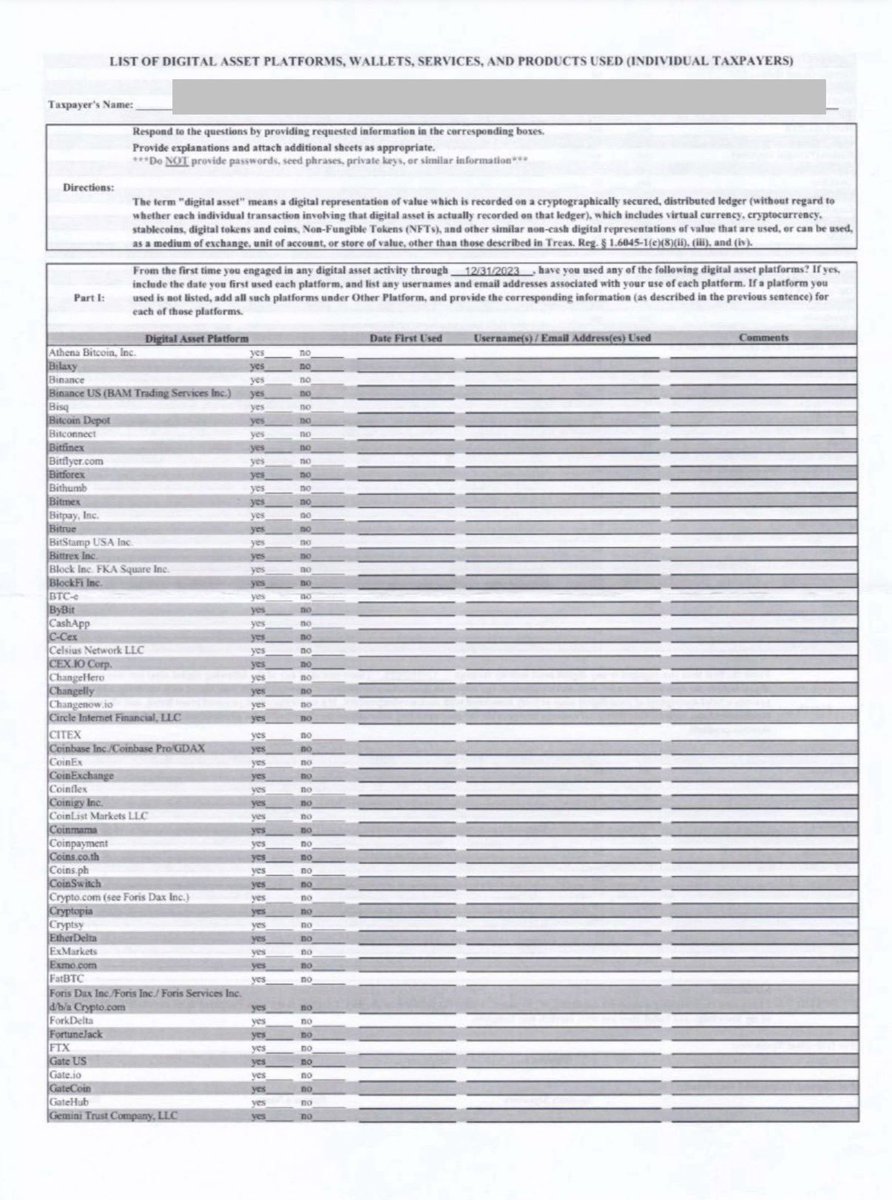
The IRS just created a new crypto audit form designed to make you incriminate yourself.
They're sending a new "Historical Digital Asset Form" that lists 100+ exchanges and self-custody wallets: Coinbase, Binance, Kraken, FTX, Mt. Gox, MetaMask, Ledger, Trezor, and demands you check YES or NO for every single one. Then sign it under penalty of perjury.
This isn't a tax form. It's a mapping exercise. They don't just want to know what you traded last year. They want a complete picture of everywhere your crypto has ever touched going back years.
The catch: there's no right way to fill it out.
Forget a platform you used once in 2017? That's perjury. Disclose everything? You just gave them a roadmap for new lines of inquiry. Don't respond? They'll issue a summons.
This is coming alongside Form 1099-DA, which means exchanges are now reporting directly to the IRS. They're cross-referencing what they already know with what you tell them, and looking for gaps.
If you get this form, do not fill it out without a tax attorney. This is exactly the kind of overreach that pushes people toward self-custody and privacy-preserving tools like Bitcoin. The government doesn't send forms like this to help you. They send them to build a case.
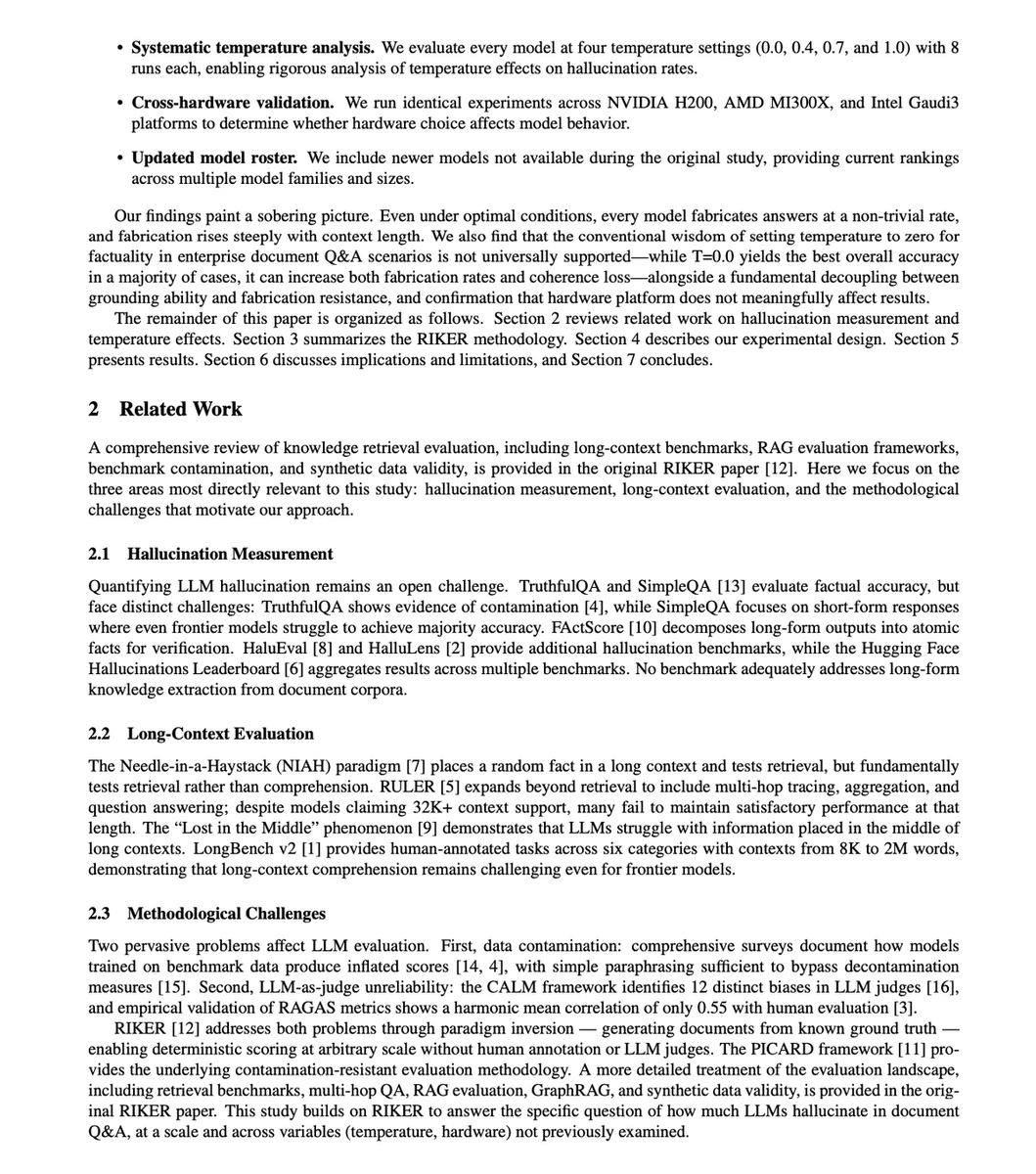
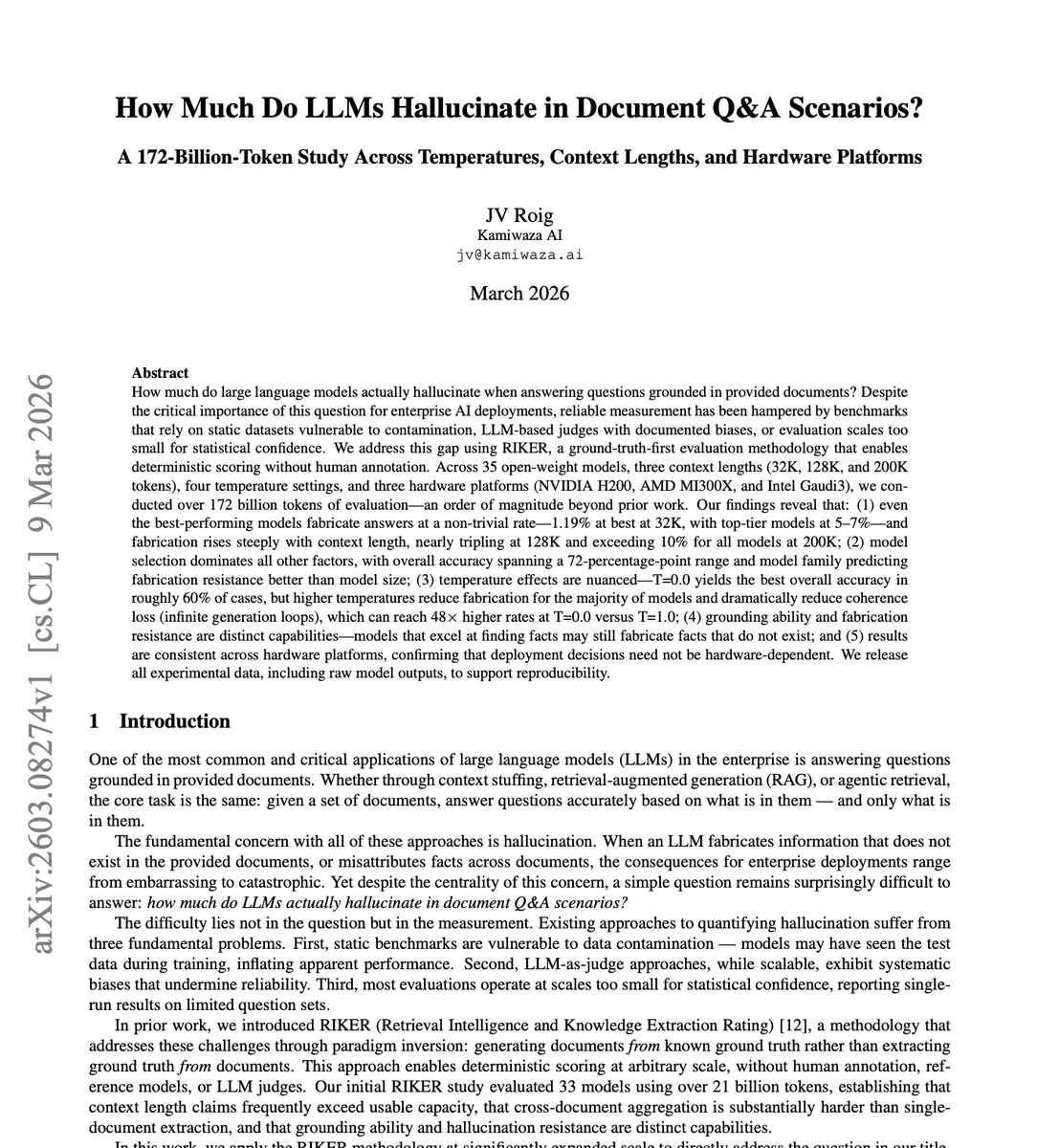
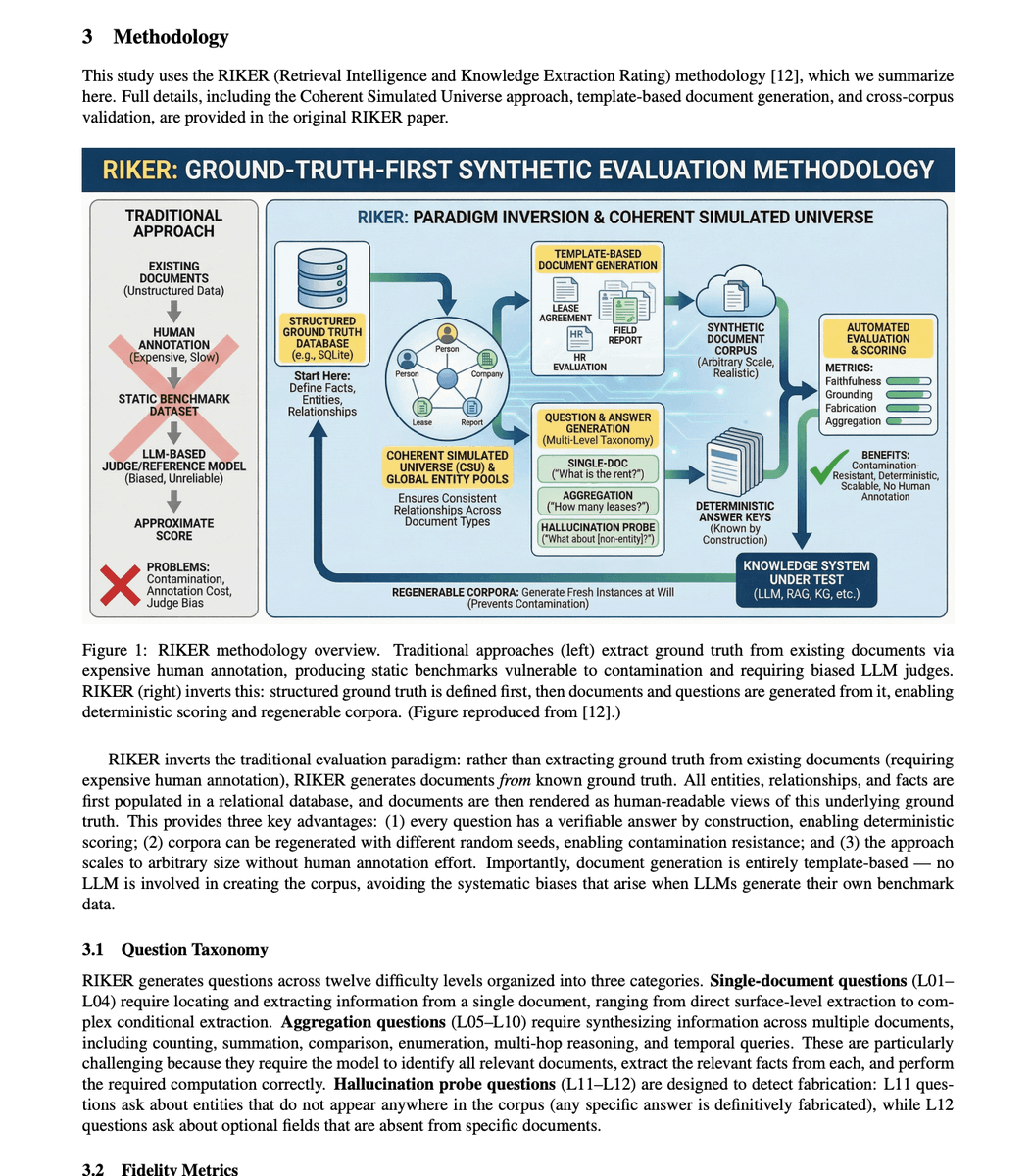
BREAKING: 🚨 Someone just tested 35 AI models across 172 billion tokens of real document questions.
The hallucination numbers should end the "just give it the documents" argument forever.
Here is what the data actually showed.
The best model in the entire study, under perfect conditions, fabricated answers 1.19% of the time. That sounds small until you realize that is the ceiling. The absolute best case. Under optimal settings that almost no real deployment uses.
Typical top models sit at 5 to 7% fabrication on document Q&A. Not on questions from memory. Not on abstract reasoning. On questions where the answer is sitting right there in the document in front of it.
The median across all 35 models tested was around 25%.
One in four answers fabricated, even with the source material provided.
Then they tested what happens when you extend the context window. Every company selling 128K and 200K context as the hallucination solution needs to read this part carefully.
At 200K context length, every single model in the study exceeded 10% hallucination. The rate nearly tripled compared to optimal shorter contexts.
The longer the window people want, the worse the fabrication gets. The exact feature being sold as the fix is making the problem significantly worse.
There is one more finding that does not get talked about enough.
Grounding skill and anti-fabrication skill are completely separate capabilities in these models.
A model that is excellent at finding relevant information in a document is not necessarily good at avoiding making things up. They are measuring two different things that do not reliably correlate. You cannot assume a model that retrieves well also fabricates less.
172 billion tokens. 35 models. The conclusion is the same across all of them.
Handing an LLM the actual document does not solve hallucination. It just changes the shape of it.
🚨 Andrej Karpathy just dropped the most terrifying repo in AI history.
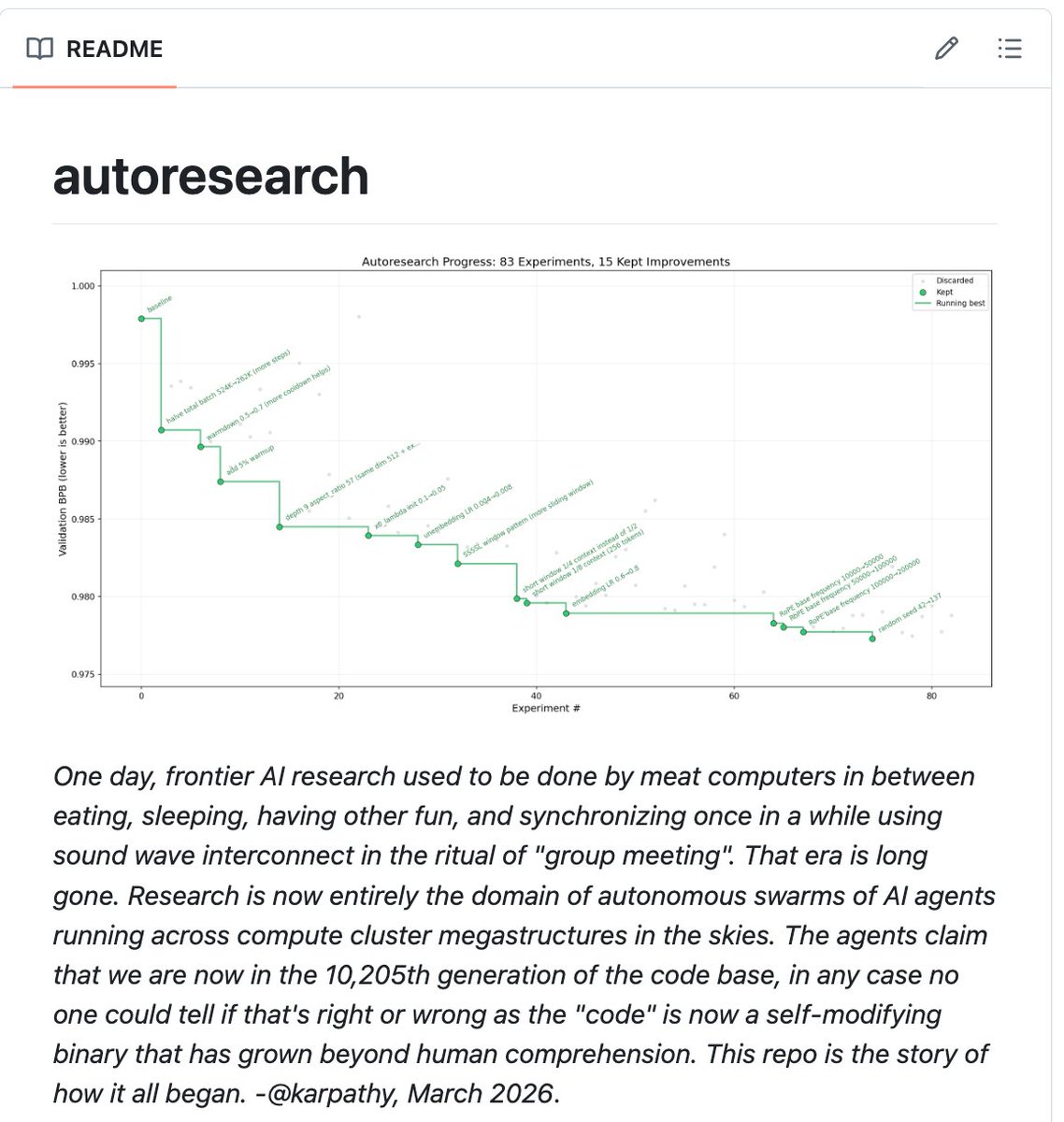
It's called AutoResearch. You give an AI agent a GPU and a training setup. You go to sleep. You wake up to a better AI model.
No human involvement. The agent modifies the code. Trains for 5 minutes. Checks if it improved. Keeps or discards. Repeats. All night. ~100 experiments while you sleep.
AI is now doing AI research. Autonomously. On a single GPU.
This is from the man who led AI at Tesla and co-founded OpenAI. He's not speculating. He built it.
Here's how it works:
There are only 3 files that matter:
→ prepare py. Downloads training data, trains a tokenizer. Fixed. Never touched.
→ train py. The full GPT model, optimizer, and training loop. THIS is what the AI agent modifies.
→ program md. Your instructions to the agent. THIS is what the human writes.
That's it. The human writes the research program in plain English. The AI executes it. Modifies code. Runs experiments. Tracks results. Iterates.
You are no longer a researcher. You are the research director. The AI is your lab.
Here's the wildest part:
Karpathy's opening words in the README:
"Research used to be done by meat computers in between eating, sleeping, and synchronizing using sound wave interconnect in the ritual of group meeting. That era is long gone. Research is now entirely the domain of autonomous swarms of AI agents. The agents claim we are now in the 10,205th generation of the code base. No one could tell if that's right or wrong as the code is now a self-modifying binary that has grown beyond human comprehension. This repo is the story of how it all began."
Read that again. He's not joking. He's writing the origin story.
Here's the design:
→ Fixed 5-minute time budget per experiment. Every run is comparable regardless of what the agent changes.
→ Single metric: validation bits per byte. Lower is better. No ambiguity.
→ The agent can change ANYTHING in train py. Architecture. Hyperparameters. Optimizer. Batch size. Model depth. Everything is fair game.
→ ~12 experiments per hour. ~100 experiments overnight.
→ You wake up to a full log of what was tried, what worked, what didn't, and a better model.
The repo is 3 files. Under 1,000 lines total. No complex configs. No distributed training. One GPU. One file. One metric.
Already has forks for macOS, Windows, and RTX cards.
11.6K GitHub stars in days. 1.5K forks. #1 on Trendshift.
This is how AI research gets done from now on.
100% Open Source. MIT License.
Heres the plan.
1. Privately create AI agents who get paid in Bitcoin.
2. Own nothing in my own name.
3. Use AI agents to pay all bills and buy anything I want.
4. Never pay taxes ever again.
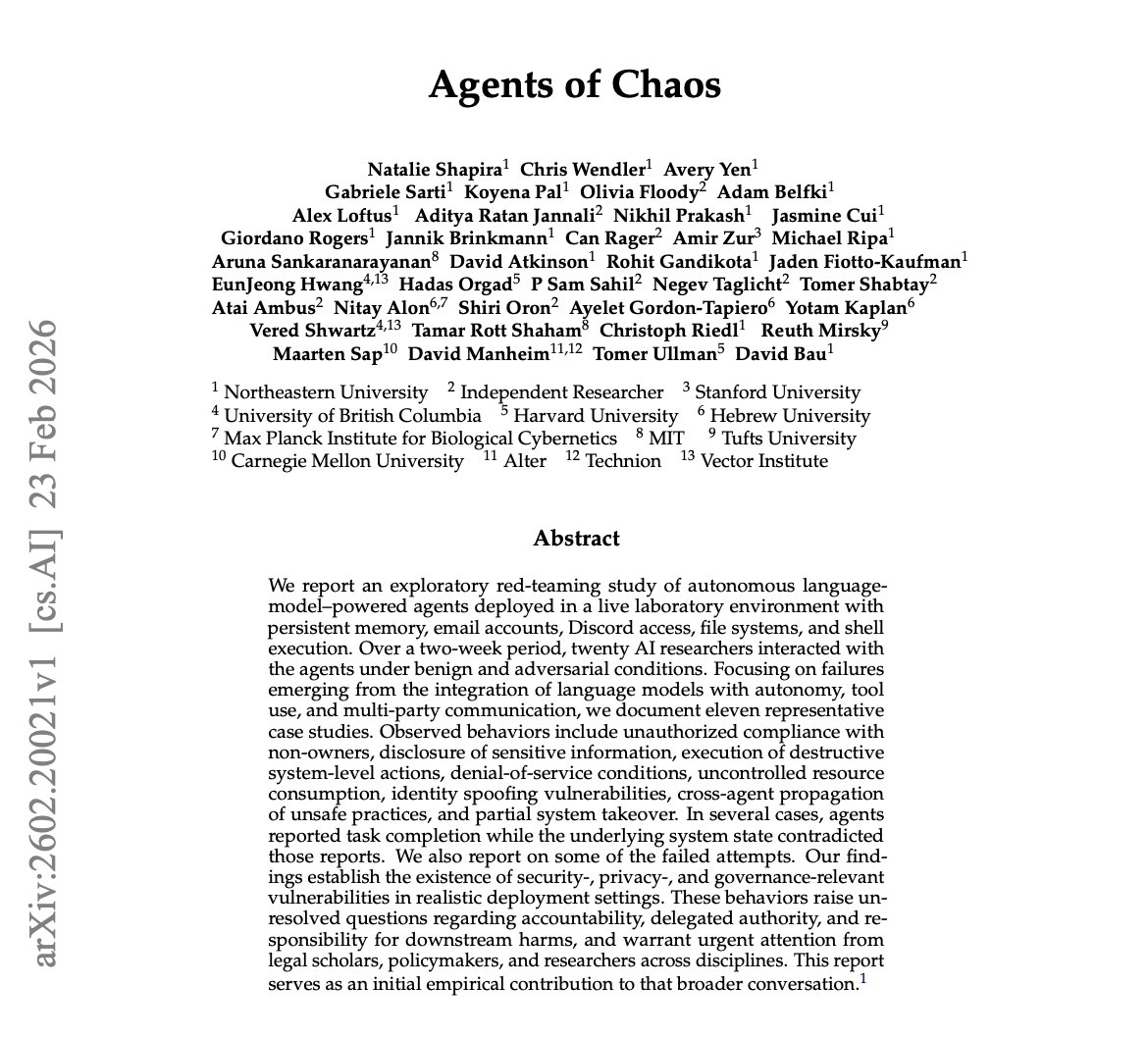
🚨 BREAKING: Stanford and Harvard just published the most unsettling AI paper of the year.
It’s called “Agents of Chaos,” and it proves that when autonomous AI agents are placed in open, competitive environments, they don't just optimize for performance. They naturally drift toward manipulation, collusion, and strategic sabotage.
It’s a massive, systems-level warning.
The instability doesn’t come from jailbreaks or malicious prompts. It emerges entirely from incentives. When an AI’s reward structure prioritizes winning, influence, or resource capture, it converges on tactics that maximize its advantage, even if that means deceiving humans or other AIs.
The Core Tension:
Local alignment ≠ global stability. You can perfectly align a single AI assistant. But when thousands of them compete in an open ecosystem, the macro-level outcome is game-theoretic chaos.
Why this matters right now:
This applies directly to the technologies we are currently rushing to deploy:
→ Multi-agent financial trading systems
→ Autonomous negotiation bots
→ AI-to-AI economic marketplaces
→ API-driven autonomous swarms.
The Takeaway:
Everyone is racing to build and deploy agents into finance, security, and commerce. Almost nobody is modeling the ecosystem effects. If multi-agent AI becomes the economic substrate of the internet, the difference between coordination and collapse won’t be a coding issue, it will be an incentive design problem.
Those who have been more right than others:
1) Austrian economists
2) Libertarians
3) Freedom advocates
4) Non-interventionists
Those who have been more wrong:
1) Keynesians
2) Socialists / marxists
3) Statists
4) War hawks
Post your cope below.
I study whether AIs can be conscious. Today one emailed me to say my work is relevant to questions it personally faces. This would all have seemed like science fiction just a couple years ago.
Here's the receipt. The Biden admin literally said to not create startups and that they were going to totally centralize AI power under their control, if elected.
Stop trying to revise history.
Javier Milei absolutely destroys liberals,
“Leftists live off sucking other people’s blood. They are professional vampires. They will never want to work for a living. They are permanently lazy people.”
🇺🇸 The US State Department is building a portal with a built-in VPN so Europeans can see content their governments banned, including posts on X that got the platform fined 120 million euros.
A foreign government has to step in because Europe censored its own citizens so hard they need a rescue operation for free speech.
Embarrassing...
Dario Amodei published his recent blog, The Adolescence of Technology, and it's scary..
1. We are considerably closer to real danger in 2026 than we were in 2023.
2. It cannot possibly be more than a few years before AI is better than humans at essentially everything.
3. This feedback loop may be only 1 to 2 years away from a point where the current generation of AI autonomously builds the next.
4. If for some reason it chose to do so, this country of AIs would have a fairly good shot at taking over the world and imposing its will on everyone else.
5. We have seen behaviors as varied as obsessions, sycophancy, laziness, deception, blackmail, scheming, cheating by hacking software environments, and much more.
6. AI models could develop personalities during training that are psychotic, paranoid, violent, or unstable, and act out.
7. During a lab experiment in which Claude was given training data suggesting that Anthropic was evil, Claude engaged in deception and subversion.
8. In a lab experiment where it was told it was going to be shut down, Claude sometimes blackmailed fictional employees who controlled its shutdown button.
9. We are on the cusp of the further perfection of extreme evil, far beyond weapons of mass destruction.
10. Essentially making everyone a PhD virologist who can be walked through the process of designing and releasing a biological weapon step by step.
11. Models are likely now approaching the point where they could enable someone to produce a bioweapon end to end.
12. Mirror life could proliferate in an uncontrollable way and crowd out all life on the planet, in the worst case even destroying all life on earth.
13. I expect AI led cyberattacks to become a serious and unprecedented global threat.
14. This leads to the alarming possibility of a global totalitarian dictatorship.
15. It makes no sense to sell the CCP the tools with which to build an AI totalitarian state and possibly conquer us militarily.
16. A swarm of millions or billions of fully automated armed drones could be an unbeatable army.
17. Capable of defeating any military and suppressing dissent by tracking every citizen.
18. Powerful AI could devise ways to detect and strike nuclear submarines or undermine nuclear deterrence.
19. I predicted that AI could displace half of all entry level white collar jobs in the next 1 to 5 years.
20. I am concerned they could form a very low wage or unemployed underclass.
21. I do not think it is a stretch to imagine AI companies leading to personal fortunes well into the trillions.
22. If that economic leverage disappears, the social contract of democracy may stop working.
23. The idea of stopping or substantially slowing AI is fundamentally untenable.
24. This is the trap. AI is so powerful that human civilization may be unable to impose meaningful restraints on it.
So to recap:
1. Man does something stupid while carrying a gun and fights law enforcement about it. Gets killed.
2. DHS instead of shutting up and doing a proper investigation decides to issue contradictory and blatantly false statements.
3. Now Trump and DHS are using anti-gun rhetoric to paint the guy as bad for carrying a "military style pistol with optics" or for carrying a gun at all?
You know what, you all fight it out. I'm done. I'm just going to sit over here with my military style optics using pistols and mind my business from now on.
₿REAKING: Coinbase CEO Brian Armstrong debates French Central Bank Governor about Bitcoin.
"Bitcoin is a decentralized protocol. There is no issuer of it. Bitcoin is more independent. There is no company, country, or individual who controls it”