I've been heavily speculating in the markets (not full time) since 1992. My first trades were before online brokerage, you had to call in for quotes and to place orders. 4% commission in AND out.
I had a great run during the DOT COM era. By 1999, I had a really chunky (for my age) portfolio and thought it was easy. By late 2000, the account was $0. That part was fun, at least. For the next 10 years I was super active, some good runs, some big drawdowns. Overall, nothing exceptional. Just decent.
Then something shifted. The need to speculate faded and that’s when things actually got better.
Once I stopped chasing it, opportunities started coming to me. Not just in trading. As I’ve gotten older and less interested in money itself, seeing opportunity has become clearer. And more than anything, removing that constant need elevated how I experience life.
This isn’t meant to be spiritual (for some it is). But for a lot of people who are active and still underperforming, it’s worth asking what purpose this is really serving.
Most of the time, it’s just a dopamine loop. And for many, it’s closer to an addiction than they would like to admit. And that could be what’s holding you back.
In 1870, a German chemist named Erich von Wolf was analysing the iron content of various vegetables.
He made a decimal point error.
He recorded spinach as containing 35mg of iron per 100g. The correct figure was 3.5mg. The misplaced decimal sat in the nutritional literature for decades, entirely unchallenged, because nobody particularly felt like re-testing spinach.
In 1929, the Popeye comic strip launched. The creators cited the iron content of spinach as the scientific basis for their character's powers. By this point, the decimal point error was already sixty years old and fully embedded in received nutritional wisdom.
The error was identified and corrected in 1937. The correction was not issued with anything approaching the cultural reach of the original claim.
Popeye continued punching things.
The actual iron content of spinach, 3.5mg per 100g, roughly where it was always supposed to be, is further complicated by the fact that spinach is among the highest-oxalate vegetables known.
Oxalates bind to iron and calcium in the gut and remove them before absorption. The iron in spinach absorbs at around 1–2%, compared to 15–35% for haem iron from red meat. You would need to eat roughly a kilogram of spinach to absorb the iron equivalent of a 100g beef steak.
There is also the kidney stone question. Spinach contains around 970mg of oxalates per 100g: one of the densest plant sources. Chronic high spinach consumption, particularly raw in daily smoothies, is a documented pathway to calcium oxalate kidney stones.
The smoothie industry has not issued a correction.
Popeye is still a sailor.
The image's claims aren't fully accurate based on 2025 data from official and reliable sources. Muhammad is top in London and Manchester (England/Wales stats), and Mohammad in Oslo. But in Berlin it's Noah, Brussels Jules, Amsterdam Adam, The Hague likely Noah, Warsaw Nikodem (Jan is 3rd). Variations in spellings and local data may affect rankings.
@Bluntz_Capital Looks very similar to 2021 cycle top and bear market indeed. Keep in mind it took 8 months for it to double bottom and reverse though, so probably no rush in getting positioned.
A negative event is only a negative event if you don’t create something positive out of it. Let me elaborate.
A lot of people in the trading space just got absolutely obliterated during this market correction. Portfolios down bad, believe getting crushed and honestly just the hope for a better financial future gone. And right now, this exact moment, can feel like THE ultimate setback.
But here’s the truth most people miss.
This is only a negative event if nothing comes from it.
If you got wrecked because you thought buy & hold was the shortcut to getting rich. If you thought you could just sit there, hope, and watch your portfolio go up forever… and this correction shattered that belief, good.
Because this is the moment THE shift can happen. Right now, this exact moment as you are reading this, this could be the most important moment of your life.
Some of you are going to use this moment to invest in yourselves. To learn the skill set. To understand risk. To understand timing. To actually learn how to trade instead of hoping the market saves you.
And years from now, when you’re consistently pulling money from the markets. When you’re making the kind of money that genuinely changes your life.
You’re going to look back at this exact period and think:
“Damn… that needed to happen. That’s what flipped the switch.”
Because without getting obliterated, you would’ve stayed comfortable.
Without the loss, you wouldn’t have changed.
Without the pain, you wouldn’t have leveled up.
Sometimes the market has to humble you before it can reward you. For me this happened during the 2021-2022 correction, for you it might be right now.
So if this correction hurts you, good.
Don’t waste it.
Turn that frustrative, anger energy into the moment that changed everything.
A wise man once said:
“Showtime”
@kristenreagan@ctoLarsson Not the same! Supertrend on the Daily gave 4 fake outs during this topping process while Larsson Line only flipped once and got it correct. Supertrend would have chopped you up.
$BTC
Price is around 74k. A good moment to take stock of the last years performance and lessons learned.
In terms of analysis, I identified the major tops and bottoms of this cycle ahead of time, including the Oct ’25 top.
In terms of execution, unfortunately, I fell short when it mattered most:
✅ Bought during the bear
✅ Bought during Aug '24 bottom
✅ Bought during Mar '25 bottom
❌ Did not sell during the Oct '25 top
I've reviewed the successes here with you, so it only makes sense to review this failure too.
Looking back, there were two common reactions to the breakdown among those who expected price to impulse further (myself included):
1⃣The environment was still very bullish and the failure was a low probability outcome.
2⃣There were valid bearish triggers and the system failed to act on them.
While I will often default to 1⃣, as a single failure does not disprove a system, in this case I am firmly in camp 2⃣
After a thorough review, it became clear there was a structural blind spot at the execution layer of my system.
I won’t cover every nuance here. Instead, I’ll focus on the most important takeaway, for both education and accountability.
🧵 (1/5)
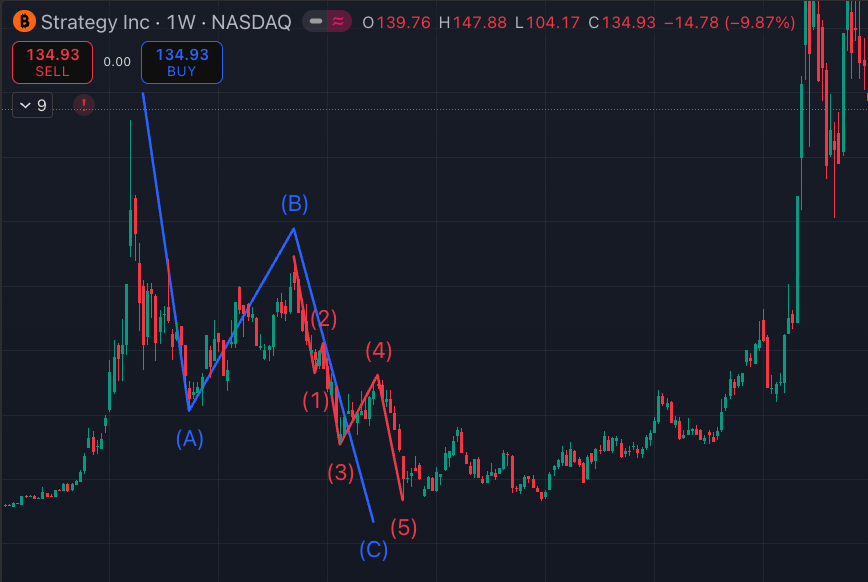
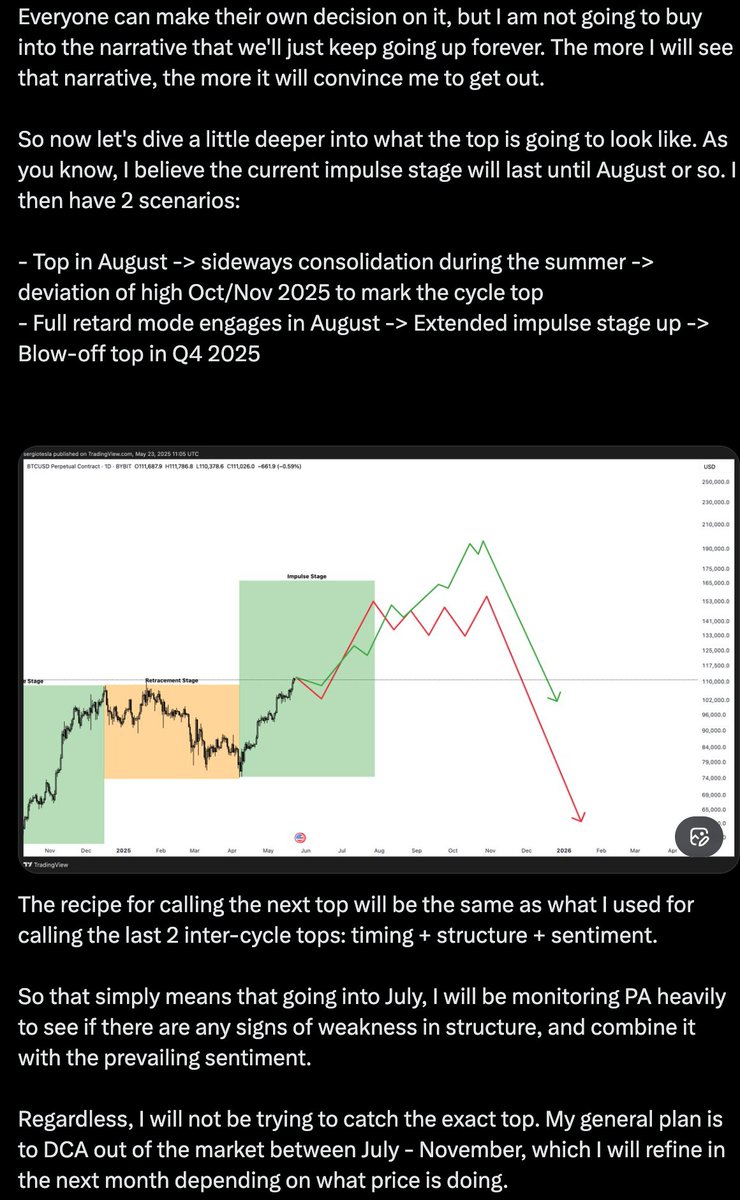
For context, this is a screenshot of my analysis on the '25 top (https://t.co/Lab7X4EAhX):
@DexFi_ Arguably THE biggest crypto influencer has posted about it several times, what are you on about? (It's not his base case though).
https://t.co/jNge7ug9Ua
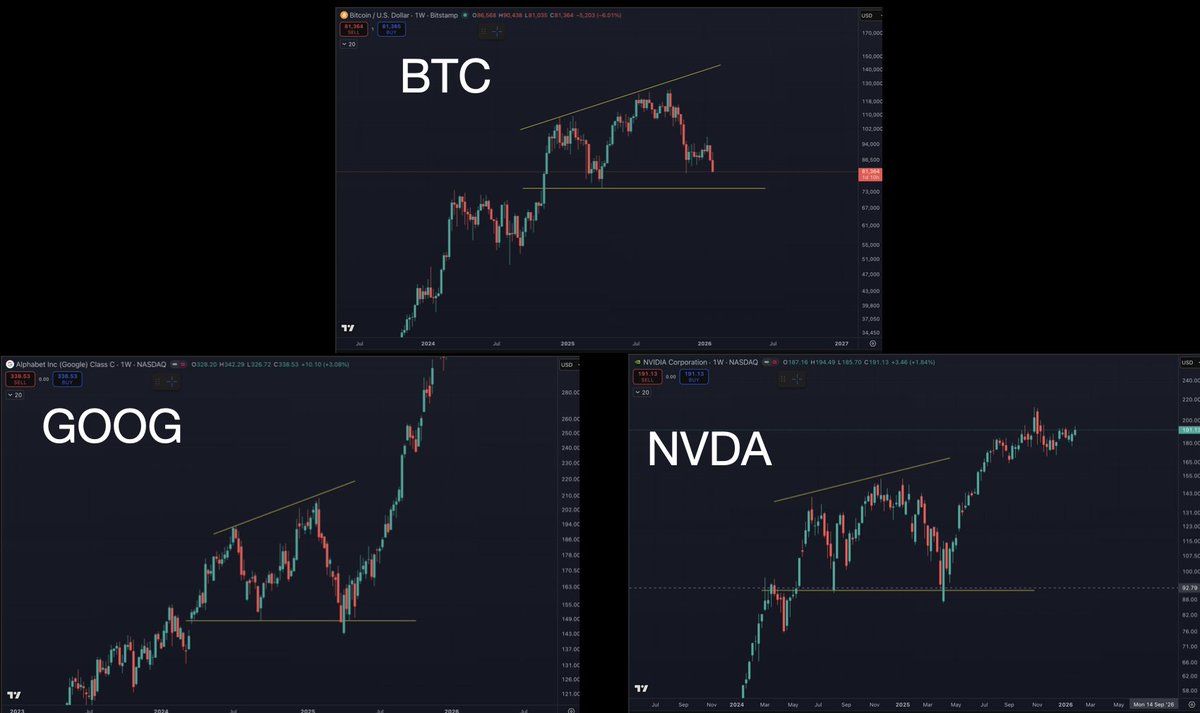
This is the bull case for Bitcoin by the way.
If Bitcoin sweeps the low, the pattern would look a lot like prior patterns by GOOG and NVDA.
I would assume that the rally would not result in a new all time high, but a macro lower high, before going to the 200W SMA.
@decodejar Market can be in extreme greed and extreme fear for months, there's no alpha in that. Only when combined with huge downside liquidation or upward spike + catalyst (see FTX crash or Coinbase IPO) does it give an edge. I think a downside catalyst + capitulation is near.
No complexity. No accident.
10/10 was caused by irresponsible marketing campaigns by certain companies.
On October 10, tens of billions of dollars were liquidated. As CEO of OKX, we observed clearly that the crypto market’s microstructure fundamentally changed after that day.
Many industry participants believe the damage was more severe than the FTX collapse. Since then, there has been extensive discussion about why it happened and how to prevent a recurrence. The root causes are not difficult to identify.
⸻
What actually happened
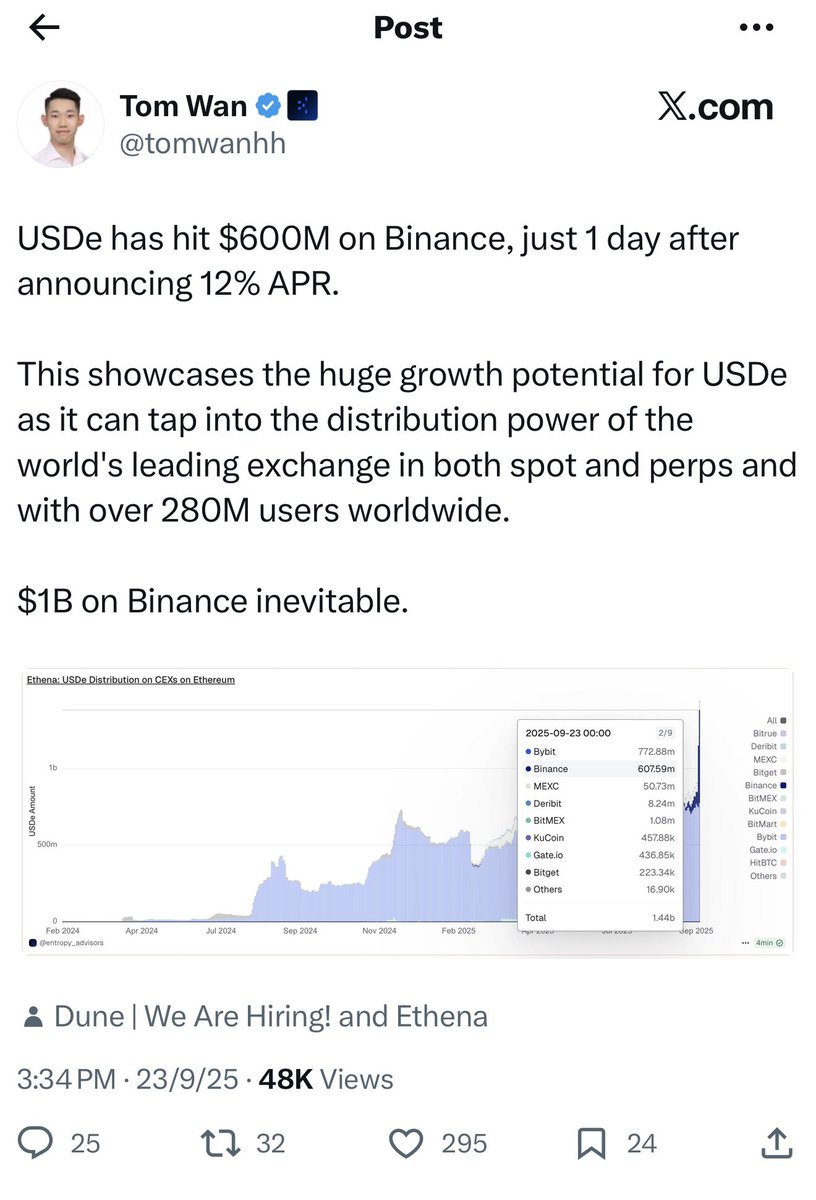
1.Binance launched a temporary user-acquisition campaign offering 12% APY on USDe, while allowing USDe to be used as collateral with the same treatment as USDT and USDC, and without effective limits.
2.USDe is a tokenized hedge fund product.
Ethena raises capital via a so-called “stablecoin,” deploys it into index arbitrage and algorithmic trading strategies, and tokenizes the resulting fund. The token can then be deposited on exchanges to earn yield.
3.USDe is fundamentally different from products such as
BlackRock BUIDL and Franklin Templeton BENJI, which are tokenized money market funds with low-risk profiles.
USDe, by contrast, embeds hedge-fund-level risk. This difference is structural, not cosmetic.
4.Binance users were encouraged to convert USDT and USDC into USDe to earn attractive yields, without sufficient emphasis on the underlying risks. From a user’s perspective, trading with USDe appeared no different from trading with traditional stablecoins—while the actual risk profile was materially higher.
5.Risk escalated further as users:
•converted USDT/USDC into USDe,
•used USDe as collateral to borrow USDT,
•converted the borrowed USDT back into USDe,
•and repeated the cycle.
This leverage loop produced artificial APYs of 24%, 36%, and even 70%+, widely perceived as “low risk” simply because they were offered by a major platform. Systemic risk accumulated rapidly across the global crypto market.
https://t.co/IK2gW4xUOP that point, even a small market shock was sufficient to trigger a collapse.
When volatility hit, USDe depegged quickly. Cascading liquidations followed, and weaknesses in risk management around assets such as WETH and BNSOL further amplified the crash. Some tokens briefly traded near zero.
The damage to global users and companies—including OKX customers—was severe, and recovery will take time.
⸻
Why this matters
I am discussing the root cause, not assigning blame or launching an attack on Binance. Speaking openly about systemic risks is sometimes uncomfortable, but it is necessary if the industry is to mature responsibly.
I expect there may be significant misinformation and coordinated FUD directed at OKX in the near future. Even so, speaking honestly about systemic risk is the right thing to do—and we will continue to do so.
As the largest global platform, Binance has outsized influence—and corresponding responsibility—as an industry leader. Long-term trust in crypto cannot be built on short-term yield games, excessive leverage, or marketing practices that obscure risk.
The industry needs leaders who prioritize market stability, transparency, and responsible innovation—not a winner-take-all mentality where criticism is treated as hostility.
Crypto is still early.
What we choose to normalize today will determine whether this industry earns lasting trust—or repeats the same mistakes again.
@TechDev_52 I have no doubt you will be right, eventually. But being early is the same as being wrong, especially if you hold alts. Holding from 125k to 60k and pretending like it's not a big deal is pretty unreasonable imo.
Yesterday I said 2 things have to happen for me to consider taking out the weekly high:
❌ Yesterday's level had to hold
⏳ No weekly low after Tuesday
Small wicks only hold when price is clearly trending away from it, which in my opinion is the case right now, with the path of least resistance being down.
Hard invalidation for taking the wOpen is taking yesterday's low, which would confirm the smallest wick on a weekly candle in 3 years, but for me personally the idea has already become very unlikely.
So the idea is very simple now:
- Hold yesterday's low = look to take out the weekly high & wOpen
- Take yesterday's low = look for bearish monthly confidence targets at 84k-80k area
Personally biased for the second. I explain my thoughts in more detail in the following video: