Qui suis-je : voyageur et explorateur. J'ai quitté la France en 2008, vécu et voyagé dans une trentaine de pays.
Initié à la crypto en 2017 je me suis ensuite lancé dans d'autres investissements avant de ré-entrer en 2021.
Mon objectif est simple : €5k / mois de revenus passifs.
@GregInvestFr Je trade la "wheel" stratégie depuis un an (31% ROI depuis le début de cette année).
Tu commences par vendre un put (comme mentionné dans ton tweet).
Si tu es assigné (quand tu es obligé d'acheter car le prix est en dessous de ton strike), tu vends un Covered Call.
Ireland?
Dublin?
Guinness?
Bitcoin Conference?
2 FREE TICKETS?
To enter:
Follow @BitcoinconfIRL@larpar@dinnycollins
Drop a gif in the replies.
Lauren will choose the winner.
You have 24 hours from now.
Paul Sztorc va lancer un hard fork de Bitcoin nommé "eCash" en aout 2026. Je vous résume rapidement ce que c'est et ce que ça change pour vous si vous avez des BTC.
Pour comprendre ce que prépare Sztorc, il faut comprendre ce qu'est un hard fork. C'est une modification non rétrocompatible des règles du protocole Bitcoin : on modifie ou on supprime des règles d'une manière que les anciens noeuds rejettent. Conséquence : à partir du bloc où la modification s'active, le réseau de noeuds se sépare définitivement en 2 groupes :
→ ceux qui appliquent les nouvelles règles,
→ ceux qui restent sur les anciennes
Chaque groupe continue d'ajouter ses propres blocs sur sa propre chaine, mais les 2 chaines partagent tout l'historique antérieur au point de séparation. C'est par exemple ce qui s'est passé avec Bitcoin Cash le 1er aout 2017 au bloc 478 559, et c'est ce qui va se passer ici (à priori) au bloc 964 000 (normalement en août 2026).
À ce moment là, le vrai Bitcoin continuera son chemin normalement. Rien ne change pour lui. À côté, une nouvelle chaine (eCash) démarrera avec le même historique jusqu'au bloc 963 999, puis avec sa propre suite de blocs qui seront différents de ceux du vrai Bitcoin.
Comme l'historique est commun jusqu'au point de fork, tous les UTXO existants sont présents sur les 2 chaines. Si tu as 1 BTC avant le fork, tu te retrouveras avec 1 BTC sur Bitcoin + 1 ecash sur la nouvelle chaine, sans rien faire.
La L1 de ecash sera une quasi copie de Bitcoin, avec une différence importante : l'activation des drivechains via les BIP-0300 et BIP-0301. Pour simplifier, une drivechain c'est une architecture de sidechains que Sztorc propose depuis 2015 et que la communauté Bitcoin refuse d'activer. C'est pour cela qu'il fait ce hard fork (si vous voulez en savoir plus sur les drivechains, je vous renvoie vers mon dico, lien en commentaire).
Pour financer le développement, Sztorc réécrit dans le code de la nouvelle chaine une partie des soldes des coins "dormants" vraisemblablement possédés par Satoshi (500k eCash) au profit d'investisseurs accrédités. Les BTC réels de Satoshi sur Bitcoin ne vont pas bouger sur Bitcoin, mais l'équivalent ecash qui aurait dû être crédité aux mêmes adresses/clés publiques est redirigé (ou "volé", en fonction de comment vous le voyez).
Outre l'idée désastreuse de faire un hard fork pour imposer une idée, et le vol arbitraire des ecash de Satoshi, le choix du nom est très très mauvais.
"ecash" c'était déjà le nom d'un système de paiement électronique anonyme développé par DigiCash dans les années 1990, basé sur les signatures aveugles de David Chaum. Cela permettait à un utilisateur de retirer auprès de sa banque des jetons numériques cryptographiques dépensables en ligne sans que la banque ni le commerçant ne puissent relier le paiement à son identité. C'est souvent considéré comme un système précurseur de Bitcoin. Mais ici, ce que veut faire Sztorc n'a rien à voir avec le principe d'ecash de David Chaum.
Le terme "ecash" est aussi utilisé de nos jours pour désigner des protocoles en surcouche de Lightning ou de Bitcoin comme Cashu et Fedi, qui, eux, s'inspirent réellement de Chaum pour faire des paiements anonymes.
Et aussi, il existe déjà un autre shitcoin appelé ecash (ticker XEC), qui est un fork de Bitcoin Cash de 2020 (lui même un fork de Bitcoin).
→ Quelles sont les implications pour les détenteurs de bitcoins ?
Eric Voskuil explique très bien ce scénario dans le livre Cryptoeconomics : l'utilité d'une monnaie ne vient pas de ceux qui la détiennent, mais des commerçants qui l'acceptent en paiement. Un billet de 5€ n'est utile que si le boulanger te vend du pain en échange de ce billet. Si aucun commerçant n'accepte ta monnaie, c'est juste du papier imprimé.
Un fork ne crée jamais d'utilité supplémentaire, mais il divise l'utilité existante. Si la moitié des commerçants (en poids économique) qui acceptent le BTC bascule sur ecash uniquement, on se retrouve avec 2 monnaies qui ont la même utilité, égale à la moitié de l'utilité de la monnaie de base. La valeur de la nouvelle monnaie n'est pas volée à Bitcoin, mais elle le quitte avec les commerçants qui partent.
Voskuil précise également que les détenteurs n'influent pas sur l'utilité d'une monnaie, seulement sur son prix unitaire via leur niveau de thésaurisation. Donc recevoir 1 eCash dans ton wallet ne te donne aucune valeur en soi. Cette valeur dépendra uniquement du nombre de commerçants qui accepteront eCash en paiement. Le funding levé sur le dos de Satoshi et des investisseurs pigeonnés financera une tentative de migration, mais pas de la valeur en soi.
Par contre, il y a un vrai risque à prendre en compte ici, c'est celui du rejeu, car Paul Sztorc a prévu de ne pas l'empêcher nativement.
Au moment du fork, les 2 chaines partent du même UTXO set, avec les mêmes adresses, le même format de transaction, les mêmes signatures. Mécaniquement, une transaction signée valide sur l'une est valide également sur l'autre, à condition que les UTXOs utilisés datent d'avant le fork. Sans protection contre le rejeu intégrée au protocole (type SIGHASH_FORKID, ce qu'avait fait BCH en 2017), si tu envoies 1 BTC à un Bob sur Bitcoin après le fork, la même transaction peut être rediffusée sur eCash et y dépenser 1 eCash t'appartenant, sans ton accord.
Sztorc a fait le choix délibéré de ne pas implémenter cette protection, car le rejeu est un levier, selon lui, pour forcer les exchanges à lister eCash.
Pour te protéger sur Bitcoin d'une attaque par rejeu, c'est extrêmement simple : ne touche pas à tes eCash. Si tu ne fais aucune transaction sur le fork eCash, l'attaque par rejeu n'est pas possible.
Il faut tout de même être conscient que chaque transaction Bitcoin te fera sûrement perdre des ecash, mais si tu t'en fou, bah c'est pas grave.
Si tu veux vraiment utiliser tes ecash (ce que je te déconseille car c'est une prise de risque pour sûrement aucun gain ou très peu), il faudra faire une étape préalable qu'on appelle le "coin splitting". Ça consiste à créer une transaction qui dépense un UTXO d'une manière uniquement valide sur l'une des 2 chaines, ce qui rend tes 2 soldes définitivement indépendants. Tant que tu n'as pas splitté, ne dépenses rien sur la chaine eCash, sinon la même transaction pourra être rejouée sur Bitcoin, et tu risques de perdre tes sats.
Il y a également un risque au niveau de l'utilisation de tes clés privées : au début, ce seront les mêmes clés privées que tu utilises sur Bitcoin qui te permettront de déplacer tes eCash (et donc de faire le split). Cela implqiue de renseigner ta seed dans un logiciel tout nouveau, peu testé, et cela augmente énormément la surface d'attaque de ton portefeuille.
TL;DR: ne touche pas à eCash.
🥳 1er concours de 2026 avec 2 lots à gagner 💰
🥇 40€ ou 0,25 action Nvidia 😂
🥈 Mon ebook "investir sur le PEA/CTO" (valeur 10€)
👇 Conditions 👇
❤️ Like et RT ce post
✅ Etre abonné à ma page X
➕ Bonus double chance de gagner (2 participations) si tu es aussi abonné à ma chaine Youtube
⚔️ Tirage le 15/01
🇪🇺 EUROPE: THE GIANT WITH EVERYTHING - EXCEPT THE WILL TO ACT
Europe is the richest underachiever in modern history.
A $17 trillion economy. A half-billion people. Top-tier universities, elite engineering talent, world-class infrastructure, deep capital pools, and a currency rivaling the dollar in global trade.
By any rational metric, Europe should be a geopolitical superpower.
Instead, in 2025, it behaves like a consortium of anxious middle managers hoping no one notices they’re technically in charge.
And here’s the tragedy: Europe doesn’t lack capability. It lacks nerve.
Europe has everything great powers dream of. The raw ingredients are absurd:
— Economic mass greater than China’s.
— Human capital unmatched outside the U.S.
— A stable rule-of-law environment businesses kill for.
— Energy potential from nuclear, renewables, and imported pipelines.
— Technological ecosystems that produce world-leading research.
If Earth were drafting civilizations for the next century, Europe would go first round.
But potential without willpower is just trivia.
Europe in 2025 is a geopolitical ouroboros: it has all the tools, but somehow manages to defeat itself before the game even starts.
In trade negotiations with Washington, it caves.
In responding to Russia's sabotage campaign, it dithers.
In arming Ukraine - its own first line of defense - it moves in slow motion (putting it lightly).
In dealing with China, it bickers internally until Beijing writes the rules.
In every crisis, Europe becomes the audience, not the actor.
This is far from weakness of resources. It’s weakness of mindset alone.
Europe behaves as if power is vulgar, as if coordination is optional, as if existential threats are merely interesting philosophical debates.
Europe has a unity problem, first and foremost.
When 27 nations all hold vetoes, strategy becomes performance art.
Belgium blocks Russia asset confiscation to avoid legal exposure.
Spain shrugs at defense spending because tanks won’t cross the Pyrenees.
Hungary freelances foreign policy like a side gig.
Germany agonizes over “escalation.”
France insists on being the adult in the room but rarely pays the full bill.
Meanwhile, Poland, Finland, the Baltic states - the ones who can hear the bear breathing - watch the West Europeans play academic theory games with real-world danger.
If Europe's structure incentivizes paralysis, the shock is that anyone expected coherence.
Putin and Trump have reached the same conclusion, from opposite angles:
Europe talks a big game but won’t fight for its interests.
So Washington negotiates Ukraine peace deals without Europe in the room.
This is how great powers treat regions they do not fear.
Yet: Europe still has the capacity to terrify its adversaries! This is what makes the whole story so maddening.
Look at the numbers:
Europe has sent more total aid to Ukraine than the United States.
It outguns Russia economically 10 to 1.
It has a population four times larger.
Its industrial base - once mobilized - could overwhelm Russian capacity in months.
When Europe decides to act, it moves mountains. The problem is that it almost never decides.
For 80 years, Europe has been on sabbatical from its own history.
A peace project. A rules-based sanctuary. A moral power instead of a military one.
But Europe’s peacefulness is not inevitable. It is a choice - fragile, reversible, and very much under strain right now.
If Russia pushes too far…
If Washington abandons the continent…
If the EU’s eastern members conclude that Paris and Berlin can't or won’t defend them…
Europe could snap awake.
And a re-militarized Europe, with its industrial depth and historical muscle memory, would change the world in ways neither Moscow nor Washington is prepared for.
Europe can no longer afford to behave like an affluent spectator.
It needs a unified defense policy that actually defends... a functioning foreign policy with consequences, not communiqués... a willingness to prioritize power, not process.
And a recognition that unity is survival, not a vibe.
Europe is not a weak continent. It is a strong continent demonstrating weakness.
The 2020s will be Europe’s hinge decade. Either it leverages its vast economic and human capital to become the 3rd pole of global power -
or it continues drifting, divided, diminished, and dismissed.
Source: Warfronts
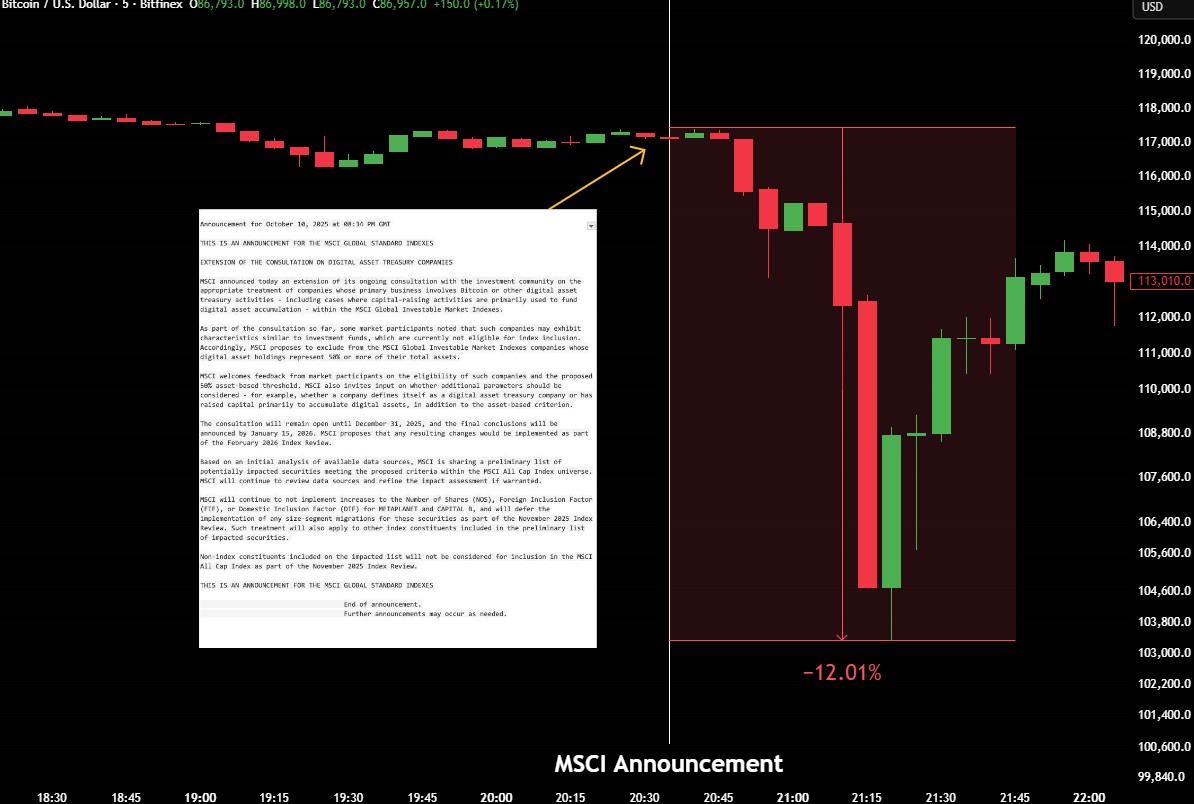
THE REAL REASON BEHIND THE OCTOBER 10TH CRYPTO CRASH IS FINALLY OUT.
And it’s much bigger than what people thought.
For weeks, traders kept asking the same question:
"Why did the market collapse so violently on Oct 10 when there was no macro event, no ETF news, no exchange failure, nothing?"
Now we have the missing piece and it explains a lot.
1) MSCI quietly dropped a major update on Oct 10
On the same evening the crash began, MSCI released a consultation note that almost nobody in crypto paid attention to.
MSCI said they are reviewing how to classify companies whose main business involves accumulating Bitcoin or digital assets.
Key proposal:
- If digital assets = 50% or more of a company’s total assets
- And the company’s operating activity resembles a digital asset treasury
→ That company can be excluded from MSCI global indexes.
This directly puts several Bitcoin-heavy companies at risk, especially MicroStrategy.
2) Why this matters
If MSCI excludes these companies:
• Index funds are forced to sell
Funds tracking MSCI indices must remove these stocks.
They do not get to choose. This is literal forced institutional selling.
• MicroStrategy becomes a primary target
If MSTR is labeled fund-like, MSCI indexed funds could be forced to reduce or exit positions.
• When MSTR dumps → BTC reacts immediately
Like it or not, $MSTR is treated as a leveraged Bitcoin proxy.
If the stock shows weakness: confidence drops → Bitcoin correlation increases → retail panic accelerates → liquidations start hitting → BTC falls harder.
3) How this connects to the Oct 10 crash ?
The market was already fragile:
- Trump new tariffs
- Weak Nasdaq
- High leverage in BTC markets
- Fear of 4-year cycle top
When MSCI’s note dropped, it added a new type of structural risk that traders did not expect.
The fear was simple:
"If MSTR or similar companies get removed from MSCI, large funds will be forced to sell, what happens to Bitcoin then?"
This fear hit right into an already stressed market.
The result: one of the biggest liquidation waves in crypto history.
4) But there’s another layer: JPMorgan’s timing
3 days ago, JPMorgan published a bearish report highlighting the same MSCI risks, right when:
- MSTR was weak
- BTC was weak
- Liquidity was thin
- Sentiment was fragile
This amplified panic, causing a 14% dump in a few days.
And if you know JPMorgan’s history, you know this pattern:
They speak bearish when prices are weak.
They accumulate assets when retail is scared.
They publish bullish notes near tops.
Their timing is never random.
This is not a secret. This is standard Wall Street behavior.
5) Is JP Morgan manipulating the market?
Not illegally. But strategically, yes.
This is how big institutions operate:
- Push fear when liquidity is low
- Trigger panic
- Let weak hands sell
- Accumulate at a discount
- Turn bullish later
They’ve done it with metals. They’ve done it with bonds. They are doing it with Bitcoin.
This is not a cartel. This is Wall Street strategy.
6) Now the plot twist: Michael Saylor responds publicly
Right when MSCI fears started dominating headlines, Saylor dropped a detailed clarification:
"MicroStrategy is not a fund, not a trust, not a holding company. It is a publicly traded operating company with a $500M software business and a Bitcoin based treasury strategy."
He also highlighted:
- 5 new digital credit instruments ($STRK, $STRF, $STRD, $STRC, $STRE)
- $7.7B notional value issued this year
- Stretch ($STRC), the first Bitcoin backed variable yield credit instrument
- Ongoing software operations and financial product innovation
His message was simple:
"We are not passive holders. We are builders. We are innovating. Index labels do not define us."
7) So what does all this mean for the market?
✔ Oct 10 crash was NOT random
It aligns exactly with MSCI’s consultation release.
✔ Forced-selling fear created liquidity stress
Traders panicked because they assumed index funds might eventually dump large positions.
✔ JPMorgan amplified the fear
Their bearish note came at the perfect moment to shake markets further.
✔ Saylor finally cleared the air
His statement explained why MicroStrategy is fundamentally different from what MSCI is describing.
✔ But uncertainty remains
Final MSCI decision comes on 15 January 2026.
Policy goes into effect February 2026.
Between now and then? The market may price in more volatility.
Final Take:
The market did not crash because of a single event.
It crashed because one unexpected structural risk hit an already fragile system.
And large institutions used that moment to shape sentiment.
But the long term picture is simple:
Bitcoin adoption unchanged.
Corporate interest unchanged.
Saylor remains on track.
Institutions still building.
ETF flows will stabilize.
Liquidity cycles will return.
MSCI classification will not stop Bitcoin.
Fear creates opportunity. Narratives create volatility. But fundamentals do not change.
This is why the Oct 10 crash was violent and why it will be remembered as a technical panic, not a fundamental breakdown.
@cryptosNF Ibkr est le plus compliqué mais aussi plus complet. J'utilise pour trader des options.
Pour acheter des actions fractionné, Trade Republic est très bien. Les frais sont plus plus bas que revolut, tu peux mettre en place un DCA et ton cash est rémunéré à 2% (payé chaque mois).
How to trade the liquidation levels.
These are @binance Leverage Traders Liquidation Levels. The Red lines are high leverage (100x+). The Yellow are medium (50-100x) the Blue are low leverage 25-50x). When the price hits these lines the trader is liquidated if they did not exit, add margin or stop out. Use these levels to trade crypto. Forget traditional TA it is a retail trap. Follow the liquidity in crypto.
-Where the top blue lines end is Short Setup A
-Where the upper yellow lines meet the upper blue lines is Short Setup B
-Where the upper red lines meet the upper yellow lines is Short Setup C
-Where the upper red lines meet the upper yellow lines is Long Setup C
-Where the lower yellow lines meet the lower blue lines is Long Setup B
-Where the lower blue lines end is Long Setup A
IMO: ALWAYS WAIT FOR SETUP A.
ALWAYS USE A STOP LOSS. EXIT IN PROFIT. MOVE STOP LOSS IN THE MONEY AS SOON AS POSSIBLE.
NFA. Nobody has a crystal ball. Use as a guide. Trade carefully with good stop loss management. Educational purposes only.
After Ethereum puts in new all time highs, we will likely witness a massive rotation back into Bitcoin.
However, the rotation back to BTC will likely be initiated by a BTC correction in September and will continue on a BTC rally in October.
🇫🇷 FRANCE JOINS THE GLOBAL HASH WAR ⚡
Max Keiser predicted this in 2019:
Nations would stop banning Bitcoin… and start HOARDING it.
Today, France proposes mining BTC with nuclear energy 🔥
Europe just stepped onto the Hash War battlefield.
▶️ LIVESTREAM 4PM ET
🎯 https://t.co/w1Qw1zOhdG
"This is the Will of Satoshi." 🥷