Most people were never taught how money actually works.
A lot is changing right now, and you should probably know about it.
Breaking it all down this Tuesday. No jargon, just the stuff that matters.
Free to join. Link in the comments
Something unusual is happening in crypto.
Bitcoin and alts are pushing higher with oil above $100, while gold briefly dipped below $4,000 before bouncing back.
Someone’s positioning for something. Could be smart money getting ahead of the news, or just another trap.
We’ll find out soon enough.
SpaceX is targeting $1T in annual revenue by the end of 2027.
They’re currently at a ~$15B quarterly run rate, with $19.6B spent on capex in just one quarter.
>Think about how much compute they’ll need to build to make this happen.
>Now think about who supplies the chips and memory to power all of it.
Are we underestimating what this could mean for chip and memory stocks?
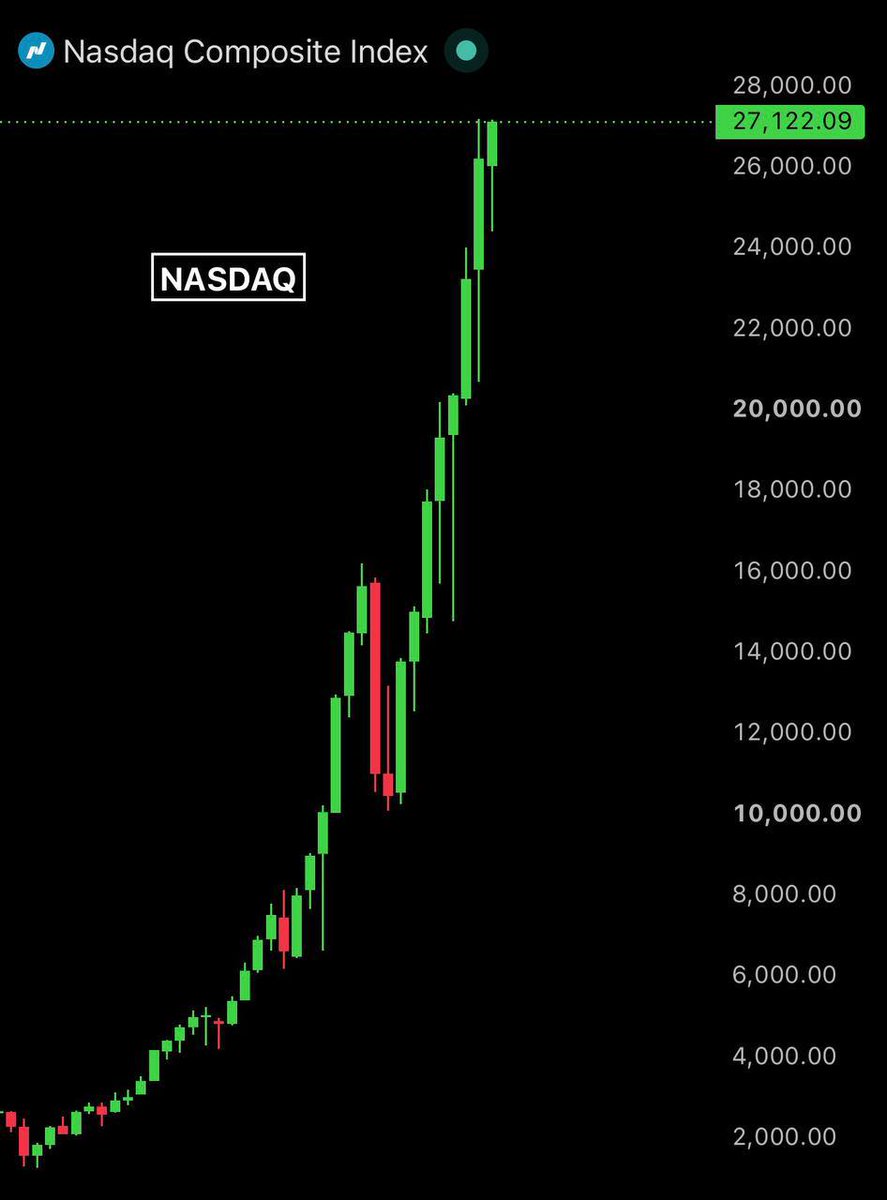
Black Monday turned into Bull Monday.
People need to understand the difference between a crash and a correction.
These days, every small dip is called a “CRASH.”
Not every fall is a crash. Sometimes, it’s just a correction.
TOKEN2049 left me thinking less about which coin will pump next, and more about where crypto is actually creating value.
After conversations with founders, fund managers and institutional investors, 5 things stood out:
> Fundamentals are starting to matter more than narratives
> Picking the right assets matters more than buying the whole market
> TradFi is looking at blockchains as financial infrastructure
> Stablecoins might be crypto’s most practical use case
> AI agents using crypto sounds great. But are they actually doing it?
One line stuck with me: AI agents today are often using credit cards, not crypto
Goldman Sachs is bullish on both stocks and bonds again.
The bank moved equities to overweight for the next 3 months and bonds to overweight over the next 12 months.
Stocks have been stuck in a range since summer, with rising rates and energy prices offsetting solid earnings.
That’s kept valuations in check heading into Q3 earnings season
If you don’t speak cryptography, here’s the simple version:
>Bitcoin is safe today because knowing someone’s public key doesn’t let you work backwards to their private key. That’s basically the assumption protecting billions in BTC.
>Drake’s concern is that AI could potentially find a mathematical shortcut that breaks that assumption far sooner than expected.
>If that ever happens, wallets with already-exposed public keys become the obvious targets.
Hence the “bunker mode” idea: move funds to fresh addresses before the public key is exposed, and rotate to another address after spending.
The ironic part? A huge chunk of Satoshi’s BTC already sits behind exposed public keys
Today I call upon the blockchain industry to calmly begin planning for "bunker mode". My personal recommendation is to set in motion a controlled mass migration of assets to fresh addresses, i.e. addresses whose pubkeys remain hidden behind a hash.
Holders, starting with large and sophisticated ones, should consider moving the bulk of their funds to addresses that have never signed a transaction. And when they do sign one, they should also move remaining funds to a new address (possibly generated from the same seed phrase).
Don't rush. While I believe there is cause for action a rushed migration would do more harm than good. Don't panic either. Moving assets to protected addresses is a simple, preventative step which does not require new cryptography or new wallets.
IMO it is now reasonable to brace for the possibility that ECDSA breaks before qday, in the worst case in months not years. By "break" I mean fast private key recovery (e.g. in one week) on available hardware (e.g. a large GPU cluster).
Recent days have been humbling for human mathematical intuition. Long-held, unquestioned hypotheses have fallen. This includes the n log(n) bound for integer multiplication and the 3SUM conjecture. In hindsight, May's unexpected disproof of the Erdős unit distance conjecture was our warning shot.
Yesterday's OpenAI drop made it clear that mathematical superintelligence is upon us. They say there are weeks where decades happen. We are about to live through weeks where centuries of mathematical progress happen. Could our magic 64-byte ECDSA signatures be too good to be true? Was it just security through obscurity all this time?
Elliptic curves feel especially vulnerable to superintelligence. Curves carry rich structure, with room for fancy tricks like Schoof, Frobenius, pairings. (By contrast, hashes are designed to minimise algebraic structure.)
Separately, as Ewin Tang can attest, an efficient quantum algorithm sometimes foreshadows an efficient classical one. We should be open to the possibility of a classical counterpart to Shor that breaks elliptic curves and RSA at once.
Also noteworthy is the striking under-representation of cryptographic breakthroughs among the 722 mathematical results OpenAI published. I've witnessed first-hand the US government censoring academic quantum cryptanalysis results. Backroom interventionism is my base case.
I urge large, sophisticated actors to lead by example. Project11's "risq list" (bitcoin-risq-list.projecteleven[.]com) is a great tracker of exposed BTC pubkeys. Binance, Bitbank, Robinhood, Bitfinex, and Tether have an opportunity to harden their cold storage. Next month I'll address institutions in London in a live Q&A (forum.ethereuminstitutional[.]org/london-2026).
Again, please do not rush. Wallets holding under 50 BTC enjoy partial cover from "Satoshi's shield", i.e. his 20K exposed addresses that hold 50 BTC each. Load-bearing signers like oracles and L2 security councils should consider rotating ECDSA pubkeys with every signed message and/or multi-signing with a hash-based schemes like SPHINCS.
Exiting bunker mode safely will require post-AI cryptography. My inclination is to go all-in on hash-based cryptography and avoid structured mathematical assumptions entirely, whether from curves, lattices, or isogenies. A single battle-tested hash (e.g. from the SHA or BLAKE families) yields plausible post-AI security.
The Ethereum roadmap on strawmap[.]org fully embraces hash-based cryptography with end-to-end formal verification as a response to the quantum threat. Those timelines must now be revisited and accelerated in light of mathematical superintelligence. I'll be pushing for maximum defensive acceleration.
I asked Danielle (@cryptocrushshow): Do memecoins come back as hard as last Alt run?
Her Call: YES — and Robinhood Chain takes a lot of that liquidity.
Robinhood pioneered Wall Street Bets.
Now it has a chain.
~$1B TVL in ~two months.
Meme coins already ripping there.
She’s not playing the coins.
Workaround she named: HOOD stock for the upside without the tokens.
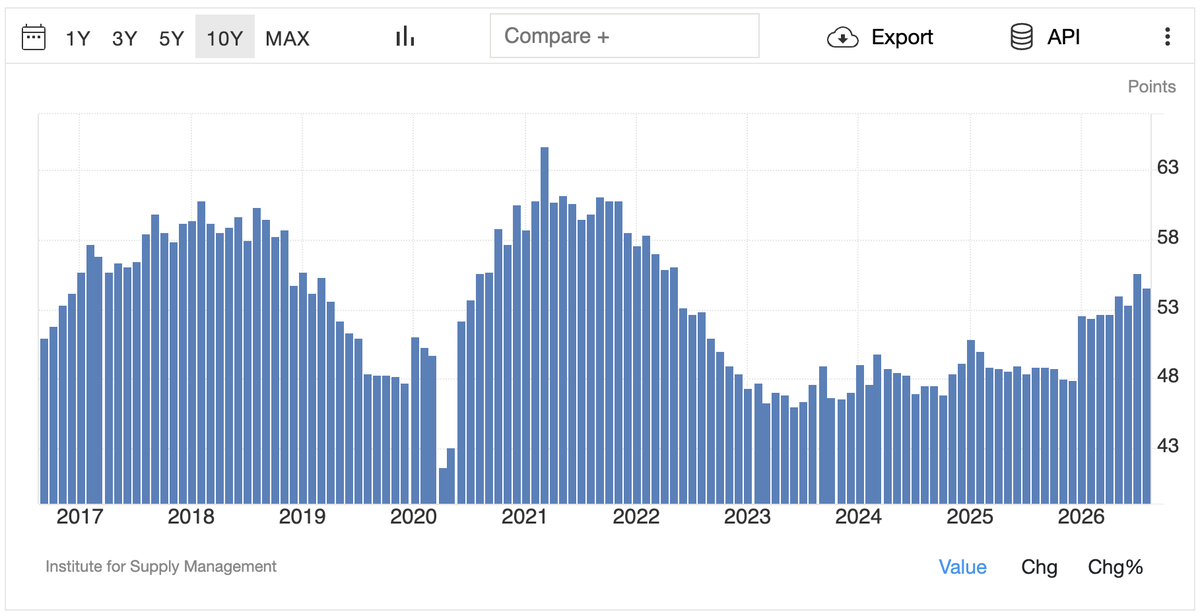
ISM could be one of the biggest macro signals for crypto right now.
2017 & 2021: ISM held above 55 → alts went crazy
2025: ISM stayed below 50 → no real altseason
Now it’s back at 54.6. If it keeps pushing toward 60, 2027–28 could get very interesting
Today’s ISM release at 10:00 AM ET will decide the next big move
Danielle (@cryptocrushshow): #1 this run is stablecoin infrastructure.
DTCC + NYSE tokenization → rails in stablecoins and tokenized stocks.
Her list:
• Chainlink
• Circle (no crypto token; new ARK chain, no token yet; public stock)
• Coinbase
• Robinhood (tokenize stocks on its chain)
She calls it the on-chain money flow the space waited a decade for.
Here's a reminder of what this industry can do when it's done right:
@cryptocrushshow has been on a mission in Bali to build houses for families in need.
Funded by her affiliate revenue on @BTCCexchange, Danielle and her community are turning trading profits into real impact.
Is tokenization actually the next big phase of crypto, or just another narrative that will fade like the rest?
Quant’s recent move raises that question
$QNT has surged, but the more interesting part is what’s behind the narrative
TLDR: Quant’s latest whitepaper lays out a vision for infrastructure that can connect tokenized deposits, payments, mortgages, liquidity and digital-asset settlement across different ledgers.
Is Bitcoin Still Following The Four-Year Cycle?
Danielle (@cryptocrushshow) used to think the four-year cycle had finally broken.
Recent price action suggests it is still largely intact, even with bigger deviations than before.
As institutions continue entering crypto, she wonders whether the market could eventually shift toward traditional 7–8 year financial cycles.
For now, she would put it at roughly 75% intact.
I've Switched Bullish On Bitcoin
I was waiting for a break above $83K to confirm we were moving out of the downtrend.
Now we’ve broken above the 200-day MA and 50-week MA, with weekly RSI bullish divergence and a reverse head-and-shoulders pattern.
For the first time in a year, I’m bullish. — Danielle (@cryptocrushshow)
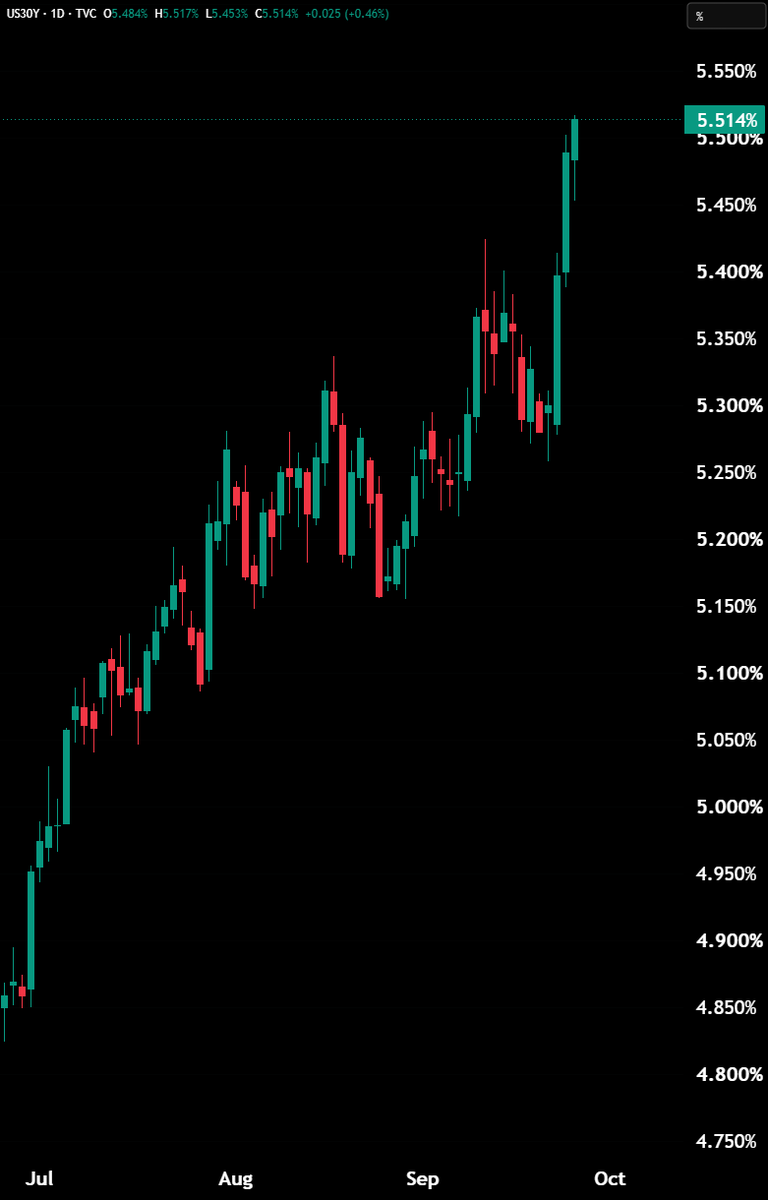
Everyone keeps saying higher yields are bad for Bitcoin
But the market isn't exactly following that script
> Over the past month, the US 10Y yield moved from ~4.5% to ~5.2%, while BTC went from around $60K to $86K.
>So maybe the relationship between Bitcoin and bond yields isn't as straightforward as people think.
>Bonds and Bitcoin serve very different purposes.
And if confidence in traditional fixed-income markets starts weakening, capital could eventually look for alternatives like gold and Bitcoin.
BTC can still get hit during a risk-off move.
But what matters is where the money goes after the panic
Bitcoin ETF flows have flipped positive
After months of selling, institutional demand is picking up again, with 2026 net flows now around +$170M
What's next ?