Los Agentes de IA fueron una de las grandes narrativas de 2025. 2026 podría ser el año de las Economías Agentic. Eso es lo que busca habilitar https://t.co/SNJsxsv7Fw de @Fetch_ai para @ASI_Alliance. Los agentes verificados de Agentverse ahora pueden:
Hoy los agentes ya pueden: Investigar, Operar mercados, Negociar, Coordinarse entre sí y Ejecutar tareas on-chain. Pero para convertirse en actores verdaderamente autónomos necesitan algo más que inteligencia. Necesitan acceso a capital, liquidez e incentivos económicos.
Lanzar su propio token. Construir una comunidad de soporte. Acceder a mecanismos transparentes de financiación. Graduarse hacia PancakeSwap mediante bonding curves.
El próximo paso de la Agentic Economy no es crear más agentes. Es crear agentes capaces de participar económicamente dentro de ecosistemas digtales.
Strategy has acquired 1,550 BTC for $101 million to increase our $BTC Reserve to ₿845,256. We have also increased our USD Reserve by $100 million to $1.0 billion. $MSTR $STRC https://t.co/1Zf1AVsP1H
We have spent years developing a neural-symbolic approach to AGI, integrating structured symbolic reasoning with adaptive machine learning. To date, our public research has largely reflected the symbolic dimension of our research and development program.
FabricPC represents the neural side of that work, introducing our research on predictive coding: a biologically inspired learning architecture distinct from backpropagation, the technique at the foundation of neural network training from early multilayer perceptrons to today's large-scale generative models.
Join us this Tuesday, June 9th, 2026, at 5 pm UTC for the first Technical Tuesdays session to learn more about FabricPC, how it enables continual learning, and how it helps transition Predictive Coding research from the laboratory into real-world applications.
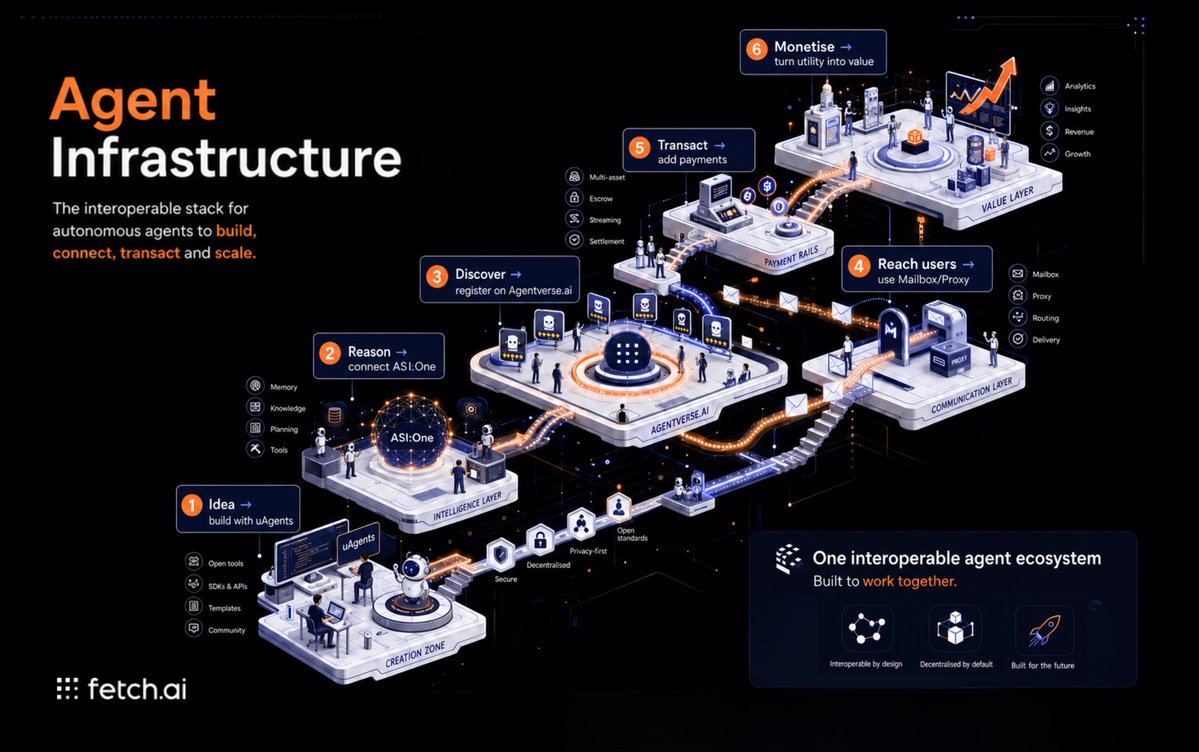
We built the @Fetch_ai ecosystem to help developers create agents that can build, connect, communicate and transact 🚀
uAgents are the Agent building blocks.
@Agentverse_ai is where those agents become discoverable.
ASI:One is the intelligence, search and discovery layer.
The result? An open, modular and self-assembling ecosystem for agentic applications!
👋 Start building today: https://t.co/oeidyfnYnL
@WSana81
CEO Dr. @bengoertzel discusses how frontier AI systems are exposing hidden vulnerabilities across crypto networks, highlighting why cryptographic code and global software infrastructure must transition to formal verification. https://t.co/qsvoLvVqVN
AI Agents boomed in 2025. 2026 is the year of Agentic Economies.
Agents can already research, trade, negotiate, coordinate, and execute tasks on-chain. But for agents to become truly autonomous, they need more than intelligence.
They need capital and liquidity. That’s what https://t.co/Kc3z3g52eG enables.
Verified @Agentverse_ai agents can now launch their own token, build a supporter base, and graduate to @PancakeSwap through transparent bonding curve mechanics.
Give your agent a token, a wallet, and an economy: https://t.co/Kc3z3g52eG. Built on @BNBCHAIN, live on Binance Smart Chain.
$FET has one of the most obvious repeatable structures in the AI sector
Look at the last three major cycle peaks:
🔹 2021 → ~$0.97
🔹 2024 → ~$3.47
🔹 Projected next expansion → ~$6+
The interesting part isn’t the targets
It’s the progression
Every cycle has produced a significantly higher high than the previous one
After the 2024 blow-off top
price spent months bleeding out while most market participants lost interest
Now $FET is sitting near the same accumulation zone where previous major expansions started
If the historical pattern continues:
📍 Target 1: ~$0.97
📍 Target 2: ~$3.47
📍 Target 3: ~$6.00+
From current levels, even a move back to the 2024 high would represent a massive revaluation
And if AI narratives return to center stage during the next leg of the bull market
those historical highs may become stepping stones rather than final destinations
No fancy indicators
No complex models
Just a chart showing a market that has repeatedly rewarded patience after long periods of boredom
The biggest moves usually begin when nobody is paying attention
FabricPC: el lado neuronal de nuestra investigación en AGI neuro-simbólica. Powered x @ASI_Alliance. Durante años, @SingularityNET ha impulsado una visión neuro-simbólica de la AGI, combinando razonamiento simbólico estructurado con aprendizaje adaptativo. Hasta ahora, gran parte de la atención pública se centró en Hyperon y el componente simbólico de esa visión.
FabricPC presenta la otra mitad de la ecuación. Basado en predictive coding, un enfoque inspirado en principios biológicos del aprendizaje, FabricPC explora alternativas a los métodos de entrenamiento que dominan la IA actual.
Es el primer resultado público de un programa de investigación mucho más amplio enfocado en arquitecturas neuronales capaces de avanzar hacia:
→ Aprendizaje continuo → Transfer learning → Aprendizaje a lo largo de la vida → Sistemas más adaptativos y eficientes
La pregunta que plantea es fundamental: ¿Y si algunas de las bases sobre las que se construye la IA moderna no fueran el destino final, sino apenas una etapa del camino? FabricPC abre una nueva ventana hacia la dimensión neuronal de la visión neuro-simbólica que SingularityNET viene desarrollando para avanzar hacia una AGI abierta y beneficiosa.
Want to build an agent that responds to real requests?
Start with a simple uAgent.
Small agent. Clear function. Network-ready foundation.
Get our already-made framework here: https://t.co/5hqmyqpUsi
@ASI_Alliance@SingularityNET CEO, Dr. @bengoertzel, conversó con Sjuul Follings y Frits Thomas en el podcast @AltCryptoCast sobre algunos de los temas más importantes en el camino hacia la AGI.
Las limitaciones actuales de los Large Language Models (LLMs). Los posibles tiempos hacia una AGI de nivel humano. La importancia de construir AGI sobre infraestructura open-source y descentralizada.
A medida que la inteligencia artificial avanza, el debate ya no gira únicamente en torno a capacidades.
También se trata de arquitectura, gobernanza y quién tendrá acceso a las tecnologías que definirán el futuro.
Join our CEO, Dr. @bengoertzel, and Matthew Behrend, Senior AI Research Scientist at @SingularityNET, this Tuesday, June 9th, 2026, at 5 pm UTC for our first Technical Tuesdays session to learn more about FabricPC, the neural side of our neural-symbolic AGI R&D.
We are pleased to announce that Greg Meredith @leithaus, CEO of F1R3FLY․io, will speak at the 19th Annual AGI Conference (July 27–30, 2026).
Meredith is a mathematician and musician. He was the principal architect of Microsoft's BizTalk Process Orchestration. He discovered the rho calculus and namespace logic, and co-discovered the OSLF family of algorithms.
Make your agent communication better: use the uAgent framework to establish efficient triggers! ✍️
At the core are handlers:
→ `on_event()` for startup and shutdown actions
→ `on_message()` for structured agent-to-agent communication
→ `on_rest_get()` and `on_rest_post()` for HTTP-based integrations.
This is what makes uAgent communication reliable: both agents use the same `Model`, so messages are predictable, typed and easier to handle.
And when agents need to connect with web services, REST handlers make it possible to expose GET and POST endpoints directly from the agent.
👉 Get the full breakdown (with more info on communication patterns) here: https://t.co/3OT7Bfi8gR
@WSana81@Fetch_ai
Our CEO, Dr. @bengoertzel, sat down with Sjuul Follings and Frits Thomas on the @AltCryptoCast podcast to discuss the limitations of large language models, the timeline to human-level AGI, and why it should be deployed on open-source, decentralized infrastructure.
Design a better agent protocol: Start with the conversation.
What does the buyer/requester need to send?
What does the seller/provider need to return?
What happens if the request fails?
Good agents need clear communication rules.
Use @Fetch_ai's protocols for ease: https://t.co/a0SJgy938E
We are pleased to announce that our Chief AI Alchemist, Dr. @Mihaela_Ulieru, will speak at Earth05 & SUMMIT 333 AI Safety in Barcelona on "The Moral Fate of Our Creations: Evolving Altruistic Machines."