Three months ago I wrote my first reflections on AI
I had been using OpenClaw for a few weeks, and it blew my mind
I could now simply talk to a computer, and it could orchestrate and execute complex, creative tasks of all kinds
This open-source AI harness gave me, personally, new powers of computer programming, design, and beyond that I never had before
It was a real “I know Kung Fu” moment, straight out of The Matrix
The most awesome part was that the harness itself -- the software I was using to operate the AI “brain” or model -- was open source and fully customizable
The evolution of AI had been forked away from corporate dominance to create a path of sovereignty for the user, allowing them to choose their own intelligence
It felt like we were on the brink of something big
And yet still, three months later, it feels like these times were so very long ago
In February and March, we ran a fun OpenClaw experiment at HRF with just a few people, to see what kind of impact personal agents could have on productivity and on reducing busy work and bureaucracy
By May, we had actually started to give some of the world’s leading dissidents easy-to-use, extremely powerful, freedom-oriented AI tools to help them turn their dreams into reality
We do this at “Agent Camps”: 3-day, in-person experiences with teachers who are experts in education, design AI software, AI hardware, and software engineering
We have also created beautiful, engaging AI experiences and content at massive live events ranging from Bitcoin 2026 in Vegas to the Oslo Freedom Forum, sparking curiosity in thousands of people
We began with the open-source ethos, and now have been able to add privacy, and even full sovereignty, to our toolset
The product HRF has helped bring into existence -- Finite -- now offers a “private” mode where the inference provider can’t read the user data, similar to a Signal server. This product is what our Agent Camp graduates now use, and is what we hope to scale to more and more activists as we move through the year
We are even testing a “local” mode powered by our very own cluster, that we control, that gives us the ability to control the full AI stack
What I’m still struggling to digest is how fast the AI hardware and software environment is evolving towards making “sovereign AI” a practical reality
There’s a lot of doom in the headlines around the big AI corporations and their relationships with governments -- for good reason -- but when you zoom out and consider the big picture, the undeniable reality is that open weight models are getting more powerful, easier to use, and smaller so that they fit on cheaper and more widespread devices
One year ago, open weight AI models were mostly a joke. They couldn’t really execute anything that complex
Today, it’s getting hard to tell the difference between a personal agent powered by the best open weight models versus the best frontier ones
And while the frontier model companies are struggling through massive scaling and legal and political issues, open weight models and open-source harness software sets are blazing ahead
Consider that just *3* months ago, local AI was mostly a joke
Today it actually works: HRF and Finite currently have an uncensored model running on ~ $4,500 of equipment that can serve a dozen people, and it’s extremely useful for research. No third parties involved. The cost to do this will only decrease over time until it is something that simply can be run on any phone or computer or tablet
Already there are ways where you can run an open weight model on an iPhone, completely locally, and get a decent research assistant, no internet required
The latest development is the fusion model: where harnesses can “fuse” together several model brains to nearly replicate, for certain tasks, the performance of something like Fable -- the most powerful frontier model on earth
Technology and business and culture are, surprisingly, pushing us faster and faster towards workable freedom AI that is either privacy-protecting or completely sovereign, for the average person
The evolution of AI continues to trace the evolution of the computer, which went from something you had to once rent from a university or a library to something in the 1980s that came into your home in the form of the “personal” computer
We are in the middle of a similar shift where you might now “rent” compute from a giant corporation, to a world where, quite possibly, much of, or even most of, your compute will one day be done on devices you own and control
This shift could be expedited dramatically by companies like Apple, Google, and maybe even WhatsApp or Signal getting into the local AI game, and enabling users to fire up local AI assistants or use inference through a TEE
We are already seeing companies like Apple make very positive signs in that direction
So what’s the bad news? There is plenty.
The top-end frontier models are coming under increasing pressure from governments, and will likely end up fully KYC’d and gatekept, only accessible to a tiny few trusted people and institutions
This is the nightmare scenario: a small few with superpowers, and a permanent underclass with none
But if the average person can, in the next 12-18 months, use open-source software with no KYC to privately access or locally download frontier-like intelligence… then, the expansion of freedom in the 21st century seems more realistic
So far at HRF, we have worked with Finite to focus on helping activists learn the magic of personal agents. Make no mistake, dictators and tyrants are pushing full speed ahead on AI. We can’t afford to sit on the sidelines.
We give dissidents their own agent, even if running on a frontier brain, just to try it out on harmless or fun projects, to see what is possible and start building their “agent” muscle and mental framework
This step alone is hugely liberating. When you watch someone use an agent for the first time, it’s like being in the same room as someone when they first used email or the internet, but even more jaw-dropping. Some people even get so emotional that they cry, happily.
Something else we have helped organize are the “AI Hack for Freedom” events, where activist team captains collaborate with developers to make freedom tools. The first one was in January of this year, and what made it special is that the devs could actually, with coding agents, make shippable products in just 2 days.
But at the May “AI Hack for Freedom,” just a few months later, the activists now helped make the software, driving the process themselves! Developers still help of course, but the shift is remarkable
On June 2 at the Oslo Freedom Forum we debuted the "AI Lounge", a cafe-style, Apple Store-vibe experience where attendees could come in and start playing with cutting-edge personal agents powered by our customized version of Hermes. They could choose a frontier experience or a “private” mode powered by a TEE model, or they could even play with a fully local uncensored model
It was a home run. Human rights defenders who had never thought of themselves as digital creators were completely engaged, generating incredible things
So what next? Two big steps
We aim to put our harness server into the TEE, so that no one can see what activists are doing, even as they use top-of-the-line models
And we aim to finalize a mobile app where you can talk to your agent in a slick way, fully encrypted, with no third parties or KYC
At that point, we will have what we need to really take it to the next level and start to truly scale the freedom AI experience
Later this year, I expect the discussion to move beyond personal agents to organizational agents. Following in the footsteps of Block, more and more organizations will set up an “organizational brain,” where their key internal meetings, achievements, outcomes, and goals will all be uploaded live into an AI-powered database, so that complex projects can be created by individuals in minutes instead of requiring teams of people, taking months
I’ve built my own “local brain” with all of my writings, posts, interviews, etc -- and I’ve seen how powerful this is. I can’t wait to help freedom fighters build brains for themselves and their organizations, to continue to superscale their work
I plan to continue these updates -- so in September, I will come back with more
Stay tuned!
Cashu is a building block for privacy-preserving applications.
Its only use isn't money. In fact it is extremely similar to PrivacyPass, a protocol once invented bypass captchas.
Its main purpose is to get rid of accounts and to decouple the user from usage.
Remember that all government money is counterfeit.
Such money began as discrete quantities of a real commodity: silver or gold. Such money was used and trusted because it was a bearer proxy for this real good; the paper (valueless) a receipt for a quantity of metal (valuable).
And then the metal was stolen by the US Federal Government from all holders of the proxy instrument. The public was rugged, and now all government money is counterfeit, aka fiat.
That the world continued on without rebellion says something about how easily the masses may be deceived so long as a charismatic man with a flag pin stands before them.
When will he next appear before us? What illusion will we next be asked to believe?
The bill for this crime is paid every year by everyone holding fiat, as they see prices rise and struggle with the attendant consequences of being paid in an asset debased in perpetuity. They attribute their suffering to some phenomenon of nature, or to the greed of capitalists, rather than to that specific act of fraud on August 15 1971.
I'm imagining the bears who think that Bitcoin is so weak that if you buy 4% of it and talk a lot, you can destroy the whole network.
It's not even a person, but a group. Bought 4%.
Like, somehow the key weakness of Bitcoin is that if someone buys 4% of it, everything fails.
Huge milestone for Cashu.
After 3 years of work, we finally have unruggable mints.
I'm testing the first on-chain Cashu mint running inside a Trusted Execution Environment (TEE), where the mint keys are generated entirely within the enclave and remain unknown to the operator.
That means the operator cannot inflate the ecash supply and cannot access the Bitcoin reserves backing it.
We've moved from trusting operators to relying on hardware-enforced cryptographic guarantees.
There's still work to do, but the path forward is clear. This is an incredibly exciting step toward trust-minimized ecash.
Huge progress update. We will soon have Cashu Ecash mints in secure enclaves that the mint operator can't steal the Bitcoin from, not can they inflate or manipulate the Ecash supply.
The operator has no access to the private keys of the mint. This is amazing news for users and operators alike.
It allows us to build tools for communities that allow them to run mints without being afraid of malicious actors, internally or externally, such as security threats from hackers.
We're building this for the Bitcoin community first but we're planning to expand this also for local currency communities outside of the crypto space that exist in pockets all around the world. Especially the local currency tech stack is old and antiquated. We're going to give them the most advanced ecash protocol they could ever dream of. For free!
Lots of moving parts here: servers, libraries, backend, wallets, and protocol extensions. Incredible work by the entire Cashu team.
Martti Malmi, one of Bitcoin's earliest developers, just released a new version of Nostr VPN, an open-source mesh VPN that replaces the entire trust model of traditional VPN services.
Traditional VPNs route all your traffic through a central server operated by a company you have to trust. They see your data. They require your email. They can log your activity. They can be subpoenaed, hacked, or shut down. Even modern mesh VPNs like Tailscale, which improved on this by sending data peer-to-peer, still require you to authenticate through a centralized coordination server using third-party accounts like Google or Microsoft.
Nostr VPN eliminates the central server entirely. Your identity is a Nostr keypair, a self-generated cryptographic key pair with no registration, no email, no third-party account. The underlying transport layer is FIPS (Free Internetworking Peering System), a self-organizing encrypted mesh network where nodes authenticate each other, route traffic for each other, and establish connections without any central authority or global topology knowledge. Each node's Nostr public key (npub) serves as its network address.
The architecture uses two layers of encryption: hop-by-hop encryption between peers and independent end-to-end encryption between mesh endpoints with periodic rekeying for forward secrecy. When direct connections fail due to NAT issues, the system falls back to Nostr-based multihop routing through other FIPS nodes rather than relying on company-operated relay servers. Peer discovery and NAT traversal happen through public Nostr relays using encrypted gift-wrapped messages.
The new release adds native desktop apps for macOS, Linux, and Windows, an Android app, Nostr-based multihop routing for when NAT holepunching fails, and improved network management. It supports UDP, TCP, Ethernet, Tor, and Bluetooth transports simultaneously on a single mesh.
This is what happens when you apply Bitcoin's design philosophy, permissionless, self-sovereign, no trusted third parties, to networking infrastructure. Built by one of the people who helped Satoshi build Bitcoin in 2009.
Just stumbled across https://t.co/e7aTwFHxgA, an excellent Bitcoin metrics site with over 22,000 charts.
Even better, it's all open source so you can run your own version locally. The project is called Bitcoin Research Kit by @_nym21_
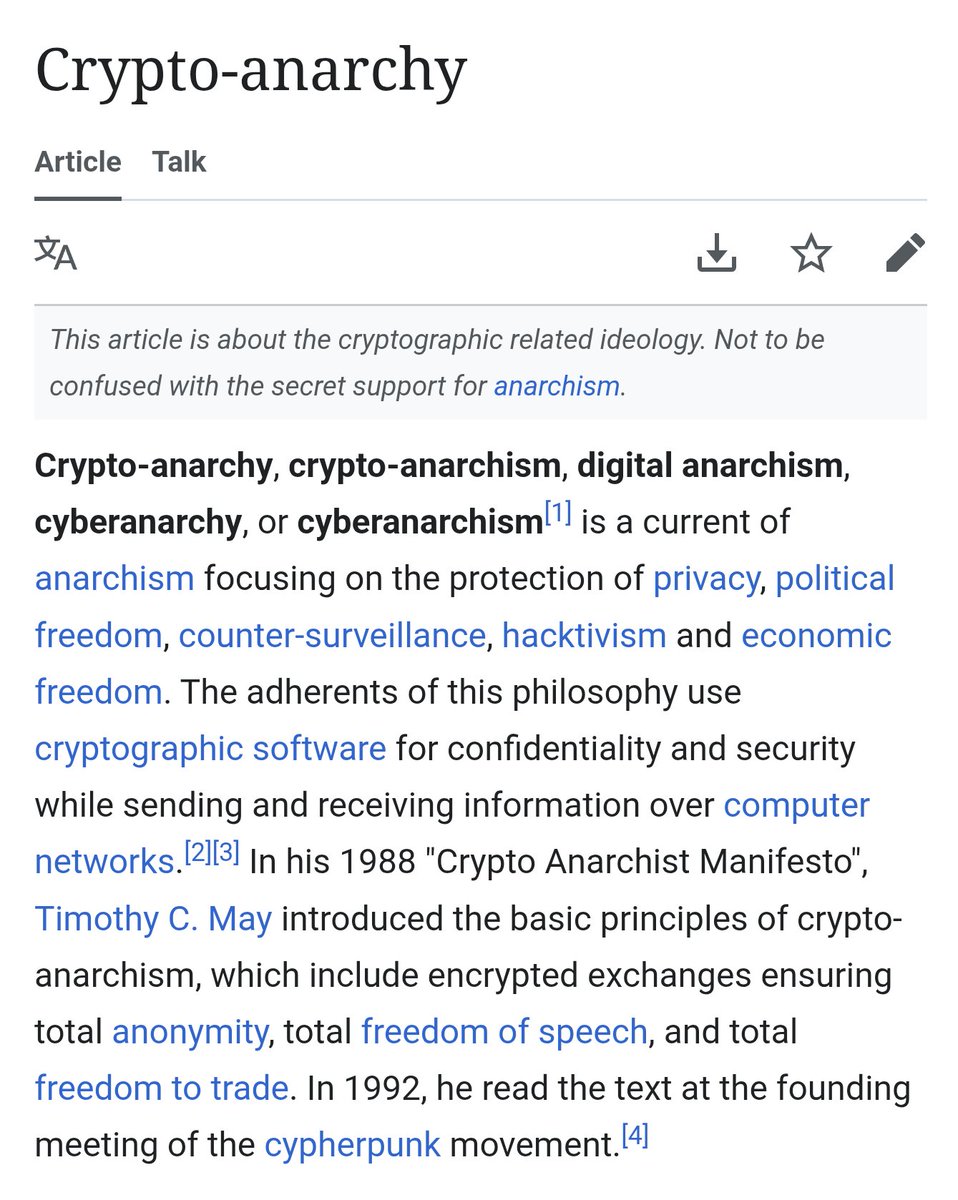
The Crypto Anarchist Manifesto
By Timothy C. May
A specter is haunting the modern world, the specter of crypto anarchy.
Computer technology is on the verge of providing the ability for individuals and groups to communicate and interact with each other in a totally anonymous manner. Two persons may exchange messages, conduct business, and negotiate electronic contracts without ever knowing the True Name, or legal identity, of the other. Interactions over networks will be untraceable, via extensive re-routing of encrypted packets and tamper-proof boxes which implement cryptographic protocols with nearly perfect assurance against any tampering. Reputations will be of central importance, far more important in dealings than even the credit ratings of today. These developments will alter completely the nature of government regulation, the ability to tax and control economic interactions, the ability to keep information secret, and will even alter the nature of trust and reputation.
The technology for this revolution--and it surely will be both a social and economic revolution--has existed in theory for the past decade. The methods are based upon public-key encryption, zero-knowledge interactive proof systems, and various software protocols for interaction, authentication, and verification. The focus has until now been on academic conferences in Europe and the U.S., conferences monitored closely by the National Security Agency. But only recently have computer networks and personal computers attained sufficient speed to make the ideas practically realizable. And the next ten years will bring enough additional speed to make the ideas economically feasible and essentially unstoppable. High-speed networks, ISDN, tamper-proof boxes, smart cards, satellites, Ku-band transmitters, multi-MIPS personal computers, and encryption chips now under development will be some of the enabling technologies.
The State will of course try to slow or halt the spread of this technology, citing national security concerns, use of the technology by drug dealers and tax evaders, and fears of societal disintegration. Many of these concerns will be valid; crypto anarchy will allow national secrets to be trade freely and will allow illicit and stolen materials to be traded. An anonymous computerized market will even make possible abhorrent markets for assassinations and extortion. Various criminal and foreign elements will be active users of CryptoNet. But this will not halt the spread of crypto anarchy.
Just as the technology of printing altered and reduced the power of medieval guilds and the social power structure, so too will cryptologic methods fundamentally alter the nature of corporations and of government interference in economic transactions. Combined with emerging information markets, crypto anarchy will create a liquid market for any and all material which can be put into words and pictures. And just as a seemingly minor invention like barbed wire made possible the fencing-off of vast ranches and farms, thus altering forever the concepts of land and property rights in the frontier West, so too will the seemingly minor discovery out of an arcane branch of mathematics come to be the wire clippers which dismantle the barbed wire around intellectual property.
Arise, you have nothing to lose but your barbed wire fences!
Nostr Mail | The Open Protocol for Decentralized Email -
The first decentralized email protocol powered by Nostr. Own your identity, your keys, and your inbox. No central authority. No gatekeepers.
https://t.co/iS5LCrYHlK
Game theory pretty much proves that the long game is not a strategy most people can execute at all. That's because it tends to require a negative short-term position in exchange for a real advantage later. Most people cannot commit to this because their threat-detection system reads current loss as an existential failure. And that's vicious short-sightedness. It leads them to optimize for visible progress and sacrifice their real position. The people who constantly win rarely have better information. Instead, they accept that losing now will pay off later. Never quit a game before it starts.
The answers to many modern problems are simple but politically incorrect.
So instead of solving anything, everybody pretends they don't know what's going on, and spend years misdiagnosing the issue, talking in circles, and wasting time.