Being from NYC doesn’t make you the international authority on Blackness. You can have your own cultural identity without erasing someone else’s. Black people existed centuries before the United States. You don’t get to revoke somebody’s race because they crossed a border. That’s not how genetics, history, or geography works.
I dumped it all. The Maelstrom directional book, took profits on $ETH, $ENA, $UNI and other shitcoins. I think we gotta go down to go up. It looks a bit dicey out there in macro and geopolitical land. Going to sit on the sidelines and wait for the all clear signal … Brrrrr
So you collected a bunch of random tweets and decided they represent millions of people? That’s your evidence? Black people existed long before America was even a country. Being Black isn’t an American invention, and you don’t own the trademark. You can distinguish between Black American ancestry and Black immigrants without pretending you’re the CEO of Blackness..broke ass 😂
Done with y’all
Could LIT reach a $150B FDV by 2027?
After the Q3 Investor Update, I started thinking more seriously about how hard it is to properly value LIT right now.
The problem is that there is no clean historical comparison for what Lighter is trying to build. We've seen DEXs become large crypto-native businesses, we've seen CEXs expand into multiple products, and we've seen regulated venues dominate institutional markets. But we haven't really seen a crypto-native DEX combine regulated US access, institutional flow, onchain settlement, external distribution, TradFi products and token buybacks inside the same system.
If Lighter actually executes on that roadmap, simply comparing it to another DEX and applying the same valuation framework may stop making sense.
Main things that could move the valuation:
> CFTC DCM + DCO approval and real US order flow
> Robinhood expanding beyond the current Wallet integration
> FCMs, brokers and fintech apps routing volume through Lighter
> Vanilla options + portfolio margin bringing in professional and institutional flow
> RWA, equities, commodities and pre-IPO markets getting real volume
> More wallet, CEX and institutional integrations globally
> LighterEVM turning Lighter from an exchange into an ecosystem
> Revenue growth and how much of it eventually flows back into LIT buybacks
And none of these really happen in isolation. CFTC matters more if Robinhood expands, Robinhood matters more if options and RWA actually get volume, and options matter more if institutional traders can use portfolio margin efficiently. LighterEVM becomes much more valuable if all of that liquidity is already sitting underneath it.
That's where this gets interesting.
Lighter is not trying to stay another perp DEX. Vlad has been pretty clear that the longer-term vision is closer to programmable financial infrastructure / a financial super-platform, where crypto and traditional financial assets can eventually use the same execution, liquidity, collateral, risk and settlement infrastructure while other financial applications are built around Lighter Core.
So I don't really look at CFTC approval as the finish line. It's more like one of the main unlocks that could let the next stage actually start.
Robinhood already gave us a small preview of what external distribution can do.
After the Robinhood Wallet integration:
> $17.85B volume in Q3
> 13% of Lighter's total Q3 volume
> 13% of Lighter's Q3 revenue
> $454M open interest
> Almost 70% of Robinhood OI was in RWA markets
And this was still early. There was no full regulated US rollout, no broad FCM distribution, no vanilla options business and no deep integration across Robinhood's full US stack. Yet one partner instance already accounted for 13% of total quarterly volume and 13% of revenue.
The RWA number is probably even more interesting. Almost 70% of Robinhood OI came from RWA markets, which already suggests that users coming through a more TradFi-facing distribution channel may want very different products from the average Lighter Core user.
If the same thing starts happening through Robinhood, brokers, fintech apps and FCMs, then the market Lighter is going after gets a lot bigger than crypto perps.
So here's how I currently think about the scenarios.
1. Bearish - DEX remains DEX
FDV ($5B-$15B)
Lighter stays a strong crypto derivatives platform, but the bigger financial infrastructure thesis never really takes off. The US opportunity exists, but it does not bring enough real flow to materially change the business.
> Robinhood stays relatively limited
> FCM and institutional adoption remains small
> Options stay secondary
> RWA and TradFi products remain niche
> LighterEVM never becomes a major economic engine
> Most activity still comes from crypto-native trading
Lighter can still be a very good project in this scenario, but it stays in roughly the same valuation category as other large crypto trading venues.
2. Base - One of the leading DEXs
FDV ($15B-$40B)
Here Lighter executes well across most of the roadmap. Core keeps growing, options work, portfolio margin gets real usage, LighterEVM develops an ecosystem and the project adds more distribution partners. The US strategy also works, but institutional adoption remains meaningful rather than transformational.
> DCM + DCO approval opens the US market
> Robinhood expands gradually
> More wallets and CEXs integrate Lighter
> Options and portfolio margin become meaningful products
> LighterEVM gets real apps and users
> RWA grows, but crypto still drives most of the business
At this stage, Lighter would already be much more than a perp DEX. But most of the economic activity would still come from crypto-native markets, so the market would probably continue valuing it mainly as one of the leading crypto trading networks.
3. Bullish - A new category of DEX
FDV ($40B-$100B)
This is where the thesis starts changing. CFTC approval stops being just a regulatory headline and actually turns into meaningful US order flow, while Robinhood, brokers and FCMs start becoming real distribution channels.
> Robinhood expands into more parts of its US stack
> FCMs and brokers start routing meaningful volume through Lighter
> Institutional market makers participate
> Options become a major business
> Portfolio margin starts mattering for professional traders
> RWA, equities, commodities and pre-IPO products generate real volume
> More users trade on Lighter infrastructure through third-party apps
This is where comparing Lighter only to other DEXs starts to break. At some point users might be trading through Robinhood, another broker or a fintech app while Lighter sits underneath as part of the execution, liquidity or clearing layer.
That is already a very different business from a normal crypto DEX.
4. Very Bullish - Institutional financial rail
FDV ($100B-$200B)
This is the scenario where Lighter starts functioning as actual financial infrastructure rather than primarily as an exchange. Robinhood becomes only one of several major distribution channels, while multiple brokers, FCMs, fintech apps, wallets and exchanges send meaningful flow into Lighter.
> Multiple major FCMs and brokers route flow through Lighter
> Institutions actually use the network at scale
> Options become a large institutional market
> Crypto, equities, commodities and RWA share the same infrastructure
> Portfolio margin and unified collateral matter for large traders
> LighterEVM develops a real financial ecosystem
> Partner instances become a major distribution model
> Annual revenue reaches the multi-billion-dollar range
At that point, the product itself becomes increasingly invisible to the end user. Someone might trade through Robinhood, a broker or another app while Lighter handles part of the execution, liquidity, risk or clearing underneath.
And then there is the other part of the thesis:
buybacks and burns.
Right now 100% of trading revenue is used to buy back LIT. By the end of Q3, more than 18M LIT had already been bought back and 109.8M LIT was staked.
I don't expect the 100% model to stay forever. Vlad has already said that once Lighter gets more mature, buybacks would likely move from using all revenue toward using profits or surplus. But that does not necessarily make the buyback thesis weaker, because a lower percentage of a much larger business can still create far more absolute demand for LIT.
20% of $3B is still much bigger than 100% of $100M.
I'm not saying a $150B FDV in 2027 is the base case. A lot still has to go right: CFTC approval has to happen, distribution has to follow, Robinhood has to expand, FCMs have to route real flow, institutions actually have to use the infrastructure, options need liquidity, RWA needs demand and LighterEVM needs apps people care about.
But the interesting part is that the upside does not depend on one catalyst. It depends on what happens if several parts of the roadmap start working at the same time and reinforcing each other.
DEX → multi-product exchange → regulated derivatives network → programmable financial infrastructure
If Lighter actually makes that transition, comparing it to today's DEXs stops being enough.
The question becomes much bigger: how valuable can a global onchain financial network become if it combines crypto-native liquidity, regulated US access, institutional distribution, TradFi products, programmable applications and recurring token buybacks?
We don't really have a clean precedent for that yet, which is exactly why LIT is so hard to value right now.
And that's also why I and a lot of other LIT holders are so bullish.
The bear case on $LIT was that Robinhood picked Bitstamp over Lighter for US perps
@Lighter_xyz responded by announcing it plans to file for its own CFTC derivatives license in November, aiming to be the first CFTC-approved on-chain perp DEX
@citrini gave it a 10% weight in their portfolio. I was late getting into position on $LIT, but I still beat them to it.
Let's unpack the bear FUD first.
At @RobinhoodApp's Sept 29th summit, it said US perps would run through Bitstamp, and LIT fell 14-20%
I, personally, lost several trillion imaginary dollars in the great nothing-burger panic that day.
Then came Lighter's Q3 gigachad investor call on Oct 21st. The team said it plans to submit the application in November. The CFTC should respond within 180 days.
When I had Lighter's Head of Growth, Trevor King @trevor_flipper on @MilkRoadDaily in September, he told me the team was "spending a lot of time with the CFTC trying to get US licensing."
Founder Vladimir Novakovski says the team has been talking with regulators for about 11 months. (Translation: they've hashed things out)
LIT jumped about 19% after the investor call, to $3.94
I, personally, made several trillion imaginary dollars that day of days.
The license matters because of how Lighter makes money. Retail trades for ZERO fees, and Lighter earns from premium tiers sold to market makers and API traders
King's pitch: "Zero fees makes us a really good dance partner because we can share economics really well." A US license lets Lighter pitch that to US brokers directly
Robinhood already took the deal outside the US. Lighter runs the perps in Robinhood's wallet on a 50/50 revenue split
Lighter buys $LIT with that revenue and burns it: 15.64M on Jul 10 and 2.45M on Oct 11, over 7% of circulating supply
Across both instances, Lighter now carries about $1.6B of open interest and did about $2.9B of volume in the last 24 hours (from whenever I last checked before writing all this at two in the morning)
The product keeps shipping too, and this, to me, is the huge thing everyone is overlooking. Lighter isn't going after just perps. They are coming for every trading market they can reach.
- BTC and ETH binary options went live this week (prediction markets)
- Lighter Core passed 1M accounts
- King told me a full options suite is coming by the end of the year
- all your trade are belong to us
Alright, now a dose of reality. They still don't have the actual license yet, and King told me the CFTC gets a 180-day window to answer an application. So it could be a bit.
The team and investor cliff also ends Dec 27 per Tokenomist, and @m0xt_ estimates about $50M of tokens a month could unlock from January against about $3M a month of buybacks
Lighter's Founder and CEO @vnovakovski addressed these concerns in the Q3 gigachad investor call as well, but the concerns remain for the time being.
Supply of LIT and demand for all of its products are going to battle it out on the charts for a while, perhaps, but ultimately, this market is huge, and Lighter is extremely well positioned. They have an amazing team, bold strategy, and proven results.
I think it's pretty $LIT
CoinGecko lists Lighter's Robinhood Chain instance alone at about $421M of open interest.
I am also openly interested.
Disclosure: I hold $LIT in my Milk Road PRO portfolio. We were early to $UNI (+54.8%), $AERO (+93.7%), and $SOL (+39.1%)
Try Milk Road PRO for $1 for 7 days, link in bio: @BitcoinJesusETH
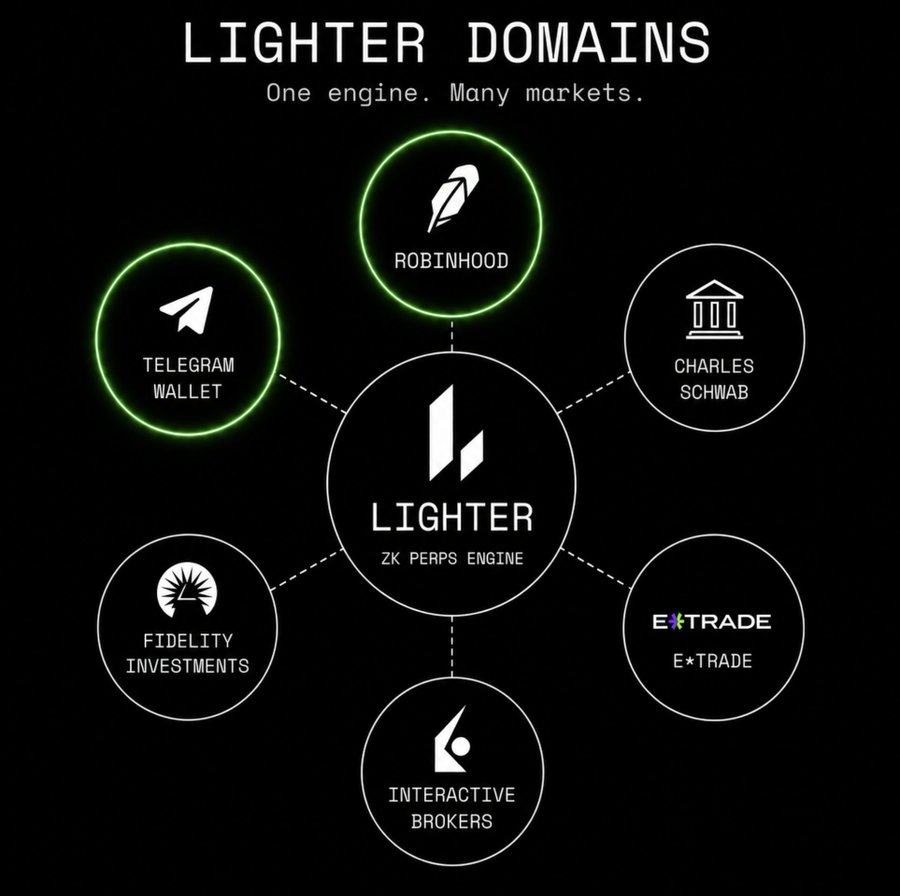
Schwab. Fidelity. E*TRADE. IBKR.
now imagine @Lighter_xyz getting integrated into any of them
honestly, i can totally see this happening. the whole system is being built to support multiple domains, so why would Robinhood be the only one?
imagine other major brokerages plugging in and bringing their users along. imagine the growth potential for ethereum:0x232ce3bd40fcd6f80f3d55a522d03f25df784ee2
source: Q3’26 Lighter Investor Call
@worldprincetwo So let me get this straight. Cubans flee a communist dictatorship, rebuild their lives, open businesses, and somehow they’re the reason Miami is a shithole? 😂 That’s an impressive level of historical ignorance. Castro would’ve loved your logic….
You’re confusing government assistance with socialism. PPP was an emergency program to keep businesses open and people employed during COVID shutdowns. Nobody was handing ownership of their business over to the government. Capitalism has always had government intervention. Not every dollar the govt spends is socialism. That’s a pretty basic distinction…,
The Eagles doctors who allowed Jalen Hurts to fly on a plane to London with blood clots, cleared him to play, but told him it was too dangerous to go to sleep.
Lighter EVM devnet is live! An EVM-equivalent rollup built in collaboration with @axiom_xyz, powered by OpenVM. It runs alongside Lighter Core, and the two are designed to settle jointly to Ethereum with a single ZK proof 🧵