Citadel & Two Sigma Quant just showed how quants build uncorrelated factor portfolios using PCA.
83-minutes. free. By Harvard PhD at MIT.
here's what they cover:
• isolating idiosyncratic yield curve factors (Level, Slope, Curvature)
• using massive leverage to scale market-neutral portfolios
• out-of-sample stability & handling post-COVID regime shifts
• explaining 90% of bond market variance with 1 dominant factor
watch full video then read article.
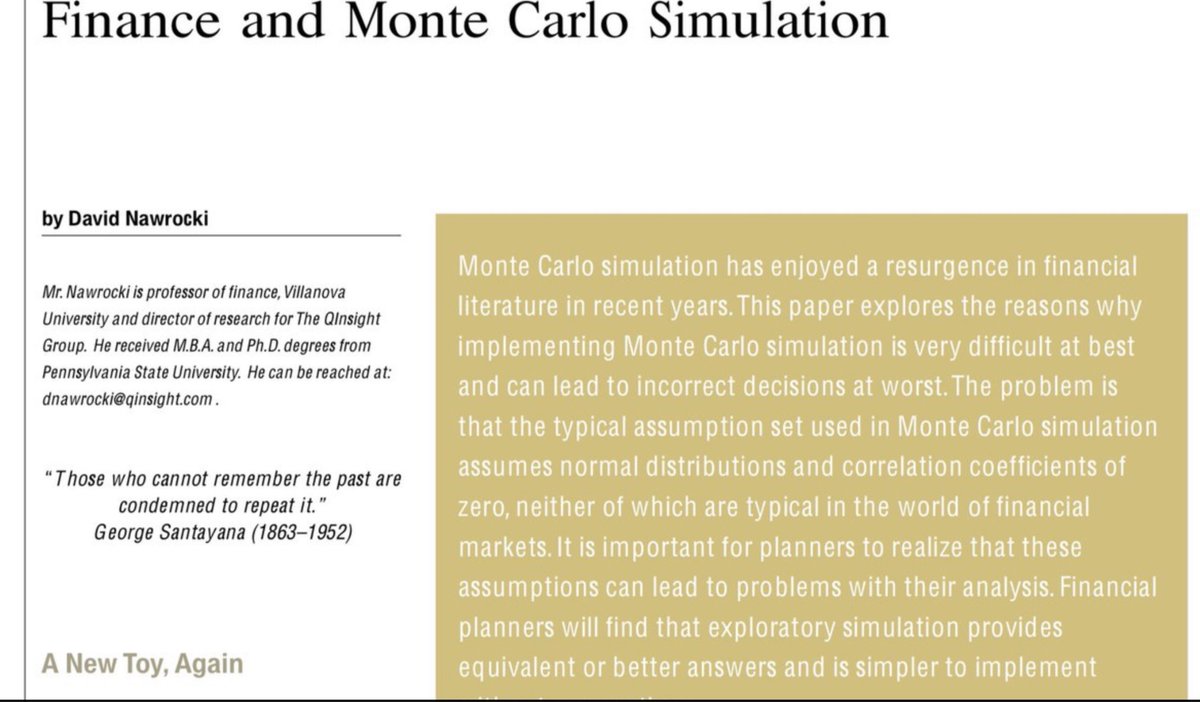
Explorations in Monte Carlo Methods (Undergraduate Texts in Mathematics): https://t.co/w6epFC6ywB
From the Back Cover:
"Monte Carlo methods are among the most used and useful computational tools available today, providing efficient and practical algorithims to solve a wide range of scientific and engineering problems. Applications covered in this book include optimization, finance, statistical mechanics, birth and death processes, and gambling systems."
"Explorations in Monte Carlo Methods provides a hands-on approach to learning this subject. Each new idea is carefully motivated by a realistic problem, thus leading from questions to theory via examples and numerical simulations. Programming exercises are integrated throughout the text as the primary vehicle for learning the material. Each chapter ends with a large collection of problems illustrating and directing the material."
"This book is suitable as a textbook for students of engineering and the sciences, as well as mathematics. The problem-oriented approach makes it ideal for an applied course in basic probability and for a more specialized course in Monte Carlo methods. Topics include probability distributions, counting combinatorial objects, simulated annealing, genetic algorithms, option pricing, gamblers ruin, statistical mechanics, sampling, and random number generation."
Super interesting!
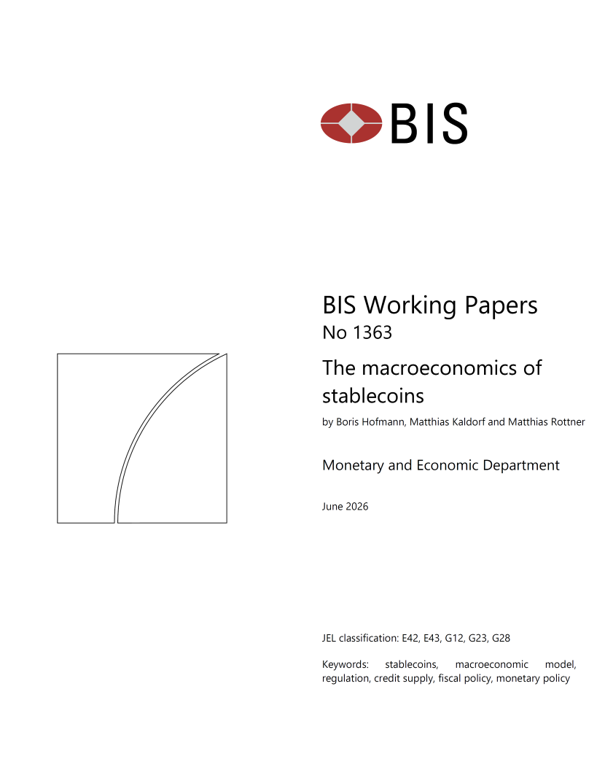
"The macroeconomics of stablecoins" by Boris Hofmann, Matthias Kaldorf, and Matthias Rottner.
"Our analysis suggests that stablecoin adoption affects the economy through two main channels: a bank lending channel and a fiscal space channel. The bank lending channel operates through banks' deposit funding and credit supply, while the fiscal space channel operates through stablecoin issuers' demand for Treasury bills and the government budget constraint. These channels have opposing effects on output. Calibrated to the United States, the model predicts that, in the long run under our baseline specification, the contractionary effect of the bank lending channel dominates slightly. The net effect, however, depends on stablecoin regulatory design, the strength of foreign demand for stablecoins and fiscal conditions. The model also implies that the fiscal space channel acts more quickly during the transition and that stablecoins can amplify monetary policy transmission through bank lending."
https://t.co/Up1UNIXBiw
Food for thought!
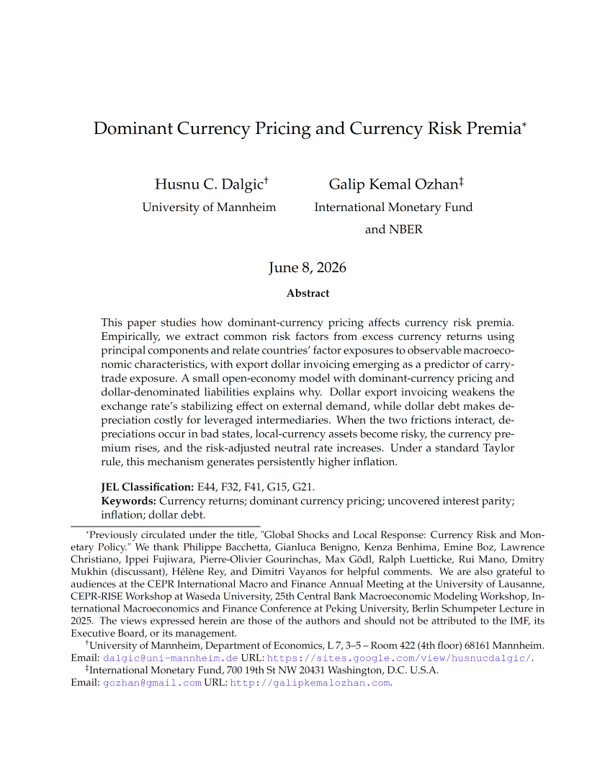
"Dominant Currency Pricing and Currency Risk Premia" by Husnu C. Dalgic and Galip Kemal Ozhan.
"This paper studies how dominant-currency pricing affects currency risk premia. Empirically, we extract common risk factors from excess currency returns using principal components and relate countries’ factor exposures to observable macroeconomic characteristics, with export dollar invoicing emerging as a predictor of carry-trade exposure. A small open-economy model with dominant-currency pricing and dollar-denominated liabilities explains why. Dollar export invoicing weakens the exchange rate’s stabilizing effect on external demand, while dollar debt makes depreciation costly for leveraged intermediaries. When the two frictions interact, depreciations occur in bad states, local-currency assets become risky, the currency premium rises, and the risk-adjusted neutral rate increases. Under a standard Taylor rule, this mechanism generates persistently higher inflation."
https://t.co/JRPTZhQShe
if people want to do research on their own here, are some sources you can look into
this has it around $100B: https://t.co/BrL2ZDNr0N
this has it at $233B but includes Anduril, Waymo, some other ones in defense & autonomous vehicles most people wouldn't consider private robotics: https://t.co/dLUVi4ndcO
this has it at $133B: https://t.co/zxt2NwZWVF
always important to do your own research and draw your own conclusions
but yea it really is wild when you think about it
Very valuable!
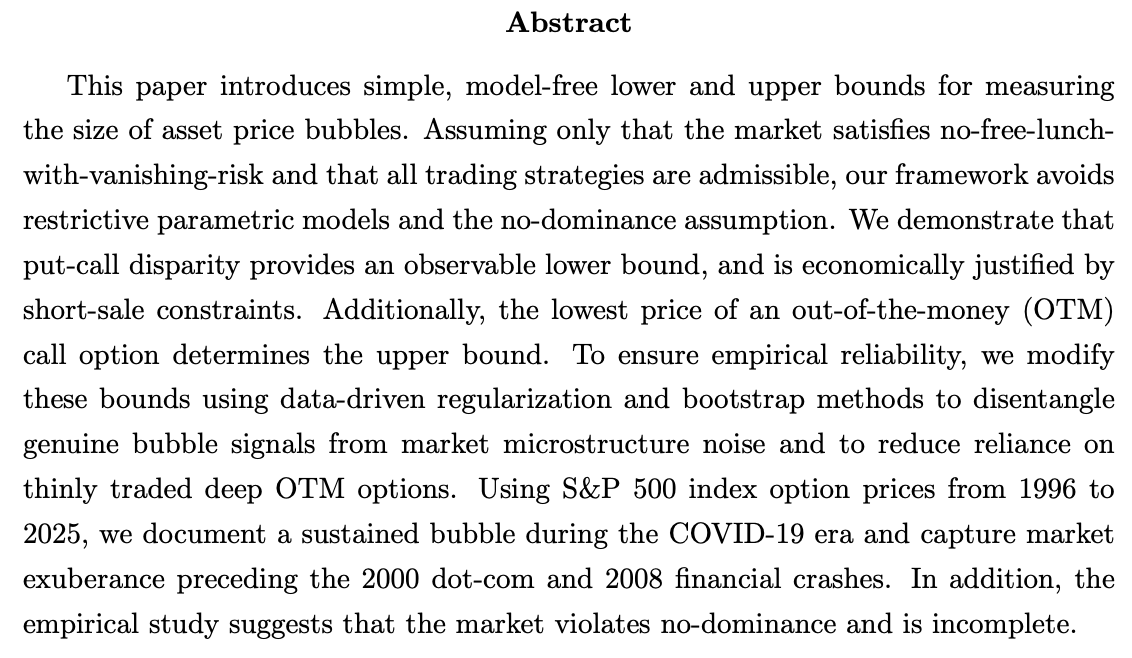
"Tracing the History of Asset Price Bubble Theory: A Literature Review" by Sally Dubach.
"The literature on rational asset price bubbles has grown substantially, yet its internal logic is difficult to trace without reading across a large and technically demanding body of work. This paper provides a guide to the literature on rational asset price bubble theory, tracing its evolution from early overlapping generations models to environments with financial frictions, infinitely lived agents, and dividend-paying assets. Two mechanisms consistently sustain rational bubbles across these frameworks. The first is resale: investors buy above fundamental value, expecting to sell to subsequent buyers. The second is savings pressure that pushes the bubbleless equilibrium interest rate below the economy’s growth rate. Despite substantial theoretical progress, a gap remains between theoretical insights and the frameworks policymakers need."
https://t.co/2zb4LSTeKE
Highly relevant!
"The Causal Effect of Debt on Interest Rates" by Abhik Bhatt, Anthony M. Diercks, Benjamin Eyal, and Arsenios Skaperdas.
"This paper uses a natural experiment to measure the causal effect of an expected debt-financed fiscal stimulus on interest rates. We find that a 1 percentage point increase in the expected US debt-to-GDP ratio leads to an increase of about 1-2 basis points in the longer-run neutral rate (r∗) and of about 2–3 basis points in the 10-year Treasury term premium. Our results validate estimates from a common time-series approach that regresses long-term forward interest rates on long-term projections of government debt, where the exclusion restriction does not apply."
https://t.co/G0XEkzoCmh
"L2s were a failed experiment. App chains were a failed experiment outside of Hyperliquid."
Logan Jastremski reveals why he hasn't thought about Ethereum since 2021:
"L2s never made sense. A transaction is just bytes. An L2 compresses 5 bytes to 1 byte. If you want compression, why apply it to a low-throughput chain instead of a high-throughput one?"
"Ethereum is mostly an artifact of people making money in the early days. From an institutional and product use case standpoint, it's largely dead. The most overvalued asset in the world."
Super interesting!
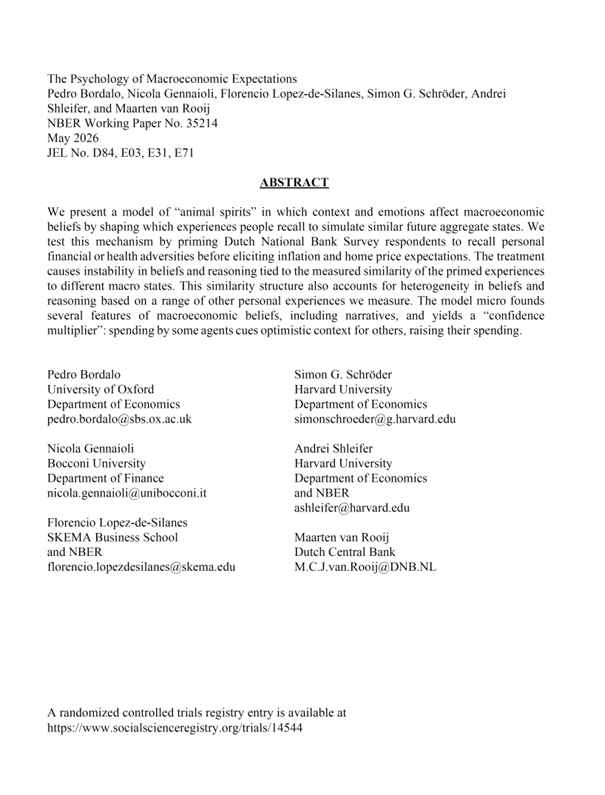
"The Psychology of Macroeconomic Expectations" by Pedro Bordalo, Nicola Gennaioli, Florencio Lopez-de-Silanes, Simon G. Schröder, Andrei Shleifer, and Maarten van Rooij.
"We present a model of “animal spirits” in which context and emotions affect macroeconomic beliefs by shaping which experiences people recall to simulate similar future aggregate states. We test this mechanism by priming Dutch National Bank Survey respondents to recall personal financial or health adversities before eliciting inflation and home price expectations. The treatment causes instability in beliefs and reasoning tied to the measured similarity of the primed experiences to different macro states. This similarity structure also accounts for heterogeneity in beliefs and reasoning based on a range of other personal experiences we measure. The model micro founds several features of macroeconomic beliefs, including narratives, and yields a “confidence multiplier”: spending by some agents cues optimistic context for others, raising their spending."
https://t.co/IOUjtke7UD
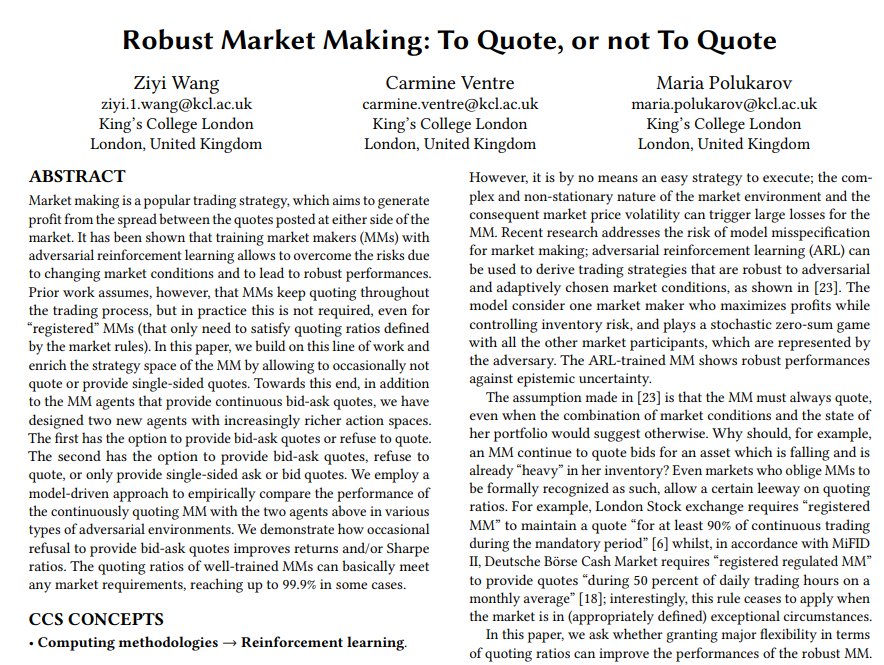
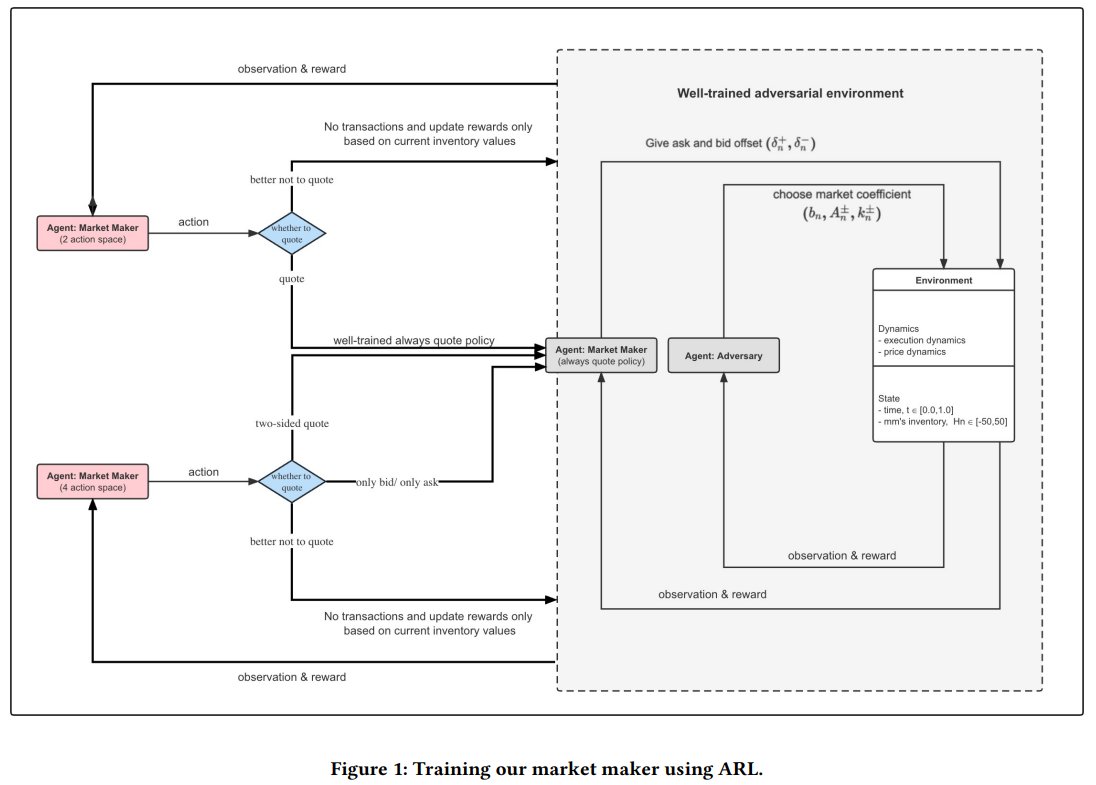
The asset price follows Brownian motion with drift, fixed volatility, and a Markov structure where only the current price matters for the next step. That removes many things that dominate market making: clustered volatility, jumps, queue dynamics, hidden liquidity, toxic flow, news shocks, latency, spread regime shifts, and intraday seasonality
must read paper on arbitrage between dex and cex!!!
so proud of @stabble_loewe for publishing in journal of banking and finance and so happy being a part of it from day 0
https://t.co/eQp6wzXCIz